Reheating Furnace Slab Temperature Prediction

By James Smith on July 24, 2026

reheat-furnace-slab-temperature-prediction-ai

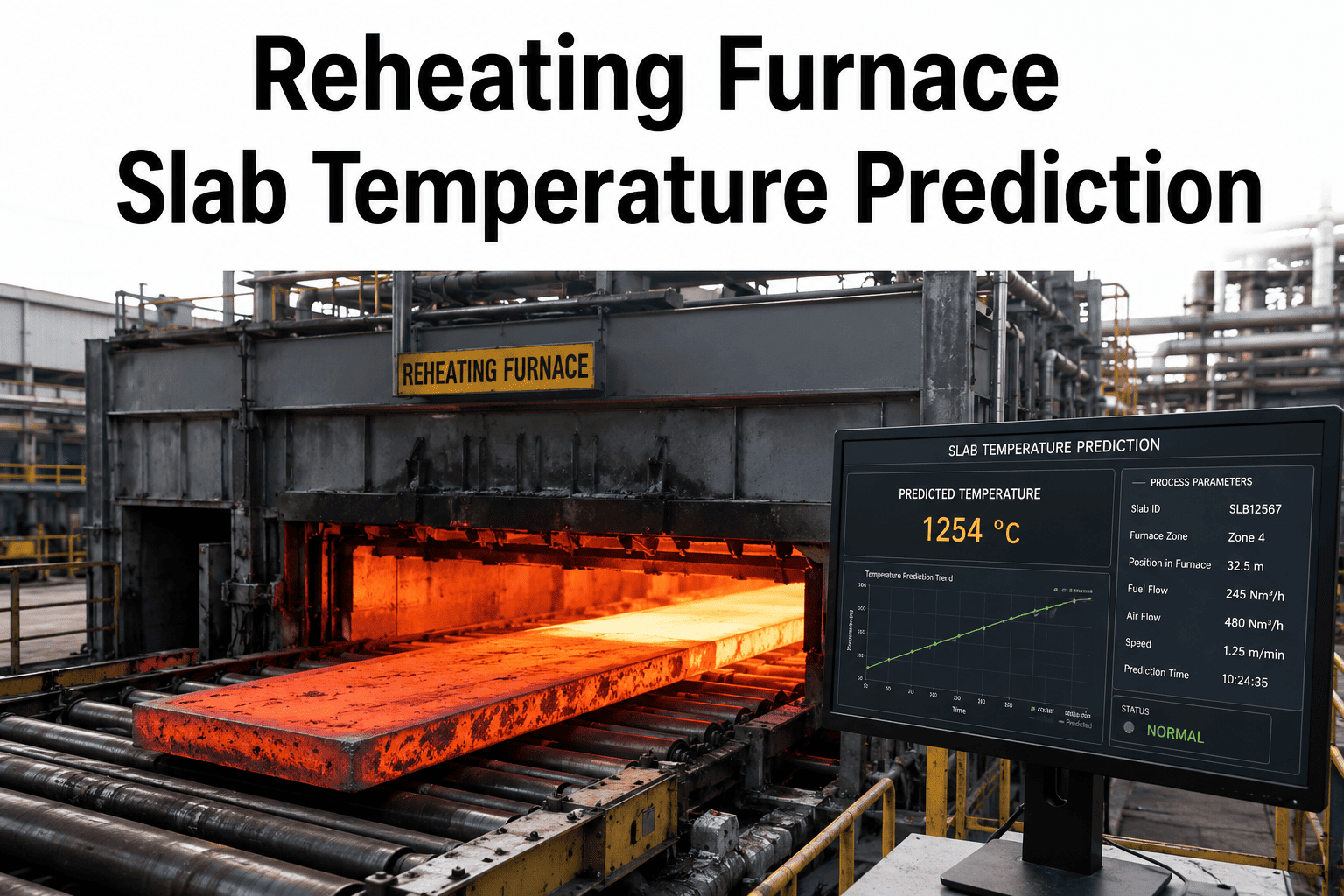
A reheat furnace can hold a slab at target temperature for hours, yet the number that actually determines whether the first pass on the roughing mill comes in on gauge is one nobody can directly measure — the slab's interior core temperature at the moment it leaves the furnace. Surface thermocouples and pyrometers see the skin, not the core, and the difference between the two can run 40–80°C depending on soak time, slab thickness, and furnace zone control. Mill setup engineers have compensated for this blind spot for decades with fixed soak-time tables and operator judgment. AI slab temperature prediction closes that gap directly — modeling the full thermal profile through the slab cross-section in real time so the discharge temperature fed into mill setup math is a calculated value, not an assumption. You can book a demo to see this model running against live walking beam furnace data.

REHEAT FURNACE · AI TEMPERATURE PREDICTION · HOT ROLLING
Know Your Slab's Core Temperature Before It Hits the Roughing Mill
iFactory's reheat furnace AI models slab core and surface temperature continuously through every zone — giving reheat engineers a real discharge temperature number instead of a soak-time estimate.
The Core Problem

Why Discharge Temperature Is the Number That Breaks Mill Setup

Every calculation that follows a slab out of the furnace — roll gap settings, roughing mill pass schedule, finishing mill speed, and coiling temperature target — is built on an assumed discharge temperature. If that assumption is off by even 20–30°C, the downstream pass schedule is calculated against the wrong flow stress, and the mill spends its first pass correcting an error that originated at the furnace, not on the mill stand. Reheat engineers have long known this, which is exactly why so much operator experience gets built around "how this slab probably heated" rather than a measured number.

The reason surface measurement cannot solve this on its own is straightforward thermal physics. A slab heats from the outside in, and a thick slab — 200mm or more — can have a meaningfully cooler core than its surface reading suggests, particularly if soak time was shortened to protect throughput during a high-demand production run. AI reheat temperature prediction models don't guess at this differential; they calculate it continuously from the slab's actual thermal history as it moves through preheat, heat, and soak zones, updating the predicted core-to-surface gradient every time furnace conditions shift.

This blind spot becomes especially costly during production scenarios that deviate from routine operation — a furnace delay that leaves a slab soaking longer than planned, a charge temperature that runs cooler than usual because slabs sat in the yard overnight, or a grade changeover that shifts the thermal properties the furnace needs to account for. In each of these cases, a fixed soak-time table simply cannot adapt, because it was never built to represent anything other than the average scenario it was derived from. The slabs that deviate most from that average are, not coincidentally, the ones most likely to produce a rolling correction downstream — which means the cases where accurate prediction matters most are exactly the cases traditional methods handle worst.

Furnace Anatomy

Inside the Walking Beam Furnace — Where Prediction Actually Happens

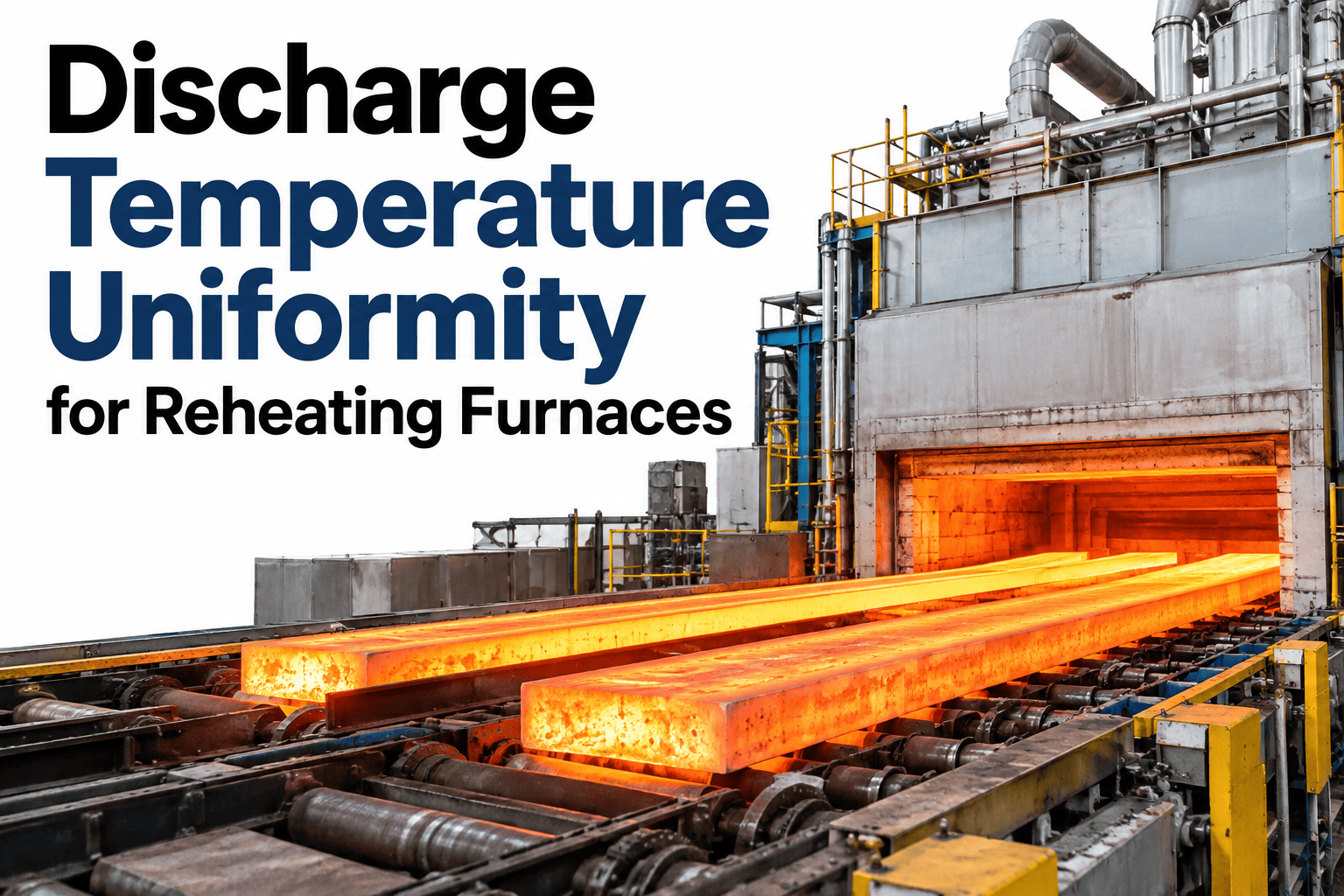
A walking beam reheat furnace is not a single thermal environment — it's three or four distinct zones, each with different burner configurations, temperature setpoints, and heating objectives. An accurate discharge temperature model has to track a slab's individual thermal history as it moves through each one, not simply apply an average furnace temperature across the whole residence time. This matters because a slab that spends extra time in the preheat zone due to an upstream delay arrives at the heating zone with a different starting condition than a slab that moved through on schedule — and that difference propagates all the way to discharge if it isn't tracked explicitly.

ZONE 1
Preheat Zone
Slab surface temperature rises rapidly using waste heat recovered from downstream zones. Core temperature lags significantly behind surface — this is where the eventual thermal gradient begins forming.
400–800°C
ZONE 2
Heating Zone
Primary burners bring surface temperature to near-target levels. The core continues absorbing heat conductively, with the gradient between surface and core reaching its widest point in this zone.
1000–1250°C
ZONE 3
Soak Zone
Surface and core temperatures converge as the slab equalizes at a controlled, lower firing rate. Soak time here is the single biggest lever for closing the core-surface gap before discharge.
1200–1280°C
DISCHARGE
Extraction Point
The slab exits with a residual core-surface differential that depends on everything upstream — thickness, total residence time, and zone-by-zone firing history all factor into the final predicted number.
Predicted Value
Prediction Accuracy

Fixed Soak Tables vs. AI Thermal Modeling — A Direct Comparison

Traditional reheat furnace operation relies on fixed soak-time tables built from historical averages — a reasonable starting point, but one that cannot account for slab-to-slab variation in charge temperature, chemistry, or actual furnace zone conditions on a given shift. Book a demo to see how AI-predicted discharge temperature compares against your current soak-table accuracy on real production data.

Discharge Temperature Prediction — Method Comparison
Prediction Factor Fixed Soak-Time Table Surface Pyrometer Only AI Thermal Model
Accounts for charge temperature variation No — uses average assumption No — reads current surface only Yes — tracked per slab from charge
Models core-to-surface gradient Approximated by table lookup Not possible — surface only Continuously calculated
Adapts to slab thickness changes Requires manual table update No adjustment Automatic, per-slab
Responds to zone temperature drift Not reflected until re-tabled Reflected at surface only Reflected in real time, full gradient
Typical discharge temperature error ±35–55°C ±25–40°C (surface only) ±8–15°C (full profile)
First-pass-right rolling impact Frequent pass schedule correction Moderate correction frequency Substantially reduced correction
Heat Balance

The Heat Balance Inputs Behind Every Prediction

An AI discharge temperature model is only as good as the heat balance data feeding it. Reheat engineers evaluating any prediction system should understand exactly what inputs drive the model — because a model missing key variables will quietly degrade in accuracy the moment furnace conditions shift outside its original training range. This is also the area where reheat engineers can add the most value during deployment, since nobody understands the specific quirks of a given furnace — a burner that runs slightly hot in one corner, a stroke pattern that creates uneven residence time across the furnace width — better than the team that operates it daily.

1
Charge Temperature and Slab Geometry
Starting slab temperature, thickness, width, and steel grade all determine how quickly heat conducts from surface to core — a thin slab equalizes far faster than a heavy plate slab under identical furnace conditions.
2
Zone-by-Zone Furnace Temperature History
The model tracks actual zone temperatures the slab experienced during its residence — not a nominal setpoint — since burner output, fuel quality, and combustion air ratio all cause real deviation from target.
3
Residence Time Per Zone
Walking beam stroke rate and any dwell delays directly determine how long each slab spends in each thermal zone, which is one of the most sensitive variables in the entire heat balance calculation.
4
Steel Grade Thermal Properties
Thermal conductivity and specific heat vary meaningfully across steel grades. A model trained without grade-specific thermal property data will systematically mispredict core temperature on grade changeovers.
5
Furnace Atmosphere and Scale Formation
Oxidizing atmosphere conditions affect scale layer thickness, which changes surface emissivity and therefore the relationship between pyrometer readings and true surface temperature.
6
Slab Position Within the Furnace Width
Edge and center slab positions experience different heat flux from burners and refractory walls, a variation that a single-point average model misses but a spatially aware model accounts for directly.
Downstream Impact

What First-Pass-Right Rolling Actually Saves

The value of an accurate discharge temperature prediction is not abstract — it shows up directly in roughing mill pass corrections, finishing mill speed adjustments, and coiling temperature accuracy. Getting this number right the first time, rather than correcting for it mid-schedule, compounds across every downstream process step. Mill setup engineers who have worked through enough shifts of pass schedule corrections know that most of these corrections trace back not to a mill stand problem but to an entry condition that was wrong from the start — which is exactly the class of error that accurate discharge temperature prediction eliminates before it ever reaches the mill. To see how this plays out against your specific mill configuration, book a demo with our reheat engineering team.

Roughing Mill Pass Schedule
Accurate discharge temperature means the initial pass schedule is calculated against the actual flow stress of the slab, reducing mid-pass corrections and roll force overshoot on the first breakdown passes.
Finishing Mill Speed Setpoints
Entry temperature accuracy into the finishing train directly affects rolling speed calculations, reducing the frequency of speed corrections that would otherwise ripple through the entire finishing schedule.
Coiling Temperature Control
A correctly predicted discharge temperature carries forward into more accurate coiling temperature targeting, directly supporting the mechanical property specifications the coil needs to meet.
Furnace Fuel Efficiency
Accurate core temperature tracking reduces the tendency to over-soak slabs "to be safe," which directly reduces fuel consumption per ton without sacrificing discharge temperature confidence.

Taken together, these downstream effects explain why hot rolling mills that have deployed accurate discharge temperature prediction report improvements that extend well beyond the reheat furnace itself. A pass schedule that starts from an accurate entry condition tends to stay accurate through the rest of the rolling sequence, since each subsequent calculation in the mill setup chain builds on the one before it. The furnace is the first link in that chain, and it is also the one link where measurement has historically been weakest — which is exactly why it represents the highest-leverage place to apply AI-driven prediction in the entire hot rolling process.

Getting Started

Deploying Slab Temperature Prediction — A Practical Path

Reheat furnace AI temperature prediction does not require replacing existing pyrometers, thermocouples, or furnace control systems. It sits above them, using the data already being generated to build a continuous thermal model that existing instrumentation alone cannot provide. Most reheat engineers find this reassuring rather than disruptive — the deployment is additive to what's already running on the furnace, not a rip-and-replace of control infrastructure that took years to tune correctly.
Step 1
Furnace Data Baseline
Existing zone temperature sensors, thermocouples, and pyrometer feeds are connected to establish a baseline thermal history dataset across representative slab charges and steel grades.
Step 2
Model Calibration Against Known Discharges
The thermal model is calibrated against historical discharge temperature outcomes and any available core temperature validation data, tuning predictions to your specific furnace's actual thermal behavior.
Step 3
Live Prediction and Mill Setup Integration
Predicted discharge temperatures feed directly into mill setup calculations, giving roughing and finishing mill setup engineers a live, per-slab number instead of a static soak-table assumption.
Step 4
Continuous Accuracy Tracking
Prediction accuracy is tracked against actual mill performance data, allowing the model to improve continuously as more production cycles and grade changeovers accumulate in the training history.
SEE IT ON YOUR FURNACE DATA
Model Your Furnace's Actual Thermal Behavior, Not a Generic Average
Our reheat engineering team will walk through how AI discharge temperature prediction applies to your specific walking beam configuration, slab range, and grade mix.
Frequently Asked Questions

Reheat Furnace Slab Temperature Prediction — FAQs

How does AI predict core temperature when it can't be measured directly?
The model calculates core temperature using thermal conduction physics applied to the slab's actual measured history — charge temperature, zone-by-zone furnace temperatures, residence time, and slab geometry — rather than attempting to measure it directly. Because heat transfer from surface to core follows predictable physical behavior for a given steel grade and thickness, this calculated value tracks true core temperature far more closely than surface-only readings or fixed soak-time assumptions ever can.
Does this replace existing pyrometers and thermocouples in the furnace?
No — the AI model uses the data from existing pyrometers, thermocouples, and furnace control sensors as its primary inputs. Rather than replacing instrumentation, it synthesizes what that instrumentation is already reporting into a continuous, physics-based thermal profile that individual sensor readings alone cannot provide. Book a demo to see the exact data integration on your furnace's existing sensor layout.
How much does discharge temperature accuracy actually affect rolling quality?
A discharge temperature error of 30–50°C changes the flow stress assumption the mill setup calculation is built on, which typically shows up as roll force deviation, gauge correction needs on early passes, and downstream coiling temperature drift. Closing that error to within 10–15°C measurably reduces the frequency of mid-schedule corrections across the rolling process.
Can the model handle grade changeovers and mixed charging patterns?
Yes, provided the model has been trained with grade-specific thermal property data for each steel grade run through the furnace. Grade changeovers are one of the more sensitive scenarios for temperature prediction, since thermal conductivity and specific heat differ meaningfully across grades, which is why grade-aware training data matters more than general furnace averages.
How long does it take to see reliable prediction accuracy after deployment?
Most furnaces reach stable, reliable prediction accuracy within four to eight weeks of live operation, once the model has been calibrated against a representative range of slab thicknesses, charge temperatures, and grade mixes. Continued accuracy improvement typically continues over the following months as more production cycles accumulate in the training data.
HOT ROLLING · REHEAT FURNACE AI
Give Your Reheat Engineers a Real Discharge Temperature Number
iFactory's AI thermal model replaces soak-time guesswork with a continuously calculated slab core and surface temperature — built specifically for walking beam furnaces feeding hot strip, plate, and bar/rod mills.

Share This Story, Choose Your Platform!