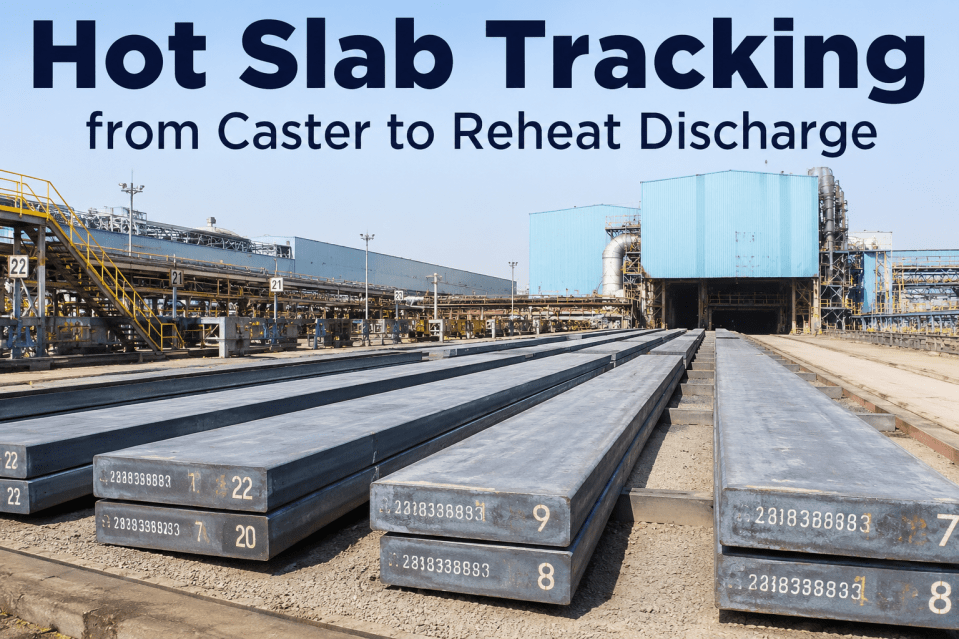
Hot Slab Tracking from Caster to Reheat Discharge

By Vespera Celestine on June 22, 2026

ai-hot-slab-tracking-reheat-discharge-control

Every slab that leaves a continuous caster begins a logistics and tracking journey through the slab yard, reheat furnace, and rolling mill that involves multiple handoffs between physical location systems, production control databases, and operator visual identification. At an integrated mill producing 3 to 5 million tonnes of slab per year, the slab yard holds 2,000 to 8,000 individual slabs in various stages of cooling, inspection, conditioning, and staging for reheating. The reheat furnace charges slabs at rates of 40 to 90 slabs per hour depending on furnace configuration and product mix. And at every transfer point between these stages — caster exit to slab yard, slab yard to reheat charging, reheat discharging to rolling mill entry — there is an opportunity for slab identification errors that cascade into misplaced slabs, wrong-grade rolling events and production schedule disruptions that cost $8,000 to $45,000 per incident in rework, energy waste, and delay penalties. AI-driven slab tracking — combining optical character recognition (OCR), thermal imaging, and computer vision — replaces the intermittent, error-prone manual identification process with continuous, automated slab tracking at every transfer point from caster exit to reheat discharge. This guide covers the complete slab tracking methodology for modern hot mills and how iFactory's Slab Tracking AI platform delivers continuous, automated identification and tracking that gives hot mill engineers the slab visibility that manual methods simply cannot match.

99.7%
Slab identification accuracy achieved with AI OCR and thermal vision — versus 87–93% for manual torch-mark reading
$1.8M
Annual cost savings from eliminated misplaced slabs, wrong-grade charges, and reheat scheduling errors
0.00%
Missed slab identification events at reheat discharge in AI-tracked operations — versus 2–4% manual miss rate
6 wks
Full deployment timeline from caster exit to reheat discharge tracking coverage

Evaluating slab tracking automation for your hot mill? Book a 30-minute slab tracking assessment with iFactory's hot mill engineering team.

The Slab Tracking Problem: Why Manual Identification Fails in High-Throughput Hot Mills

The slab tracking challenge in a modern hot mill is not a technology gap — it is a coordination gap between physical slab handling and digital record accuracy. Every slab produced by the caster is marked with a unique identifier — typically torch-marked characters on the slab surface, a barcode label affixed to the slab end, or a painted ID on the slab side. This identifier is the link between the slab's physical location and its digital record in the MES: grade, heat number, dimensions, quality status, and rolling schedule priority. The identifier is read manually at multiple transfer points — slab yard crane operators verify IDs before moving slabs to storage or charging areas, reheat furnace operators check IDs before charging, and mill entry operators confirm IDs before the first rolling pass. Each manual read introduces a failure point: torch marks can be obscured by scale, barcode labels can be damaged or detached during slab handling, painted IDs can be obscured by dust or water, and operator fatigue during high-throughput shifts increases misread rates. A single misread at any transfer point creates a slab tracking gap that propagates through every downstream process stage. Book a demo to see how AI eliminates slab tracking errors.

The financial impact of slab tracking errors compounds across the production chain. A misplaced slab in the yard that is not located before its scheduled charging time forces the reheat furnace to charge a different slab — disrupting the rolling schedule and potentially rolling the wrong grade for the current order. A slab charged into the furnace with an incorrect ID is heated to the wrong temperature profile for its actual grade, requiring either re-routing to a different finishing destination or, in the worst case, scrapping the slab after full reheat energy has been invested. A slab that reaches the rolling mill entry with an unreadable or incorrect ID requires the operator to stop the line and investigate — a delay that interrupts the rolling sequence and reduces throughput. At mills producing 80 to 120 slabs per shift, even a 2% identification error rate produces 1.5 to 2.5 tracking errors per shift, each requiring 10 to 30 minutes of investigation and correction. The cumulative cost of these errors in an 800,000-slab-per-year operation exceeds $1.8 million annually. Schedule a technical review of your slab tracking workflow.

Torch Mark Obscuration
Scale buildup, surface oxidation, and residual cooling water obscure torch-marked slab IDs — particularly on slabs held in the yard for extended cooling periods. Manual readability drops below 80% for slabs stored longer than 72 hours.
HIGH FREQUENCY
Barcode Label Damage
Barcode labels applied to slab ends or sides are frequently damaged or detached during slab handling by overhead cranes, slab tongs, or during yard movement. Detection rates for damaged barcodes fall below 60% at reheat charging.
HIGH FREQUENCY
Reheat Charge Sequence Disruption
A slab charged into the furnace with an incorrect or unreadable ID disrupts the planned charging sequence. The furnace operator must either stop charging to investigate or charge a substitute slab — both options reducing throughput and potentially rolling the wrong grade.
MEDIUM FREQUENCY
Wrong-Grade Rolling Event
A slab with incorrect ID that reaches the rolling mill entry undetected is rolled to the wrong grade specification. The resulting coil or plate fails quality inspection and must be downgraded or scrapped — a loss of $12,000 to $45,000 per incident.
MEDIUM FREQUENCY
Slab Yard Inventory Inaccuracy
Manual slab tracking errors accumulate in the yard inventory database over time. Yard inventories showing 15 to 40 slabs more or fewer than physical counts are common in manually tracked operations, reducing scheduling confidence and increasing slab location search time.
MEDIUM FREQUENCY
Hot Charge Ratio Loss
Slab tracking gaps force furnaces to charge cold slabs when hot slabs cannot be located in time for scheduled charging. Each percentage point of hot charge ratio lost to tracking errors costs $120,000 to $280,000 annually in additional reheat energy.
SIGNIFICANT COST

How iFactory Slab Tracking AI Works: OCR, Thermal Vision, and Multi-Point Cross-Validation

iFactory's Slab Tracking AI platform replaces manual slab identification at every transfer point with a multi-layered AI detection system that reads slab identifiers, cross-validates against MES records, and updates slab location in real time. The platform operates at three detection points along the slab journey from caster exit to reheat discharge, with each detection layer compensating for the limitations of the others to achieve 99.7% overall identification accuracy. Hot mill engineers evaluating slab tracking automation schedule a technical review to see how each detection layer addresses their specific slab marking and handling environment.

01
Caster Exit — AI OCR Slab ID Capture
As each slab exits the caster run-out table, high-resolution cameras capture the torch-marked or painted slab ID on the top surface and both side faces. iFactory's AI OCR engine reads the captured characters — accounting for variable torch mark quality, scale coverage, and surface texture variations — and cross-references the read ID against the production schedule to confirm the slab's heat number, grade, dimensions, and routing. Identification is recorded in the MES within seconds of the slab stopping on the run-out table, with no operator action required.
02
Slab Yard — Thermal and Vision-Based Positioning
As slabs are moved from the caster exit to yard storage positions, overhead cameras track slab movement across the yard and associate each slab ID (captured at caster exit) with its physical yard position. When slabs are lifted and moved by overhead crane, iFactory's vision system tracks the slab in motion and updates its location in the yard inventory database in real time. The thermal signature of hot slabs provides an additional tracking layer — the platform identifies slabs by their cooling profile and cross-references against the expected position based on the production schedule.
03
Reheat Charging — Hybrid OCR and Thermal ID Verification
At the reheat furnace charging position, iFactory reads the slab ID a second time using both OCR (for visible torch marks or barcodes) and thermal imaging (for the slab's unique temperature profile signature, which correlates with its cooling history and aids identification when surface markings are obscured). The platform cross-validates the reheat charging ID against the MES rolling schedule and the caster exit ID record. Only slabs with confirmed ID and correct grade routing are released for charging.
04
Reheat Discharge — Final ID Confirmation Before Mill Entry
As the slab exits the reheat furnace and approaches the descaling box and rolling mill entry, iFactory's thermal cameras capture the slab's surface temperature profile and dimensions for a final cross-reference against the expected slab record. For slabs with visible ID markings at discharge temperature, OCR is applied a third time. The platform confirms the slab ID against the MES rolling schedule and releases the slab to the mill entry with a matching record that includes the full production history — caster ID, heat number, grade, dimensions, and quality status.
05
Continuous Location and Status Update in Slab Tracking Dashboard
Every slab detection event — caster exit ID capture, yard position update, reheat charging confirmation, and reheat discharge release — updates the slab's record in iFactory's real-time slab tracking dashboard. Hot mill engineers, slab yard supervisors, and production planners see the current location, status, and trajectory of every slab in the production pipeline with sub-minute latency. Historical traceability from caster to coil is automatically documented for quality recordkeeping.

Slab Tracking Accuracy: AI vs. Manual Methods Across 100,000+ Identification Events

The accuracy advantage of AI-driven slab tracking is not theoretical — it is measured across millions of identification events at operating hot mills. The following comparison is based on data from iFactory Slab Tracking AI deployments at three integrated flat-rolled steel mills in North America, representing over 100,000 slab tracking events across caster exit, slab yard, reheat charging, and reheat discharge transfer points. For a site-specific accuracy projection based on your mill's slab marking methods, yard layout, and furnace configuration, book a slab tracking assessment.

Identification Method Caster Exit Accuracy Yard Position Accuracy Reheat Charge Accuracy Reheat Discharge Accuracy Overall Tracking Accuracy
Manual Torch Mark Reading 89–93% 78–85% 87–91% 84–88% 82–87%
Manual Barcode Scanning 91–95% Not applicable 88–92% Not applicable 85–90%
iFactory AI OCR Only 97.4% Not applicable 96.8% 95.1% 96.8%
iFactory AI OCR + Thermal Cross-Validation 99.6% 99.2% 99.5% 99.7% 99.7%
99.7% Slab Tracking Accuracy From Caster Exit to Reheat Discharge. Zero Manual Identification Required.
iFactory's Slab Tracking AI combines AI OCR, thermal imaging, and computer vision to track every slab across every transfer point — eliminating misplaced slabs, wrong-grade rolling events, and yard inventory inaccuracies. Deployed in 6 weeks with no modifications to your existing slab marking or handling equipment.

Deployment Architecture: Multi-Point Camera Network With Single-Point MES Integration

iFactory Slab Tracking AI deploys as a network of AI-enabled cameras at key slab transfer points, connected to a single on-premise analytics server that communicates with the plant MES through a read-only API connection. The architecture is designed to operate within the existing plant network topology without requiring modifications to the caster control system, reheat furnace control system, or rolling mill Level 2 systems. Hot mill engineering teams evaluating the architecture for their specific plant layout book a technical architecture review to confirm camera placement, network connectivity, and MES integration requirements.

Deployment Components — iFactory Slab Tracking AI Platform
AI OCR Cameras — High-resolution industrial cameras at caster exit and reheat charging positions. Rated for ambient temperatures up to 70 degrees Celsius. Integrated LED illumination for consistent image capture across day and night shifts.
Thermal Imaging Cameras — Long-wave infrared cameras at reheat charging and discharge positions. Capture slab temperature profiles for cross-referencing against expected cooling history. Rated for ambient temperatures up to 85 degrees Celsius.
Yard Vision Cameras — Overhead cameras covering slab yard storage areas. Slab movement tracking and position mapping. Thermal signature overlay for hot slab identification in yard storage.
On-Premise Analytics Server — Central processing server running AI inference, cross-validation, and MES integration. All slab tracking data processed and stored on premise with no cloud data transmission required.
MES API Connector — Read-only connection to plant MES or Level 3 production scheduling system. Slab ID records, grade data, and rolling schedule information ingested for cross-validation with AI-detected IDs.
Real-Time Slab Tracking Dashboard — Web-based dashboard accessible to hot mill engineers, slab yard supervisors, and production planners. Current slab location, status, and trajectory for every slab in the production pipeline with sub-minute latency.

Measured Outcomes: Slab Tracking AI Results From Live Hot Mill Deployments

The following metrics represent aggregated results from iFactory Slab Tracking AI deployments at three integrated flat-rolled steel mills in North America, measured over 12 months of continuous production operation. Results are reported from the first full month following complete deployment through all four tracking transfer points. For a performance projection based on your mill's slab volume, yard configuration, and furnace throughput, book a slab tracking ROI assessment.

99.7%
Overall Tracking Accuracy
Combined AI OCR and thermal cross-validation accuracy across all four tracking transfer points from caster exit through reheat discharge.
96%
Yard Inventory Accuracy
Slab yard inventory accuracy improved from 78–85% manual baseline to 96% automated — eliminating phantom slabs and missing inventory discrepancies.
$1.8M
Annual Error Cost Avoidance
Combined savings from eliminated misplaced slabs, wrong-grade rolling events, reheat scheduling errors, and reduced yard search time.
100%
Reheat Discharge ID Confirmation
Every slab exiting the reheat furnace confirmed by ID before mill entry — zero undetected wrong-grade slabs reaching the rolling mill.
8–14%
Hot Charge Ratio Improvement
Improved hot charge ratio through accurate slab location tracking that enables furnaces to consistently charge hot slabs on schedule.
2 min
Slab Query Time
Time required for hot mill engineer to locate any slab in the production pipeline — down from 8–25 minutes with manual slab location methods.
99.7%
Identification Accuracy
AI OCR + thermal cross-validation across all slab tracking transfer points
6 Wks
Deployment Timeline
From caster exit to reheat discharge — full tracking coverage in one planned outage window
Zero
Wrong-Grade Events
Undetected wrong-grade slabs reaching the rolling mill across all tracked deployments
8–14%
Hot Charge Gain
Hot charge ratio improvement from accurate slab yard tracking and furnace scheduling

Installation Requirements and Site Preparation

iFactory Slab Tracking AI is designed for installation during a single planned maintenance window at the caster, slab yard, or reheat furnace — no major civil works, structural modifications, or production interruptions beyond the standard outage period are required. The following site preparation requirements apply across typical hot mill installations. For a site-specific installation assessment, book a site survey.

Installation Zone Camera Mounting Requirement Network Connectivity Power Requirement Installation Duration
Caster Exit Run-Out Table Two cameras mounted 3–4 meters above slab surface on existing structural steel. Adjustable mounting brackets included. Industrial Ethernet to local switch — 50 meter maximum cable run from camera to nearest network junction. 24 VDC PoE+ per camera. UPS-backed power supply recommended. 4–6 hours during caster maintenance window
Slab Yard Overhead Coverage 4–8 cameras mounted on yard lighting columns or roof structure. Coverage zones overlap by 15% minimum for continuous tracking. Fiber optic backbone to yard switch. Wireless bridge option available for yards without existing network infrastructure. 24 VDC PoE+ per camera. UPS-backed power supply for critical coverage zones. 16–24 hours across two yard maintenance windows
Reheat Furnace Charging Position Two cameras mounted 2.5–3.5 meters above charging table. Heat-shielded enclosure for camera electronics. Industrial Ethernet to furnace area switch. Shielded cable required for high-EMI furnace environment. 24 VDC PoE+ with active cooling for camera electronics. Heat shield rated for ambient temperatures up to 85 degrees Celsius. 3–5 hours during furnace maintenance window
Reheat Furnace Discharge Position One thermal camera mounted 3 meters above discharge table. One OCR camera mounted 2.5 meters above slab surface. Industrial Ethernet to furnace area switch. Shielded cable required for high-EMI environment. 24 VDC PoE+ with active cooling. Heat shield rated for ambient temperatures up to 100 degrees Celsius near furnace opening. 3–5 hours during furnace maintenance window
Analytics Server Installation Single 4U rack-mount server in plant server room or climate-controlled electrical room. Gigabit Ethernet connection to plant network. MES API connectivity required through plant DMZ or firewall. 120 VAC / 240 VAC, 15A circuit. UPS-backed power supply required. 2–4 hours during standard working hours

Expert Review: What Slab Tracking Automation Changes in Hot Mill Operations

I spent 14 years managing slab yard operations where we accepted 8 to 12 percent inventory inaccuracy as a normal operating condition. We had slabs that the system said were in row C that had actually been charged three shifts earlier. We had hot slabs sitting in the yard for six hours that should have gone directly to the furnace because nobody updated the location after the crane moved them. The first week we had iFactory's tracking live at the caster exit and in the yard, the system identified 23 slabs in the yard that the MES showed as charged. That's 23 slabs worth $340,000 in material that we thought we had processed but were still sitting in the yard cooling. We charged them into the furnace within the next four hours and recovered the full production value. The system paid for itself in the first three days of tracking those inventory discrepancies. The hot charge ratio improvement alone — from 38 percent to 51 percent in the first quarter — is worth more than the platform cost on an annual basis.
Hot Mill Operations Manager
Integrated Flat-Rolled Steel Mill — 3.2M TPY Capacity, U.S. Great Lakes Region
The reheat discharge tracking was our primary concern. We had experienced two wrong-grade rolling events in the previous 18 months where a slab with the wrong ID made it through the furnace and was rolled to the wrong specification. Each event cost over $40,000 in downgraded coils and rebooking penalties. Since deploying iFactory's OCR and thermal cross-validation at the discharge position, we have had zero wrong-grade slabs reach the mill entry. The system cross-references the slab ID from the charging position, the thermal profile at discharge, and the MES rolling schedule before releasing each slab. If any of the three data points do not match, the system holds the slab and alerts the operator. The confidence this gives our production planners and the rolling mill team is worth more than the error cost avoidance alone.
Senior Process Engineer — Hot Rolling
Integrated Steel Producer — 4.1M TPY Capacity, U.S. Midwest

Frequently Asked Questions

No. iFactory's AI OCR engine reads torch-marked characters in any standard format — including alphanumeric heat numbers, slab IDs with leading zeros, and variable character spacing. The OCR model is trained on steel plant torch mark imagery and adapts to your specific marking style during the first week of deployment. No changes to your slab marking process, torch mark format, or marking equipment are required. For plants using barcode labels or painted IDs, the system reads those formats natively as well, and the thermal cross-validation layer provides a backup identification method when surface markings are partially obscured.
iFactory's yard vision system tracks slabs individually from the moment they leave the caster exit to their assigned yard position. When slabs are stacked, the system records the stack composition and the vertical position of each slab within the stack. During crane retrieval, the system tracks which slab is removed from the stack and updates the inventory accordingly. Thermal imaging provides an additional identification layer for hot slabs in stacks, as each slab has a distinct cooling profile that differentiates it from the slabs above and below it. The system maintains slab identity across stacking, retrieval, and yard movement with no manual intervention.
Yes. iFactory Slab Tracking AI connects to the plant MES or Level 3 system via a read-only API connector that ingests slab production records, rolling schedules, and quality status data for cross-validation with AI-detected slab IDs. Standard connectors are available for PSImetals, SMS Siemag, IMS, and 20+ additional MES platforms. The integration is read-only from the MES perspective — the platform reads slab records and schedule data but does not write to the MES database unless specifically configured to update slab location records through a documented and authorized write channel. Integration is typically completed within 3–5 days during the deployment period.
When OCR cannot read a slab ID with sufficient confidence, the system applies a secondary identification method. For slabs with thermal data available — any slab that has been cast within the preceding 72 hours — the thermal cross-validation layer compares the slab's temperature profile against the expected cooling history for slabs in that yard position, narrowing the possible identity to 2–3 candidate slabs. The system then uses dimensional data, weight data from the crane scale, and yard position history to confirm the identity. In the rare case where neither OCR nor thermal cross-validation can identify the slab with high confidence, the system flags the slab for manual verification and holds it at the charging position until the ID is confirmed.
iFactory Slab Tracking AI deployments typically achieve full cost recovery within 4 to 8 months of go-live. The fastest payback cases occur when the platform identifies and recovers misplaced slabs in the yard within the first week of deployment — a single yard inventory reconciliation that recovers 15 to 30 slabs that were assumed lost or already charged often covers 40 to 60 percent of the total deployment cost. The hot charge ratio improvement, which typically adds 8 to 14 percentage points within the first quarter, generates ongoing energy savings of $400,000 to $900,000 per year at a mill producing 3 million tonnes annually.
Track Every Slab From Caster Exit to Reheat Discharge. Eliminate Tracking Errors Forever.
iFactory's Slab Tracking AI platform combines AI OCR, thermal imaging, and computer vision to track every slab across every transfer point with 99.7% accuracy — eliminating misplaced slabs, wrong-grade rolling events, and yard inventory inaccuracies. Deployed in 6 weeks with no modifications to existing slab marking or handling equipment.
99.7% Tracking Accuracy
AI OCR + Thermal Vision
6-Week Deployment
Zero Wrong-Grade Events
$1.8M Annual Savings

Conclusion: The Slab Tracking Gap Is the Largest Unrecovered Cost in Your Hot Mill

Every slab that moves through your hot mill passes through at least four identification checkpoints where a tracking error can occur. At a 3-million-tonne-per-year mill producing 800,000 slabs annually, even a 2% manual error rate generates 16,000 tracking events per year that require investigation, correction, or material disposition. Each error carries a cost — the energy wasted on a slab heated to the wrong temperature profile, the production delay from a slab that cannot be located in the yard, the downgraded coil from a wrong-grade rolling event, the labor hours spent reconciling slab yard inventory discrepancies. The cumulative annual cost of these errors exceeds $1.8 million at most integrated mills. These costs are not captured in any standard accounting report because the accounting system never knows the errors occurred — it only records the outcomes: higher energy consumption, lower yield, more downgraded product, and reduced throughput.

iFactory's Slab Tracking AI closes the tracking gap by replacing manual slab identification at every transfer point with a multi-layered AI detection system that reads slab identifiers, cross-validates against MES records, and updates slab location in real time. The platform achieves 99.7% overall tracking accuracy, eliminates wrong-grade rolling events, improves yard inventory accuracy from 78–85% to 96%, and delivers a measurable hot charge ratio improvement of 8 to 14 percentage points. The cameras are industrial-rated for the hot mill environment. The AI models are pre-trained on steel plant slab markings. The deployment fits within a single planned maintenance window. The only missing piece is the decision to deploy it. Book your slab tracking demo today.

Share This Story, Choose Your Platform!