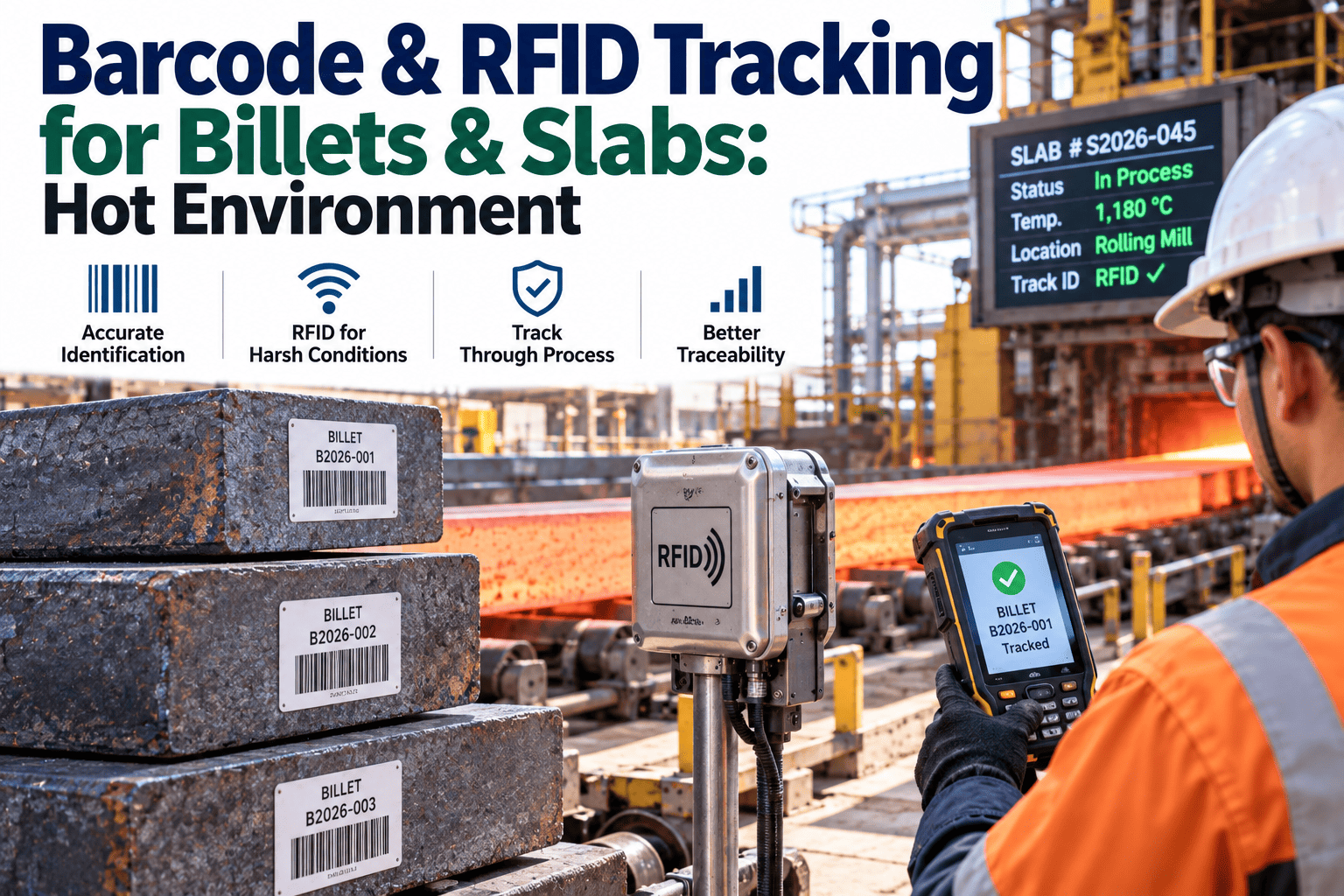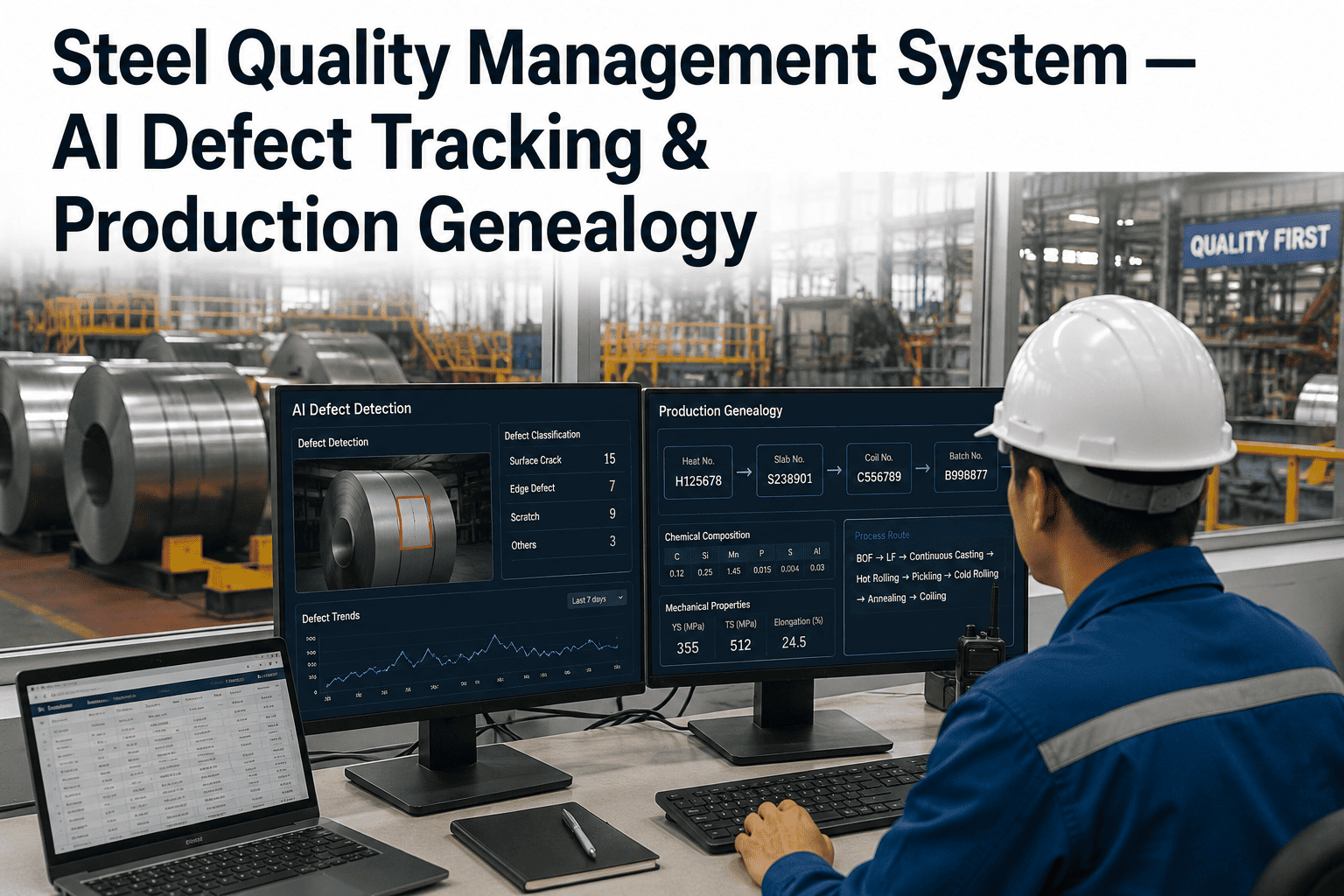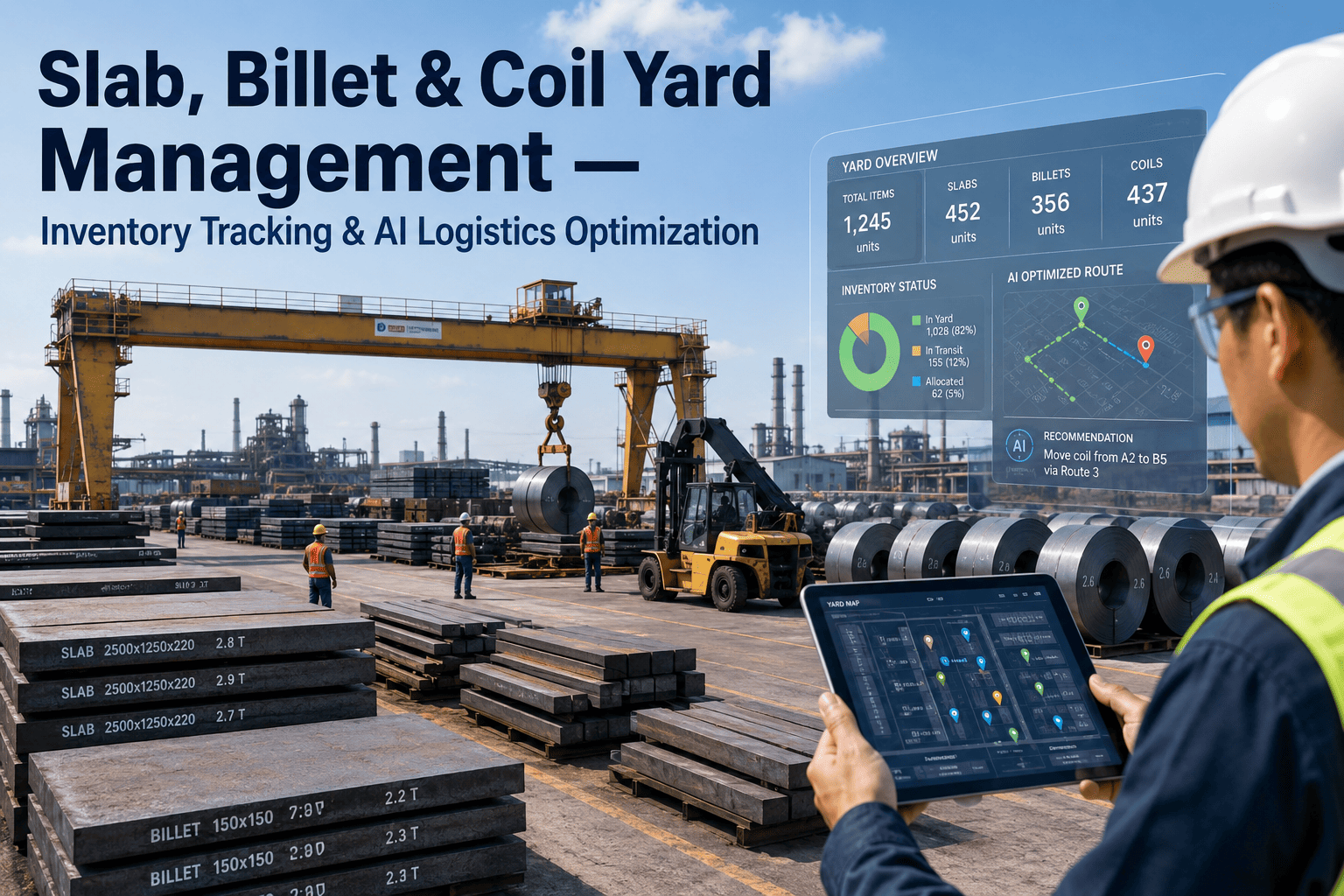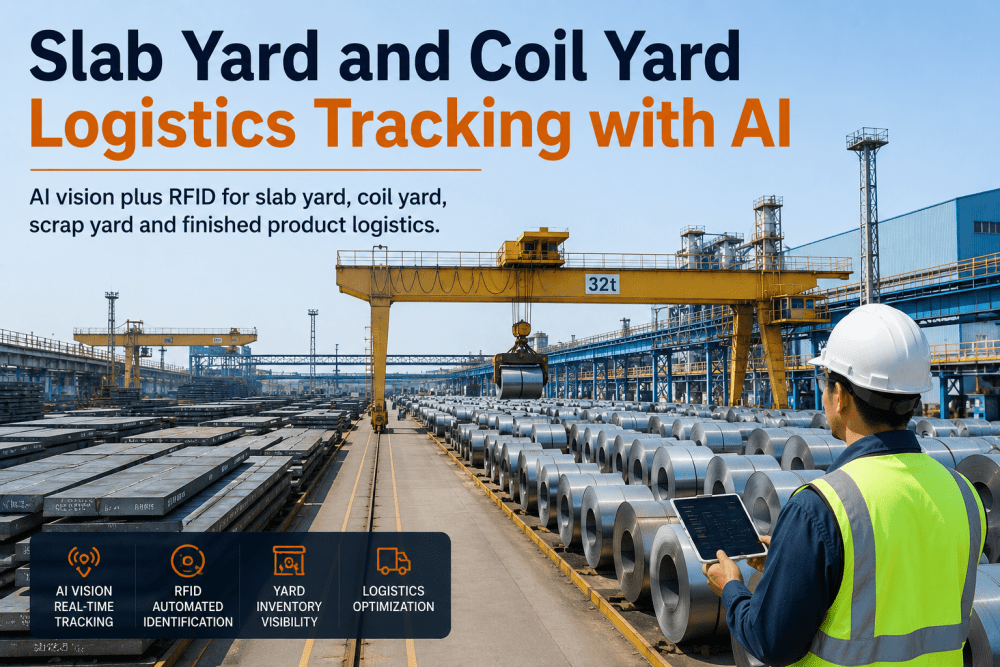
Every steel mill yard is a physical buffer between production stages — slabs between the caster and the reheat furnace, coils between the hot mill and the finishing lines, scrap between the receiving gate and the melt shop, finished products between the processing lines and the loading bay. Yet most yards today operate with the same fundamental visibility gap: the location, identity, and status of every slab, coil, scrap bundle, and finished coil in the yard is known only to the yard operator who last handled it. When that operator leaves for the day, goes to lunch, or moves to a different crane, the knowledge goes with them. AI-powered yard logistics tracking eliminates this gap entirely — deploying RFID readers, AI vision cameras mounted on gantry cranes, and weigh-scale integration that creates a continuous, real-time digital model of every item in every yard, accessible to every shift, every dispatcher, and every production planning system that needs it. Book a Yard Logistics Technology Review to see how iFactory's AI platform brings real-time visibility to your slab, coil, and scrap yards.
The cost of yard visibility gaps compounds across every production hour. Slabs that cannot be located when the reheat furnace calls for them delay the rolling schedule. Coils stacked in the wrong bay position require multiple crane moves to retrieve, consuming crane capacity that should be moving production. Scrap inventory that is misidentified or miscounted drives incorrect charge mix calculations in the melt shop. Finished coils that are loaded onto the wrong truck create customer complaints and re-routing costs. Each of these losses is individually small — a few minutes here, a missed forklift move there — but across a 1,000-employee integrated mill operating 24 hours per day, the aggregate throughput loss from yard logistics inefficiency typically exceeds $4–7 million per year in avoidable delay costs, crane utilization losses, and dispatch error rework.
Why Yard Logistics Analytics Is the Hidden Constraint in Steel Mill Throughput
Yard logistics is the most under-invested function in steel mill operations technology. Mills spend millions on Level 2 process control systems for the rolling mill, Level 3 production scheduling for the melt shop and finishing lines, and laboratory information management for quality. The yard — where every slab, coil, and scrap shipment physically enters, moves through, and exits the facility — typically operates on a combination of clipboard sheets, whiteboard grids, and the yard crane operator's mental map of what is sitting where. The gap between the operational technology investment in production systems and the investment in yard logistics is the largest single source of avoidable throughput loss in most integrated and mini-mill operations.
The throughput constraint imposed by yard logistics is invisible to most production planning systems because it operates below the resolution of the MES. A slab that is "in the yard" in the production system is actually somewhere in a 20-acre slab yard with 800 storage positions, 12 crane bays, and slabs stacked three high. The production planner sees "position 47-B" on the schedule and assumes the slab is retrievable in 4 minutes. If the slab is actually buried under two other slabs, or has been moved to a holding area that was not updated in the system, the actual retrieval time is 18 minutes — and the reheat furnace waits, the rolling schedule shifts, and the delay propagates through every downstream operation. A yard logistics analytics layer that tracks every slab's physical location, stack position, and retrieval sequence in real time eliminates this class of delay entirely.
- Slab location known only to the crane operator on duty — no visibility across shifts
- Coil retrieval requires visual confirmation and manual inventory lookup before every move
- Scrap yard inventory reconciled manually — charge mix planning uses outdated tonnage figures
- Finished coil dispatch relies on paper pick tickets and driver-dependent bay identification
- Yard crane utilization tracked by operator log — idle time and empty travel invisible
- Inventory discrepancies identified only during physical audit — monthly, at best
- Every slab, coil, and scrap bundle location mapped in real-time digital yard model — any shift, any operator
- AI vision and RFID identify each item at pick and place — location updated automatically with every crane move
- Scrap inventory tracked by grade, weight, and position — charge mix accuracy improved to 98%+
- Finished coil dispatch directed by automated bay assignment — zero manual pick ticket required
- Crane utilization measured per move cycle — idle time and empty travel flagged for dispatch optimization
- Inventory self-reconciles after every move — physical audit required once per quarter at most
Slab Yard and Coil Yard Tracking: From Receipt to Production
The slab yard is the highest-value tracking environment in an integrated steel mill because the cost of a tracking failure is a delayed rolling campaign — which cascades through every downstream operation at a cost of $12,000 to $28,000 per hour of schedule disruption. AI-powered slab tracking converts the slab yard from a three-dimensional inventory problem into a real-time digital model where every slab's location, orientation, stack depth, and retrieval sequence is known continuously. The same approach applies to coil yards, where the tracking challenge is complicated by coil density, variable stacking configurations, and the need to integrate with downstream finishing line scheduling. Book a Yard Tech Review to see the tracking model configured with your yard layout and slab/coil data.
Real-Time Yard Inventory Intelligence Across Every Yard Type
Different yard types present different tracking challenges — slab yards require three-dimensional position tracking with stack depth awareness, coil yards require identification on curved surfaces that complicate barcode and RFID tag placement, scrap yards require grade identification and weight tracking across irregular material shapes, and finished product yards require integration with order fulfillment and loading bay dispatch. iFactory's yard logistics platform adapts its sensor configuration and AI vision models to the specific characteristics of each yard type while maintaining a unified digital yard model that provides complete inventory visibility across the entire facility.
Measurable Yard Performance Improvements
The transition from manual yard tracking to AI-powered real-time visibility produces measurable improvements across every yard performance dimension. The following metrics represent outcomes documented at integrated and mini-mill steel operations that have deployed AI yard logistics tracking across slab, coil, scrap, and finished product yards.
| Yard Type | iFactory Tracking Method | Key Metric Improved | Typical Improvement |
|---|---|---|---|
| Slab Yard | AI vision + crane position tracking + surface marking reading | Retrieval time per slab | 14 min → 0.8 min average |
| Coil Yard | AI vision + RFID (where applicable) + crane sensor fusion | Coil locate accuracy | 76% → 99% first-attempt retrieval |
| Scrap Yard | AI vision + weigh scale integration + grade classification | Inventory accuracy by grade | 68% → 97% |
| Finished Product Yard | AI vision + order database integration + bay assignment engine | Loading accuracy | 91% → 99.5% correct load rate |
Building the Business Case for the Integrated Yard Digital Twin
Making the transition from manual yard tracking to an AI-powered digital twin of every yard in the mill requires a structured business case that accounts for direct labor savings, crane utilization improvements, delay recovery, inventory accuracy gains, and dispatch error elimination. The following checklist covers the specific evaluation criteria that steel mill operations and logistics teams use to justify yard logistics AI investment to plant management and corporate stakeholders. Book a Yard Tech Review for a site-specific ROI projection based on your mill's yard configuration and current performance data.
Expert Perspective: What Changes When Yards Have Real-Time Visibility
We had been running our slab yard with a whiteboard grid for 18 years. The yard operator on the day shift had a system of colored magnets that worked for him, but the afternoon shift operator had a completely different mental model, and the midnight shift operator was essentially flying blind. When we deployed iFactory's yard tracking, the first thing we discovered was that our actual slab retrieval times were three times longer than what we had been reporting to the production scheduler. The scheduler was planning 4-minute slab retrievals. The actual average was 13 minutes. The rolling mill had been running at 88% utilization not because of mill delays, but because the reheat furnace was waiting on slabs that no one could find quickly. Once the digital yard model was live and every slab location was visible to every operator on every shift, the retrieval time dropped to under 90 seconds and the rolling mill utilization moved to 94% within the same quarter — with no changes to the caster, the reheat furnace, or the mill itself. The constraint was the yard. We had been looking at the wrong bottleneck for years.
Frequently Asked Questions
At minimum, iFactory requires installation of AI vision cameras on yard cranes or at fixed positions covering yard bays, plus RFID readers at key transfer points — slab yard entry, coil staging area, scrap weigh scale, loading bay. Crane position encoders or laser rangefinders are recommended for automatic location capture but are optional; AI vision can infer position from camera field-of-view calibration. Integration with the existing production database or MES for slab, coil, and order data is completed in 1–2 weeks. A site assessment is available at no cost to determine the specific sensor layout and integration scope for your yard configuration.
Yes. iFactory's AI vision models are trained on imagery captured in outdoor steel mill conditions — direct sunlight, rain, snow, fog, and nighttime operation with crane-mounted lighting. Camera housings are rated for industrial environments with vibration, dust, and temperature extremes from -20°F to 140°F. RFID readers operate reliably in these conditions when properly positioned. iFactory has deployed yard tracking at facilities in the U.S. Midwest, Gulf Coast, and mountain region climates with no weather-related availability degradation.
iFactory uses redundant identification — AI vision reads heat numbers and slab IDs from surface markings, while RFID tags at the slab yard transfer table provide a secondary identification channel when surface markings are damaged or obscured by scale. For slabs with no readable marking and no RFID record, the platform assigns a temporary tracking ID based on position, dimensions, and weight — and flags the slab for manual identification when the crane retrieves it for furnace charging. In practice, the dual AI vision plus RFID approach achieves 99.3% identification accuracy across all slab conditions.
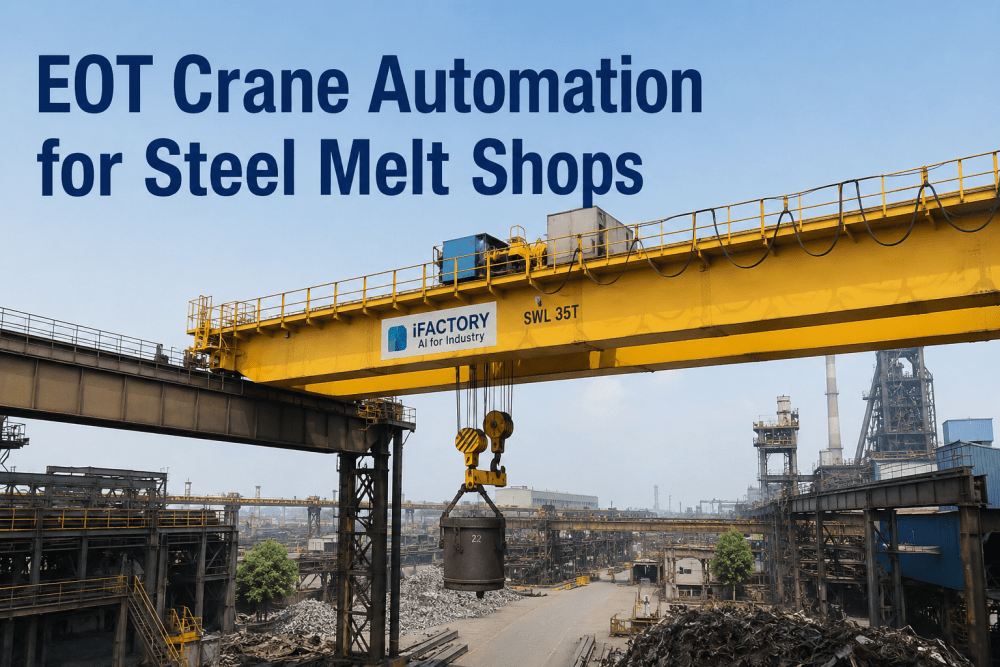
iFactory integrates with existing crane control systems through standard interfaces — Profibus, Profinet, EtherNet/IP, or OPC-UA — reading crane position, hoist status, and load weight from the existing crane PLC without requiring hardware modifications. For cranes without position feedback, iFactory can install independent laser rangefinders or encoder wheels that communicate wirelessly to the yard analytics server. The platform supports both gantry and overhead crane configurations common in U.S. steel mill yards.
iFactory yard logistics deployments typically achieve full cost recovery within 7 to 12 months, with the fastest payback cases occurring when slab or coil retrieval delay recovery alone generates enough additional production throughput to cover the platform investment in the first two quarters. At a typical 2 million TPY integrated mill, reducing retrieval times from 14 minutes to under 1 minute recovers approximately 800 crane hours per year — valued at $1.2–2.4 million in schedule reliability and reheat furnace utilization gains. An ROI modeling session using your facility's specific yard layout, crane configuration, and production economics is available at no cost.
Conclusion: The Yard Is the Largest Remaining Visibility Gap in Steel Mill Operations
Every production stage in a modern steel mill has a control system, a historian, and a real-time display. The slab yard, coil yard, scrap yard, and finished product yard typically have none of these — despite being the physical locations where every ton of material is handled, stored, and dispatched. The gap between the operational technology investment in production systems and the investment in yard logistics is the single largest source of avoidable throughput loss in most integrated and mini-mill operations. Closing that gap does not require new production equipment, capital approval cycles, or extended installation outages. It requires deploying AI vision cameras, RFID readers, and crane sensors that connect to a real-time digital yard model — and giving every operator on every shift the same complete visibility into what is in the yard and where it is located.
iFactory's yard logistics platform tracks slabs, coils, scrap, and finished products across every yard type — with AI vision that reads surface markings on red-hot slabs and curved coil surfaces, crane position tracking that captures every move automatically, and continuous reconciliation that maintains 98%+ inventory accuracy without physical audits. The platform integrates with existing crane control systems, production databases, and order management systems to create a single real-time digital view of everything in every yard. That visibility is available for your facility today. Book a Yard Logistics Technology Review to see the iFactory platform configured with your yard layout and operating data.