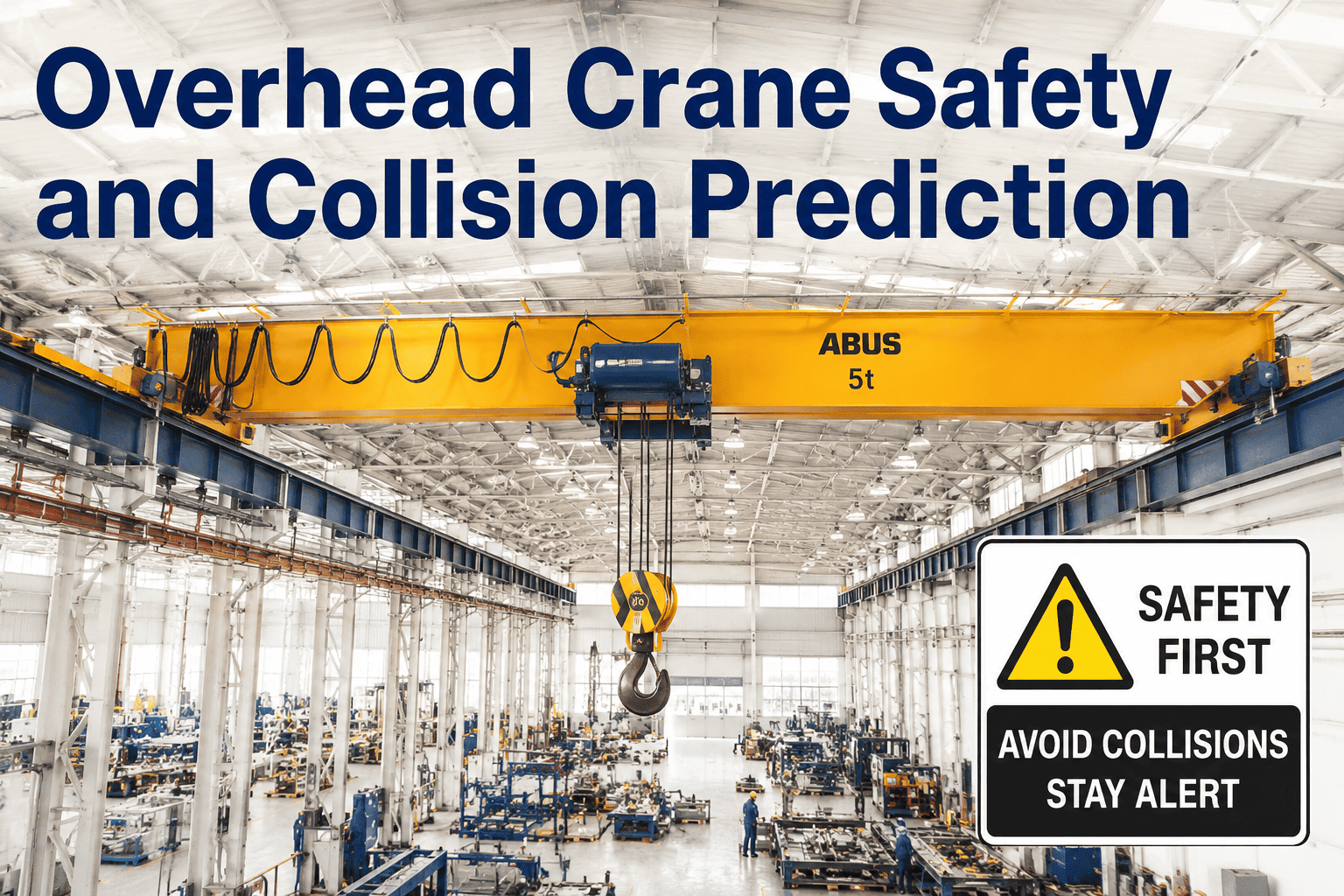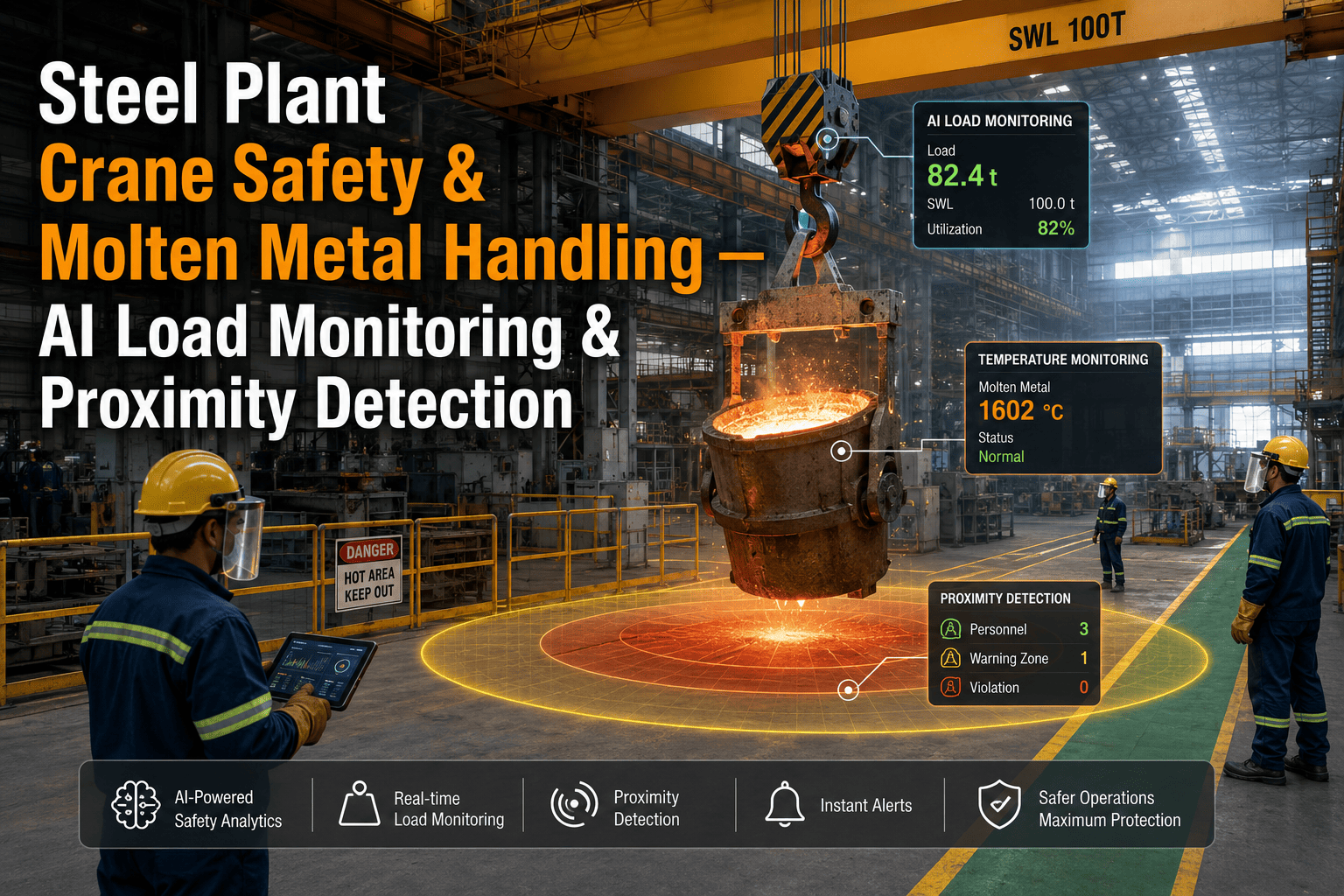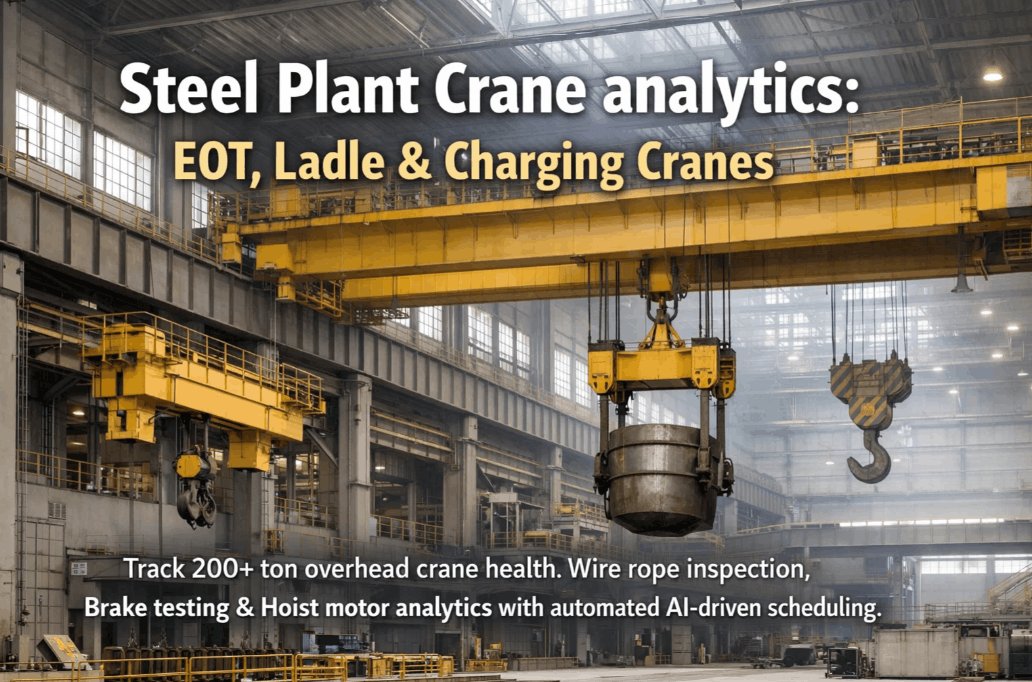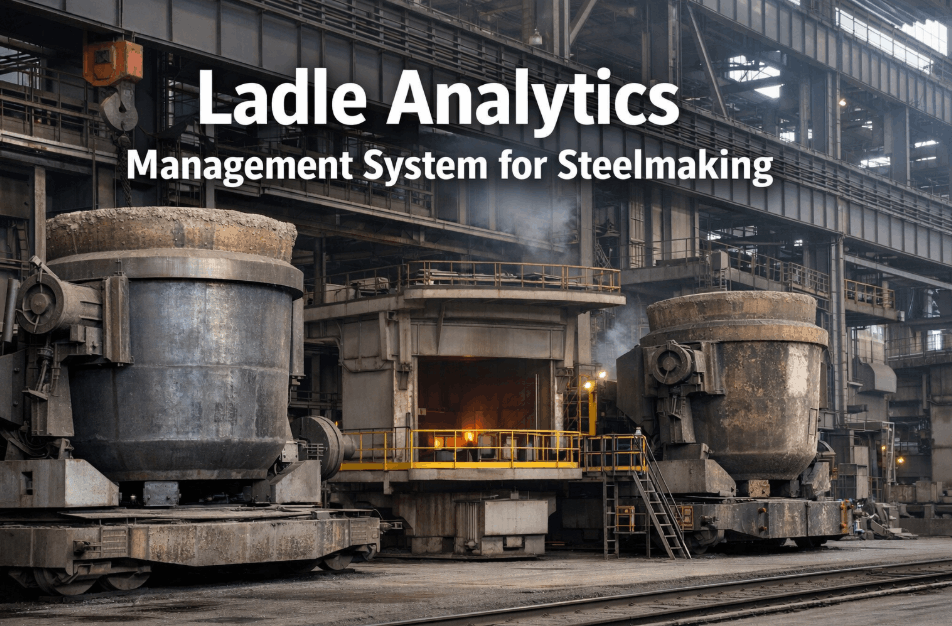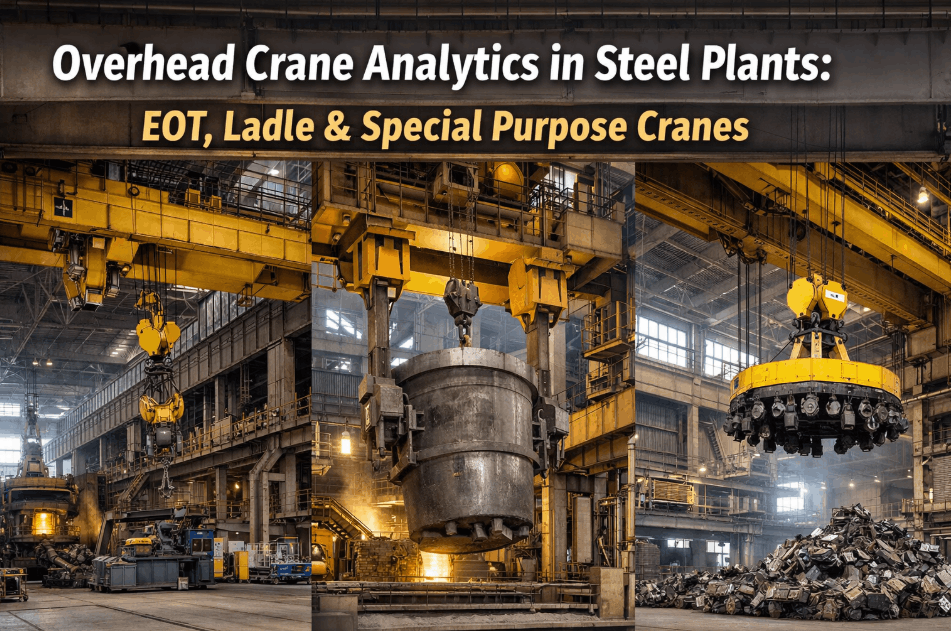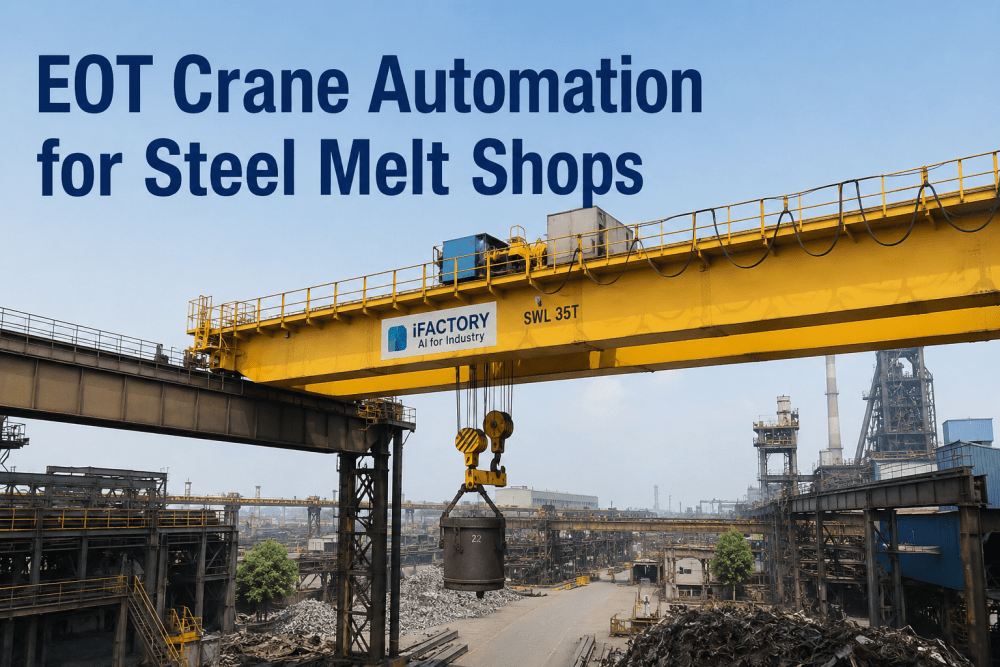
Every ton of steel produced in a melt shop passes through an EOT crane at least three times — from scrap loading to furnace charging, from furnace tapping to ladle handling, and from caster torch cut to slab yard storage. These crane moves are the physical choreography that connects every production stage, and the speed, accuracy, and safety of each move directly determines melt shop throughput. Yet most melt shop cranes today operate with the same fundamental limitations: manual operator control that depends on individual skill level, pendulum-based load sway that forces operators to slow down during positioning, and collision risk that requires conservative operating margins that leave crane capacity on the table. AI-powered semi-autonomous crane automation eliminates these limitations entirely — deploying anti-sway control, collision avoidance, and AI-driven path planning that allows EOT cranes to move faster, stop precisely, and operate safely at utilization levels that manual operation cannot sustain. Book a Crane Automation Technology Review to see how iFactory's AI platform transforms melt shop crane operations.
Semi-Autonomous Cranes for the Modern Melt Shop
iFactory's AI crane automation platform delivers anti-sway control, collision avoidance, and adaptive path planning — purpose-built for the demanding environment of steel melt shop EOT crane operations.
The Crane Operations That Define Melt Shop Throughput
Every melt shop has four distinct crane operations, each with a unique set of performance requirements, safety constraints, and throughput impact. The most productive melt shops treat each crane type as a specialized automation problem rather than applying a one-size-fits-all approach. iFactory's AI platform configures its anti-sway, collision avoidance, and path planning algorithms to match the specific load characteristics, operating environment, and criticality of each crane operation. Crane and logistics engineers who schedule a technical review consistently report that this targeted approach delivers faster deployment and higher ROI than generic crane automation solutions.
Charging Crane Automation
Core Function: Scrap bucket and DRI charging into EAF or BOP vessels. Charging cranes operate in the highest-temperature environment with the tightest positioning tolerances — the bucket must center precisely over the furnace opening while the operator maintains visual clearance from the hot face.
Ladle Crane Automation
Core Function: Molten steel ladle handling between furnace, refining station, and caster tundish. Ladle cranes carry the highest consequence load — a ladle swing incident or positioning error can cause a breakout event with catastrophic safety and production impact.
Scrap Crane Automation
Core Function: Scrap basket filling and transport from scrap yard to furnace charging bay. Scrap cranes handle irregular loads with variable center-of-gravity, making manual anti-sway control particularly challenging and reducing achievable cycle speeds.
Slab Handling Crane Automation
Core Function: Hot slab transfer from caster torch cut to storage yard or direct to reheat furnace. Slab cranes operate in the highest-duty-cycle environment with repetitive moves that benefit most from automated path optimization and collision avoidance.
AI Crane Automation Technologies Compared
The transition from fully manual to fully autonomous crane operation is not a single technology jump — it is a progression through four distinct control modes, each with different capability profiles, investment requirements, and safety case implications. Most melt shops begin with sensor deployment and anti-sway implementation before progressing to semi-autonomous operation, while fully autonomous crane operation remains appropriate only for the most repetitive and least operator-critical moves. The table below maps the key capabilities and limitations of each control mode across the dimensions that matter most to melt shop crane and logistics engineers.
| Control Mode | How It Works | Safety Level | Cycle Time Impact | Best Fit |
|---|---|---|---|---|
| Manual Operation | Operator in cab controls all crane axes — hoist, trolley, bridge — using joysticks or master switches. Load sway managed by operator skill through pendulum damping techniques. | Operator-dependent — fatigue, distraction, and experience gaps create variable risk | Baseline — operator skill determines achievable speed | Low-volume operations, non-repetitive moves, maintenance cranes |
| Remote Radio Control | Operator controls crane from floor level using radio transmitter. Improves operator positioning but does not address sway control or path optimization. | Improved — operator can choose safest viewing position for each move | Similar to manual — no automation of sway or positioning control | Scrap cranes, slab cranes where cab visibility is poor |
| Semi-Autonomous AI | AI handles sway damping, collision avoidance, and precision positioning. Operator defines destination — crane executes the move with optimized path and speed profile. Operator can override at any time. | Superior — collision avoidance always active, anti-sway prevents load swing incidents, overtravel prevention engaged | 15–30% faster — consistent acceleration profiles, no operator-induced sway damping delays, precise first-attempt positioning | Charging cranes, ladle cranes, high-duty-cycle slab cranes |
| Fully Autonomous | Crane executes programmed moves without operator intervention. Production scheduling system dispatches move commands directly to crane control system. No operator in the loop. | Maximum — no personnel exposure to elevated crane operation | 30–40% faster — optimized for maximum acceleration without operator comfort constraints | Repetitive slab handling, automated storage and retrieval, yard crane operations |
How Semi-Autonomous Crane Operation Works in Practice
Deploying AI-powered semi-autonomous crane control in a melt shop follows a structured progression that builds capability incrementally — starting with sensor instrumentation and anti-sway deployment, then advancing through collision avoidance, precision positioning, and finally full integration with the melt shop production scheduling system. Each phase delivers measurable operational improvement on its own, and each phase prepares the crane infrastructure for the next level of automation. The phased approach allows melt shops to begin capturing value from the first deployment phase while building toward full automation capability over a scheduled timeline that aligns with production schedules and workforce training programs.
Sensor Instrumentation and Crane Data Acquisition
Install encoders, accelerometers, and load cells on all crane axes — bridge position, trolley position, hoist height, load weight, and sway angle. Establish real-time data stream to the AI control platform. This phase delivers immediate visibility into crane utilization, move counts, and operator performance variation across shifts. Timeline: 3–4 weeks per crane.
AI Anti-Sway and Collision Avoidance Deployment
Deploy AI anti-sway control that actively damps load pendulum motion during bridge and trolley acceleration and deceleration — eliminating the operator-induced dwell time that occurs when manually waiting for sway to settle. Activate collision avoidance using laser rangefinders or AI vision that detects bay obstructions, adjacent cranes, and personnel zones. Timeline: 4–6 weeks.
Precision Positioning and Semi-Autonomous Control
Enable AI-driven precision positioning where the operator defines the destination and the crane executes the move — handling acceleration, deceleration, sway damping, and final positioning automatically. The operator monitors the move and can override at any time. First-attempt positioning accuracy improves from ±6 inches to ±0.5 inches. Timeline: 4–6 weeks.
Adaptive Path Optimization and Load-Specific Profiles
AI learns load-specific handling characteristics for each crane type — scrap baskets with variable center of gravity, ladles with fixed attachment points, slabs with uniform geometry. Path profiles are optimized for each load type, adjusting acceleration limits, sway tolerance, and positioning approach based on the specific load dynamics. Timeline: 6–8 weeks.
Production Scheduling Integration and Fleet Coordination
Connect crane AI platform to the melt shop production scheduling system. Move commands are dispatched automatically based on the production sequence — furnace tap, ladle arrival, caster sequence, slab removal. Multiple cranes in the same bay are coordinated to prevent conflicts and optimize bay utilization. Timeline: 8–12 weeks.
See the Impact of AI-Powered Crane Control in Your Melt Shop
iFactory's phased crane automation approach delivers measurable improvements at every stage — from anti-sway deployment that accelerates existing cycle times to full production scheduling integration that optimizes bay-wide crane coordination.
Measurable Safety and Productivity Improvements
The transition from manual crane operation to AI-powered semi-autonomous control produces measurable improvements across every dimension of melt shop crane performance. The following outcomes represent documented results from steel melt shops that have deployed iFactory's AI crane automation platform across charging, ladle, scrap, and slab handling cranes.
"Our charging crane operators were among the most skilled in the mill — they could place a 40-ton scrap bucket into the EAF opening with less than 2 inches of clearance on every side. But that skill took years to develop, and we lost it every time an experienced operator retired. With iFactory's semi-autonomous control, our newer operators are matching the cycle times of our 20-year veterans within weeks, and our safety incidents from load swing dropped to zero in the first quarter. The anti-sway control alone recovered 8 minutes per hour of crane operating time that was previously spent waiting for the load to settle."
Building the Business Case for Melt Shop Crane Automation
Making the transition from manual crane operation to AI-powered semi-autonomous control requires a structured business case that accounts for cycle time savings, safety incident reduction, maintenance cost avoidance, and workforce development benefits. The following checklist maps the specific evaluation criteria that melt shop operations and engineering teams use to justify crane automation investment. Book a Crane Automation Technology Review for a site-specific ROI projection based on your melt shop's crane configuration, current cycle times, and production schedule.
| Business Case Element | Evaluation Method | Typical Annual Value |
|---|---|---|
| Cycle Time Reduction | Measure current average crane cycle time per move. Calculate time saved per crane per shift at 22% reduction. Value crane-time recovered at mill cost per operating hour. | $340,000–$580,000 per crane |
| Safety Incident Avoidance | Document load swing incidents, near-misses, and collision events over trailing 12 months. Calculate direct cost of incident investigation, downtime, and regulatory reporting. | $180,000–$420,000 per year |
| Maintenance Cost Reduction | Track crane mechanical maintenance spend — bridge drives, trolley drives, hoist components, wire ropes. Model 18% reduction from reduced shock loading and smoother operation. | $95,000–$210,000 per crane |
| Workforce Development | Quantify new operator training time reduction. Calculate value of reduced dependency on senior operators for critical crane moves — AI enables consistent performance regardless of operator experience level. | $120,000–$260,000 per year |
| Production Throughput Gain | Map crane cycle time reduction to melt shop production throughput. Calculate additional heats per day achievable when charging and ladle cranes operate at 22% faster cycle times. | $620,000–$1.4M per year |
Expert Review: What Melt Shop Engineers Get Right and Wrong About Crane Automation
"The most common mistake I see melt shops make when evaluating crane automation is assuming that fully autonomous operation is the only goal worth pursuing. They look at the cost of full automation — new control systems, redundant safety PLCs, production system integration — and decide the investment is too high. What they miss is that semi-autonomous AI control with anti-sway, collision avoidance, and precision positioning delivers 80% of the cycle time benefit at 30% of the cost of full automation. The operator stays in the loop, the safety case is simpler, and the ROI comes in 6 to 9 months instead of 18 to 24. We have deployed semi-autonomous control on charging cranes at three melt shops, and in every case the operators themselves became the strongest advocates for the system — because it makes their job easier and safer without making them irrelevant."
EOT Crane Automation — Frequently Asked Questions
What types of melt shop cranes can be automated with iFactory's AI platform?
iFactory's crane automation platform supports charging cranes, ladle cranes, scrap handling cranes, and slab handling cranes — covering the full range of EOT crane types operating in steel melt shops. The platform adapts its anti-sway, collision avoidance, and path planning algorithms to the specific load characteristics and operating environment of each crane type.
How does AI anti-sway technology improve crane cycle time compared to manual operation?
Manual anti-sway control requires operators to accelerate slowly and then wait for pendulum motion to settle before positioning the load — typically adding 8 to 12 seconds per move. AI anti-sway actively damps pendulum oscillation during all phases of motion, eliminating the settling dwell time and enabling faster acceleration and deceleration profiles that reduce average cycle time by 22%.
Can semi-autonomous cranes operate in the same bay as manually controlled cranes?
Yes. iFactory's collision avoidance system uses laser rangefinders and AI vision to detect all cranes in the bay — regardless of whether they are operating in manual or semi-autonomous mode. The system prevents bridge and trolley conflicts between automated and manual cranes by dynamically adjusting path plans and speed profiles when another crane enters the operating zone.
What is the typical ROI timeline for AI crane automation in a steel melt shop?
Melt shops deploying semi-autonomous crane control with iFactory typically achieve full cost recovery within 6 to 12 months, with the fastest payback on high-duty-cycle charging and slab handling cranes where cycle time reduction translates directly to additional production throughput. An ROI modeling session using your melt shop's specific crane configuration and production economics is available at no cost.
Does iFactory's crane automation require new cranes, or can existing cranes be retrofitted?
iFactory's platform is designed for retrofit deployment on existing EOT cranes. The system uses encoder installation on bridge and trolley drives, accelerometer mounting on the crane structure or load beam, and integration with the existing crane control system through standard interfaces — Profibus, Profinet, EtherNet/IP, or OPC-UA. No new crane procurement is required for semi-autonomous operation.
Semi-Autonomous Crane Control — Faster Cycles, Zero Load Swing, Proven ROI.
iFactory's AI crane automation platform delivers anti-sway control, collision avoidance, and precision positioning for charging, ladle, scrap, and slab handling cranes — purpose-built for the demanding environment of steel melt shop EOT crane operations.
The Case for AI-Powered Crane Automation Is Clear
The economic and safety case for AI-powered semi-autonomous crane control in steel melt shops is well-established and no longer speculative. The 22% cycle time reduction, the 87% reduction in load swing incidents, the 18% maintenance cost reduction, and the 6- to 12-month ROI timeline are measured outcomes from operating melt shops that have deployed AI crane automation across charging, ladle, scrap, and slab handling cranes. The technology is deployable today on existing crane infrastructure — no new crane procurement required — and it delivers measurable operational improvement from the first deployment phase.
Melt shops that continue operating cranes purely on manual control are accepting cycle time losses, safety risks, and maintenance costs that are no longer necessary. The choice is not between full autonomy and manual operation — semi-autonomous AI control delivers the majority of the benefit at a fraction of the cost and complexity, while keeping the skilled operator in the loop where their judgment and experience remain essential. Book a Crane Automation Technology Review to see how iFactory's AI platform transforms melt shop crane operations at your facility.