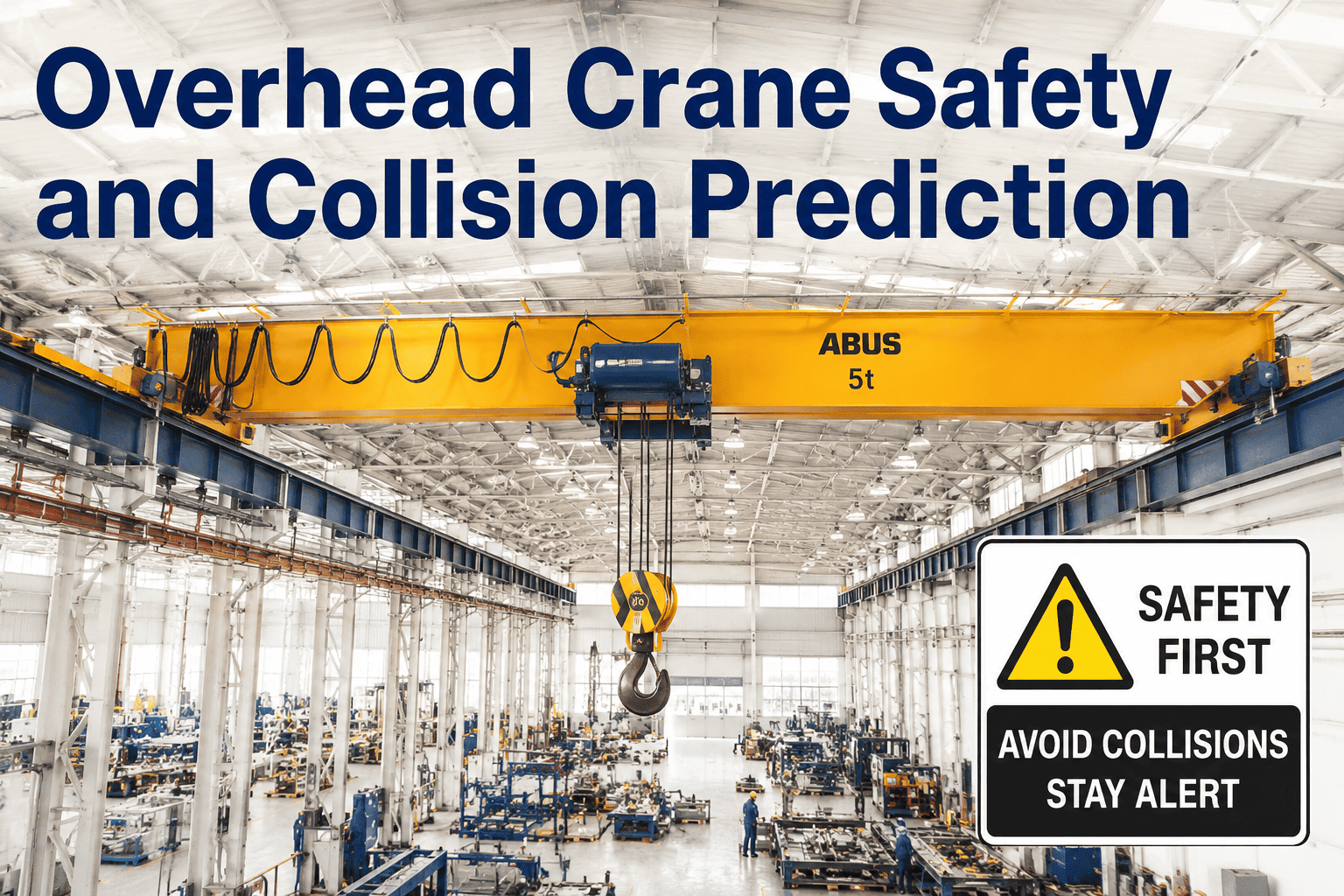
Overhead cranes move heavy, often molten or superheated loads across a shared bridge and runway system, frequently within the same bay as one or more other cranes on the same rail. Crane-on-crane collisions and dropped loads sit among the most serious risks in any steel plant, and standard operator training and proximity markings only go so far when two cranes are converging on the same zone under time pressure. Operations managers looking for a real-time layer of collision prevention can book a demo to see how AI-based crane monitoring supports safer lifts.
Predict Crane Collision Risk Before It Becomes an Incident
AI models track crane position, load state, and closing speed in real time, giving operators an early alert when two cranes are converging on the same zone — well before proximity sensors alone would trigger.
Why Proximity Sensors Alone Aren't Enough
Basic proximity sensors trigger when two cranes get close, but by then the operator may already be in a reactive position with limited time to respond. Predictive monitoring looks at trajectory and closing speed, not just current distance.
Reactive Sensors vs Predictive Monitoring
The difference between a proximity trigger and a predictive model comes down to how much time the operator has to actually respond.
| Capability | Standard Proximity Sensors | AI Predictive Monitoring |
|---|---|---|
| Trigger Basis | Current distance threshold | Trajectory and closing speed |
| Warning Time | Seconds, at close range | Extended, based on approach rate |
| Load Swing Factored | Rarely | Yes, included in risk model |
| Blind Spot Coverage | Limited to sensor field | Full bay position tracking |
Map Your Crane Bays for Collision Risk
Share your crane bay layout and current proximity system. iFactory engineers will identify where predictive monitoring adds the most warning time for your operators.
From Converging Paths to Operator Alert
Predictive value only matters if the operator gets a clear, timely signal in the cab. iFactory delivers the alert where the decision actually gets made.
Where Collision Risk Concentrates
Not every bay carries equal risk. Shared-rail zones, blind corners, and high-traffic transfer points typically account for the majority of close-call events across a plant's crane fleet.
Extending Predictive Monitoring Across a Multi-Bay Operation
Plants running multiple crane bays rarely see uniform collision risk across the whole facility, and treating every bay as equal priority is one of the most common ways an operations manager slows down a rollout that could otherwise move much faster. The bays with the highest shared-rail traffic and the most frequent transfer handoffs almost always deserve to go first, both because that is where the risk actually concentrates and because that is where the earliest results will be most visible to the rest of the operation.
A useful first step before any hardware decisions are made is pulling near-miss and close-call records, even informal ones logged by supervisors or noted in shift handover notes, across every bay in the facility. Patterns that operators already sense intuitively — a particular corner, a particular time of shift, a particular pair of cranes that seem to converge more often than others — usually show up clearly once the data is actually reviewed together, and that review becomes the basis for a defensible rollout sequence.
Integration effort varies more by existing crane instrumentation than by bay size. Newer cranes with digital control systems typically expose position and load data that can be integrated with comparatively little additional hardware, while older cranes running on relay logic may need supplemental position sensors added before predictive monitoring is possible. Auditing existing crane instrumentation early in the planning process avoids surprises once installation is underway.
Operator trust in the alerts builds gradually, and the fastest way to undermine that trust is a poorly tuned alert threshold that triggers too often on routine, low-risk movements. Running the system in a monitoring-only mode for the first few weeks in each new bay, reviewing what would have alerted against what operators already knew was routine, lets the team tune thresholds before alerts actually reach the cab. Operators who see a small number of genuinely meaningful alerts trust the system far more than operators buried in constant low-value notifications.
As coverage extends across additional bays, the collision risk data itself becomes a valuable planning input beyond just in-cab alerting. Recurring high-risk convergence points can inform crane scheduling, staffing decisions during high-traffic periods, and even longer-term decisions about bay layout or rail configuration changes, turning what starts as a safety monitoring project into an ongoing input for how crane operations are planned across the whole facility.
Training Operators to Work With Predictive Alerts
Introducing predictive collision alerts into an operator's cab changes the working environment in a way that deserves deliberate training, not just a brief mention during a shift meeting. Operators who have spent years relying on direct sightlines and radio coordination with other crane operators need time to understand how the new alerts fit into that existing routine, rather than treating them as a replacement for practices that have kept the bay safe up to this point.
The most effective training programmes are explicit that predictive alerts are meant to add warning time on top of existing procedures, not to substitute for an operator's own judgement or communication with other cranes on the same rail. Framing the technology this way from the outset avoids a common failure mode where operators either over-rely on the system and reduce their own situational awareness, or dismiss it entirely because it feels like it is second-guessing decisions they have safely made for years.
Hands-on familiarisation, ideally during a period when the system is running in observation mode before alerts go live, gives operators a chance to see what a typical alert looks like and understand what it means in practical terms, without the pressure of responding to it during an actual lift. This kind of low-stakes exposure tends to produce far more confident, appropriate responses once the system is fully active than training delivered purely through a classroom briefing.
Feedback channels matter throughout the rollout. Operators are often the first to notice when an alert threshold feels miscalibrated for a specific bay's actual traffic patterns, and a straightforward way for them to flag that feedback to the safety and operations team accelerates the tuning process considerably. Programmes that treat operator feedback as a core part of calibration, rather than a one-time survey at the end of a pilot, tend to reach a well-tuned, trusted alert system much faster than those that don't.
Frequently Asked Questions
The questions operations managers most often raise before adding predictive collision monitoring to an existing crane fleet.
Book a Crane Bay Risk Assessment
Share your crane bay layout and current proximity system setup. iFactory engineers will show you where predictive collision monitoring would add the most warning time.