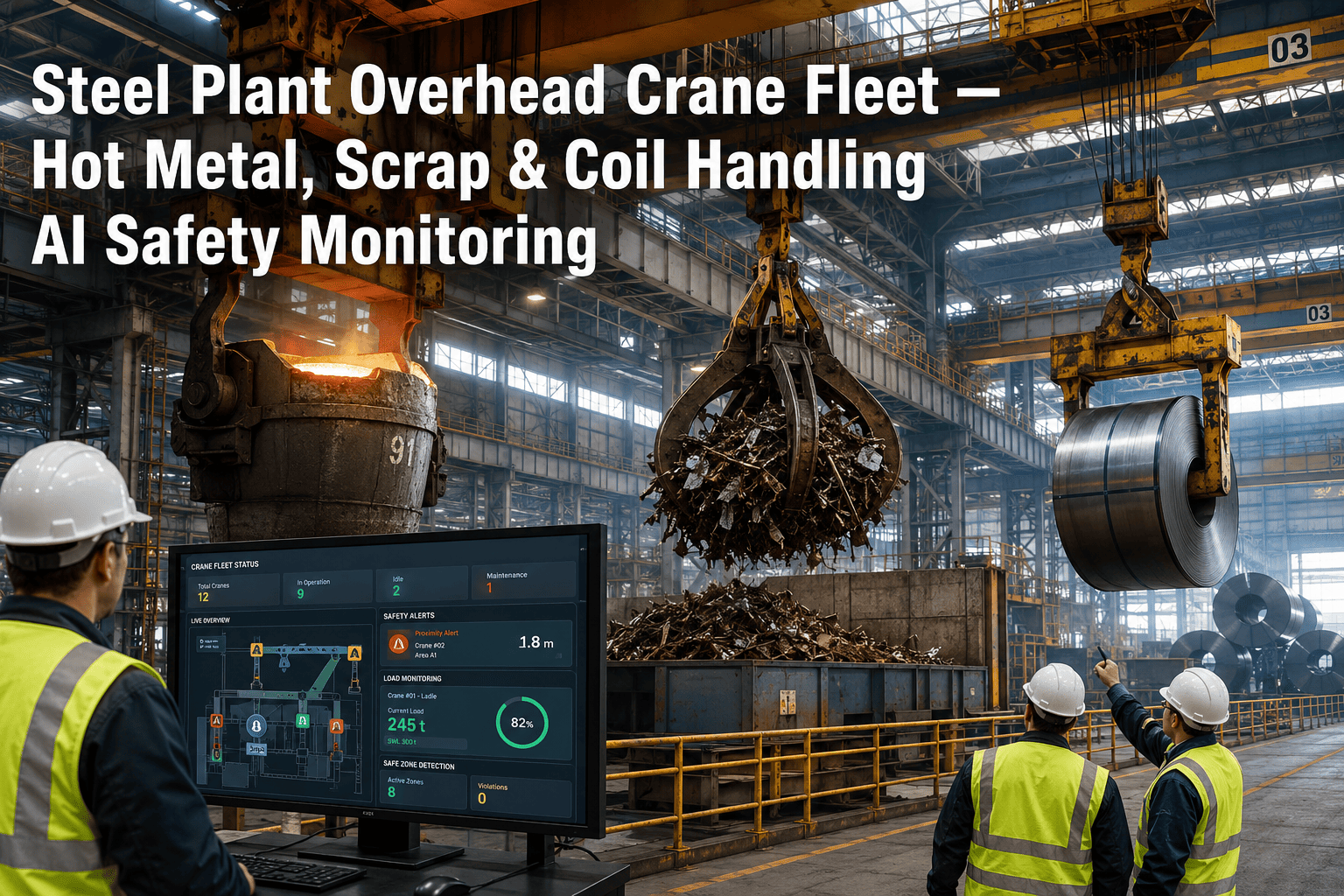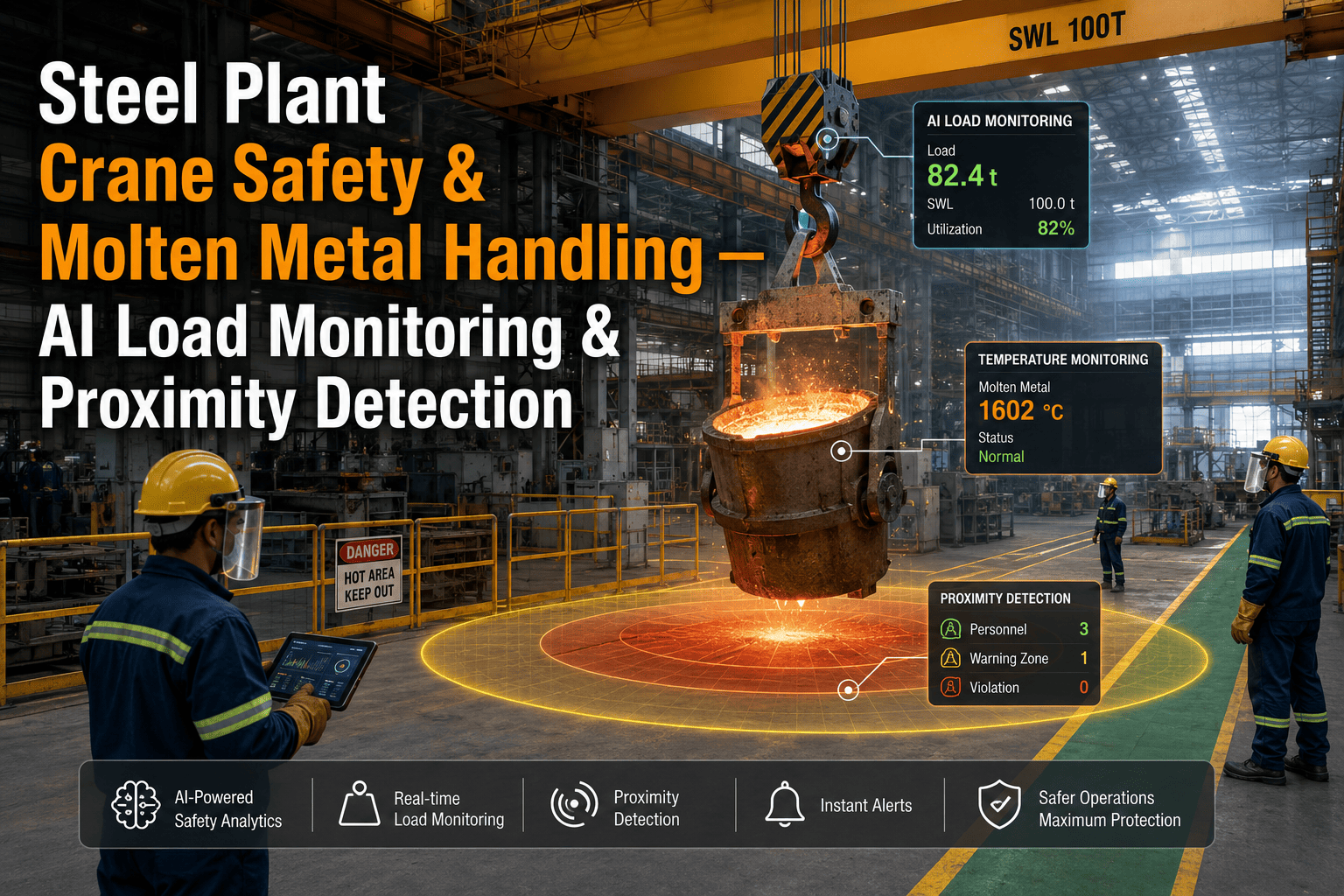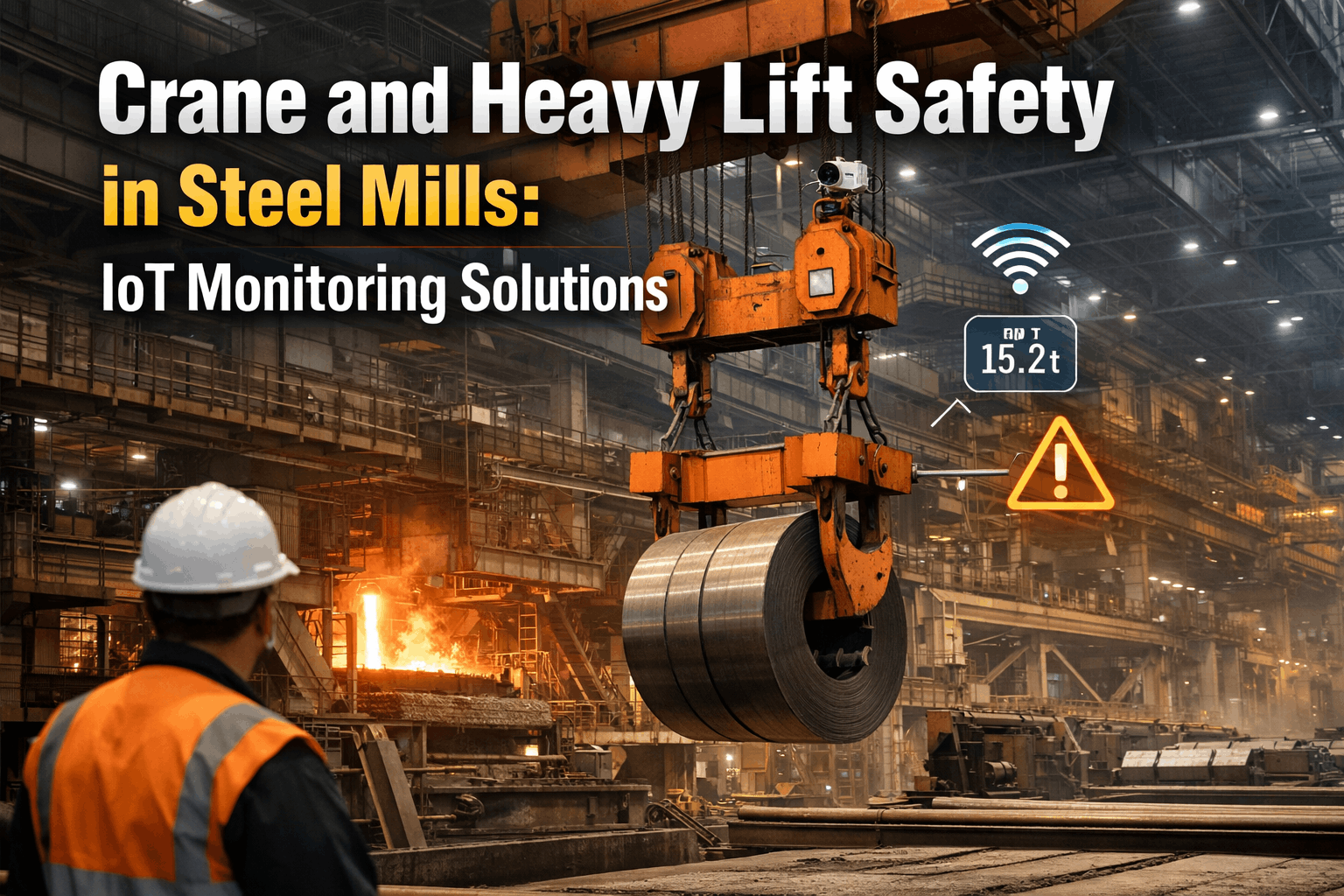
Steel mill cranes are among the most safety-critical assets in heavy industry — handling molten metal ladles weighing over 300 tons, moving red-hot slabs through hazardous production zones and operating thousands of cycles per year in extreme heat, corrosive dust, and 24/7 duty environments. A review of 249 overhead crane incidents documented by OSHA revealed 838 safety violations, resulting in 133 injuries and 133 fatalities — with 37% of cases involving workers crushed by a load and 27% caused by dropped loads from rigging failure. Approximately 90% of crane accidents are attributed to human error, and the average cost per crane fatality exceeds $4 million in direct and indirect losses. In 2026, IoT-enabled crane monitoring is transforming steel mill lifting operations — replacing visual inspections and gut-feel decisions with continuous sensor data on structural health, load dynamics, brake wear, wire rope condition, and operator behavior. OxMaint integrates IoT crane monitoring directly into your CMMS for automated safety alerts, predictive maintenance, and complete compliance documentation. Book a free demo and see how IoT crane safety protects your workforce and your operations.
Why Steel Mill Cranes Are Uniquely Dangerous — And Why Visual Inspections Aren't Enough
Steel mill overhead cranes face operating conditions that no standard inspection regime can adequately monitor. Radiant heat from molten metal degrades wire ropes, structural members, and braking systems between inspection intervals. Shock loading from scrap charging and ladle handling creates fatigue damage invisible to the naked eye. Abrasive metallic dust penetrates bearings, gearboxes, and electrical systems. And duty cycles measured in tens of thousands of lifts per year push components to failure thresholds that time-based inspection schedules cannot predict.
The result: critical components fail between inspections, loads are dropped onto production floors, and workers are killed by equipment that "passed inspection last month." IoT monitoring closes this gap by providing continuous, real-time condition data on every safety-critical component — not periodic snapshots separated by weeks or months. See how continuous monitoring replaces periodic inspections
37% Crushed by Load
The most common crane fatality — workers struck or crushed by falling or swinging loads due to rigging failure, overloading, or brake malfunction.
27% Dropped Loads
Wire rope failure, hook latch malfunction, and rigging point overload cause loads to drop — catastrophic in steel mills where loads include molten metal ladles.
12% Falls from Height
Crane maintenance requires working at height on bridge structures, trolleys, and runways — falls from 8 to over 100 feet account for 12% of crane fatalities.
11% Run Over / Pinched
Workers crushed between the crane structure and fixed objects during travel — anti-collision and proximity sensing prevents these incidents entirely.
What IoT Monitors on Every Steel Mill Crane — Sensor by Sensor
IoT crane monitoring deploys a network of sensors across every safety-critical component — creating a digital nervous system that detects degradation, predicts failure, and triggers automated safety responses before accidents occur.
Load Cells & Overload Protection
Precision load cells on hooks and trolleys measure actual load weight in real time. Automatic overload lockout prevents the crane from lifting beyond rated capacity — eliminating the 80% of crane accidents caused by exceeding load limits. Load history logging provides fatigue cycle counting for structural life assessment.
Wire Rope Monitoring
Electromagnetic wire rope inspection (MRI) sensors detect broken wires, corrosion, and cross-section loss in real time — without stopping the crane. In steel mills, extreme heat and metallic dust accelerate wire rope degradation between visual inspections. Continuous monitoring catches deterioration that periodic inspections miss. See wire rope monitoring live
Structural Health Monitoring
Strain gauges and accelerometers on bridge girders, end trucks, and trolley frames detect fatigue cracking, structural deflection beyond safe limits, and impact damage from crane collisions. Thermal sensors track structural member temperatures to identify heat-induced degradation from radiant heat exposure — a uniquely steel mill hazard.
Brake Condition Monitoring
Brake systems are the last line of defense against dropped loads. IoT sensors monitor brake disc/pad wear, brake torque output, response time, and operating temperature. In ladle cranes carrying molten metal, brake failure is catastrophic. Predictive alerts trigger brake maintenance before torque output drops below safe holding capacity.
Anti-Sway & Load Dynamics
Load sway is one of the most dangerous conditions in steel mill crane operations — a swinging ladle of molten metal can cause catastrophic spills. IoT sensors measure sway angle and acceleration in real time, feeding anti-sway control systems that automatically dampen pendulum motion. Digital records of sway events identify operators or conditions requiring intervention. See anti-sway monitoring in your demo
Anti-Collision & Proximity
Multiple cranes operating on the same runway — common in steel mill melt shops and casting bays — create collision risks between crane structures and between cranes and fixed objects. Radar and LiDAR proximity sensors create dynamic exclusion zones that automatically slow and stop cranes before collisions occur. Pedestrian detection protects ground-level workers in crane operating areas.
IoT Monitoring by Crane Application — Every Lift Type Covered
Steel mills use specialized cranes for different production stages — each with unique safety risks that IoT monitoring addresses specifically. Schedule a demo to see your crane fleet mapped in OxMaint.
EXTREME Ladle Cranes — Molten Metal Transport (200–350+ Tons)
Ladle cranes carry molten steel at 1,600°C in open-top ladles weighing 200–350+ tons. A dropped ladle or molten metal spill is the most catastrophic crane failure possible in any industrial setting — resulting in fatalities, massive equipment destruction, and production shutdown lasting weeks or months. IoT monitoring on ladle cranes includes dual-redundant load cells, continuous brake torque monitoring, wire rope MRI, anti-sway systems, and thermal sensors tracking heat exposure on structural members. Every safety parameter is monitored continuously because the consequence of failure is catastrophic.
HIGH Charging Cranes — Scrap & Raw Material Handling
Charging cranes load scrap metal and raw materials into EAF and BOF converters — handling irregular, unpredictable loads with extreme shock forces. The violent nature of scrap charging creates impact loads 2–3x the static weight. IoT monitoring tracks shock load events, structural fatigue accumulation from impact cycling, and magnet/grab system health. Load cell data identifies overloading patterns before structural fatigue reaches critical thresholds. See charging crane monitoring
HIGH Casting Cranes — Continuous Caster & Slab Handling
Casting cranes handle red-hot slabs, blooms, and billets from the continuous caster — operating in extreme heat with high precision requirements. Misaligned slab placement damages downstream rolling equipment. IoT provides precision positioning data, anti-sway control for accurate slab placement, and thermal monitoring of crane components exposed to radiant heat from hot steel product.
MODERATE Maintenance & General Purpose Cranes
Maintenance cranes service equipment across the plant — lifting mill rolls, vessel components, and heavy replacement parts. These cranes often have less operational oversight than production cranes but carry significant safety risks during shutdown maintenance when workers are positioned beneath lifted loads. IoT monitoring provides overload protection, operator behavior tracking, and automated safety zone enforcement during maintenance lifts. Explore maintenance crane safety
Traditional Crane Safety vs. IoT-Monitored Operations
Without IoT Monitoring
- Visual wire rope inspections every 1–3 months — damage develops between checks
- Overload relies on operator judgment — 80% of accidents involve overloading
- Brake condition checked during scheduled shutdowns only
- Structural fatigue invisible until cracks become catastrophic
- Load sway controlled by operator skill alone
- Crane collision prevention depends on operator awareness
- Paper inspection logs — incomplete, illegible, non-searchable
- No data on actual operating conditions or remaining component life
With OxMaint IoT Monitoring
- Continuous wire rope MRI — broken wires detected in real time
- Automatic overload lockout — crane physically cannot exceed rated capacity
- Continuous brake torque and wear monitoring with predictive alerts
- Strain gauges detect micro-cracking and fatigue before visible damage
- Anti-sway sensors with automatic dampening — zero operator dependency
- Radar/LiDAR anti-collision with automatic slowdown and stop
- Digital logs — timestamped, complete, OSHA-audit-ready
- Remaining useful life predictions for every monitored component
The Business Case for IoT Crane Safety in Steel Mills
IoT crane monitoring delivers measurable returns across safety, compliance, maintenance cost, and production uptime.
Direct + indirect costs including legal, insurance, shutdown
AI-driven predictive maintenance on crane components
Condition-based maintenance replaces run-to-failure
Digital inspection logs, load records, maintenance history
Replace on condition, not on calendar schedule
Automated data collection replaces manual documentation
A single prevented dropped-load incident justifies the entire IoT monitoring investment. Let our steel mill crane specialists show you the safety and ROI impact for your specific fleet. Get your free crane fleet safety assessment
Schedule Free Demo ↗IoT Data Feeds Directly Into Your CMMS — Automated Safety & Maintenance
OxMaint CMMS is the platform that turns IoT sensor data into actionable safety alerts, predictive work orders, and compliance documentation — closing the loop between monitoring and maintenance execution.
Automated Safety Alerts
When any IoT sensor detects a condition exceeding safe thresholds — overload, excessive sway, brake degradation, wire rope damage, structural anomaly — the CMMS instantly generates an alert to the crane supervisor, safety officer, and maintenance planner. Critical alerts trigger automatic crane lockout until the condition is resolved and documented.
Predictive Work Orders
IoT trend data generates predictive maintenance work orders before components fail. When brake pad wear reaches 70% of service life, a work order is auto-created and scheduled for the next planned maintenance window. Wire rope condition data triggers replacement orders at optimal timing — not too early (wasting life) and never too late (risking failure). See predictive WO generation
Compliance Documentation
Every IoT reading, alert, inspection, and maintenance action is logged with timestamps in the crane's digital asset record. OSHA 1910.179 crane inspection requirements are tracked automatically. When an inspector asks for load test records, inspection history, or brake maintenance documentation, you retrieve the complete digital file in seconds — not days of searching paper records.
Fleet-Wide Dashboards
Plant managers see real-time health status of every crane across the facility — color-coded by condition (green/amber/red), with drill-down into specific sensor readings, maintenance history, and remaining useful life projections. Multi-plant operations compare crane fleet performance across sites. Identify underperforming cranes, overworked assets, and maintenance backlog trends from a single screen.
IoT Crane Monitoring Deployment — Phased Rollout on Running Equipment
IoT sensors install on operating cranes without extended shutdowns. Most installations complete during routine maintenance windows. Get a deployment plan for your fleet.
Weeks 1–2 · Crane Fleet Assessment
Survey all cranes — type, capacity, duty cycle, criticality ranking. Identify highest-risk cranes for Phase 1 IoT deployment. Map sensor requirements per crane type.
Weeks 3–5 · Sensor Installation (Critical Cranes)
Install IoT sensors on ladle cranes, charging cranes, and other critical assets during scheduled maintenance windows. Load cells, brake monitors, wire rope sensors, anti-collision, and data gateway commissioning.
Weeks 6–8 · CMMS Integration & Training
Connect IoT data feeds to OxMaint CMMS. Configure automated alerts, predictive work order triggers, and compliance schedules. Train crane supervisors, maintenance teams, and safety officers on dashboards and mobile app.
Month 3+ · Fleet Expansion & Optimization
Extend IoT monitoring to remaining crane fleet. Optimize alert thresholds based on operational data. AI predictive models begin generating failure predictions and remaining-life estimates for all monitored components.
Every Crane Component Monitored — Complete IoT Coverage Scope
Frequently Asked Questions — IoT Crane Safety for Steel Mills
What does IoT crane monitoring actually measure in a steel mill?
IoT crane monitoring deploys a network of sensors that continuously measure load weight (via load cells), wire rope condition (electromagnetic inspection), brake pad wear and torque output, structural strain and deflection, load sway angle, proximity to other cranes and obstacles, motor current and temperature, gearbox vibration, and operating environment temperature. All data streams feed into OxMaint CMMS for real-time dashboards, automated safety alerts, and predictive maintenance work orders. Book a demo to see the full sensor suite.
Can IoT sensors be installed on existing cranes without replacing them?
Yes. IoT sensors retrofit onto existing crane infrastructure — load cells mount on hooks or trolley frames, strain gauges bond to structural members, brake monitors attach to braking assemblies, and anti-collision sensors install on end trucks. Most sensor installations complete during routine maintenance windows without extended crane downtime. Wireless data transmission eliminates the need for extensive cabling. Legacy cranes that have operated for decades can be upgraded to smart, monitored assets without replacement.
How does automatic overload protection work?
Precision load cells measure the actual weight on the hook in real time. When the load approaches the crane's rated capacity, the system provides graduated warnings — visual, audible, and digital alerts. If the load reaches or exceeds the rated capacity, the system automatically locks out the hoist function, physically preventing the crane from lifting a dangerous load. This eliminates the 80% of crane accidents attributed to exceeding load capacity. The system also logs every load event for fatigue cycle counting and compliance documentation. See overload protection live
What happens when a sensor detects a safety-critical condition?
The response depends on severity. Warning-level conditions (e.g., brake wear approaching replacement threshold) generate automated maintenance work orders and supervisor notifications. Critical conditions (e.g., wire rope damage exceeding safe limits, structural deflection beyond tolerance) trigger immediate crane lockout — the crane stops and cannot be operated until the condition is inspected, repaired, and the lockout is released by authorized personnel. Every alert, lockout, and resolution is logged in the CMMS with timestamps for regulatory compliance.
How does this help with OSHA 1910.179 crane inspection compliance?
OSHA 1910.179 requires daily operator inspections, frequent (monthly-to-quarterly) inspections, and periodic (annual) inspections of overhead cranes. IoT monitoring automates much of the data collection required for these inspections — load test records, brake condition verification, wire rope condition documentation, and structural integrity assessment. Digital checklists guide operators through required daily checks with mandatory completion. All records are stored digitally with timestamps, creating the audit-ready documentation that OSHA inspectors require. See compliance management in your demo
What ROI can we expect from IoT crane monitoring?
ROI comes from multiple sources: prevented incidents (each avoided fatality saves $4M+ in direct and indirect costs), extended component life (condition-based wire rope replacement extends service life 2–3x vs. calendar replacement), reduced unplanned downtime (50–70% fewer unexpected crane stoppages), and compliance efficiency (70% faster regulatory reporting). A single prevented dropped-load incident in a steel mill — where the load may be a ladle of molten metal — justifies the entire monitoring investment many times over.
Does this work for multi-crane operations on the same runway?
Yes. Anti-collision systems use radar and LiDAR sensors to track the position of every crane on shared runways in real time. Dynamic exclusion zones automatically adjust based on crane speed and position. When two cranes approach within the safety buffer distance, both automatically decelerate and stop before contact. This is critical in steel mill melt shops and casting bays where multiple cranes operate on the same runway at high duty cycles. Schedule a demo to see multi-crane management.
Every Crane Lift in Your Steel Mill Should Be Monitored — Starting Now
With 44 crane fatalities per year, 90% caused by human error, and $4 million+ in costs per incident — the question isn't whether you can afford IoT crane monitoring. It's whether you can afford to operate without it. Let our steel mill crane safety specialists show you the IoT monitoring solution for your specific crane fleet — in a free 30-minute demo.