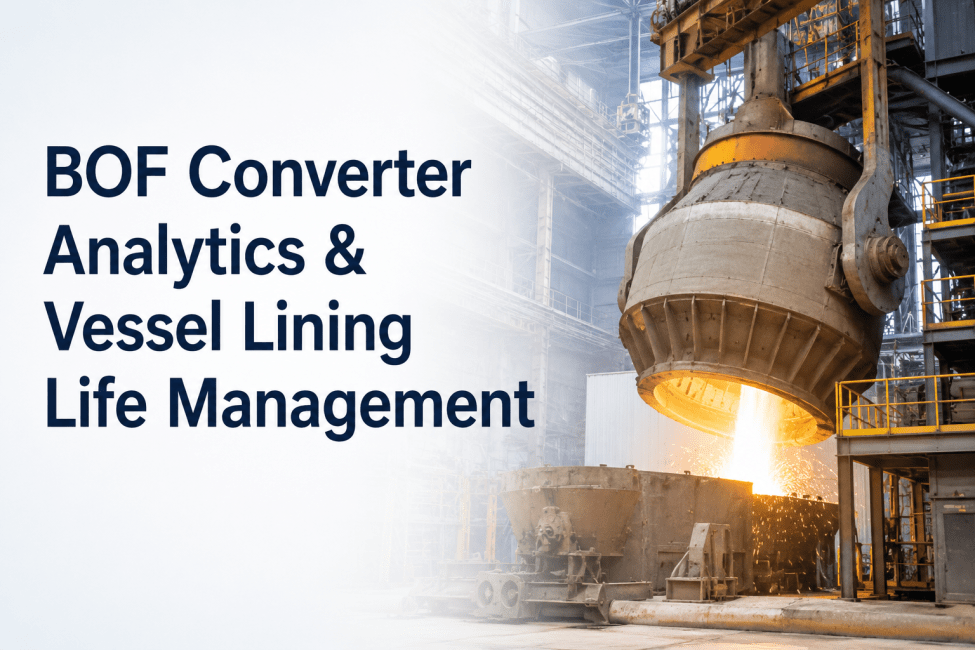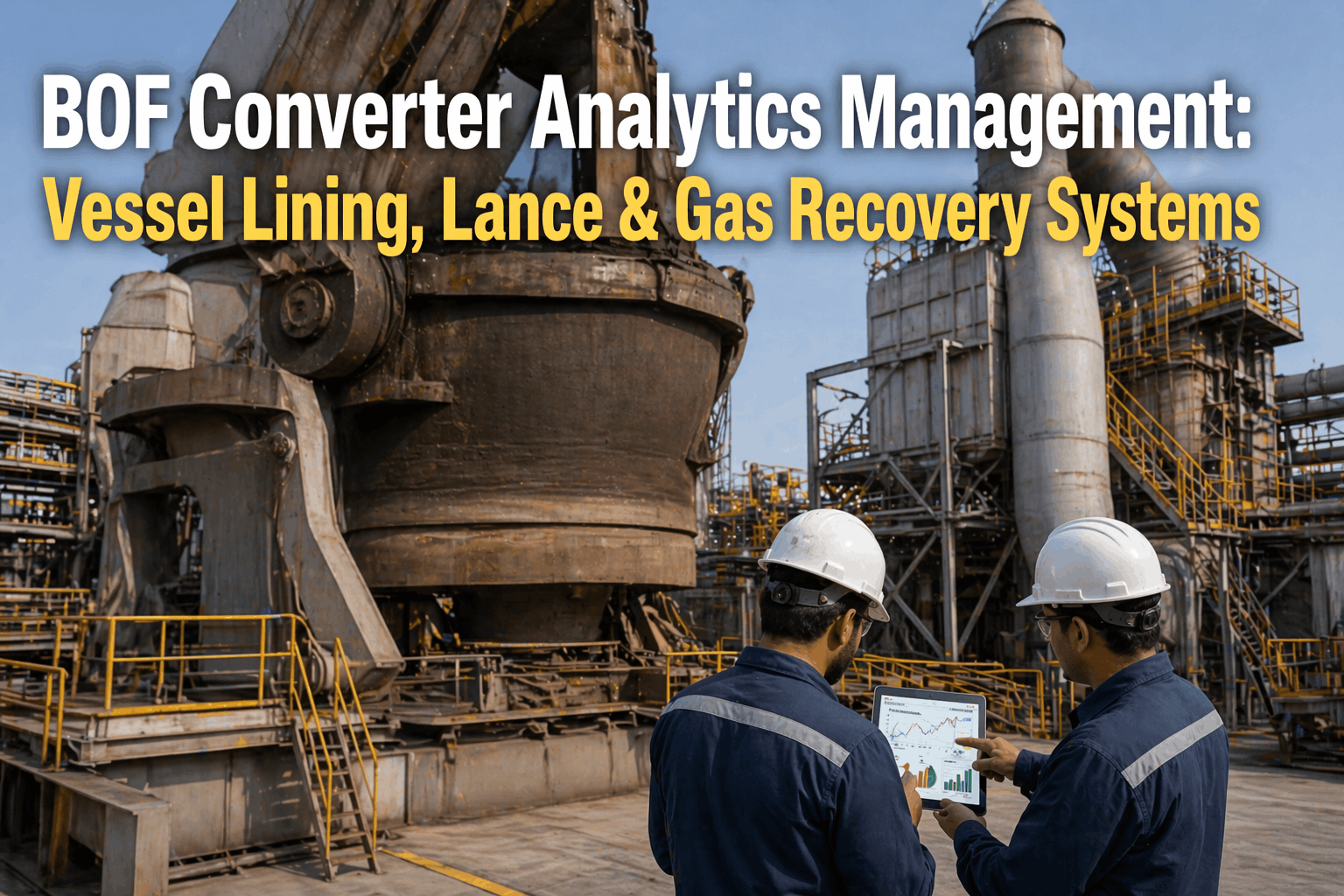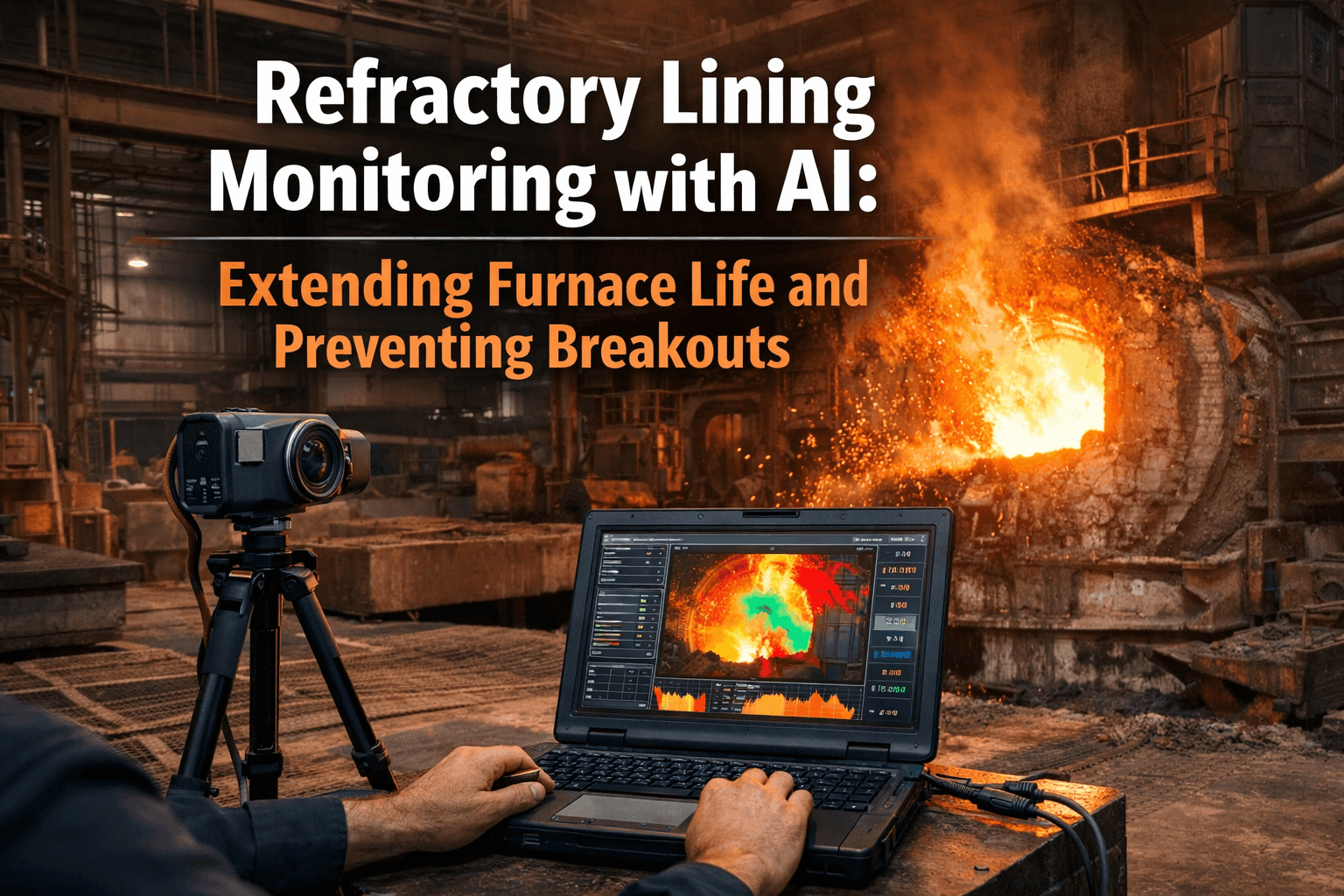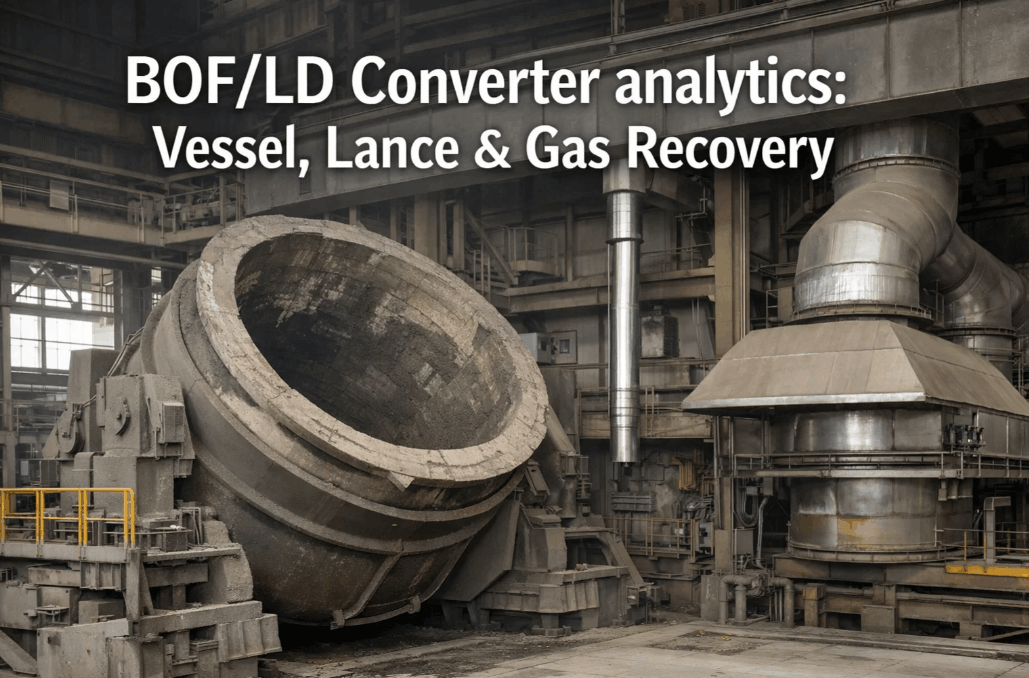
The Basic Oxygen Furnace (BOF) or LD converter dictates the operational throughput of an entire integrated steel plant. Converting primary liquid iron into prime steel requires violent oxygen injections, generating extreme exothermic reactions and volatile slag chemistry. For decades, plants have relied on delayed batch metallurgical samples, risking catastrophic slopping, accelerated BOF refractory wear, and unpredictable tapping temperatures. Today, LD converter AI-driven insights change this narrative entirely. By integrating high-frequency off-gas analyzers, vibration sensors, and heat flux models, our integrated platform delivers pinpoint BOF analytics. Protect your primary steelmaking vessel by monitoring BOF gas recovery hood integrity, executing real-time oxygen lance tracking, and rigorously forecasting your entire BOF lining campaign life. Schedule an infrastructure review to see how live converter analytics deliver superior end-point hit rates and maximize asset longevity.
Absolute Control Over Your Primary Steelmaking Vessel.
Leverage deep converter analytics to extend your BOF lining campaign, predict dangerous slopping events, and precisely track dynamic carbon drop via continuous off-gas analysis.
Why Predictability Matters in Basic Oxygen Furnace Operations
The core challenge of basic oxygen steelmaking is operating completely blind during the blow. You cannot see the liquid bath behavior beneath thick foamy slag. When lance positioning or inert gas bottom-stirring falls out of equilibrium, the kinetic mass violently slops over the vessel mouth—costing millions annually in damaged equipment, lost yield, and cleanup downtime. Inefficient operation not only destroys BOF refractory blocks prematurely but also ruins the exact thermal hit rate, mandating costly re-blows that degrade the steelmaking vessel capacity.
Implementing advanced BOF vessel analytics removes the guesswork. By digitally coupling the oxygen control valves, lance hoists, and continuous carbon-monoxide exhaust metrics, the LD converter AI-driven platform creates a perfect digital twin of the heat. Operating with this level of intelligence significantly elevates direct tap-to-tap efficiency and aggressively protects your hardware.
Four Core Pillars of BOF Vessel Analytics
Managing a 300-ton converter is an interdisciplinary engineering task. Our platform consolidates the disparate mechanical, fluid, and chemical monitoring systems into single robust analytical streams to guide operators in real time.
BOF Refractory & Lining Campaign Tracking
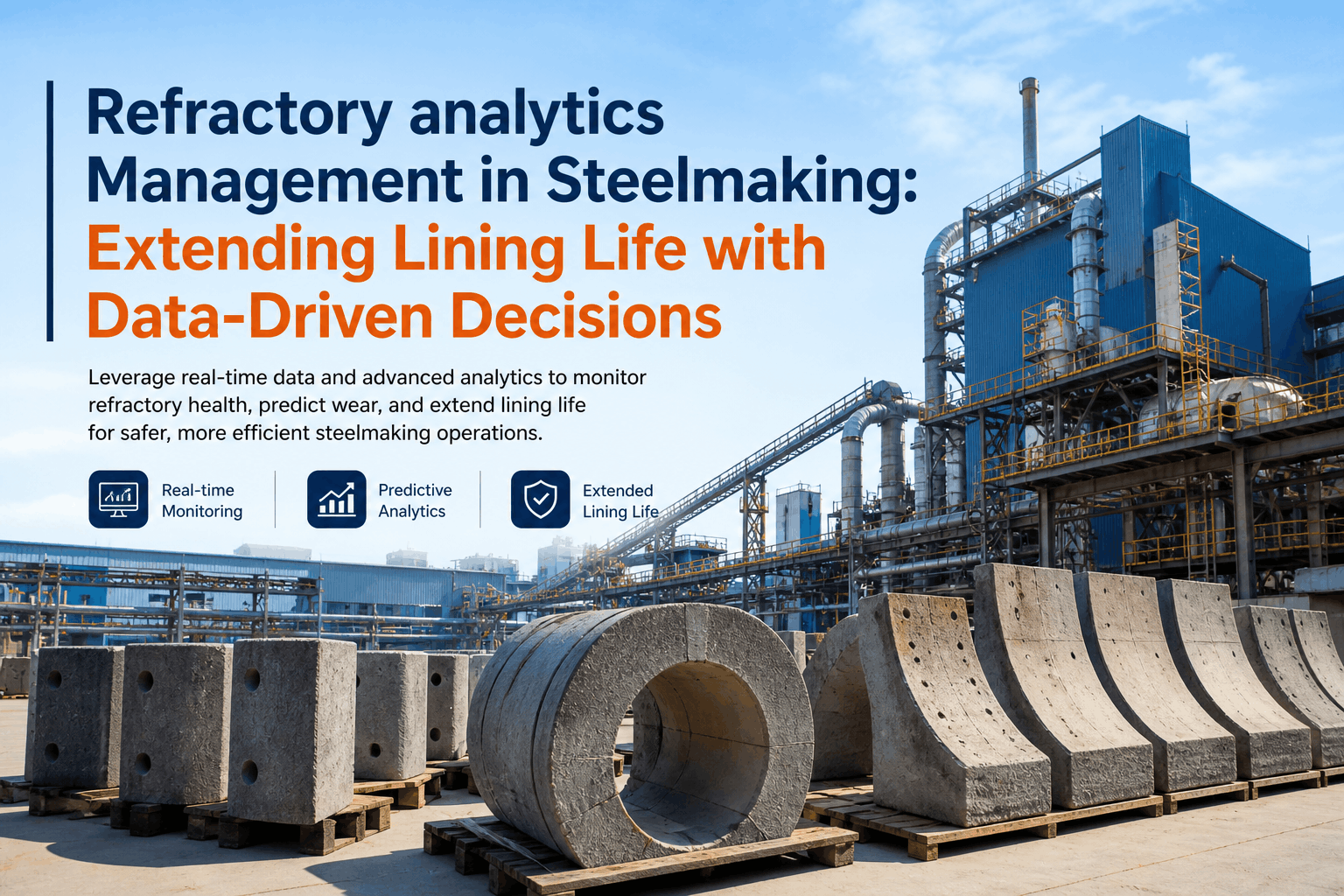
Loss of the inner working lining dictates absolute vessel availability. rather than solely relying on laser scans at the end of the campaign, AI models correlate total oxygen blown, tap temperature extremes, and aggressive slag chemistry (basicity) to algorithmically predict localized BOF refractory erosion block by block.
Oxygen Lance Tracking & Wear Monitoring
The main oxygen lance operates inches above a 1,650°C bath. Sophisticated oxygen lance tracking utilizes vibration sensors on the hoist carriage and pressure differentials across the cooling water jacket to detect copper tip scaling, nozzle blockages, or internal water leaks before catastrophic lance failure. Assess your lance diagnostics.
BOF Gas Recovery & Hood Asset Condition
The intense off-gas funneling through the exhaust hood is a hazardous but valuable energy resource. BOF gas recovery algorithms monitor skirt gap sealing, ID fan vibrations, and boiler tube heat fluxes to ensure safely maximizing CO recovery while preventing corrosive acid condensation and structural warping in the water-cooled hood.
Dynamic End-Point & Slopping Prediction
Utilizing acoustic microphones aimed at the vessel mouth (sonic meters), the platform actively "listens" to the bath foaming process. Combining audiometry with exhaust gas kinetics, the AI warns operators exactly when to raise the lance or alter the blow pattern, effectively eliminating violent slopping entirely.
The Predictive LD Converter AI Pipeline Architecture
Upgrading to AI-driven converter analytics doesn't require tearing down your legacy PLC systems. Here is our six-week roadmap to deploy high-velocity sensory fusion directly over your existing network.
We integrate secure, read-only edge gateways into the control room to extract Level 2 automation data. Concurrently, missing sensory gaps—such as sonic meters for acoustic monitoring or vibration accelerometers for oxygen lance tracking—are permanently welded into position without interrupting production.
The LD converter AI-driven brain ingests historical heat log profiles. It maps thousands of individual campaigns to isolate perfectly structured blows from sloppy ones, automatically tuning the decarburization curves and calibrating BOF vessel analytics baselines unique to your specific facility's scrap and hot metal ratios.
Supervisory UI modules go live in the pulpit. Operators receive real-time, color-coded trajectory graphs of carbon drops. Simultaneously, maintenance teams receive predictive work tickets (like replacing a degraded lance module) straight into the CMMS prior to a fatal breakdown. Request integration specs to see exactly how data flows.
Deeper Engineering Metrics: What the AI Computes
Going beyond simple averages, our converter analytics decode brutal thermodynamics into precision telemetry. We empower process metallurgists to understand exact inter-phase reactions, cycle after cycle.
Acoustic Slag Profile Index
By applying Fast Fourier Transform (FFT) analysis to the audio emitted from the basic oxygen furnace mouth, we profile the exact emulsion stability of the slag layer. A muted, muffled sound profile confirms high oxygen efficiency and proper flux absorption, maintaining a critical barrier over the metal.
Dynamic Decarburization Rate (dC/dt)
Using the instantaneous volumes generated in the BOF gas recovery hood, our algorithms inversely calculate the exact rate at which carbon is leaving the molecular bath structure. Catching the carbon drop accurately stops the blow perfectly on target without needing a physical sublance drop.
Lance Tip Stagnation Heat Flux
A blocked or eroded oxygen lance alters the supersonic mach flow of gas. By calculating absolute heat flux across the lance's return water system, the AI detects asymmetric wear or minor internal leakage, preventing the explosion risk of catastrophic water-to-liquid-steel contact.
Financial Return Operations for Converter Analytics
An optimized steelmaking vessel commands the financial cadence of the entire plant. Eliminating variability at the converter directly increases final slab or billet quality while drastically cutting raw material waste down the stream.
Slopping Elimination Scenarios
Preventing just three major slopping events per month recovers hundreds of tons of liquid yield and avoids thousands of dollars spent manually clearing the vessel trunnion ring and underlying transfer cars.
Oxygen & Flux Optimization
Stopping the blow at the precise moment prevents chemical over-oxidation. This drastically reduces the consumption of pure injected oxygen, aluminum, and costly ferro-alloys needed to treat 'wild' heats at the ladle furnace.
Extended Lining Lifecycles
Prolonging the BOF lining campaign by an average of 400 heats offsets massive reline maintenance costs and extends the uninterrupted uptime capacity of the entire melt shop.
Gas Harvesting Revenue
Strict telemetry across the BOF gas recovery processes ensures a highly calorific gas collection stream, feeding a rich byproduct fuel back into the onsite power plant and heavily offsetting municipal grid reliance.
Strategic Guidelines for Basic Oxygen Furnace Integration
Merge Top and Bottom Assets: Genuine BOF analytics must fuse data from the primary top oxygen blow with the bottom-stirring argon/nitrogen valving. Synchronizing both flows prevents violent bath stratification.
Off-Gas Speed Matters: Leverage high-speed mass spectrometry. A 10-second delay in gas analysis creates massive errors during peak decarburization phases. Data must be ingested in sub-second intervals.
Digital Twin End-Point Targeting: Ensure your models predict both carbon and absolute temperature simultaneously. Prioritize algorithms trained on thermal radiation models, not just chemical mass balance calculations.
Frequently Asked Questions
How accurately can BOF analytics predict "hitting the target" without a sublance?
By compounding real-time off-gas chemistry, bath acoustics, and initial scrap mass geometries, advanced LD converter AI-driven engines often achieve over 85% first-turn hit rates, rendering mechanical sublance dependency obsolete.
What happens when the vibration sensors detect an anomaly on the oxygen lance?
The system triggers a Level-1 interlock or immediately issues a critical alert to the pulpit via the oxygen lance tracking dashboard, prompting the operator to retract the lance to safety—preventing thermal warpage or internal water jacket rupture.
Does BOF vessel analytics track issues in the cooling hood?
Yes. The BOF gas recovery hood operates in one of the most volatile environments imaginable. Analytics constantly trace boiler feed water flows and ID fan extraction pressures to predict acid dew point corrosion and structural panel leakages.
How long does it take for the AI to "learn" a plant's specific BOF dynamics?
Initial model stabilization occurs within 3 to 4 weeks of historical data ingestion. During this time, the algorithms learn the unique blow patterns and scrap matrix specific to your steelmaking vessel. Contact our integration team to discuss timelines.
Ready to Perfect Your BOF Operations?
Eradicate slopping, stabilize your BOF lining campaigns, and hit your exact end-point chemistries on every single heat.