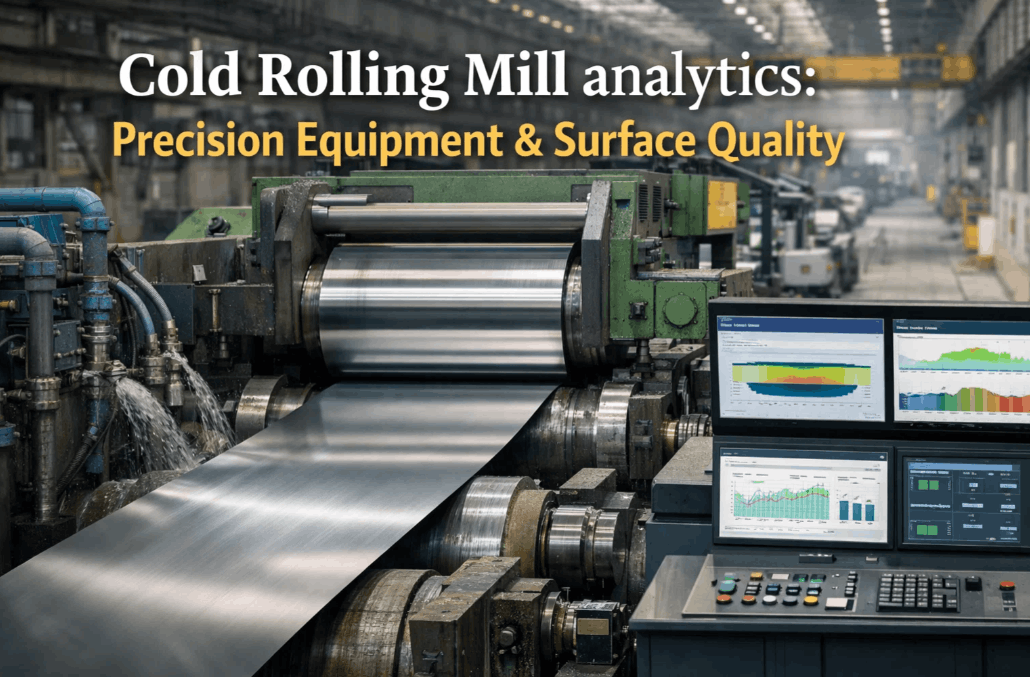
Cold rolling represents the absolute pinnacle of metallurgical precision. Transforming hot-rolled steel into high-value automotive exposed panels, tinplate, and aerospace alloys requires compressing the strip at room temperature to sub-millimeter gauge targets with flawless surface requirements. At these tolerances, a failing flatness actuator, degrading roll texture, or compromised emulsion system doesn't just bump margins—it destroys prime yield outright. Legacy cold rolling mill control relies heavily on reactive shape meters and post-processing visual audits. Implementing cold mill AI-driven analytics synchronizes tensiometers, high-frequency stand vibrations, and emulsion chemistry into a unified predictive network. By detecting microscopic roll chatter and fluid inconsistencies before they emboss permanently into the strip, producers drastically increase cold mill precision. Book a Precision Strategy Session to learn how modern tandem mill analytics completely eradicates strip breaks and chatter defects.
Target Zero Surface Defects & Strip Breaks
Leverage advanced cold rolling analytics to perfectly track skin pass mechanical properties, monitor flatness control actuators, and align tandem mill tension loops in real-time.
Why Cold Rolling Precision is Unforgiving
Unlike hot mills where scale and downstream processing offer some margin of error, errors in the cold rolling mill are permanent. Variations as slight as 0.005mm in strip crown, or a minor bacterial contamination in the cooling emulsion, generate massive client claim rejections from tier-1 automotive stampers. Cold mill precision requires absolute synchronization across all 5 or 6 tandem mill stands. If mill chatter occurs—caused by resonant stand vibration—the periodic transverse marks render the coil scrap. Integrating an overarching flatness control analytics dashboard ensures every shaping roll, bending block, and tensiometer communicates flawlessly, guaranteeing perfect metallurgical drawing properties across the entire coil run.
Cold Rolling Quality: The 6 Diagnostic Pillars
Total cold roll tracking expands beyond simple thickness gauging. By monitoring the complex interaction between mechanical shaping and chemical lubrication, the AI platform guarantees absolute surface perfection from the pay-off reel to the tension leveler.
Flatness Control Analytics
Integrates massive data from stressometer rolls directly with the work-roll bending and shifting hydraulic blocks. Prevents edge waves, center buckles, and quarter buckles by mapping dynamic thermal cambers.
Sub 5 I-Unit DeviationsTandem Mill Vibration Profiling
Cold mills are highly susceptible to third and fifth-octave regenerative chatter. Acoustic emission networks map pinion gears and backup roll chocks to instantly slow the mill down if fatal harmonics stack.
Eliminate Transverse BandingEmulsion System Analytics
Monitors emulsion concentration, dirt loading, temperature, and bacterial count via inline sensors. Ensures exact lubricity between the roll bite to prevent friction heat scratching while averting post-roll rust staining.
Perfect Bite FrictionSkin Pass Diagnostics
During temper rolling, maintaining exact drawing yield strength is critical. The AI analyzes extreme micro-elongation forces to prevent discontinuous yielding (Lüders bands) in final forming panels.
Flawless Temper ElongationDynamic Surface Texture Tracking
Automotive panels require specific roughness profiles (Ra/Pc) for paint adhesion, imparted via EDT or SBT rolls. Software calculates the exact abrasive degradation of the roll texture, extracting it right before compliance is lost.
Consistent Paint Adhesion LimitsInter-Stand Tension Networks
Tracks strip tensiometers between all tandem mill stands. AI identifies slight asymmetrical pulling that causes steering issues, guaranteeing precise mass-flow tracking that absolutely prevents catastrophic high-speed strip tearing.
100% Tracking StabilityThe AI-Driven Tension & Surface Workflow
Tracking cold rolling quality requires microsecond precision looping between laser thickness gauges and hydraulic servos. Book a workflow presentation to view how AI prevents gauge drifting across continuous shifts.
Hardness & Texture Ingestion
When textured work rolls leave the roll shop and enter the mill, the AI absorbs their exact roughness topography (Ra) profiles, syncing them natively with the incoming strip's carbon chemistry and hardness ratings.
Metallurgical Baseline AlignmentBite Friction & Emulsion Calibration
As rolling commences, edge analytics monitor mill loads against calculated friction models. If slipping or sticking is detected, the platform automatically dictates emulsion spray header pressure changes to cool the thermal roll crown.
Dynamic Flow CorrectionChatter matrix monitoring
A high-speed Fourier transform continuously scans for 120Hz – 600Hz frequency build-ups. If stand three begins to resonate with stand four via the strip tension, AI modulates hydraulic AGC blocks to break the destructive frequency loop.
Active Resonance SuppressionExtract & Regrind Triggers
The AI detects micro-drifts in thickness and roll eccentricity, calculating exactly when the roll's precision threshold breaches the limits. Work roll changes are dispatched predictively rather than waiting for a coil rejection from the QA lab.
Zero Quality HoldsCold Mill Analytical Sophistication: Upgrading to AI
Many cold mills suffer from black-box automation—relying natively on vendor PLCs without data transparency. Run an architecture audit to discover how easily machine learning overlays onto your existing tandem setups.
Post-Roll QA Testing
Operators run the mill relying entirely on legacy AGC blocks. Strip quality, roughness, and flatness are only verified at the rewinding station. Errors force entire massive coils to be downgraded or scrapped post-production.
Reactive HMI Alarms
The pulpit receives tensiometer warnings or thickness deviations, but human operators must manually override the speed and bending blocks. Reaction times are slow resulting in hundreds of meters of off-gauge tail and head ends.
Real-time Shape Modeling
Shape meters map the flatness profile (I-units) dynamically. Displays provide operators with clear topographic maps of center buckles, but vibration and roll texture limits are still tracked separately.
Fully Integrated Cold Mill AI
The ultimate unified state. Machine learning binds emulsion flow limits directly to torque algorithms and acoustic sensors. The mill runs fully optimized for micro-level defect prevention and autonomous speed management.
Telemetry Enablers for Cold Rolling Precision
True visibility at 1,500 meters per minute requires processing gigahertz data streams across immense mechanical hardware. See exactly how our gateways capture these rapid feeds by contacting our integration experts.
| Source Integration Layer | Application in Cold Rolling | Analytical Output |
|---|---|---|
| Inline Stressometer Rolls | Measuring localized tension across the strip width | Identifies waves and triggers bending actuators |
| Piezoelectric Vibration Matrices | Affixed directly onto mill housings and reduction gears | Captures high-frequency destructive acoustic chatter |
| Laser Doppler Velocimeters | Precision speed measuring before and after the roll bite | Extrapolates exact mass-flow and forward slip ratios |
| Automated Emulsion Analyzers | Continuous sampling of the tank recirculating fluid | Monitors saponification and magnetic dirt trapping |
Preventing Strip Breaks at Maximum Velocity
A strip tear in a tandem cold mill is a catastrophic event. It wraps razor-sharp steel tightly around backup rolls, obliterates expensive instrumentation, and requires days of highly dangerous manual torch extraction by maintenance teams.
Mass Flow Synchronization
As thickness decreases across stands, the exit speed must increase flawlessly. AI oversees Level 1 mass flow tracking, preventing any speed dropping that creates sudden slack loops or catastrophic tension spikes.
Unbreakable Tension AlgorithmsWeld Tracking Optimization
The weakest point of continuous rolling operations is the laser weld joining two separate coils. Tandem mill analytics maps the weld location flawlessly, momentarily reducing tension and hydraulic pressure precisely as the seam passes.
Zero Weld BreakagesEmergency Deceleration Models
If edge-cracking is detected approaching the final stand, the analytics platform executes an organized emergency coast-down. This stops the mill safely before the flaw shears the entire operating width.
Automated Safe Coasting12-Month Cold Mill Savings Projection Matrix
Cold rolling drives immense profit margins, meaning avoided rejects translate immediately into massive revenue recovery. Observe the direct efficiency progression on a typical continuous pickling and tandem rolling line over one year. Calculate specific yield savings here.
Specialized Equipment Domains
Unlike hot operations, cold rolling analytics focuses intensely on chemical composition, microscopic texture integrity, and shape topography mapping.
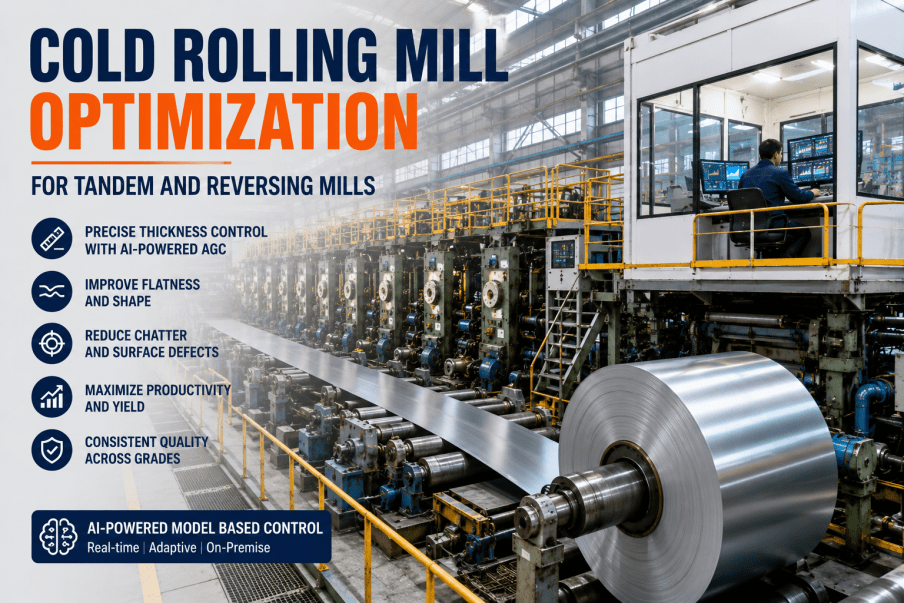
Continuous Tandem Mill (Stands 1-5)
Fuses massive drafting torques, forward-slip ratios, absolute bearing acoustics, and dynamic stand tension loops preventing mass-flow drifting and disastrous strip shearing.
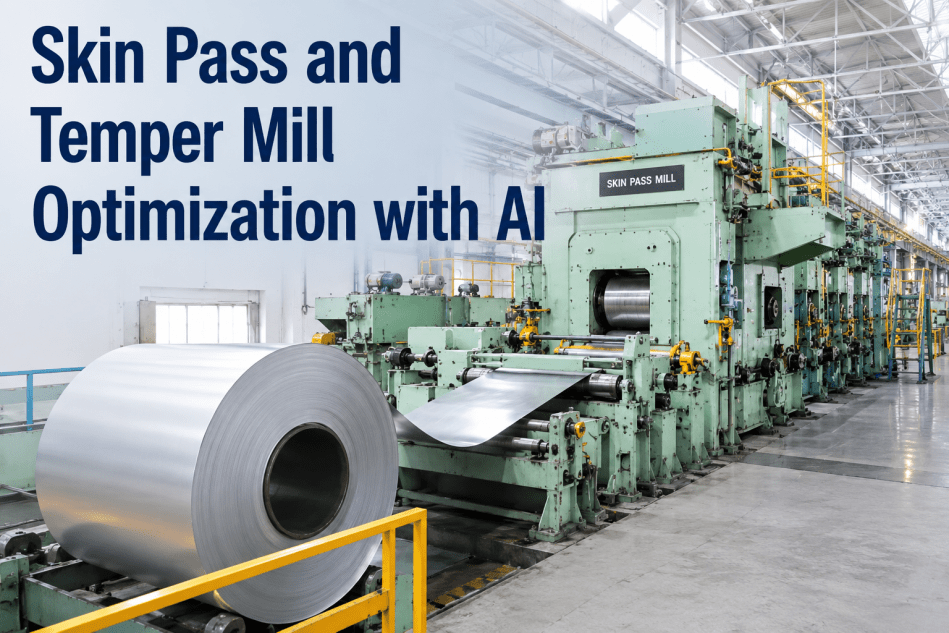
Skin Pass / Temper Mill
Achieving precise elongation (usually 0.5% - 2%) without modifying strip shape. Maps precise roughness transfer (Ra) perfectly from the roll surface onto the final steel sheet.
Emulsion & Lubrication Plant
Monitors coolant temperature gradients, saponification consistency, oil-in-water concentration, and filter health to guarantee pure, scratch-free roll-bite protection at extreme pressure limits.
Shape Measuring & Laser Speed Zones
Constantly analyzing differential stress mappings generated by the shaping rollers, directly feeding immediate bending/shifting corrections back into the mill hydraulic control layers.
Yield Gains from Flawless Precision
Every coil that successfully meets automotive exposed-body limits commands enormous margin premiums. Converting previously downgraded secondary-materials directly into prime inventory yields huge financial uplifts.
Textured Roll Conservation
Leaving highly expensive EDT or Chrome-plated work rolls in operation exactly until their absolute tolerance threshold is breached drastically drops overall grinding and plating outlays.
Strip Break Elimination
Automated tension monitoring saves mills from catastrophic 10-hour standstill cleanages. Eliminating roll wraps instantly drives equipment availability tracking towards peak potential ceilings.
Tier-1 Claims Negation
Sending perfect flat coils devoid of internal chatter marking or invisible Lüders limit defects entirely negates the cost liabilities and freight returns generated by OEM automotive rejections.
Peak Execution Tonnage
Operators natively run mills conservatively out of fear of breaking strips. Using AI shape modeling permits lines to accelerate confidently towards nameplate maximum velocity without risking instability.
What Mill Quality Managers Are Saying
"Before adopting cold mill AI-driven frameworks, handling fifth-octave chatter was a total guessing game. We would just scrap the rolls and hope the banding disappeared. Once we integrated acoustic arrays with the emulsion data directly into our dashboards, the platform instantly traced our chatter spikes back to an inconsistent saponification level killing roll-bite lubrication on F4. It solved a $400k scrap problem overnight."
Frequently Asked Questions: Cold Rolling Tracking
Will these analytics interface natively with our legacy Level 1 shape meters?
Yes. Our edge modules process the raw analog signals generating off mature stressometers directly, allowing our cloud or localized AI grids to build hyper-accurate topological map inferences without requiring multi-million dollar sensor hardware replacements.
How quickly does the platform stop a mill if tearing is imminent?
Our high-frequency edge logic can detect steering imbalances or massive tension slack events in literal milliseconds. Intercept protocols issue emergency PLC slow-down commands instantly, far preceding human operator reaction speeds.
How does emulsion analytics prevent rust staining claims?
Cold rolling analytics tracks exact chemical cooling matrices, particularly bacterial loading that breaks down oil concentrations. Ensuring pure oil-to-water ratios inherently protects the naked steel strips from premature oxidization post-coiling.
Can AI monitor temper rolling yields independently?
Absolutely. The platform maps distinct skin pass analytics, measuring precise mass-throughput elongation matrices against hydraulic cylinder load cells to assure ultimate surface finish conformity and structural stamping limits. Book a temper mill review.
Rule Every Micrometer of Flatness
Eradicate strip breaks, destroy hidden destructive chatter marking, and assure unmatched flatness actuator responses by mobilizing massive data across your entire tandem mill configuration.