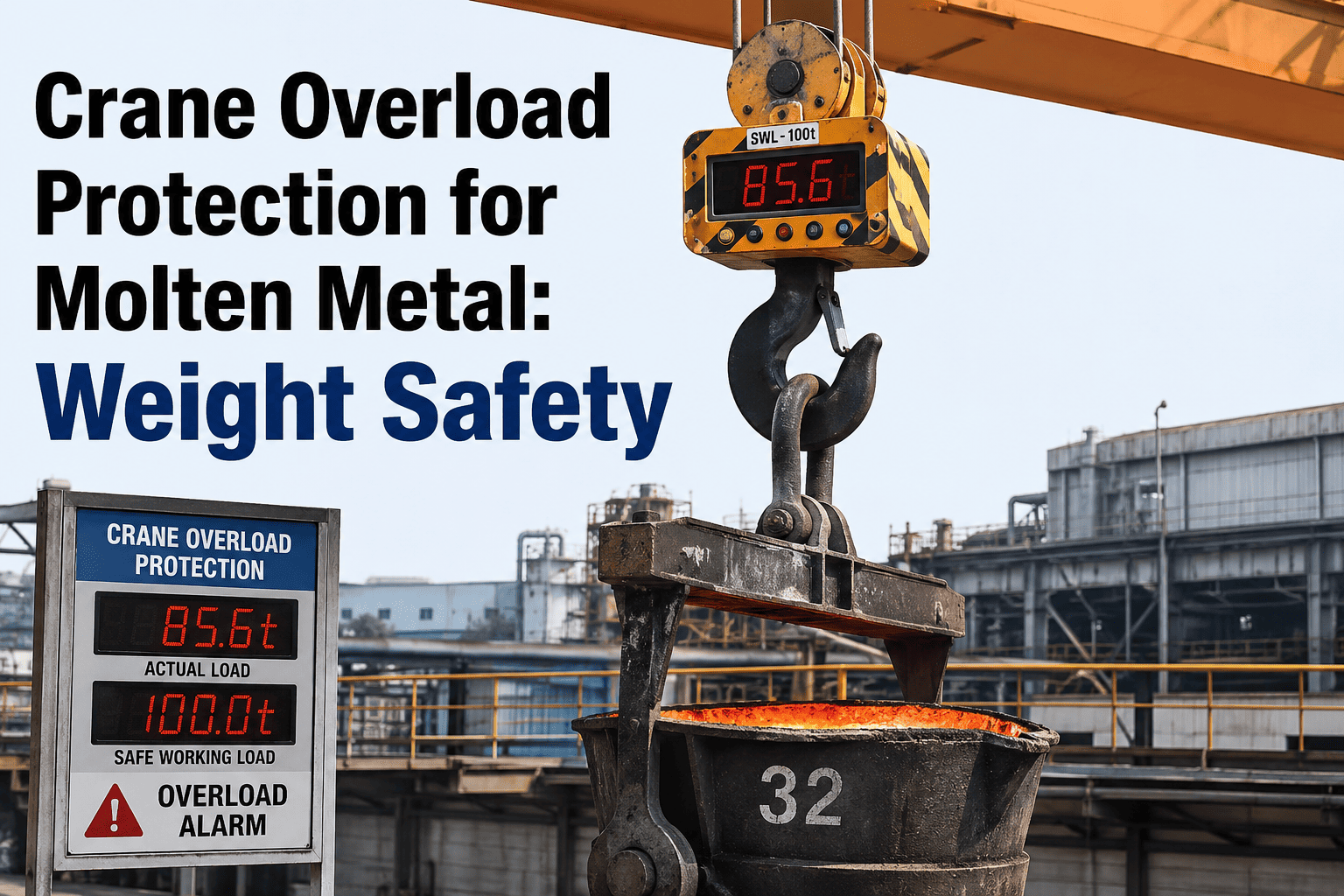
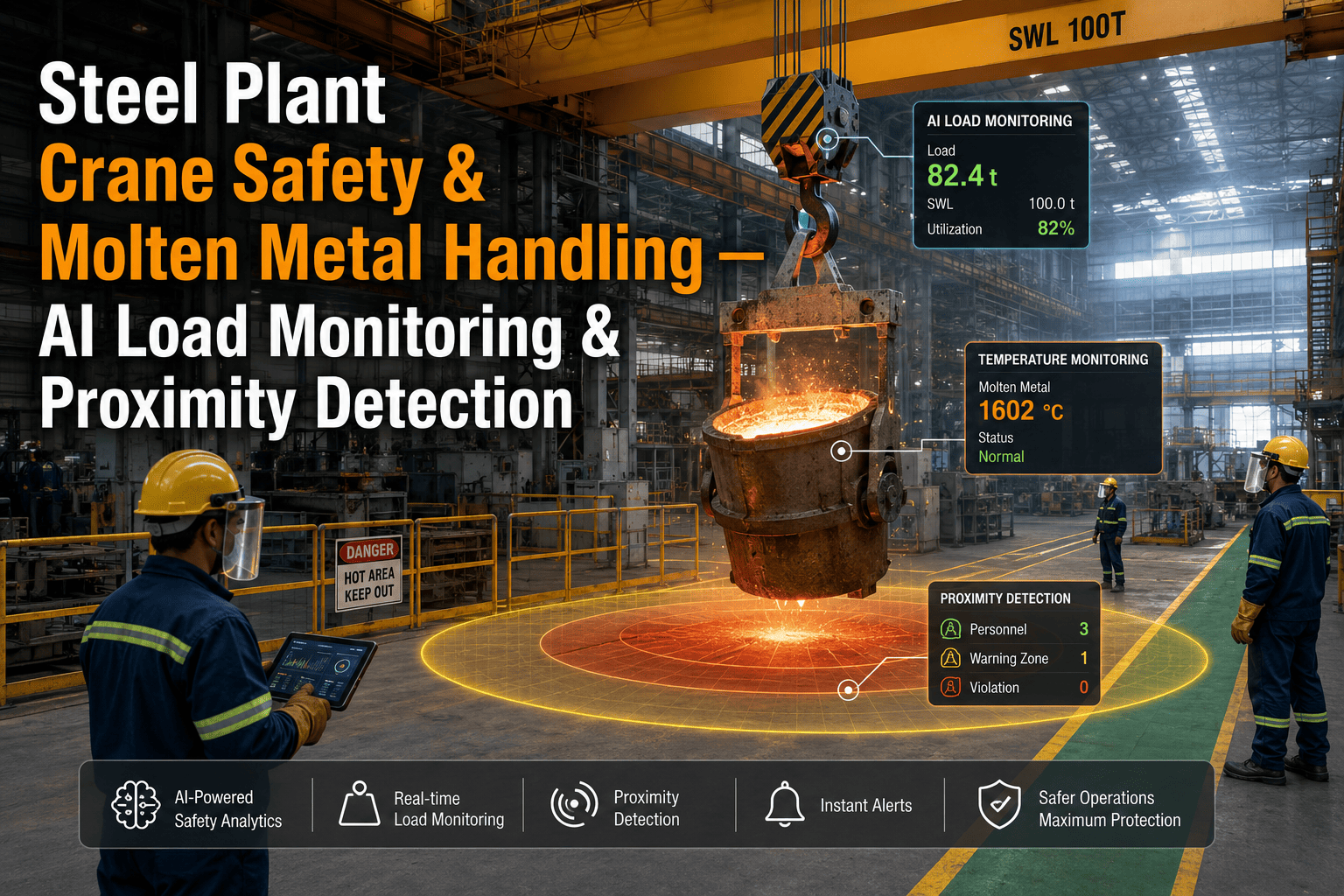
A crane rated to carry a full ladle of molten metal is not dangerous because it might lift too much weight, it is dangerous because the margin between a normal lift and an overload lift is often smaller than operators assume once refractory buildup, slag carryover, and sensor drift are accounted for. Overload protection exists specifically to catch that margin before it becomes a dropped load over liquid metal. Getting the weighing and interlock system right is less about adding another safety device and more about making sure the number the crane trusts is actually correct. See how AI keeps that number honest at ifactory support.
Crane Safety for Molten Metal
The Overload You Prevent Is the One Your Weighing System Never Sees Coming
AI-monitored crane weighing continuously cross-checks load cell readings, calibration drift, and lift behavior for cranes handling molten metal, so an overload condition is caught before the hoist reaches its limit, not after.
±1%
Typical load cell accuracy required for molten metal cranes
110%
Common overload interlock trip threshold above rated capacity
Silent
How calibration drift usually develops before it is caught
Why Overload Protection for Molten Metal Cranes Is Not Just a Bigger Safety Margin
Every overhead crane handling ladles or torpedo cars already carries a rated capacity with a built-in safety factor, and it would be reasonable to assume that factor alone protects against overload. It does, against a known and accurately measured load. What it does not protect against is a load that reads incorrectly in the first place, and in molten metal service that happens more often than most maintenance teams expect, through refractory buildup adding unaccounted weight to a ladle, slag carryover changing the effective load partway through a lift, or a load cell that has drifted out of calibration and is quietly under-reporting weight on every single lift.
An overload protection system built only around a fixed trip threshold catches the obvious case, a load that is genuinely too heavy. It does not catch the more common and more dangerous case, a load cell reporting a false low weight while the crane operator, trusting the display, proceeds with a lift that is actually already near or past capacity. That distinction is the entire reason overload protection needs to include calibration verification and drift detection, not just a threshold alarm.
Three Ways an Overload Condition Actually Develops
01
Genuine Excess Weight
The ladle or attached load is actually heavier than rated capacity, often due to refractory buildup accumulated over multiple campaigns, unaccounted skull metal, or a miscommunicated fill level.
02
Load Cell Calibration Drift
Sensor accuracy degrades gradually from thermal cycling and mechanical fatigue, causing the displayed weight to under-report the true load without any obvious fault indication.
03
Dynamic Load Spikes
Sudden acceleration, load swing, or a snag during hoisting creates a transient force well above the static rated weight, even when the nominal load is within limits.
What a Reliable Overload Interlock Actually Requires
A functioning overload protection system is really three separate capabilities working together, and a gap in any one of them can leave a crane exposed even while the other two are working correctly.
Accurate Sensing
Load cells calibrated to a known reference and verified on a schedule tight enough to catch drift before it accumulates into a meaningful reading error.
Real-Time Cross-Checking
Continuous comparison of load cell output against expected values from lift history and hoist motor load, flagging a mismatch as a potential sensor fault rather than trusting the display blindly.
Fail-Safe Interlock Logic
A trip response that defaults to stopping or preventing further hoisting whenever sensor confidence drops, rather than continuing to operate on an unverified reading.
Operator-Visible Confidence
A clear indication to the operator not just of load weight, but of how confident the system currently is in that number, so a degraded sensor state is visible before it becomes a trip.
Calibration Methods Compared
How Load Cell Accuracy Gets Verified
Check Your Own Crane Fleet
Find Out Which Cranes Have Drifting Load Cells Right Now
Bring your current calibration records and lift logs to the call. We will walk through how continuous drift detection would apply to your molten metal crane fleet.
How Overload Risk Actually Trends Over a Crane's Duty Cycle
Load Cell Accuracy Confidence
Continuously verified against lift history rather than trusted between scheduled checks
Refractory Buildup Accounted For
Ladle self-weight tracked over campaign life instead of assumed constant
Dynamic Spike Events Flagged
Transient overload conditions caught during acceleration and swing, not just at steady hoist
Why Ladle Self-Weight Is a Moving Target
One of the least discussed contributors to overload risk is that a ladle's own weight is not fixed. Refractory lining thickens with skull metal buildup over a campaign, slag rings accumulate at the pour lip, and none of this is typically re-weighed or re-entered into the crane's rated capacity calculation. A crane operator working from a tare weight recorded when the ladle was new is, by the later part of a campaign, working from a number that understates the ladle's actual empty weight, which means every subsequent load calculation carries that same understatement forward.
Correcting for this does not require weighing every ladle before every lift. It requires tracking empty-hook and known-reference lifts over time to detect when a ladle's effective tare weight has drifted meaningfully from its recorded value, and flagging that ladle for a physical re-weigh before its accumulated error becomes large enough to matter during a near-capacity lift.
Four Mistakes That Undermine Overload Protection
Trusting a Single Load Cell Reading
Relying on one sensor with no cross-check means a drifted or failed cell has nothing to contradict its reading before a lift proceeds.
Calibrating on a Fixed Calendar Only
Quarterly or annual calibration checks leave long windows where drift can accumulate unnoticed between scheduled verifications.
Never Updating Ladle Tare Weight
Using the original empty weight for the life of a ladle ignores refractory and skull buildup that grows heavier every campaign.
Ignoring Dynamic Load Behavior
Focusing only on static rated capacity misses transient spikes during acceleration, swing, or a snagged load that can exceed rated limits momentarily.
Frequently Asked Questions
How quickly can a load cell drift enough to matter for overload protection?
Drift is typically gradual, developing over months of thermal cycling and mechanical fatigue rather than appearing suddenly, which is exactly why it is easy to miss between scheduled calibration checks. A sensor reading a few percent low might seem negligible on a light lift but becomes meaningful on a near-capacity molten metal load, which is where the real risk concentrates.
Talk to our team about setting up continuous drift monitoring for your crane fleet.
Does refractory buildup on a ladle really change overload risk that much?
Over a full campaign, accumulated skull metal and refractory wear products can add a meaningful amount of unaccounted weight to a ladle's empty tare, and if that tare is never updated in the crane's calculation, every subsequent load reading is understated by roughly the same margin. On a ladle already loaded near rated capacity, that margin is exactly the buffer overload protection depends on.
What is the difference between a static overload and a dynamic overload event?
A static overload means the actual weight at rest exceeds rated capacity, while a dynamic overload is a transient force spike during acceleration, deceleration, or load swing that can exceed rated limits momentarily even when the resting weight is within range. Protection systems built only around static thresholds can miss dynamic events entirely, which is why lift behavior needs to be monitored continuously, not just checked at the start of a hoist.
Book a scoping call to see how dynamic monitoring applies to your cranes.
Can redundant load cells fully replace a calibration program?
Redundant sensors are useful for catching a mismatch between two readings, but they cannot on their own confirm which of the two, if either, is accurate, so a calibration reference is still needed to resolve which sensor to trust. The strongest setups combine redundancy for immediate mismatch detection with periodic and continuous calibration verification to confirm accuracy against a known standard.
What should happen automatically when the system loses confidence in a load reading?
A properly designed interlock should default to a conservative response, such as preventing further hoisting or restricting speed, whenever sensor confidence drops below a defined threshold, rather than continuing to operate normally on an unverified number. This fail-safe behavior is what actually protects the crew even when a sensor fault has not yet been formally diagnosed.
Reach out to our team to review your current interlock logic.
Stop Trusting Load Numbers You Can't Verify.
Get Continuous Overload Protection Across Your Crane Fleet
Bring your current load cell and calibration records to the call. We will walk through how continuous cross-checking would apply to your molten metal handling cranes.