Water Contact Prevention with Molten Metal: Explosion Risk
By James Smith on August 5, 2026
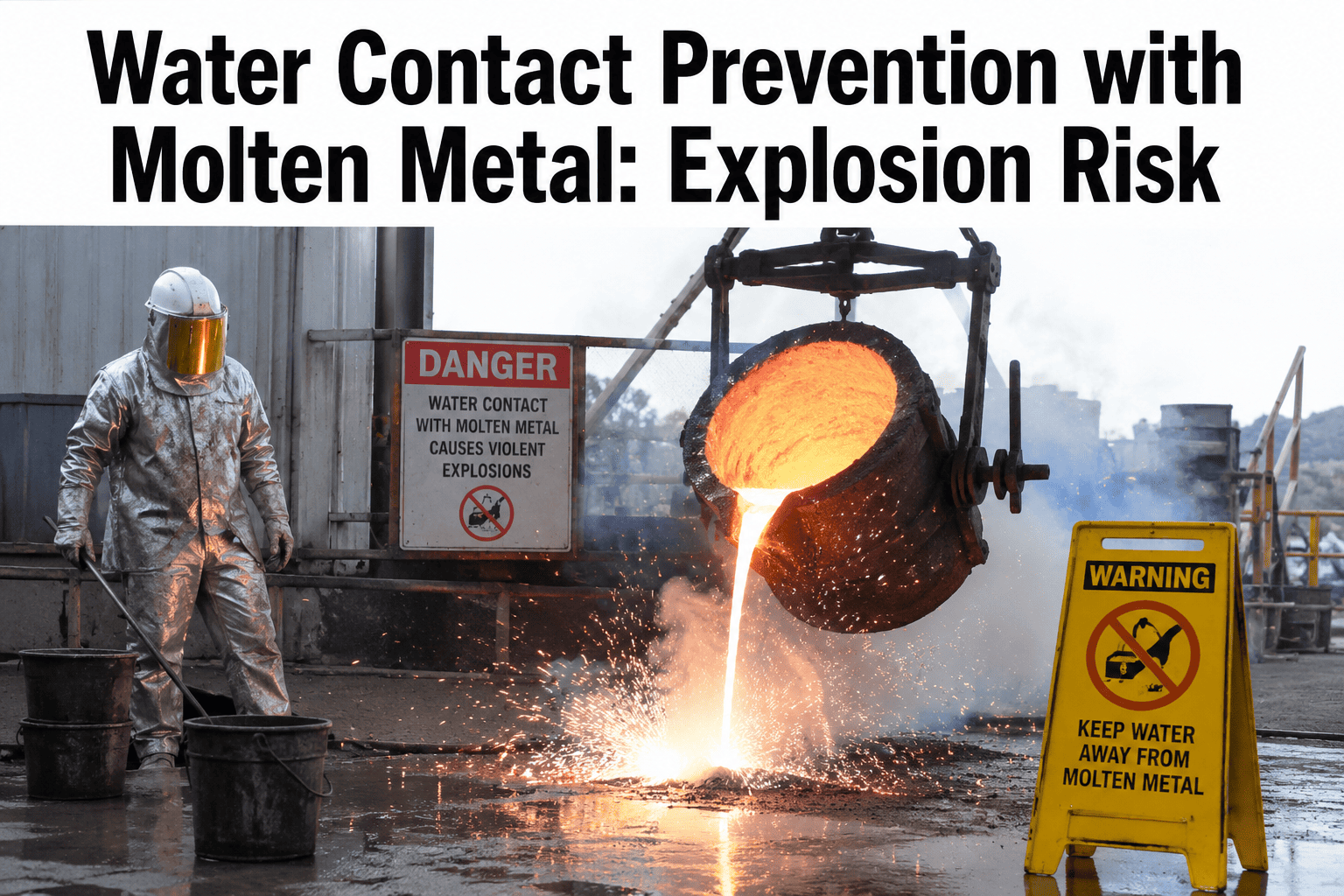
A single liter of water, on contact with molten metal, becomes roughly 1,600 to 1,700 liters of steam essentially instantaneously — a phase-change expansion violent enough to launch molten metal and equipment fragments across an entire work area. It doesn't take a spill. Independent industry sources are consistent on this point: a few drops falling into a ladle, condensation from an overhead pipe, or a damp patch of scrap can trigger a life-threatening event with no warning. This isn't a hazard that scales with the amount of water involved in any intuitive way — trace moisture and a flood produce the same category of catastrophic outcome once molten metal is in contact with it. The controlling variable is confinement, not quantity, which is precisely why a prevention program built only around obvious large-scale water sources will still miss the exposure points that actually cause incidents. See how iFactory helps plants track moisture inspection routes and drying procedure compliance as part of a documented prevention program.
⚠This article covers engineering and procedural controls for a hazard capable of causing fatal injury. It is not a substitute for site-specific safety engineering review, formal risk assessment, or your facility's documented safety program.
Water Contact Prevention with Molten Metal: Explosion Risk
Moisture detection, equipment drying procedures, and engineering controls for the single most catastrophic hazard in molten metal handling — where trace amounts of water are as dangerous as large volumes.
Why This Is Categorically Different From Other Hazards
The Physics Behind a 1,600x Volume Expansion
When water contacts molten metal, it doesn't boil in the ordinary sense — it flashes to steam essentially instantaneously, expanding to roughly 1,600 times its original liquid volume. If that expansion happens in an open, unconfined space, the result is dangerous. If the water is confined — trapped inside a sealed container, under a layer of molten metal, or inside a closed section of tubing — the expansion has nowhere to go, and the result is a violent, explosive release that propels molten metal, solids, and fragments outward with no warning.
This is why the hazard doesn't scale the way intuition suggests. A large water spill is dangerous, but a few drops of condensation falling into a ladle, or a damp patch inside a sealed scrap container, can trigger the same category of catastrophic event. The relevant variable isn't the volume of water — it's whether water is present at all in a location where it can become confined against molten metal. This distinction has direct implications for how a prevention program should be structured: a program that only screens for large, visible water sources while treating small or hidden moisture as a lower priority is misjudging the actual risk profile of the hazard.
Where Moisture Actually Gets In
The Exposure Points a Prevention Program Has to Cover
A comprehensive moisture control program needs to inspect for all of the categories below, not concentrate effort only on the most visible source. Scrap moisture tends to get the most attention because it's the most intuitive risk — the categories that get missed are frequently the ones that don't originate from the material handling process itself.
Wet or Damp Scrap Charge
Scrap stored outdoors or exposed to rain, condensation, or washdown water carries residual moisture that isn't always visible on inspection — squeezable or saturated bales are a specific red flag.
Sealed or Hollow Containers
Closed-end tubing, sealed drums, and hollow-profile scrap can trap water or condensation inside where it cannot be seen or drained before charging — these require rejection or deliberate pre-drilling, not just a visual check.
Wet or Contaminated Ladles and Tools
Any tool, ladle, or mold that contacts molten metal must be fully dry and, ideally, preheated — residual cleaning water, condensation, or moisture from storage in a damp area is a direct explosion trigger.
Overhead Condensation and Leaks
Cooling line leaks, condensation from overhead pipes, and roof leaks above a melting or pouring area are a source of moisture entirely outside the material-handling process, and are frequently overlooked because they don't originate from the charge itself.
Wet Ground, Floors, or Slag Pits
Pouring or dumping molten metal or slag onto wet ground, ice, standing water, or a damp pit floor causes the same violent steam reaction — pit and floor conditions require pre-pour inspection, not an assumption of dryness.
Personal Moisture and PPE
Sweat inside gloves or protective gear, or PPE that has become damp from prior use or improper storage, is a smaller-scale but real source of moisture directly at the point of contact with molten metal during pouring or tool handling.
Both scenarios in this diagram involve water contacting molten metal, and both are genuinely hazardous — an unconfined reaction is still capable of causing severe burns and should never be treated as a minor event. The distinction is one of degree, not of safety versus danger. What the confinement diagram illustrates is why sealed containers, closed tubing, and any location where steam expansion has no path to release deserve categorically stricter controls than open-area moisture, which is already dangerous enough to require immediate correction on its own.
Trace Moisture Is Not a Minor Finding
A Damp Bale or a Leaking Overhead Line Is a Stop-Work Condition, Not a Note for Later
iFactory helps plants document moisture inspection routes, drying procedures, and equipment dryness verification as an auditable part of your molten metal safety program.
Applying the Hierarchy of Controls to Moisture Elimination
Standard safety engineering practice prioritizes elimination and engineering controls over procedural and administrative measures, and PPE as a last line of defense — this hazard is a clear case for applying that hierarchy rigorously rather than relying primarily on training and vigilance.
1 — Elimination
Remove Moisture From the Process Before It Can Reach Molten Metal
Covered, dry scrap storage; rejection of sealed or hollow scrap that cannot be verified dry; scheduled inspection and repair of cooling lines and overhead piping in melting and pouring areas. This is the only category of control that removes the hazard rather than managing exposure to it.
2 — Engineering Controls
Design the Process So Moisture Cannot Reach the Point of Contact
Remote charging systems that let operators charge material from behind protective screens; automated charge dryers and preheaters that remove water before scrap enters the bath; equipment and vessel design that minimizes the chance of trapped moisture reaching a molten metal interface.
3 — Administrative Controls
Documented Procedures, Inspection Routes, and Verification Checkpoints
Mandatory dryness verification before any tool, ladle, or mold contacts molten metal; scheduled moisture inspection of scrap storage, pit floors, and overhead areas; a documented stop-work authority for any suspected moisture condition, exercised without requiring supervisor sign-off first.
4 — PPE
The Last Line of Defense, Not the Primary Control
Appropriate molten metal splash protection reduces injury severity if an event occurs, but PPE does nothing to prevent the explosion itself — a prevention program that leans primarily on PPE compliance while under-investing in elimination and engineering controls has its priorities inverted.
Detection & Drying Discipline
What a Documented Moisture Control Program Actually Verifies
Scrap is inspected and certified dry before charging — many plants use a minimum covered storage period specifically to allow surface moisture to evaporate before material handling beginsVerification: Pre-charge dryness inspection log
Sealed containers, closed-end tubing, and hollow-profile scrap are rejected outright or deliberately pre-drilled to eliminate trapped-water risk before they can reach the chargeVerification: Sealed-scrap rejection procedure
Every ladle, tool, and mold is confirmed dry — and preheated where the procedure calls for it — immediately before contact with molten metal, as a standing step in the pour sequence rather than an occasional spot checkVerification: Pre-pour dryness confirmation step
Cooling lines, overhead piping, and roof areas above melting and pouring zones are on a scheduled leak-inspection interval, not inspected only after a leak is reportedVerification: Scheduled leak inspection route
Slag pits, pouring floors, and casting areas are visually inspected for standing water, ice, or dampness immediately before each pour, not assumed dry based on the prior pour's conditionVerification: Pre-pour floor and pit inspection
Any worker who identifies a suspected moisture condition has clear, trained authority to halt the operation immediately — without needing supervisor approval first — and that stop-work action is documented rather than handled informallyVerification: Documented stop-work event log
If an Incident Is Suspected or Occurring
What Prevention Cannot Cover Belongs in Your Emergency Response Plan
Prevention is the primary defense against this hazard, but every molten metal operation needs a documented emergency response procedure specific to a water-contact event, developed and reviewed with qualified safety personnel — the points below are general awareness, not a substitute for that site-specific plan.
Never Use Water-Based Suppression
Standard water-based fire extinguishers must never be used on a molten metal fire or spill — doing so directly causes the exact steam explosion this hazard is defined by. Facilities require Class D extinguishers rated for combustible metal fires, clearly identified and accessible in every area where molten metal is handled.
Evacuation Routes Account for Explosive Spray Radius
A steam explosion can propel molten metal well beyond the immediate work area — emergency evacuation planning for molten metal zones should account for a spray radius substantially larger than the footprint of normal operations, not just the area immediately around the furnace or ladle.
Suspected Moisture Halts Work, Full Stop
If moisture is suspected but not yet confirmed eliminated, the correct response is to stop the operation and resolve the uncertainty — not to proceed cautiously while monitoring. This hazard does not offer a safe middle ground between "confirmed dry" and "stop."
Field Perspective
“
The mistake I see most often isn't a missing procedure — it's a procedure that only covers the obvious sources. Everyone remembers to check if the scrap looks wet. Fewer people are checking the sealed hydraulic line fitting six feet above the pouring floor, or the drum that was rinsed out and set aside three shifts ago and never actually dried. This hazard doesn't care about intent or how careful someone thought they were being. It only cares whether water was present. A mature program treats every single potential moisture source as a stop-work condition until it's specifically verified dry, not the other way around — and that mindset shift, more than any single procedure, is what separates a program that's actually protective from one that just looks thorough on paper.
Grzegorz Nowicki-Adeyemi
Melt Shop Safety Engineer · 19 years in foundry and steel plant safety engineering, specializing in molten metal handling risk
Common Questions
Frequently Asked Questions
Why is even a small amount of water so dangerous around molten metal?
Water in contact with molten metal converts to steam almost instantaneously, expanding to roughly 1,600 to 1,700 times its original liquid volume. If that water becomes confined — trapped inside a sealed container, under a layer of molten metal, or inside closed tubing — the sudden expansion has no path to release gradually, producing a violent explosion rather than ordinary boiling. Because confinement, not volume, is the critical variable, a few drops of trapped moisture can trigger an explosion just as severe in category as a larger quantity of unconfined water, which is why prevention programs treat any moisture source as a serious hazard regardless of how small it appears. Book a moisture control review to assess your facility's specific exposure points.
What should never be used to fight a molten metal fire or spill?
Water-based fire extinguishers and water in any form must never be used on a molten metal fire or spill — doing so directly causes the steam explosion this hazard is defined by. Facilities handling molten metal require fire extinguishers specifically rated for Class D combustible metal fires, and any emergency response procedure for a molten metal incident needs to explicitly prohibit water-based suppression as a first-line response, since instinctive use of a standard extinguisher on a metal fire can turn a contained incident into a catastrophic one.
How can moisture be reliably detected in scrap or sealed containers before charging?
Visual inspection catches obvious surface moisture but cannot reliably detect water trapped inside sealed containers, closed-end tubing, or hollow-profile scrap, which is why the most reliable approach for that category of material is rejection or deliberate pre-drilling rather than relying on inspection alone. For general scrap, covered dry storage for a defined minimum period before handling, combined with a documented inspection step that specifically checks for squeezable or saturated bales, addresses the more common surface- and absorbed-moisture risk. Automated charge dryers and preheaters, where installed, provide a more reliable engineering control than manual inspection alone by actively removing moisture before material reaches the bath.
Should PPE be the primary defense against a water-molten metal explosion?
No — PPE reduces the severity of injury if an explosion occurs, but it does nothing to prevent the explosion itself, and a prevention program should apply the standard safety hierarchy of controls by prioritizing elimination of moisture sources and engineering controls like remote charging and automated drying ahead of procedural and PPE-based measures. Appropriate molten metal splash protection remains essential as a last line of defense, but a program that treats PPE compliance as its main safeguard against this specific hazard has its priorities structured backward relative to established safety engineering practice. Talk to solutions engineering about documenting a full hierarchy-of-controls moisture prevention program.
Where do moisture-related incidents most commonly originate in a molten metal operation?
Independent industry sources consistently identify wet or damp scrap charge, sealed or hollow containers with trapped water, wet or contaminated ladles and tools, overhead condensation and cooling line leaks, and wet floors or slag pits as the recurring categories of origin. A common gap in prevention programs is focusing heavily on scrap moisture, which is the most intuitive source, while under-inspecting less obvious sources like overhead piping condensation or tool storage conditions — a comprehensive program needs to explicitly cover all these categories rather than concentrating inspection effort on the most visible one.
Document the Program, Not Just the Awareness
Moisture Control That's Verified and Logged, Not Assumed
iFactory helps plants build an auditable moisture inspection and drying verification program — scheduled routes, documented stop-work events, and inspection history in one system — supporting the engineering and administrative controls this hazard requires.