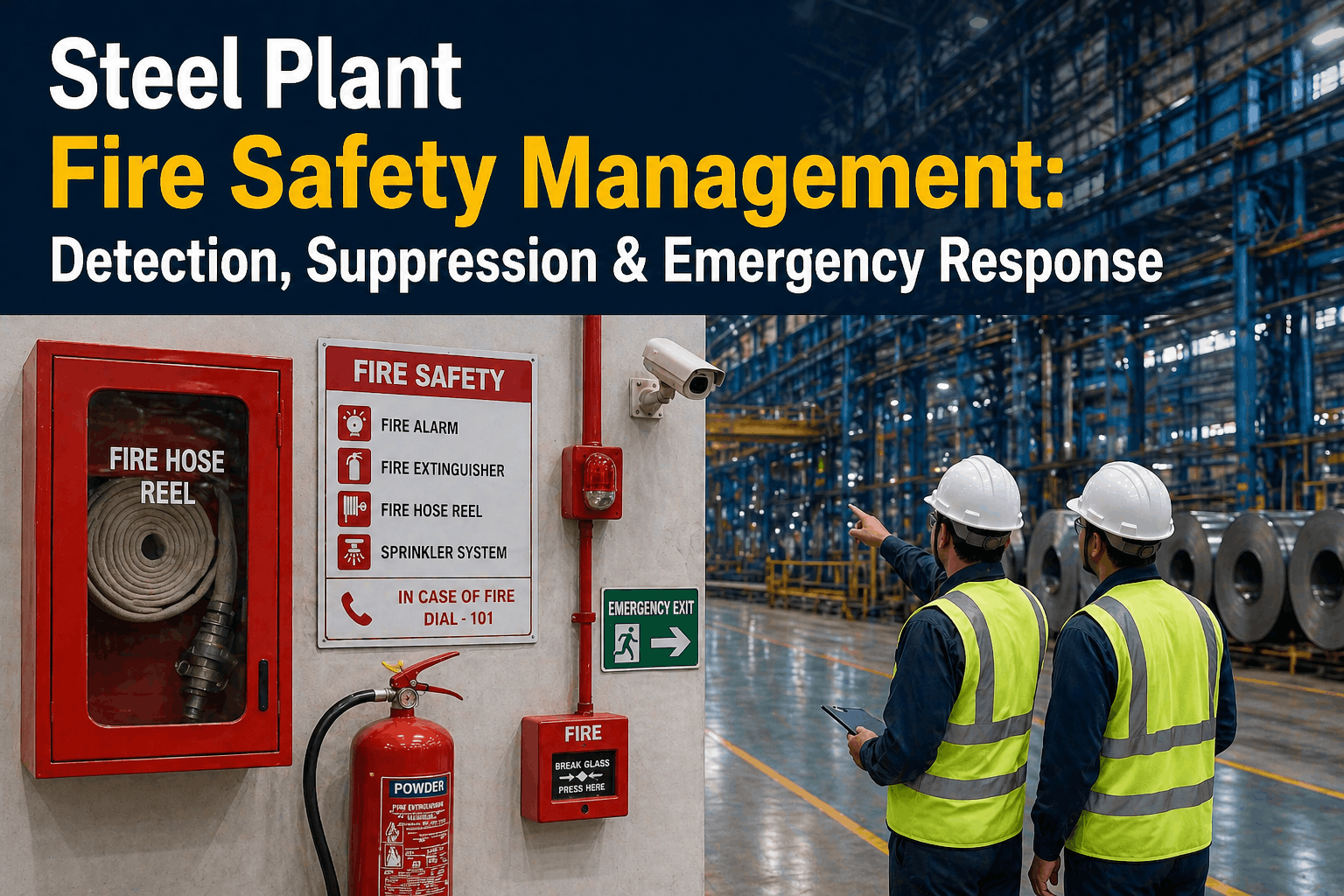
Steel plant fire safety management operations optimization has evolved from a reactive compliance checklist into a predictive, AI-powered life-safety architecture. In an environment where hydraulic oil pressures exceed 200 bar and furnace temperatures surpass 1500°C, a single ignition event can lead to catastrophic asset loss and multi-month production outages. Today, leading steel producers are deploying AI-driven **Predictive Hotspot Detection**, autonomous suppression orchestration, and real-time emergency response (ERT) platforms to slash fire-related risks by 65%. By synchronizing thermal imaging, aspirating smoke detection, and automated fire asset maintenance, iFactory ensures that 100% of fire-critical infrastructure is "Always-Ready." Whether you manage a massive integrated mill or a specialized rolling facility, mastering fire operations optimization through intelligent automation is the only way to protect your people and your bottom line. Book a Demo to see how AI-driven fire safety analytics can transform your risk profile starting in week one.
Reduce Fire Risks by 65% & Automate 100% of NFPA Compliance
Discover how iFactory's AI-driven platform optimizes fire detection, suppression readiness, and emergency response for the world's safest steel plants.
What Is Steel Plant Fire Safety Operations Optimization?
Fire safety operations optimization is the systematic application of high-speed sensors, AI-driven computer vision, and digital asset tracking to the entire fire-protection lifecycle. This encompasses **Active Suppression** (Sprinklers, CO2, Foam, Clean Agents), **Detection Networks** (IR Flame, Smoke, Thermal, Aspirating), and **Emergency Orchestration** (ERT dispatch). AI-powered platforms shift the paradigm from manual "fire-watch" rounds to predictive hotspot identification — detecting the thermal signature of a failing bearing, a cable insulation breakdown, or a high-pressure oil leak before ignition occurs. In the context of "Green Steel" transitions, this also includes the management of high-risk hydrogen zones and high-voltage electrolysis infrastructure. This ensures that every high-risk asset is cocooned in a multi-layered safety net that acts in milliseconds, not minutes.
AI-Powered Fire Safety: The 6 Pillars of Zero-Loss Operations
Effective fire safety operations optimization with AI covers six interconnected capability pillars. Each pillar addresses a specific failure point in traditional safety management — from delayed detection to unmaintained suppression equipment.
Predictive Hotspot Detection
Autonomous IR cameras continuously scan hydraulic power packs, transformer bays, and conveyor rollers. AI flags any thermal drift exceeding 5°C/min, allowing for preventive intervention before ignition.
72hr Pre-Ignition AlertHydraulic Oil Fire Prevention
AI correlates hydraulic pressure drops with localized temperature spikes to identify high-pressure oil mist leaks — the primary cause of rolling mill fires. It automatically triggers low-pressure standby modes.
-90% Oil Fire RiskAspirating Smoke (VESDA) AI
High-sensitivity air sampling in cable galleries and control rooms. AI differentiates between industrial dust and true combustion particulates, virtually eliminating nuisance alarms in dusty environments.
Zero False AlarmsSmart Suppression Orchestration
AI-driven interlocking for CO2 flooding, Clean Agents (Novec 1230), and foam systems. The system verifies personnel evacuation via computer vision before gas discharge — ensuring life-safety.
<1s Discharge DecisionFire Asset Predictive PM
Digital QR-code tracking of fire extinguishers, hydrants, and hoses. AI schedules predictive maintenance for fire pumps and sprinkler valves, ensuring 100% "Ready-State" for NFPA audits.
100% Audit ReadinessDigital ERT & Evacuation AI
Real-time tracking of personnel locations via Bluetooth/Wi-Fi during an alarm. AI generates optimal evacuation routes and provides emergency responders with a live "sweep-status" dashboard.
35% Faster EvacuationFire Response Transformation: A Step-by-Step AI Workflow
The most measurable win in fire safety comes from slashing the time between detection and suppression. Book a Demo to see this workflow in action.
Multi-Spectrum Detection — T-0 Seconds
Multi-spectrum IR flame detectors identify a high-intensity fire signature in the oil cellar. The AI computer vision verifies the incident in under 2 seconds, filtering out welding glare and furnace glow.
2s Incident VerificationAutomated Isolation — T+5 Seconds
The system automatically shuts down hydraulic pumps, closes fire dampers, and stops conveyor belts to prevent the fire from spreading across the mill. Emergency lighting and voice-evacuation are activated.
Zero-Latency IsolationPrecision Suppression — T+15 Seconds
Verification of "Zero-Personnel" in the zone is performed by AI. High-pressure water mist or CO2 is discharged directly onto the fire source, suppressing it before it reaches the main transformer.
-85% Damage ReductionDigital Post-Audit — T+30 Minutes
The system generates a complete event log: detection source, response times, suppression efficiency, and personnel sweep status — providing an instant record for investigators and underwriters.
<1 min Data FinalizationFire Safety Maturity Journey: From Manual to Autonomous Protection
Most steel organizations sit at Stage 1 or Stage 2 — paying for it in high insurance premiums and operational risk. Book a Demo to benchmark your level.
Manual & Reactive Fire Safety
Manual fire extinguisher inspections on paper. Reliance on human "fire-watch" in high-risk zones. Manual pull-stations for alarm activation. Static evacuation maps.
Digitized Alarms & Asset Tracking
Basic fire alarm panel integration. Mobile apps for extinguisher checks. Sprinkler water pressure monitored via SCADA. Digital logs of fire drill performance.
Connected AI Thermal & Response
AI-driven hotspot detection. Digital ERT orchestration with live location tracking. Predictive maintenance for fire pumps. Automated fire damper testing.
Autonomous Zero-Loss Fire Net
Fully AI-orchestrated detection and suppression. Autonomous risk mitigation via equipment interlocking. 100% digital audit compliance. Dynamic evacuation routing.
Fire Safety in the "Green Steel" Era: Hydrogen Risk Management
The shift to Hydrogen-based Direct Reduced Iron (DRI) introduces a new class of fire and explosion risks. Hydrogen's wide flammability range and invisible flame require specialized detection and suppression strategies. AI-powered platforms are essential for managing these high-stakes zones, providing sub-second leak detection and autonomous ventilation control to prevent the formation of explosive atmospheres (ATEX zones).
Key Technologies Powering Steel Plant Fire Automation in 2026
| Technology Layer | Application in Fire Operations | Performance Gain | Deployment Timeline |
|---|---|---|---|
| Thermal AI Cameras | Predictive hotspot monitoring in hydraulic cellars | 72hr ignition foresight | 14-21 days |
| VESDA Smoke AI | High-sensitivity air sampling in control rooms | Zero false alarm drift | 14-21 days |
| Flame IR Detectors | High-speed flame signature verification | <2s detection latency | 21-30 days |
| Hydrogen Detectors | Laser-based methane and hydrogen leak sensing | Sub-second response | 30-45 days |
| Suppression AI | Interlocking CO2, Novec 1230 and foam discharge | 99.9% reliability | 30-45 days |
| ERT Dashboard | Real-time responder and evacuee tracking | -35% evacuation time | 7-10 days |
| Asset QR Vault | Digital compliance for extinguishers and hydrants | 100% audit pass rate | 7 days |
| Intelligent Dampers | Automated fire-wall and damper integrity testing | 99% containment rate | 21 days |
Calculating the ROI of Steel Plant Fire Automation
Insurance Premium Savings
Underwriters provide massive discounts to plants with AI-driven suppression and predictive hotspot monitoring (NFPA 850 compliance).
Asset Loss Avoidance
Suppressing a hydraulic fire in seconds prevents the destruction of expensive rolling mill stands and transformer bays.
Audit Efficiency Gains
Eliminating manual paper-based fire inspections saves thousands of man-hours per year and ensures zero "missed" maintenance dates.
Operational Resilience ROI
The cumulative value of reduced downtime, asset protection, and insurance savings delivers a 6.8x return on the safety tech investment.
What Safety Directors Are Saying
"Before deploying iFactory's Fire Safety AI, our biggest fear was a high-pressure hydraulic leak in the cold mill. Two months ago, the thermal AI flagged a 12°C spike on a pump motor before it could ignite. We avoided a potentially $5M disaster. The peace of mind for our ERT team is invaluable."
Frequently Asked Questions: Steel Plant Fire AI & Safety
How does AI differentiate between welding and an actual fire?
iFactory uses multi-spectrum IR detectors and computer vision. The AI analyzes the flicker frequency, UV/IR ratios, and spatial growth patterns to filter out welding arcs with 99.9% accuracy.
What is the best suppression for an oil cellar?
High-pressure water mist is often preferred as it suppresses the fire while cooling the equipment, without the oxygen-displacement risks of CO2. iFactory optimizes the discharge timing for these systems.
How does the system track people during an evacuation?
The platform integrates with Wi-Fi access points and Bluetooth beacons. During an alarm, it generates a "Digital Roll Call," showing the exact count of personnel at each muster point in real-time.
Can AI predict a transformer fire?
By correlating Dissolved Gas Analysis (DGA) data with thermal imaging of the transformer bushings, AI can identify internal arcing or overheating weeks before a catastrophic failure.
What is NFPA 850 and how do we comply?
NFPA 850 provides fire protection recommendations for electric generating plants and high voltage stations. iFactory automates the documentation and inspection intervals required by this standard.
How do you manage fire safety on conveyor belts?
Linear heat detection cables and IR cameras monitor the entire belt length. If a "hot spot" (e.g., a seized idler) is detected, the AI automatically slows or stops the belt and triggers local sprayers.
How often should fire pumps be tested?
NFPA requires weekly churn tests. iFactory's predictive PM module automates the logging of these tests and alerts maintenance if pump performance deviates from the curve.
Can fire safety data reduce our ESG risk score?
Yes. Verifiable life-safety and asset-protection data are key components of the "Social" and "Governance" pillars of ESG. iFactory provides audit-ready dashboards for these disclosures.
How is Hydrogen fire detection different from COG?
Hydrogen flames are nearly invisible and emit very little IR. iFactory uses ultraviolet (UV) detectors and specialized laser absorption sensors to identify Hydrogen leaks and flames in DRI plants.
What is "Passive Fire Protection" in a steel plant?
It includes fire-rated walls, floors, and intumescent coatings. iFactory tracks the integrity of these barriers through digital "Fire Stop" audits, ensuring that compartmentalization works when needed.
What is Novec 1230 and why use it in control rooms?
Novec 1230 is a "Clean Agent" that leaves no residue. It is non-conductive and safe for electronics, making it ideal for protecting the high-value PLC cabinets that drive the mill.
How does AI manage fire-water pressure during an incident?
AI-driven pressure monitoring ensures that when one hydrant is opened, the fire pumps ramp up to maintain the required nozzle pressure across the entire loop, preventing "pressure-drop" failures.
Can we use AI for fire-brigade training?
Yes. iFactory includes a training module that uses past incident data to generate "What-If" scenarios for ERT teams, improving their decision-making speed during real emergencies.
What is a "High-Expansion Foam" system?
It is used for large volume suppression, such as in oil cellars. AI optimizes the foam-to-water ratio and expansion rate based on the temperature of the fire, maximizing cooling efficiency.
How do you protect oxygen enrichment zones?
Oxygen-rich atmospheres make materials highly flammable. iFactory uses oxygen-concentration sensors interlocked with high-speed water curtains to immediately isolate and suppress any flash fires.
What is the shelf-life of a fire extinguisher?
While the cylinder lasts for years, the agent (DCP/CO2) and the pressure must be checked monthly. iFactory's QR-code system ensures that no extinguisher is ever "expired" or under-pressurized.
Stop Losing Asset Value to Preventable Fire Incidents
Join the world's safest steel operations teams. We'll show you exactly how many risk points and insurance dollars you are leaving on the table.