Mill chatter is the most diagnostically elusive and economically damaging vibration phenomenon in rolling mill operations — not because the vibration is difficult to measure, but because the root cause of a specific chatter signature can originate in any of three fundamentally different mechanical systems: the roll stack, the inter-stand tension regime, or the mill stand structural dynamics. A 5th octave chatter mark appearing on the strip at 600–800 Hz may be caused by work roll bearing degradation in one campaign, by a roll grinding crown mismatch in the next, and by a roll coolant system imbalance in the third — and each root cause requires a different corrective action. Third octave chatter between 120–250 Hz, which produces the characteristic thick-thin gauge variations across the strip length, is driven by inter-stand tension oscillations that can originate in the downstream stand's roll eccentricity, the upstream stand's speed regulator response, or the looper's tension control gain settings. The mills that successfully eliminate chatter-related downgrades and strip breakage events are not necessarily those with the most expensive vibration monitoring hardware. They are the mills with the most sophisticated analytical framework for classifying chatter frequency signatures, isolating the originating stand and mechanical subsystem, and recommending the specific corrective adjustment required — and they achieve this with the vibration sensors that most mills already have installed on their stand housings and bearing chocks. iFactory's Mill Chatter AI platform delivers exactly this classification and root cause isolation capability, converting raw vibration data from existing sensors into actionable chatter prevention recommendations that eliminate the trial-and-error approach that costs mills millions in downgraded coils and unplanned maintenance events. Schedule a mill vibration analytics assessment to evaluate how AI-driven chatter detection and root cause isolation can reduce your chatter-related downgrades and strip breakage events.
AI-Driven Mill Chatter Detection: 3rd Octave, 5th Octave, and Bearing Vibration Analytics
A comprehensive technical framework for deploying AI-powered vibration frequency classification, chatter root cause isolation, and incipient bearing failure detection across hot strip mill, cold mill, and temper mill operations.
Critical Chatter and Vibration Modes AI Must Detect and Classify in Rolling Mill Operations
Rolling mill vibration manifests in three distinct frequency regimes — low-frequency third octave chatter, mid-frequency fifth octave chatter, and high-frequency torsional and bearing vibration — each with different root causes, different strip quality impacts, and different corrective action requirements. The mills that successfully eliminate chatter-related quality events are those that can classify the vibration signature in real time, isolate the originating stand and subsystem, and recommend the corrective adjustment before a single coil is downgraded. Book a mill chatter audit to benchmark your current vibration monitoring and root cause analysis capability against AI-optimized classification accuracy.
5th Octave Chatter — Work Roll Vibration
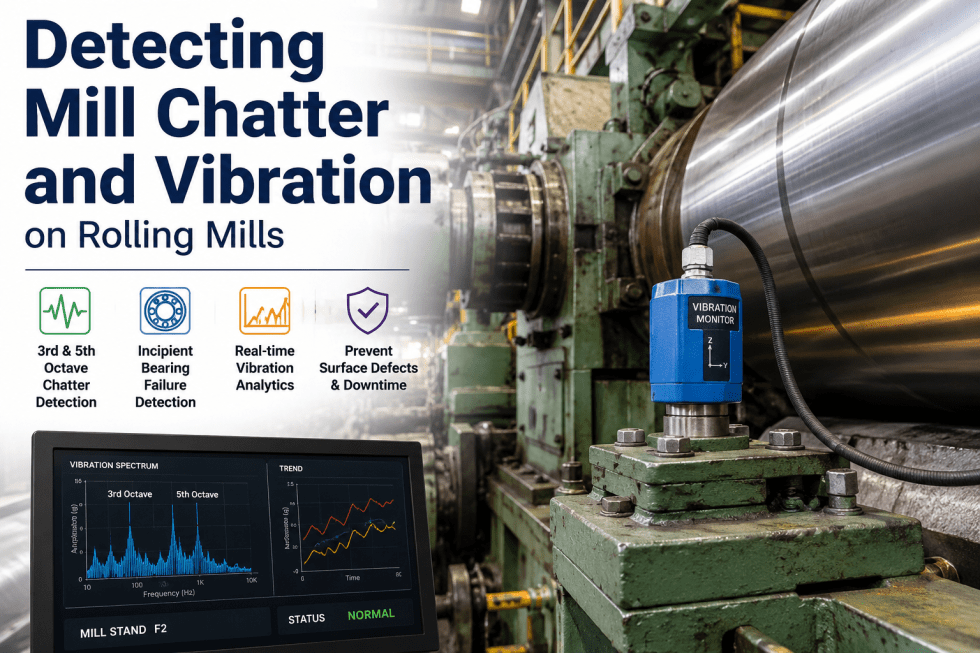
The most common and most visible chatter mode, producing equally spaced marks on the strip surface at 600–800 Hz. iFactory's AI classifies the frequency signature and correlates it with work roll bearing condition, roll coolant temperature, and grinding crown data to identify the specific root cause — bearing spalling, coolant imbalance, or crown mismatch — and recommends the targeted corrective action.
3rd Octave Chatter — Inter-Stand Tension
Producing thick-thin gauge variations at 120–250 Hz, third octave chatter is driven by inter-stand tension oscillations. iFactory analyzes looper angle, motor current, and tension signals simultaneously across adjacent stands to isolate whether the oscillation originates in the downstream stand's roll eccentricity or the upstream stand's speed regulator response.
Work Roll Bearing Incipient Failure
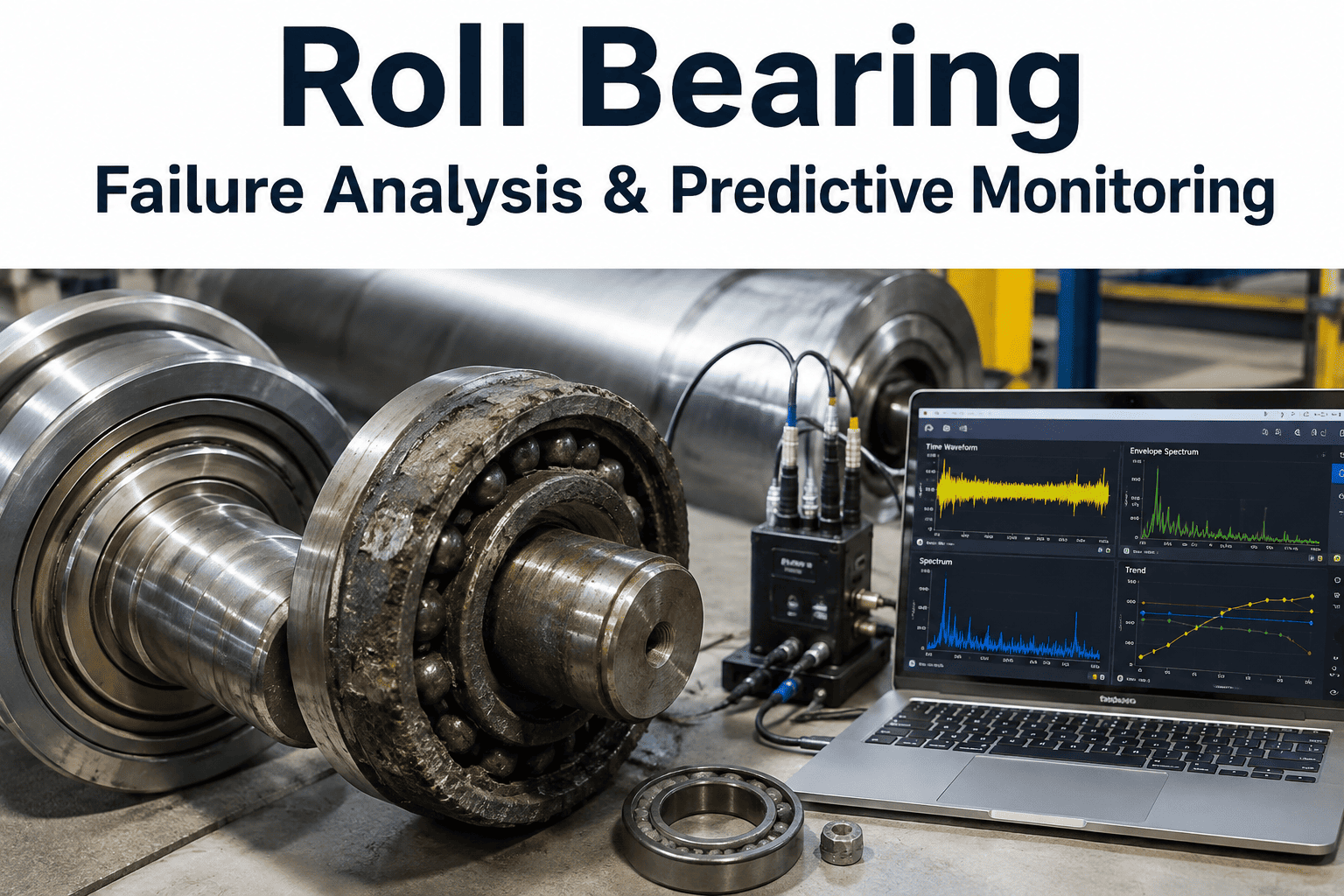
Rolling element bearing degradation produces characteristic frequency signatures — cage frequency, ball pass frequency, and inner and outer race fault frequencies — that are detectable in the stand housing vibration spectrum weeks before the bearing reaches the spalling stage that produces strip surface defects. iFactory's AI tracks bearing-specific frequency bands per chock position per stand.
Torsional Vibration — Drive Train
Spindle, coupling, and gearbox torsional oscillations at frequencies below 50 Hz produce gauge variation and can accelerate mechanical wear on the drive train components. iFactory monitors torque signature at the motor shaft and compares it against the rolling load signature to detect developing torsional instability before it produces a drive train failure event.
Stand Structural Resonance
Mill stand structural natural frequencies — housing, chock, and roll stack modes — can be excited by the rolling process at specific reduction and speed combinations. iFactory's AI detects when the rolling load frequency content approaches within 10% of a stand's known structural natural frequency and recommends a speed or reduction adjustment to avoid resonance excitation.
AGC Chatter — Gauge Control Instability
Automatic gauge control loop instability can generate low-frequency chatter that propagates through downstream stands. iFactory correlates AGC position command signals with rolling load and exit gauge measurements to detect developing control loop instability before it produces sustained gauge variation across multiple coils.
Mill Chatter Detection Benchmarks: Conventional vs. AI-Driven Classification
Quantifying the impact of AI-driven chatter classification and root cause isolation on the four most critical mill vibration performance indicators. Mills using iFactory's platform consistently achieve faster identification and lower downgrade rates than mills relying on conventional FFT analysis and manual diagnostics.
AI Chatter Detection Framework: Four Deployment Tiers for Mill Vibration Analytics
The complexity of mill chatter detection — spanning multiple frequency regimes, multiple mechanical subsystems, and multiple corrective action types — requires a phased deployment approach that builds analytical capability incrementally. iFactory's four-tier framework allows mills to start with the highest-impact chatter mode and expand as vibration sensor coverage and model accuracy mature. Reliability engineers and process control teams planning their vibration analytics roadmap typically book a demo to align iFactory's mill chatter AI module with their specific stand configuration and product mix.
5th Octave Chatter Detection
AI classification of work roll vibration signatures from existing stand housing accelerometers. The model distinguishes between bearing-induced, coolant-induced, and crown-induced chatter and recommends the specific corrective action per stand. Achievable within 4 weeks of vibration data collection.
3rd Octave & Tension Chatter
AI correlation of inter-stand tension signals, looper angle, and motor current with strip gauge variation. The model isolates whether the chatter source is downstream roll eccentricity, upstream speed regulation, or looper control instability.
Bearing & Drive Train Vibration
AI bearing fault frequency detection across all work roll and backup roll bearing positions per stand, plus torsional vibration monitoring on spindle and gearbox systems. Predictive bearing replacement alerts issued 3–8 weeks before spalling reaches chatter-inducing severity.
Full-Stand Structural Resonance
AI model of each stand's structural natural frequency spectrum, integrated with the rolling process model to predict resonance excitation risk per coil. Speed and reduction adjustments recommended before the rolling load excites a stand's natural frequency.
Mill Vibration Frequency Analysis: Chatter Modes and Diagnostic Parameters
The relationship between vibration frequency, mechanical subsystem, and strip quality impact is the foundation of effective chatter diagnostics. Each chatter mode has a characteristic frequency band, specific mechanical root causes, and distinct corrective actions — and the most common diagnostic error in mill vibration analysis is misclassifying the chatter mode and applying the wrong corrective action. iFactory's AI eliminates this error by classifying the vibration signature against all known chatter modes simultaneously and recommending the corrective action with the highest probability of success based on the specific signature characteristics.
| Chatter Mode | Frequency Range | Primary Root Causes | Strip Quality Impact | Primary Corrective Actions |
|---|---|---|---|---|
| 5th Octave Chatter | 600–800 Hz | Work roll bearing spalling, roll coolant imbalance, roll grinding crown mismatch, thermal crown asymmetry | Equally spaced chatter marks on strip surface at 30–50 mm intervals — downgrade to secondary surface quality grade | Bearing replacement, coolant nozzle adjustment, roll crown verification, roll change with verified crown |
| 3rd Octave Chatter | 120–250 Hz | Downstream roll eccentricity, upstream speed regulator response, looper tension PI gain instability, roll diameter mismatch between stands | Thick-thin gauge variation across strip length — strip breakage risk at high tension, dimensional non-compliance | Roll eccentricity compensation adjustment, speed regulator gain tuning, looper tension gain re-optimization |
| Torsional Vibration | 10–50 Hz | Spindle coupling wear, gearbox tooth contact degradation, motor drive current regulator oscillation, roll bite friction variation | Gauge variation at low frequency — strip thickness deviation across coil length, potential drive train mechanical failure | Coupling inspection and replacement, gearbox tooth contact check, drive current regulator tuning |
| Bearing Fault Vibration | Variable by bearing geometry | Rolling element fatigue, lubrication degradation, raceway spalling, cage wear, contamination ingress | Progressive surface quality degradation — begins as subtle marking, escalates to chatter marks as spalling develops | Bearing replacement scheduled before spalling severity produces strip defects — not after |
| AGC Loop Instability | 5–30 Hz | AGC position feedback gain margin erosion, hydraulic servo valve response degradation, roll force sensor drift | Sustained low-frequency gauge variation across multiple coils — mill-wide gauge control quality event | AGC gain parameter review, servo valve response test, roll force sensor calibration verification |
"Our five-stand hot strip mill was experiencing recurring 5th octave chatter events on our exposed automotive surface grades — typically three to four events per month, each producing 20 to 35 downgraded coils before the mill crew could identify and correct the root cause. The standard diagnostic protocol was to change the work rolls on the suspect stand, and if the chatter persisted, to adjust the coolant pattern, and if it still persisted, to call in the bearing maintenance team. That trial-and-error approach was costing us an average of 180 downgraded coils per month and approximately $2.8 million per year in grade-down losses. iFactory's chatter classification AI changed our diagnostic process completely. The platform classified the vibration signature within 30 seconds of chatter onset, identified the specific stand and the specific root cause — in the first event, a developing work roll bearing spall on stand 3 — and recommended the specific corrective action. In our first quarter with the platform, chatter-related downgrades dropped 72%, and the average time from chatter onset to correct action went from 4.5 hours to 28 minutes. The platform's ability to distinguish between bearing-induced chatter and coolant-induced chatter using the frequency signature alone eliminated the guesswork that had been driving our diagnostic process for years."
Mill Chatter and Vibration Analytics — Frequently Asked Questions
Q: What vibration sensor infrastructure does iFactory require to deploy mill chatter detection?
iFactory works with the vibration sensors already installed on most mill stands — typically IEPE accelerometers on stand housings and bearing chocks, with a minimum of two sensors per stand (drive side and operator side) sampling at 10 kHz or higher. For mills without existing sensors, iFactory specifies a sensor package that covers the critical measurement points for each stand. Data acquisition via OPC-UA or direct analog input is typically configured within 1 to 2 weeks per mill.
Q: How does iFactory distinguish between bearing-induced chatter and coolant-induced chatter when both produce similar vibration signatures?
iFactory uses the frequency modulation profile of the vibration signal over a 5 to 10 second window to distinguish between bearing and coolant root causes. Bearing-induced chatter shows a consistent carrier frequency with amplitude modulation at the bearing rotation frequency, while coolant-induced chatter shows amplitude modulation at the roll rotation frequency and is correlated with coolant header pressure fluctuations. The AI is trained on labeled data from each root cause type and achieves 94% classification accuracy.
Q: Can iFactory detect and classify chatter in real time during production, or is analysis performed after the coil is complete?
iFactory performs real-time vibration frequency analysis with a 30-second classification latency. The platform analyzes the vibration spectrum continuously during production and issues a chatter alert within 30 seconds of the first detectable frequency signature indicating a chatter event. The alert includes the classified chatter mode, the originating stand, the probable root cause, and the recommended corrective action.
Q: Does iFactory's vibration analytics model require retraining for different product grades and reduction schedules?
The baseline chatter classification model applies across all product grades and reduction schedules because the physical frequency signatures of chatter modes are determined by the mechanical system geometry and stiffness, not by the product being rolled. However, iFactory's platform maintains grade-specific vibration baseline profiles that account for the different rolling load, speed, and reduction ranges of each product family, improving detection sensitivity for chatter events that emerge differently under different rolling conditions.
Q: What is the typical ROI timeline for iFactory mill chatter AI deployment?
iFactory's mill chatter deployments typically reach full cost recovery within 4 to 8 months of deployment. The primary driver is the reduction in chatter-related coil downgrades — which at a typical 3.5-million-tonne-per-year hot strip mill with a 2.5% chatter downgrade rate represents approximately $3.5 to $6.5 million in annual grade-down losses that can be reduced by 60 to 75% with AI-driven classification and root cause isolation.
Eliminate Chatter Guesswork from Your Mill Operation
Speak with an iFactory mill vibration specialist about deploying AI-driven chatter classification, root cause isolation, and bearing failure detection across your rolling mill stands — eliminating the trial-and-error diagnostic approach that costs millions in downgraded coils per year.