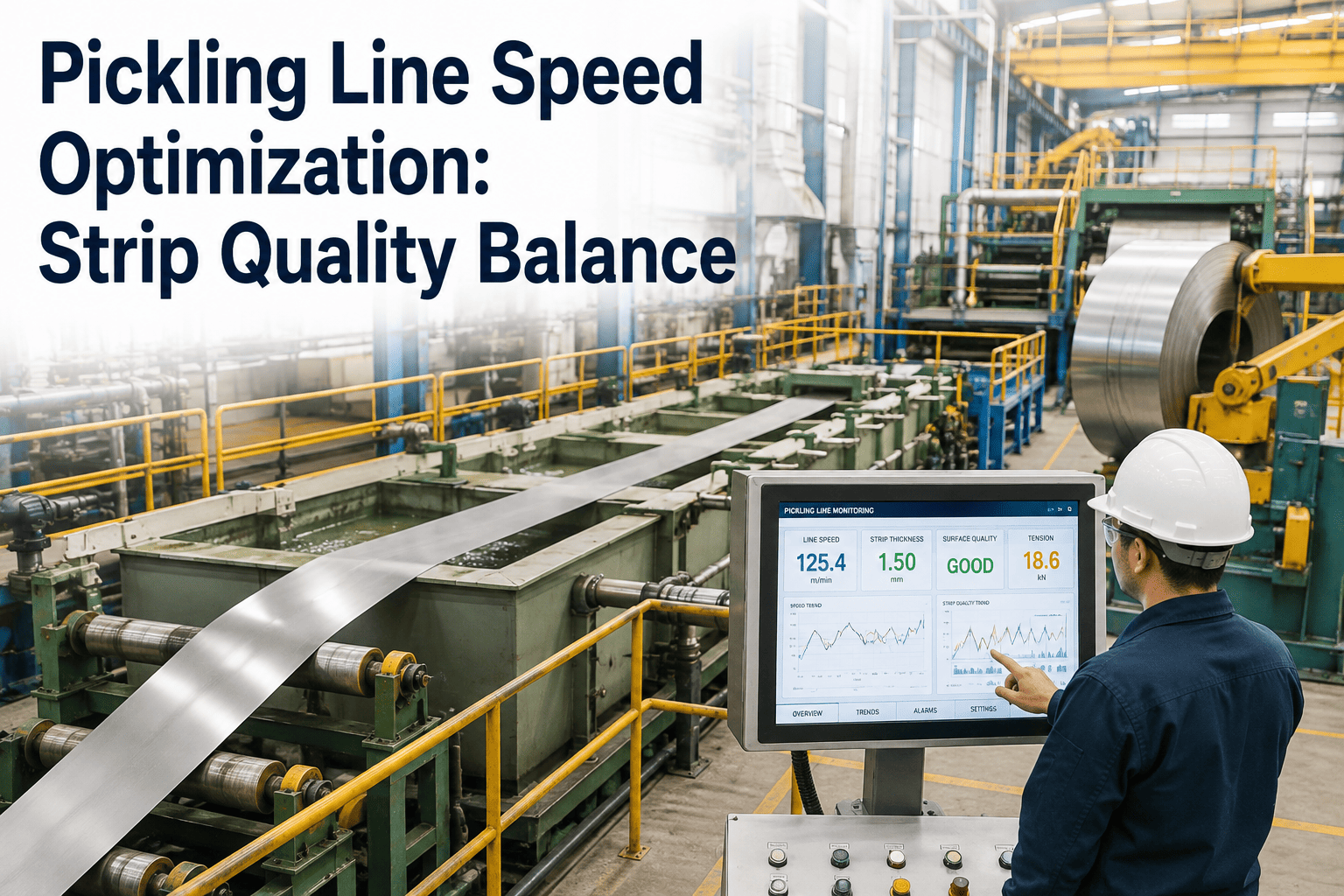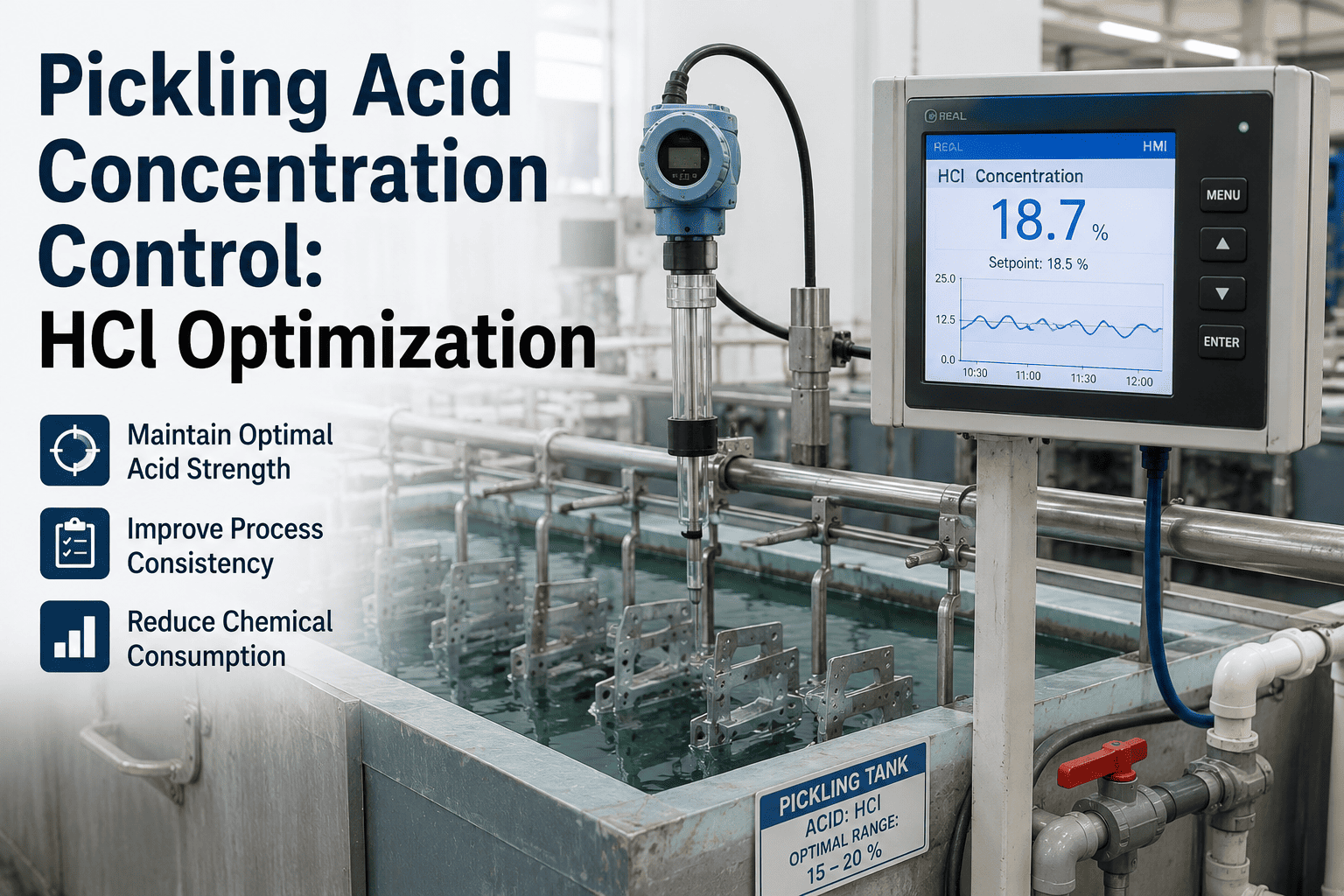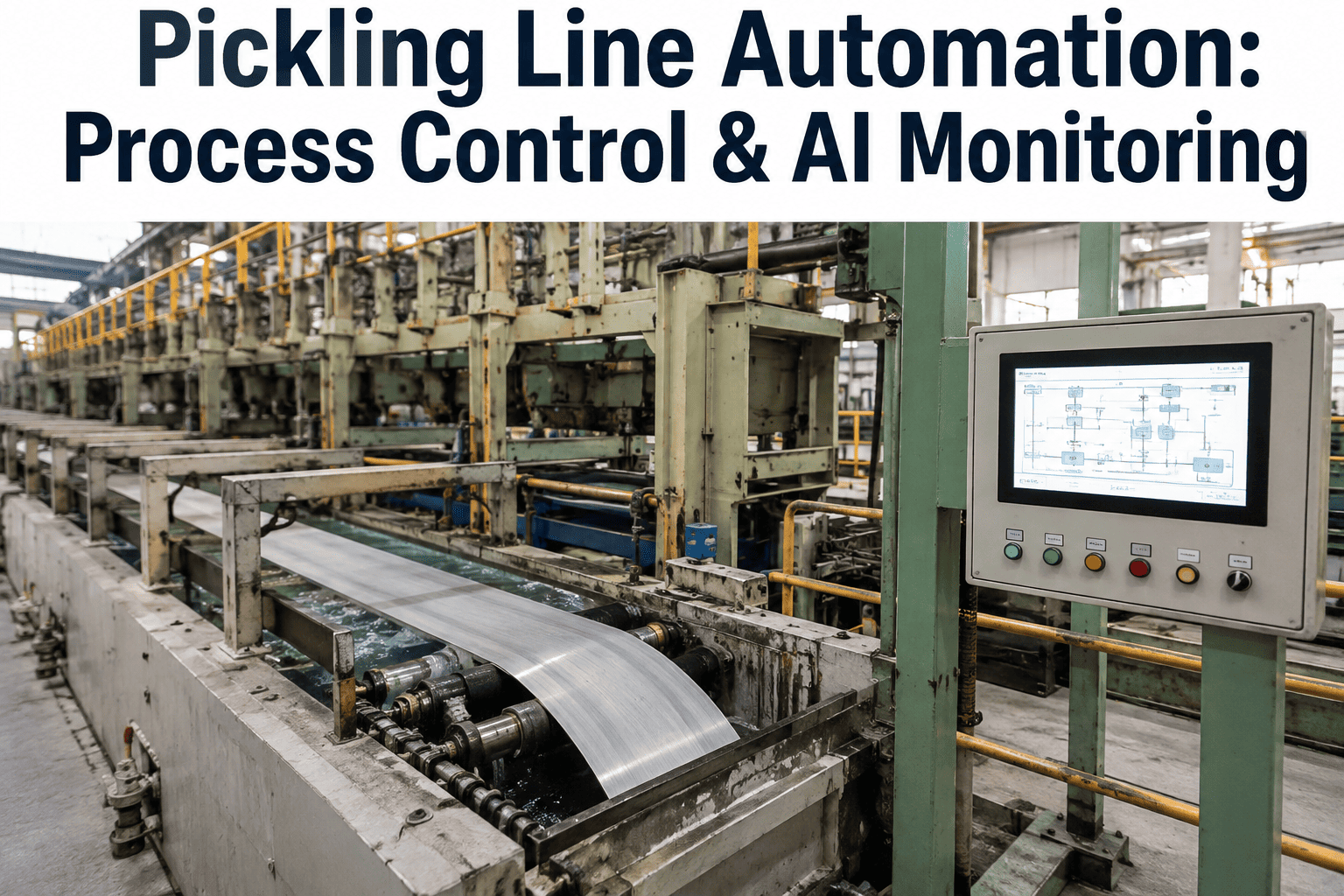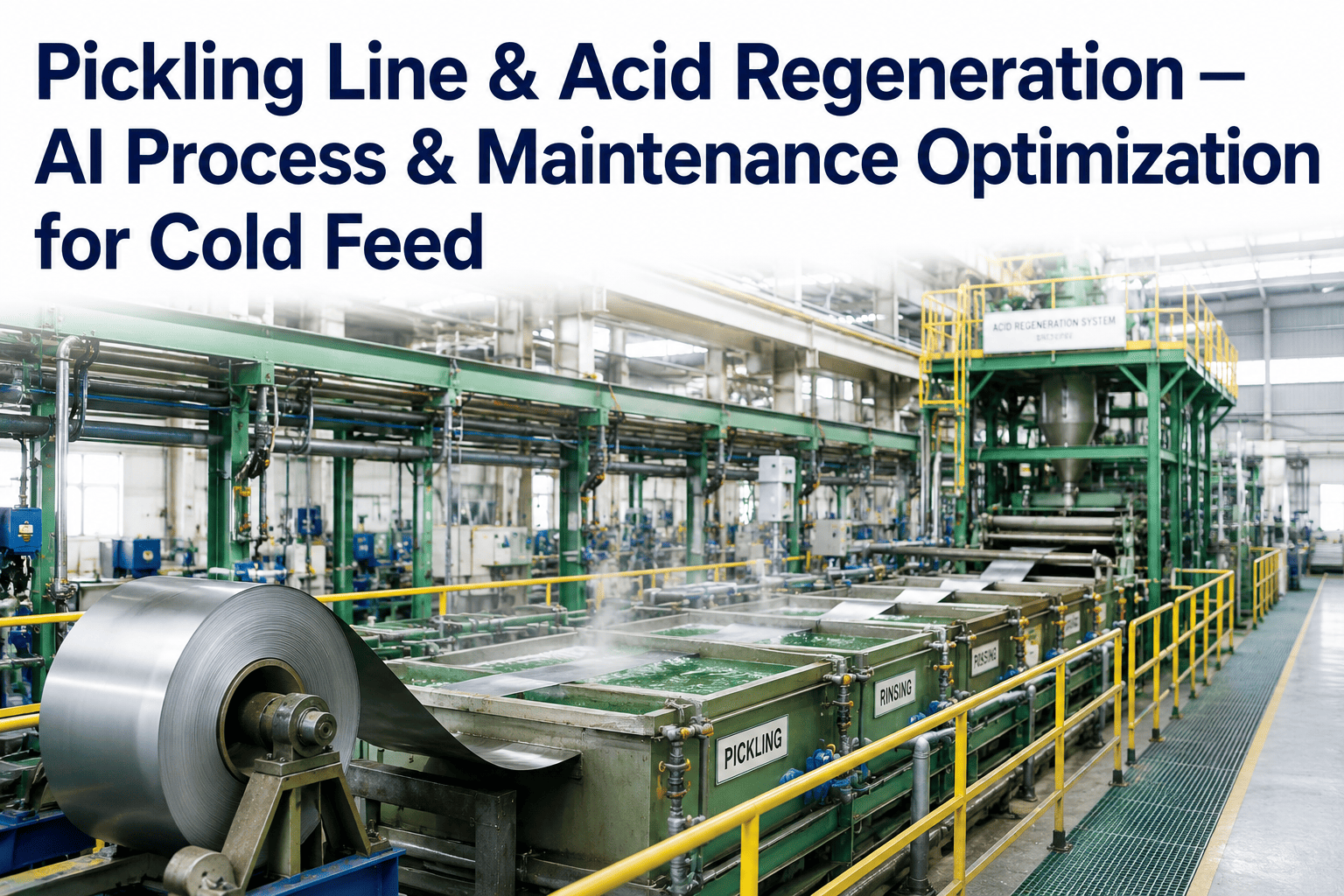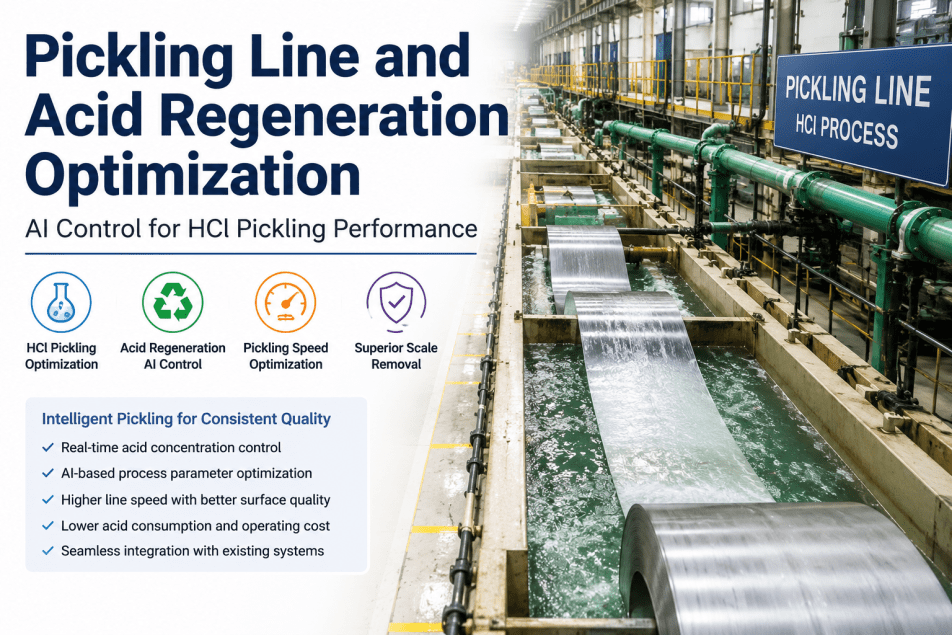
Pickling line operations — whether continuous or push-pull configuration — are the critical interface between the hot strip mill and the cold rolling mill, where scale removal quality, acid consumption, strip surface condition, and line throughput must be balanced simultaneously. The pickling process involves five interdependent control variables — acid concentration, acid temperature, strip speed, strip tension, and scale-breaking reduction — that interact to determine whether the strip exits the line with a fully descaled surface suitable for cold rolling or with residual scale patches that will produce surface defects in the downstream tandem mill. Most pickling lines still operate with fixed setpoints per product family that are adjusted manually by operators based on visual inspection of the strip surface at the exit end resulting in a conservative operating envelope that limits line speed to 70–80% of theoretical capacity. Acid concentration is maintained within broad targets that waste acid through over-pickling on thinner gauges while risking under-pickling on heavier gauges. iFactory's Pickling Optimizer platform replaces this fixed-setpoint approach with continuously learning AI models that optimize acid concentration, strip speed, acid temperature, and scale-breaking parameters in real time — increasing line speed by 12–18%, reducing acid consumption by 15–25%, and eliminating under-pickling and over-pickling defects across the full product mix. Book a Demo to see iFactory's Pickling Optimizer configured for your line configuration, product mix, and throughput targets.
Why Pickling Line Optimization Delivers the Highest ROI in the Cold Mill Entry Chain
The pickling line is the only process stage in the steel production chain where the strip surface condition is actively modified by chemical removal of scale — and it is the stage where the consequences of suboptimal control propagate most directly to downstream quality and cost. An under-pickled coil entering the tandem cold mill will produce roll marking from residual scale embedded in the work roll surface, requiring a mill stoppage for roll change and producing downgraded material across multiple subsequent coils. An over-pickled coil consumes excess acid, generates additional waste acid for regeneration, and can produce an etched surface that affects downstream coating adhesion in galvanizing or painting operations. The pickling line is also a throughput constraint in many plants — because line speed is limited by the pickling reaction rate at the available acid concentration and temperature, and the operator's natural conservatism in setting speed to avoid pickling defects means that the line consistently operates below its actual capability. Book a Demo to model the optimization potential for your pickling line product mix and annual tonnage.
Pickling Optimizer AI Core Capabilities
iFactory's Pickling Optimizer platform targets the three most impactful control domains in the pickling line — acid concentration and temperature control, strip speed optimization, and scale removal quality prediction — integrating each into a unified optimization framework that adapts to every grade change, gauge transition, and width variation in real time.
Pickling Line Control Approaches — Manual Operation vs Model-Based Control vs AI Real-Time Optimization
The table below compares three approaches to pickling line control. Traditional manual operation depends on operator experience and visual inspection. Model-based control uses static pickling models calibrated per product family. AI real-time optimization continuously adapts to every coil and every condition change across the full operating envelope.
| Control Parameter | Traditional Manual Operation | Model-Based Control | iFactory Pickling Optimizer AI |
|---|---|---|---|
| Acid concentration setpoint | Fixed target per product family — adjusted manually by shift | Pre-calculated concentration per grade group | AI-optimized per coil with continuous feedback from exit quality measurements |
| Line speed determination | Operator sets speed based on visual inspection of exit strip | Fixed speed per gauge and grade family — conservatively set | AI predicts maximum speed for guaranteed scale removal — dynamically adjusted per coil |
| Acid temperature control | Fixed temperature setpoint with manual override | Temperature setpoint per grade family | AI-optimized temperature per coil segment — balancing reaction rate against acid evaporation loss |
| Scale-breaking adjustment | Fixed roll gap based on strip thickness range | Fixed reduction percentage per product family | AI-optimized scale-breaking reduction based on entry scale thickness and strip grade |
| Rinse water management | Fixed flow rate regardless of strip condition | Flow setpoint per width range | AI-optimized rinse flow based on residual acid carryover prediction — reducing water treatment load |
| Grade change adaptation | Visual inspection of first coils — manual speed and concentration adjustment | Pre-calculated setpoints with 2–3 trial coils for verification | Zero trial coils — model predicts optimal parameters from coil data and previous runs |
| Update frequency | Per coil or per visual inspection event | Per product change | Continuous per-coil learning with real-time adjustment within each coil |
Critical Pickling Line AI Implementation Pitfalls to Avoid
Pickling line AI projects fail or underperform when implementation mistakes create gaps between model predictions and actual line conditions. These failure patterns are preventable with a structured approach to data infrastructure, model training, and acid regeneration integration. Book a Demo to review iFactory's pickling line AI deployment methodology for your line configuration.
Industry Expert Perspective: Why AI Pickling Control Is the Next Frontier in Cold Mill Entry Optimization
I spent 16 years managing pickling and tandem mill operations at an integrated producer running three pickling lines — a continuous line for automotive and appliance grades and two push-pull lines for heavy-gauge structural and pipe grades. The continuous line was our highest-volume asset at 1.2 million tons per year, and it was consistently running at 75–80% of its design speed because the operators set speed conservatively to avoid under-pickling risk. We had acid concentration data from titration samples taken every 4 hours, and the line speed was adjusted once per shift based on those samples. The variability in scale thickness from the hot strip mill — which was significant given our wide product mix — was never factored into the speed decision because we had no way to measure entry scale thickness. iFactory's pickling optimizer changed this by integrating the entry pyrometer data to estimate scale thickness, modeling the pickling reaction rate per coil in real time, and recommending the maximum line speed at which guaranteed descaling could be achieved. The result was a 15% increase in line speed within the first 60 days, a 22% reduction in acid consumption because we stopped over-pickling the thin gauges, and zero under-pickling claims from the tandem mill in the first six months of operation. The acid regeneration plant savings alone — from reduced acid consumption and more consistent spent acid concentration — paid for the platform in less than a year.
Three Business Outcomes Delivered by Pickling Optimizer AI Deployment
Beyond process optimization and acid consumption reduction, Pickling Optimizer AI creates measurable business outcomes across production, quality, and environmental performance.
Pickling Line AI Optimization — Frequently Asked Questions
The Decision That Determines Your Pickling Line Performance Trajectory — Fixed Setpoints or Continuously Learning AI
The difference between pickling lines operating with fixed setpoints per product family and lines operating with continuously learning AI models compounds with every coil processed. Each coil that runs at a conservative speed to avoid quality risk consumes line capacity that cannot be recovered. Each coil that is over-pickled wastes acid that must be regenerated at additional energy and chemical cost. Each coil that exits with residual scale causes a tandem mill stoppage that costs production time across the entire cold mill. AI-driven pickling optimization eliminates this waste by learning from every coil, every grade change, and every condition change — continuously pushing the operating envelope toward maximum throughput at minimum acid consumption with guaranteed descaling quality.