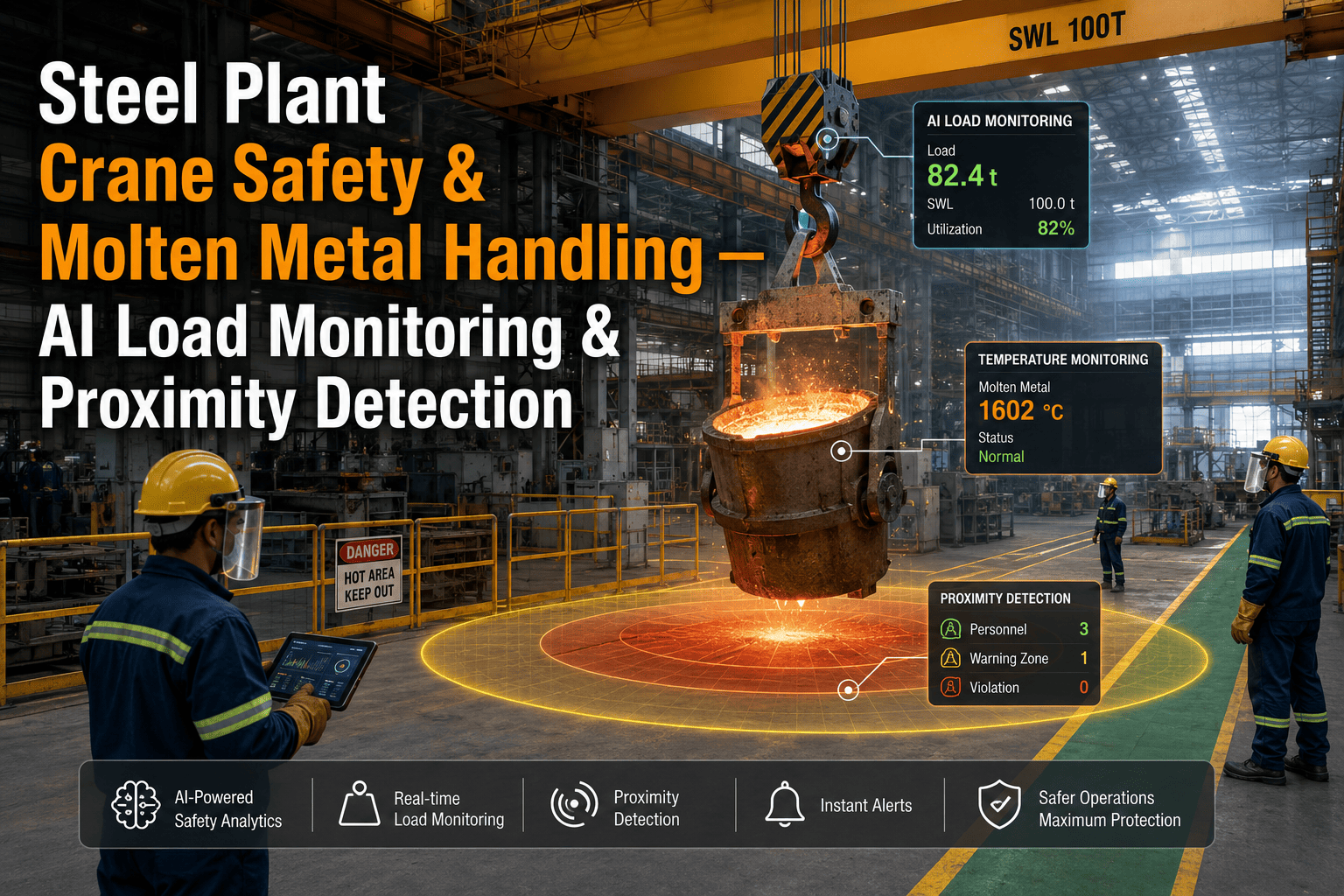
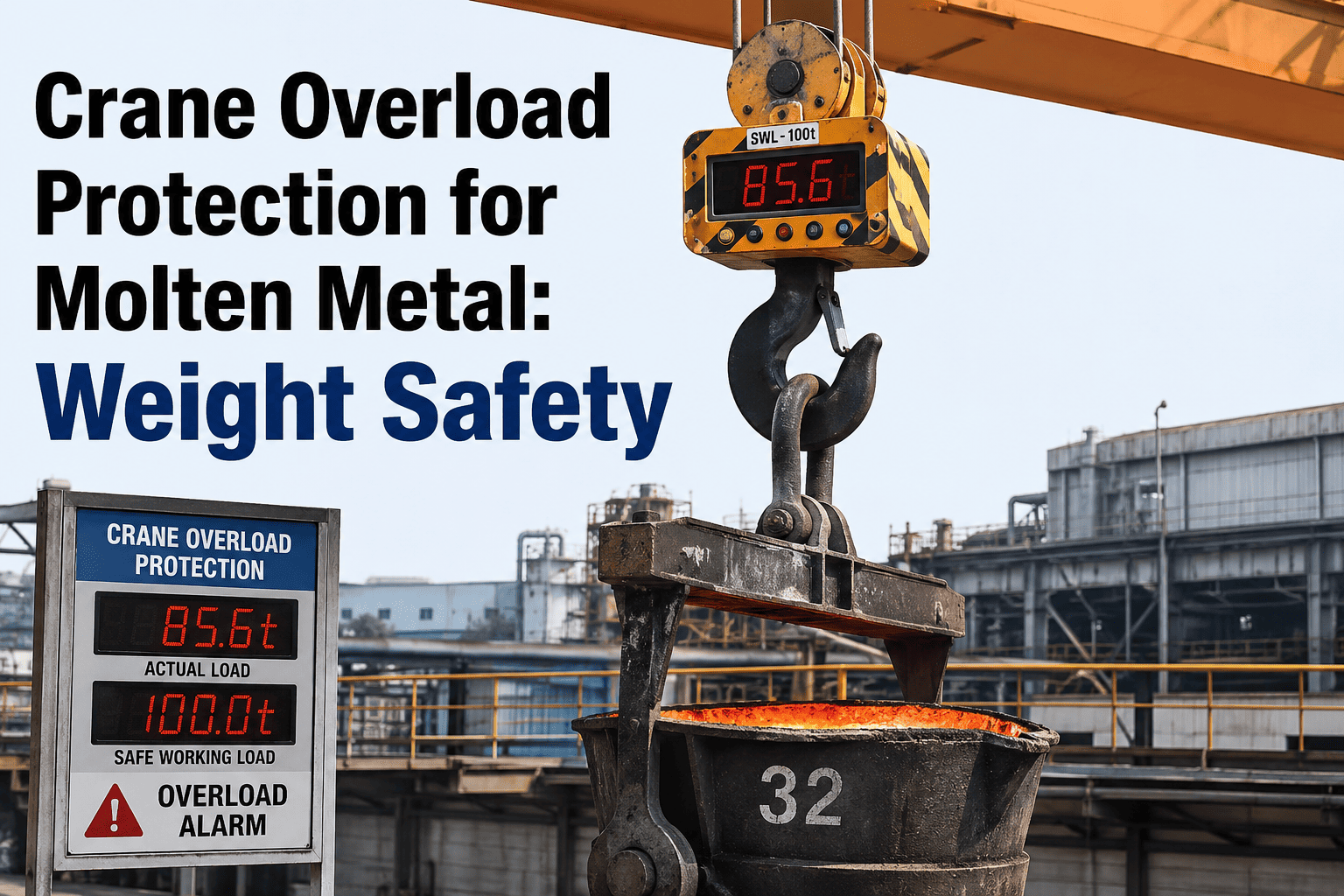
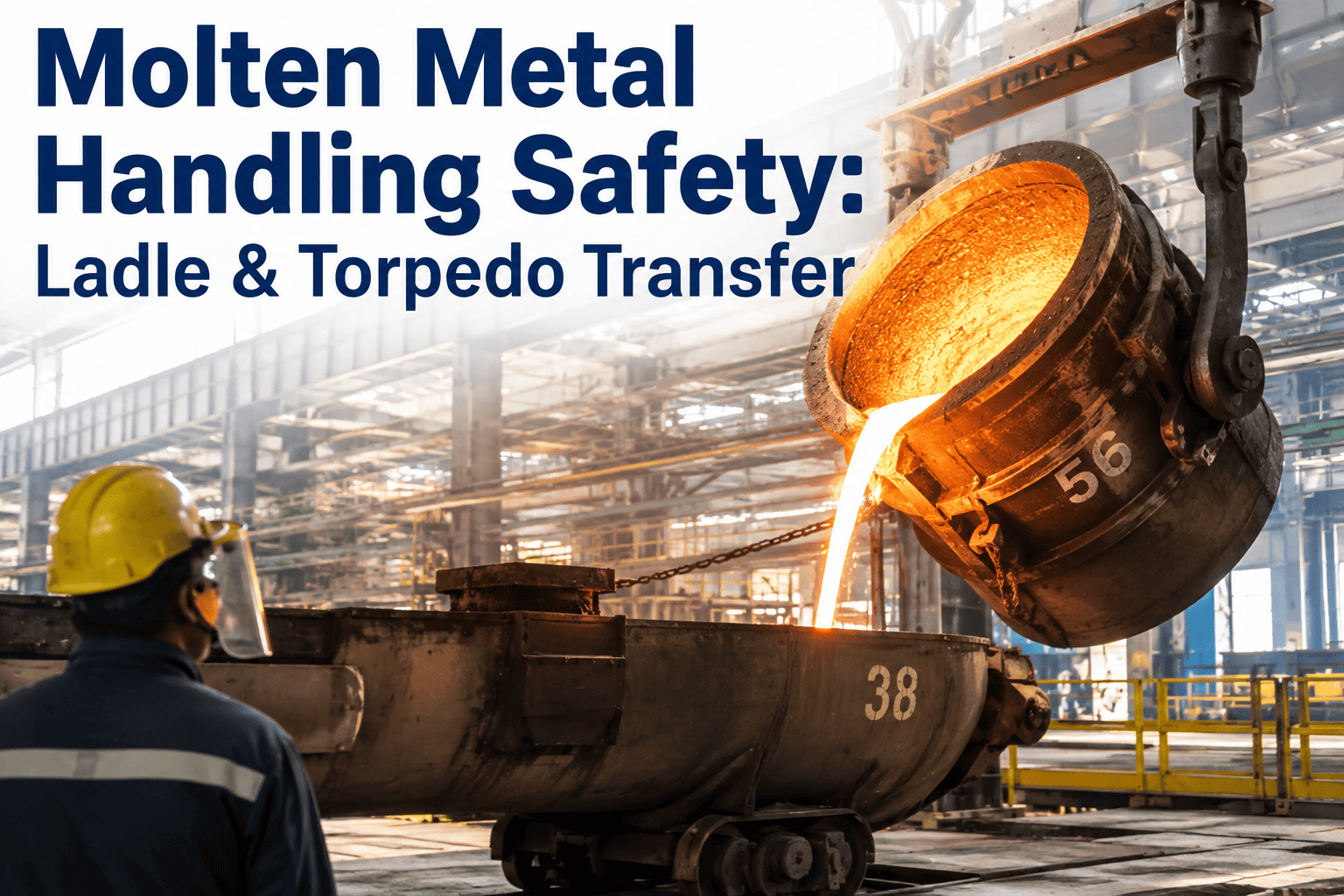
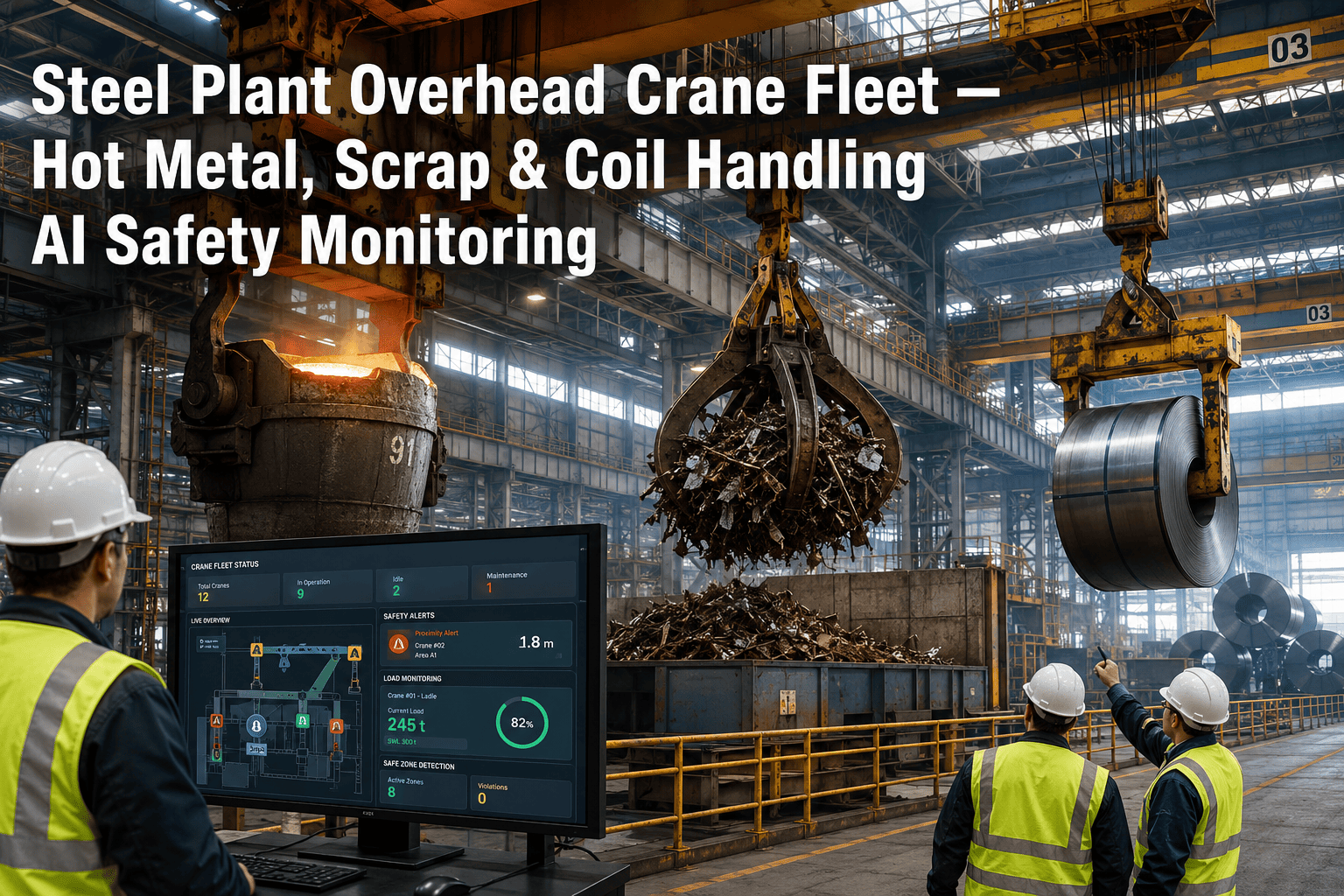
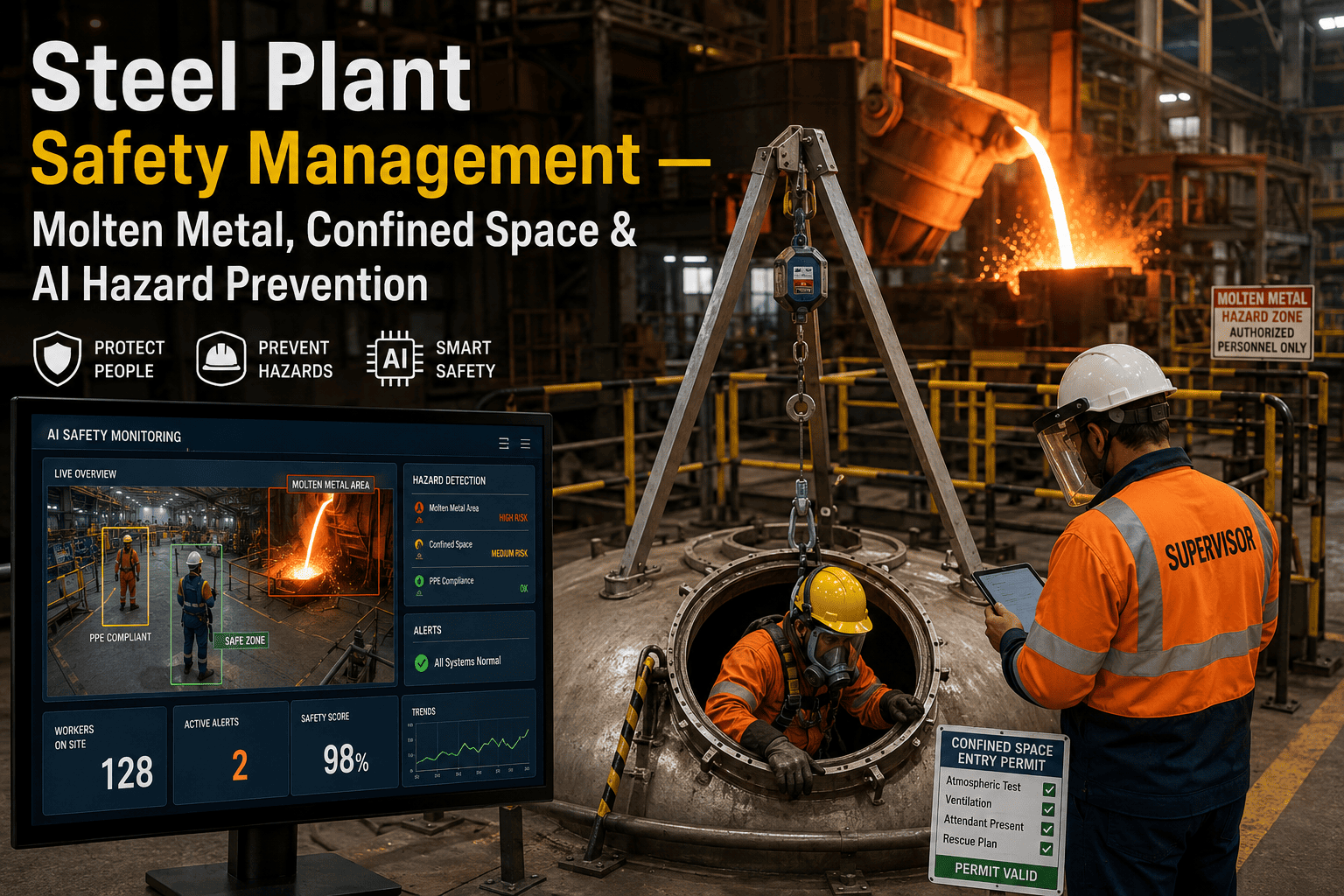
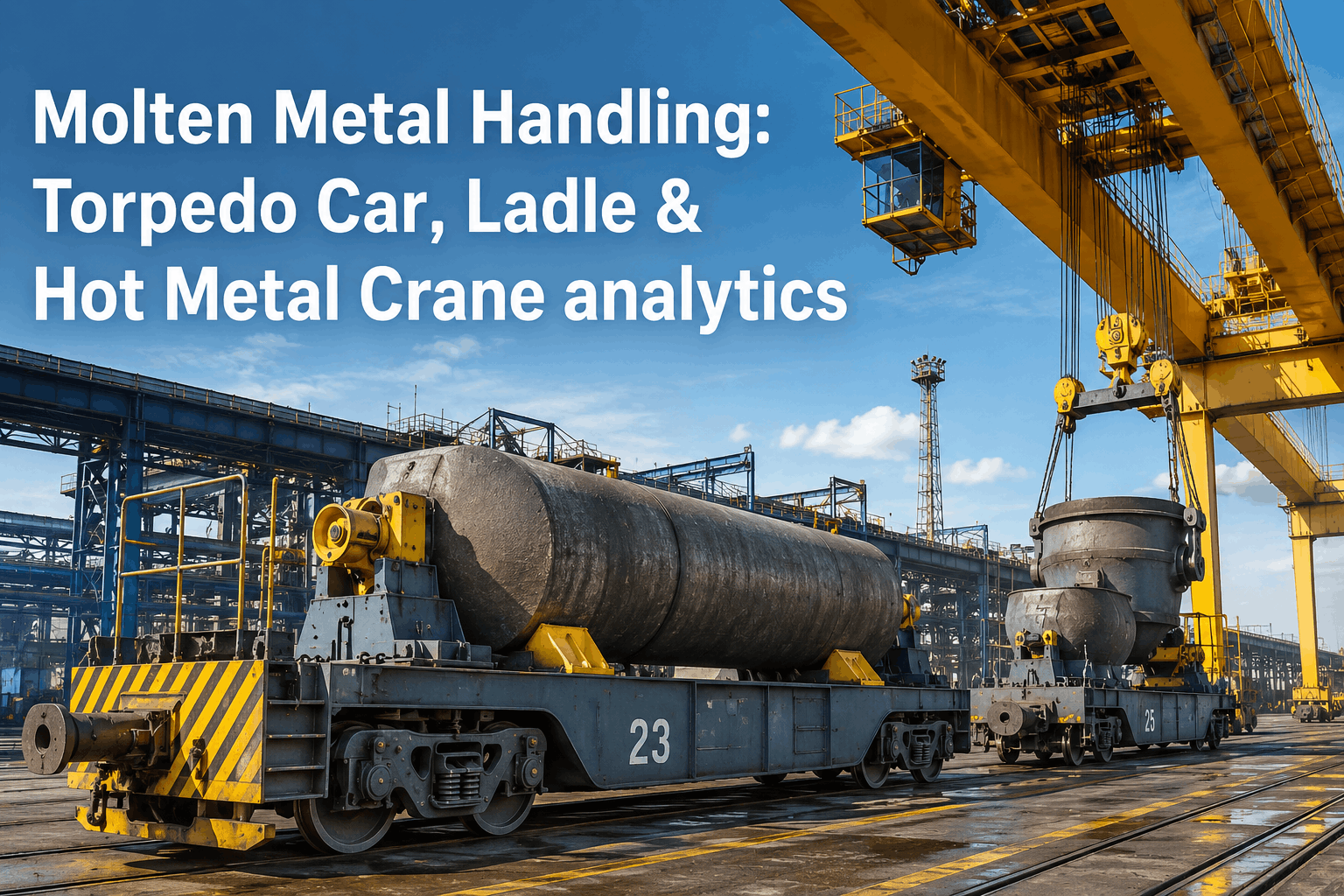
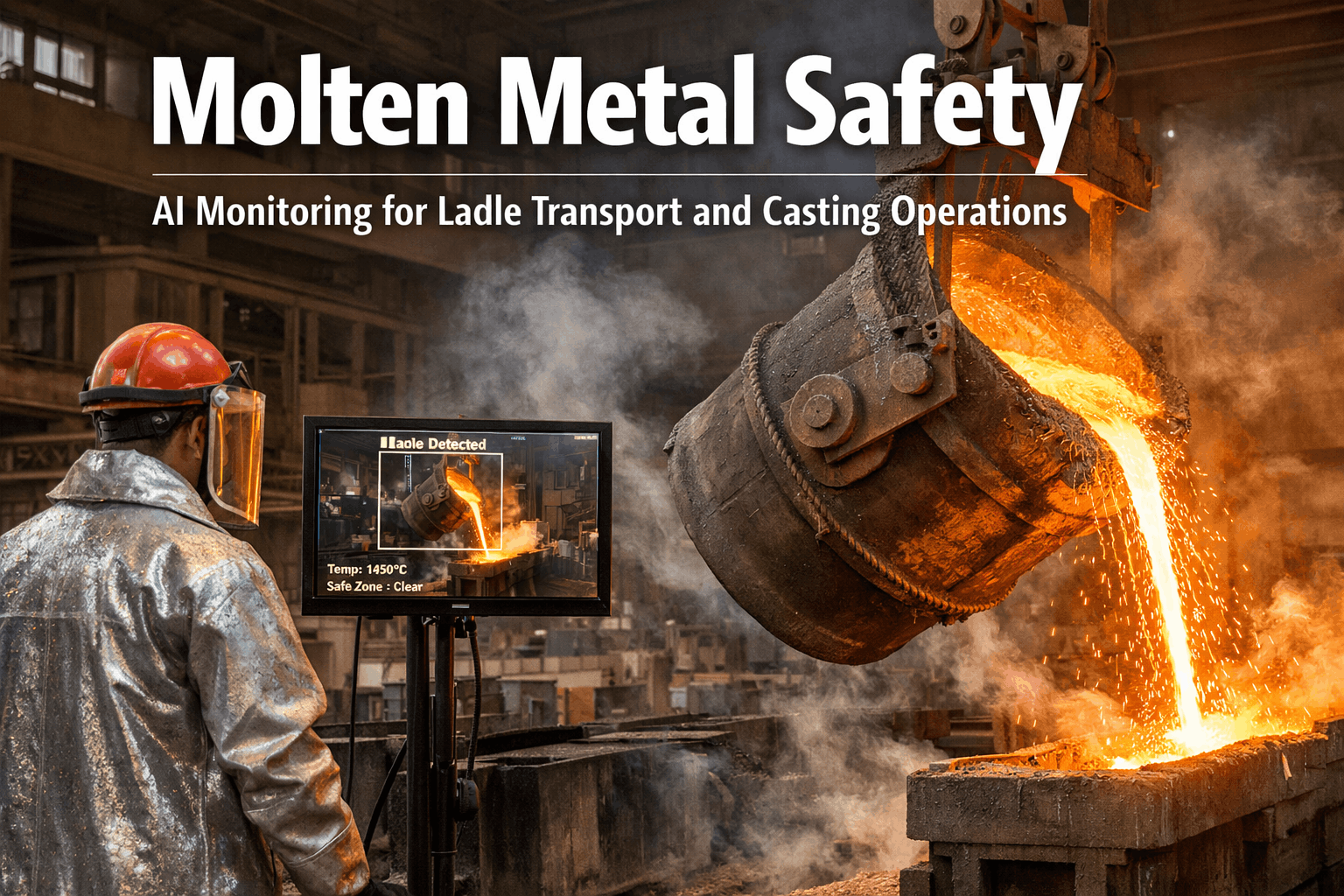
Overhead cranes carrying 150-ton ladles of molten steel at 1,500 degrees Celsius represent the single highest-risk operation in any steel plant — a load path where a single component failure, operator error, or unauthorized worker intrusion can result in a catastrophic event affecting everyone within a 50-meter radius. Traditional crane safety relies on operator training, hand signals, and physical barricades, all of which assume perfect human compliance under extreme time pressure and environmental conditions that degrade visibility and communication. AI crane safety monitoring overlays the existing operational framework with continuous load monitoring, real-time proximity detection between crane paths and ground personnel, anti-collision logic between multiple cranes sharing the same bay, and automated speed profiling that adjusts transport speed based on load stability and zone classification. If your steel plant relies primarily on operator skill and procedural compliance to manage crane-over-worker interactions during molten metal handling, book a demo to see AI crane safety monitoring designed for steelmaking environments, or contact support for a crane safety system assessment.
Crane Safety · Molten Metal Handling
Steel Plant Crane Safety & Molten Metal Handling with AI
AI load monitoring, proximity detection, and anti-collision systems protecting every crane-to-worker interaction during the highest-risk operations in steelmaking.
150+ tons
Typical ladle weight during molten metal transfer operations
50 meters
Blast radius for a catastrophic ladle failure event
0.3 sec
AI response time for proximity alert when worker enters exclusion zone
3-5 cranes
Typical crane count sharing a single melt shop bay simultaneously
Crane Safety Zone Classification for Steel Melt Shops
Every crane operation in a steel plant occurs within a zone classification that determines the required monitoring level and automated intervention threshold. The zone system below defines where AI monitoring transitions from advisory to autonomous enforcement.
Zone A — Direct Load Path
Area directly beneath an active crane carrying molten metal. No personnel permitted during lift operations. AI enforces automatic exclusion with 0.3-second detection and audible alarm.
Autonomous Enforcement
Zone B — Adjacent Travel Path
Area within 15 meters of the horizontal crane path during molten metal transport. Personnel permitted only with active clearance. AI tracks all personnel positions and alerts on unauthorized entry.
Active Monitoring
Zone C — Transfer Station
Area surrounding ladle transfer points where load rotation and tilting create splash and spill hazards. AI monitors load angle, rotation speed, and personnel proximity during transfer operations.
Conditional Alert
Zone D — Standby & Parking
Crane parking and standby positions where the ladle is stationary or the crane is empty. Standard industrial safety rules apply with background monitoring for anomaly detection.
Background Monitor
Before vs. After AI Crane Safety: What Actually Changes
AI crane safety does not replace the crane operator or the safety procedures — it adds a machine-speed perception layer that sees what humans miss under real operating conditions. The comparison below shows the operational differences across the most critical crane safety functions.
| Safety Function |
Procedural-Only Approach |
AI-Enhanced Approach |
| Worker proximity to load path |
Physical barricades, flaggers, and operator visual scan. Barricades often moved or bypassed during non-routine tasks. |
Wearable badges tracked in real time. Any personnel entering Zone A triggers immediate alarm to operator and EHS. Barricade bypass automatically logged. |
| Crane-to-crane anti-collision |
Operator-to-operator radio coordination and fixed spacing rules. Relies on operator judgment under load and time pressure. |
Real-time position tracking of all cranes in shared bays. System calculates closing speed and triggers automatic slow-down or stop before minimum safe distance is violated. |
| Load sway during transport |
Operator adjusts speed based on visual assessment of load sway. Subjective and variable between operators and shift conditions. |
AI sensors measure load swing angle and frequency in real time. Speed profile adjusts automatically — slowing for unstable loads, accelerating for stable ones without operator input. |
| Speed control in transfer zones |
Operator follows posted speed limits for each zone. Speed compliance depends entirely on operator discipline and visibility conditions. |
Zone-based speed limits enforced automatically. Crane decelerates entering Zone C regardless of operator input. Speed violations logged and reported. |
| Post-incident review |
Interviews, witness statements, and CCTV review conducted hours or days after event. Data is fragmented and incomplete. |
Complete operational record including load data, speed, position, personnel locations, and alerts archived automatically. Review available within minutes of any event. |
What the AI System Monitors on Every Crane Cycle
Each crane cycle during molten metal handling generates dozens of data points that the AI system processes simultaneously. The monitoring stack below shows the six critical data streams and the safety decision each one feeds.
01
Load Weight & Center of Gravity
Real-time load cell data tracks weight against the rated capacity and monitors center of gravity shift during tilt operations that could indicate sloshing or partial solidification.
Alert if weight exceeds 95% capacity or CG shift exceeds safe tilt envelope
02
Crane Position & Velocity Vector
Absolute position in the bay and travel speed/direction monitored continuously. Speed profile compared against zone-specific limits in real time.
Enforce zone speed limits automatically and log any override attempts
03
Personnel Proximity Map
All tracked personnel positions compared against the active crane load path. Distance calculated continuously with directional vector to nearest exclusion zone boundary.
Alert at 15m, alarm at 10m, recommend stop at 5m for any personnel in load path
04
Multi-Crane Separation
Relative position and closing speed calculated between all cranes operating in the same bay. Minimum safe separation distance maintained dynamically based on load types.
Auto-slow when closing speed exceeds threshold, auto-stop at minimum separation distance
05
Load Swing & Sway Detection
Pendulum motion of the suspended load measured in real time. Swing amplitude and frequency compared against stability thresholds for the current load type and travel speed.
Reduce travel speed proportional to swing severity, hold position if swing exceeds critical threshold
06
Structural Health Indicators
Crane structural load data, brake performance metrics, and hoist motor current patterns monitored for anomalies that could indicate developing equipment failures.
Flag degraded components before they fail under load, trigger inspection work order
Expert Review
"The crane safety problem in steel plants is fundamentally a perception-speed problem. A crane operator cannot see every worker on the ground floor, cannot calculate closing speed to another crane in real time, and cannot objectively assess load stability under changing conditions — all while managing a 150-ton load of molten metal that will kill anyone in its path if something goes wrong. We ask operators to do this job using visual checks, radio communication, and procedural discipline under heat, noise, and time pressure that degrade all three capabilities. AI crane safety does not replace the operator — it gives the operator machine-speed perception that human vision and judgment cannot provide. The operators who initially resist the system are usually the ones who become its strongest advocates within three months, because they realize it protects them from the scenario every crane operator fears most: the event they did not see coming."
Michael Brennan — Senior Crane Safety Engineer, 22+ years in steel plant overhead lifting systems and OSHA crane standard compliance
Give your crane operators machine-speed perception for the most dangerous operations in your plant. AI monitoring tracks every load, every worker, and every crane in the bay simultaneously — and enforces safety boundaries faster than humanly possible.
Crane Safety Performance: Measurable Outcomes
The following metrics represent aggregated performance data from steel plants that deployed AI crane safety monitoring for molten metal handling operations over a 12-month period. Each metric demonstrates a specific safety outcome that procedural-only approaches cannot reliably measure or control.
94%
Proximity violation detection rate — events caught before any personnel entered the direct load path
0
Crane-to-crane collisions after AI anti-collision deployment across monitored bays
67%
Reduction in zone-speed violations as automatic enforcement replaced operator-dependent compliance
12 min
Average post-incident investigation time reduced from days to minutes with complete automated data capture
Frequently Asked Questions
How does the system distinguish between authorized and unauthorized personnel in crane zones?
Each worker in the monitored area wears a tracked badge that communicates with the system. Authorized personnel in Zones B and C appear as identified tracked individuals with clearance status visible to the crane operator. Unbadged or unauthorized personnel trigger an immediate alert regardless of zone. The system can integrate with existing access control systems to auto-populate clearance status based on training certifications and shift assignments.
Book a demo to see the personnel tracking integration workflow.
What happens when the AI recommends stopping a crane during a critical molten metal transfer?
The system provides a recommendation with the specific hazard data that triggered the recommendation — such as a worker in the load path or an approaching crane collision threshold. The crane operator retains full control authority and makes the final decision to stop or adjust. However, all recommendations and operator responses are logged, creating an audit trail that documents whether the operator followed or overrode the safety recommendation and the reason provided.
Contact support for override policy configuration options.
Can this system be retrofitted to older crane models without replacing the crane control system?
Yes. The monitoring system uses external sensors — load cells, position encoders, cameras, and personnel tracking beacons — that are independent of the crane control system. No integration with the crane's PLC or drive system is required for monitoring and alerting functions. Optional integration with crane controls for automated speed enforcement is available for newer crane systems that support external speed commands.
Book a demo to review retrofit hardware options for your crane models.
How does the system handle the extreme heat and electromagnetic interference near EAF and ladle operations?
Personnel tracking beacons use industrial-grade enclosures rated for the temperature and EMI conditions in steel melt shops. Position sensors on cranes use shielded enclosures and filtered power systems designed for proximity to EAF operations. Each installation point is validated under full production conditions during commissioning, and sensor health is monitored continuously so degradation is detected before a monitoring gap creates a safety blind spot.
Contact support for environmental rating specifications.
What is the typical deployment timeline for crane safety monitoring across an entire melt shop?
Most steel plants deploy in phases, starting with the highest-risk cranes — typically the ladle cranes serving the EAF or BOF — which takes 4 to 6 weeks for a single-crane pilot including sensor installation, zone mapping, and integration testing. Full melt shop coverage across all cranes and shared bays typically requires 3 to 6 months depending on the number of cranes, bay complexity, and coordination requirements between operations and maintenance schedules.
Book a demo to build a phased deployment timeline for your melt shop.
Protect Every Crane Lift with Machine-Speed Safety Intelligence
AI load monitoring, personnel proximity detection, anti-collision logic, and automated zone enforcement — built for the extreme conditions of molten metal crane operations in steel plants.