Fugitive dust never passes through a stack, a chimney, or a vent, which is exactly why it is harder to control than any point-source emission a steel plant manages, and why EHS managers who rely on periodic visual assessment alone are often the last to know when opacity limits are drifting toward violation. Raw material stockyards, coke oven battery door leakage, transfer point spillage, and melt shop roof monitors all generate diffuse particulate close to ground level, where wind, humidity, and material handling activity change the emission picture hour to hour rather than shift to shift. Regulatory opacity limits for these sources have tightened in recent NESHAP updates, with several fugitive limits moving from 20 percent down to 5 percent opacity, leaving far less margin for a control measure that quietly stops working. EHS managers who book a demo of iFactory's fugitive dust monitoring typically start with melt shop and material handling zones, since these carry the tightest opacity margins in the current standard.
Catch Opacity Drift Before It Becomes a Reportable Exceedance
iFactory correlates roof monitor, transfer point, and stockpile dust data with wind and humidity conditions, giving EHS managers early warning before a control measure failure turns into a violation.
Why Fugitive Dust Requires a Different Monitoring Approach Than Stack Emissions
Stack emissions are managed through a mature toolkit of baghouses, electrostatic precipitators, and continuous emissions monitoring systems that sample a defined gas stream at a single point. Fugitive and diffuse emissions have no single point to sample, since they escape from an entire stockpile surface, a transfer point, or a roof monitor opening across an area rather than a duct, which is why many facilities still rely on visual opacity assessment performed by trained observers during working hours. This approach captures a snapshot rather than a continuous picture, and wind speed alone can shift a site from well within compliance to a visible dust event within the same shift, long before the next scheduled visual check would catch it.
Matching Control Measures to Fugitive Dust Sources
Every fugitive dust source on a steel plant site has a corresponding control measure, but those measures only remain effective if they are maintained on a schedule that matches how quickly they degrade in service, not a generic annual inspection cycle. EHS managers who book a consultation with iFactory can review which control measures are already deployed on their site and where continuous monitoring would close the largest compliance gap.
| Source | Primary Control Measure | Degradation Risk | Monitoring Focus |
|---|---|---|---|
| Raw Material Stockpiles | Wind fences, chemical crusting agents | Wind erosion, surface disturbance | Wind speed, PM sensor network |
| Transfer Points | Enclosures, dust collection | Seal wear, collection fan failure | Enclosure integrity, fan performance |
| Coke Battery Doors | Door seal maintenance | Seal leakage over duty cycles | Visible leakage frequency |
| Melt Shop Roof Monitor | Primary and secondary dedusting | Baghouse seal or fan failure | Opacity trend, baghouse pressure drop |
| Haul Roads | Water spray, paving | Suppression frequency lapses | Application schedule adherence |
See Fugitive Dust Risk Before the Wind Turns a Non-Issue Into a Violation
iFactory correlates dust monitoring data with real-time wind and humidity conditions, flagging when a control measure needs attention before opacity limits are approached.
What Continuous AI Monitoring Adds Beyond Visual Assessment
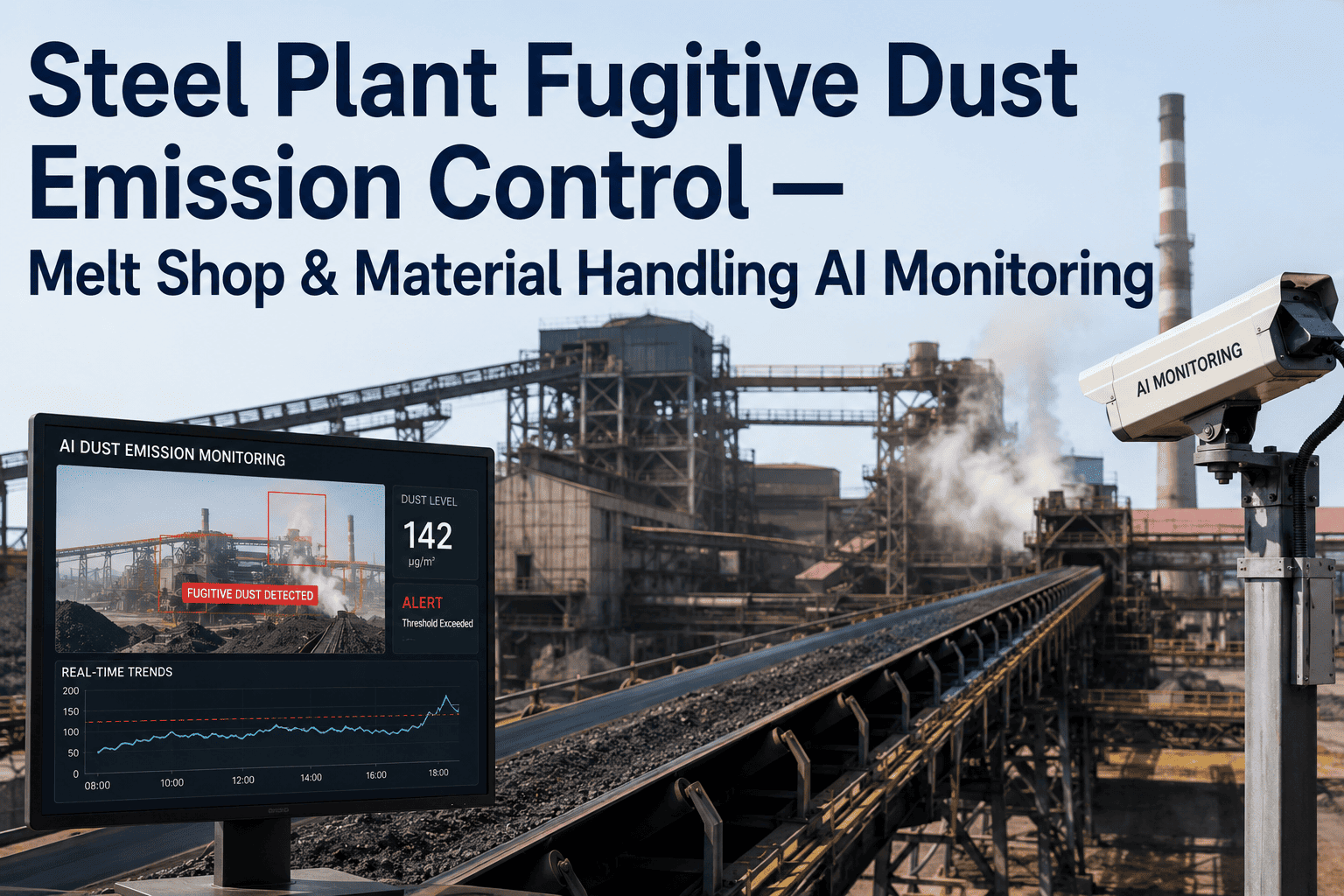
Some of the most advanced fugitive dust monitoring deployments in the steel industry use networks of particulate matter sensor towers positioned around material handling, stockpiling, and process areas, with additional stations measuring wind speed and direction to distinguish on-site sources from off-site transport. This kind of continuous sensing turns fugitive dust from a periodic visual judgment call into a data stream that can be correlated against production activity, weather conditions, and control measure status in real time.
Continuous PM Sensor Networks
Distributed particulate sensors around stockpiles, transfer points, and process areas provide continuous readings that replace or supplement periodic visual opacity checks.
Wind and Weather Correlation
Correlating PM readings with real-time wind speed and direction identifies whether a reading traces to a specific on-site source or off-site transport, sharpening root cause investigation.
Baghouse and Fan Health Tracking
Pressure drop and fan performance data on primary and secondary dedusting systems flag seal or fan degradation before it manifests as a visible opacity exceedance.
Control Measure Compliance Logging
Every scheduled control measure, from water spray application to chemical crusting agent reapplication, is logged and linked to the compliance record for audit-ready documentation.
Fugitive Dust Compliance, By the Numbers
Recent regulatory updates have tightened opacity limits at several key fugitive sources, meaning the operational margin for control measure failure is now smaller than it was for many existing steel plant EHS programs.
Rolling Out Continuous Fugitive Dust Monitoring
Because fugitive dust sources vary widely across a steel plant site, rollout typically starts with the zones carrying the tightest regulatory margin before expanding to lower-risk areas.
Map Every Fugitive Source and Control Measure
A complete inventory of stockpiles, transfer points, coke battery doors, and roof monitors is built alongside their assigned control measures and maintenance schedules.
Instrument High-Risk Zones First
PM sensors and wind stations are deployed around melt shop and material handling areas carrying the tightest opacity margins under current NESHAP limits.
Correlate Readings With Wind and Production Activity
Continuous PM data is layered against wind conditions and production schedules to distinguish genuine control measure failures from weather-driven readings.
Extend to Full-Site Compliance Documentation
Monitoring expands across remaining fugitive sources, feeding a unified compliance record that supports Title V and NESHAP reporting requirements.
Fugitive Dust Emission Control — Frequently Asked Questions
How is fugitive dust different from stack emissions for compliance purposes?
Fugitive emissions do not pass through a defined stack or vent, meaning they cannot be measured with the same continuous emissions monitoring systems used for point sources and instead rely heavily on visual opacity assessment, control measure maintenance records, and increasingly, distributed particulate sensor networks. This makes fugitive dust compliance more dependent on consistent control measure upkeep than on a single instrument reading.
Can continuous PM monitoring replace required visual opacity assessments?
Continuous monitoring supplements rather than replaces the visual opacity assessments required under most permits, but it provides supporting data between formal checks and can help identify a developing problem long before the next scheduled visual assessment occurs. Teams that book a demo can review how this fits alongside their existing compliance protocol.
Why did opacity limits for BOPF shop and blast furnace casthouse fugitive emissions get tighter?
Recent NESHAP technology review updates reduced these limits from 20 percent down to 5 percent opacity, reflecting current achievable control performance across the industry, which means facilities relying on control measures sized for the previous limit now have significantly less operating margin before a violation.
How quickly can wind correlation identify whether a PM reading is a genuine on-site issue?
When PM sensor data is paired with wind speed and direction measurements at multiple heights, elevated readings can typically be attributed to a specific upwind source or ruled out as off-site transport within the same monitoring window, rather than requiring a separate investigation days later.
Does this monitoring approach help during a regulatory inspection or audit?
Continuous monitoring data, control measure maintenance logs, and wind correlation records together create an auditable history that supports compliance documentation during an inspection, rather than relying solely on periodic visual assessment logs. EHS teams can contact support to review documentation formats suited to their permit requirements.
Keep Fugitive Dust Inside the Line Before It Becomes a Violation
iFactory helps EHS managers monitor melt shop, material handling, and stockpile dust continuously, correlating readings with wind conditions to catch control measure failures early.