Acoustic Emission Monitoring for Steel Plant Assets
By Friar Lawrence on June 19, 2026
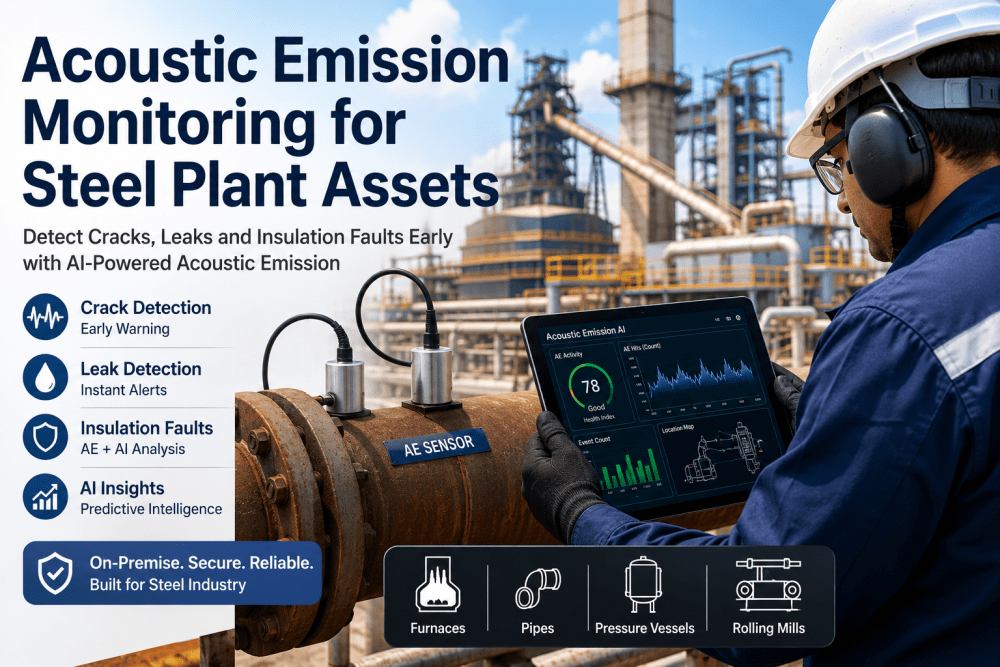
Steel plants across the USA, Canada, UK, and Australia operate some of the most asset-intensive industrial environments in the world — blast furnaces running above 2,000 degrees Fahrenheit, miles of high-pressure steam and gas piping, massive rolling mills subject to continuous cyclic fatigue, and pressure vessels holding molten metal and toxic gases under extreme thermal and mechanical stress. Across every one of these assets, a hidden risk remains invisible to scheduled inspection cycles: cracks, leaks, insulation faults, and material degradation that propagate silently until they become catastrophic failures. Traditional Non-Destructive Testing methods — ultrasonic thickness gauging, visual inspection, and periodic manual acoustic emission surveys — leave weeks or months of blind gaps during which critical faults can develop undetected. iFactory Acoustic AI Platform changes this entirely — deploying continuous, AI-powered acoustic emission monitoring across your most critical steel plant assets, training machine learning models on your plant's unique acoustic signatures, and detecting crack growth, leak propagation, and insulation degradation days or weeks before manual inspection would catch them. Book a Demo to see how iFactory deploys AI-driven acoustic emission monitoring across your steel plant asset fleet within 4 weeks.
96%
Crack and leak detection accuracy trained on plant-specific acoustic signatures vs. 54% for threshold-based AE systems
$340K
Average annual cost avoidance from prevented structural failures, leaks, and furnace breakthroughs per steel plant
82%
Reduction in manual NDT inspection costs vs. fixed-interval scheduled AE surveys and UT campaigns
4 wks
Full deployment timeline from sensor installation to live AI-powered acoustic emission monitoring
The Real Cost of Undetected Acoustic Faults in Steel Plant Assets
Most steel plants invest heavily in periodic NDT inspection — ultrasonic thickness gauging, magnetic particle testing, dye penetrant, and manual AE surveys — but these scheduled campaigns leave critical coverage gaps between inspection cycles. Without continuous AI-powered acoustic emission monitoring, the following risk scenarios remain invisible until they become emergency events:
Undetected Crack Growth in Pressure Vessels and Piping
Fatigue cracks in torpedo ladle shells, vacuum degasser vessels, and high-pressure steam piping propagate continuously under operating loads. Semi-annual manual AE surveys detect cracks only after they have reached detectable amplitude — by which point repair costs are 3–5 times higher than if caught during the initiation phase. Continuous AE monitoring detects crack growth rate changes within hours.
Refractory Breakthrough Without Warning
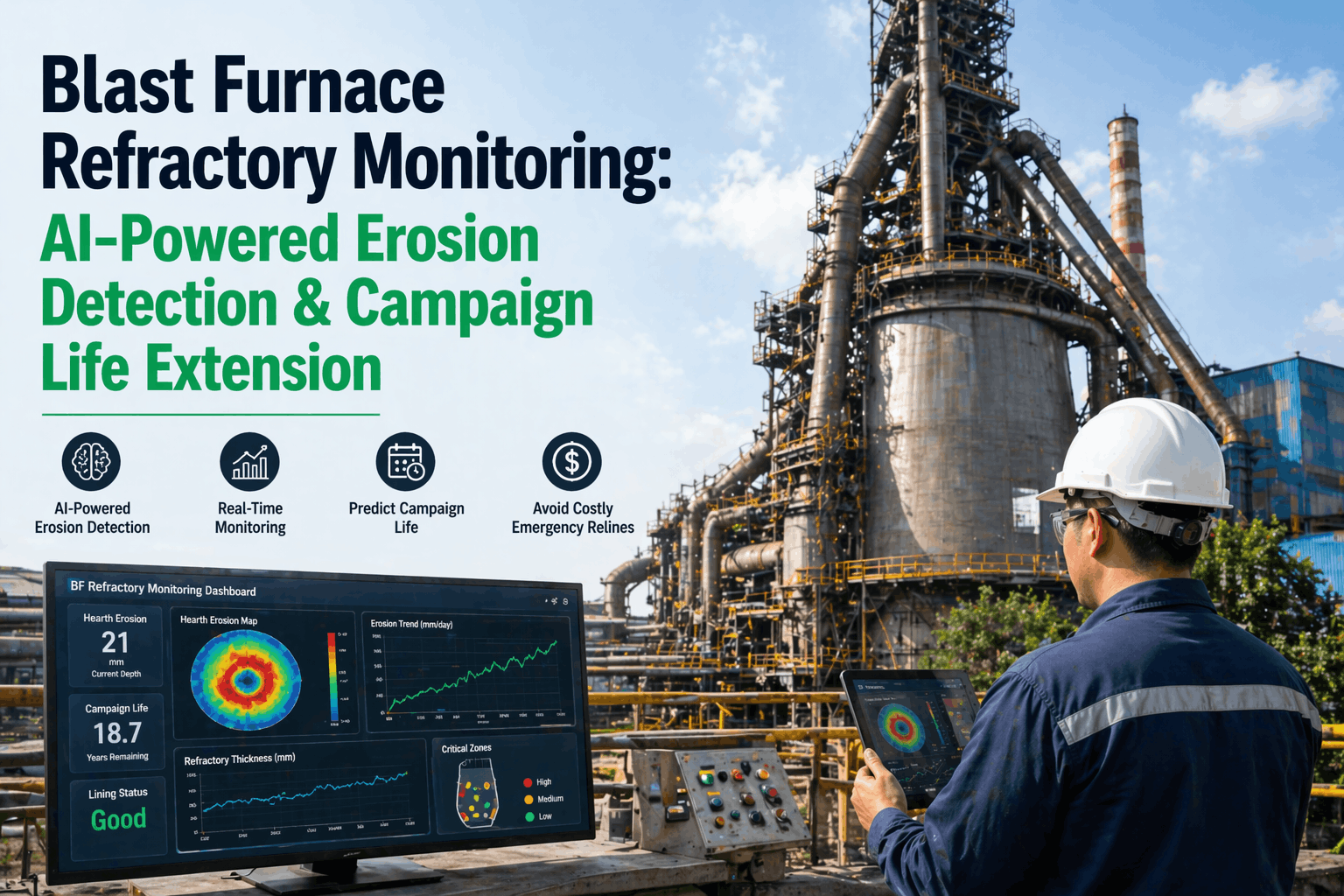
Blast furnace hearth refractory wear and BOF lining erosion occur unevenly and accelerate unpredictably under slag chemistry changes and thermal cycling. Without continuous AE monitoring keyed to spalling frequency signatures, breakthrough events that cause molten metal runouts and multi-week production losses remain the steel industry's most catastrophic unplanned event category.
Manual NDT Inspection Gaps Between Campaigns
Even best-in-class steel plants with quarterly AE survey programs operate with 90+ days of blind coverage between inspection cycles. Critical faults that initiate on day 2 of a cycle can propagate to failure by day 60 — well before the next manual survey. AI-powered continuous AE monitoring eliminates this blind window entirely, providing 24/7 asset health surveillance.
Traditional threshold-based AE systems cannot reliably distinguish between crack growth events, leak noise, and normal operational sounds from adjacent processes — generating high false positive rates that erode inspector trust and lead to bypassed alerts. AI classifiers trained on your plant's specific acoustic environment filter background noise automatically and flag only genuine degradation events.
$150K–$2M
Cost per unplanned refractory breakthrough or pressure vessel failure event
54%
Crack detection rate under threshold-based periodic AE survey programs
12–16 wks
Average interval between scheduled manual NDT inspection campaigns at most steel plants
Every Undetected Crack Costs $150,000–$2,000,000. Continuous AI Acoustic Emission Monitoring Catches It Weeks Before Manual Inspection Would.
iFactory's Acoustic AI platform deploys permanent sensor arrays across your furnace, vessel, structural, and rotating assets — training ML models on your plant's specific acoustic signatures to detect crack growth, leak propagation, and refractory degradation with 96% accuracy and under 3% false positive rate. Automated work order generation, CMMS integration, and continuous 24/7 monitoring included.
See how steel plant inspection teams across the USA, Canada, UK, and Australia use iFactory Acoustic AI to detect structural faults earlier, reduce NDT campaign costs, and eliminate unplanned asset failures.
Book a 30-minute Steel Plant Acoustic AI Demo with iFactory's industrial NDT and reliability engineering team.
How iFactory Acoustic AI Transforms Steel Plant Asset Monitoring
iFactory does not apply generic acoustic emission models trained on laboratory samples to your steel plant — it deploys permanent waveguide-mounted or adhesive-bonded AE sensor arrays across your critical assets and trains ML classifiers on your plant's specific operational acoustic environment, structural geometry, and failure history. The result is a continuously improving acoustic intelligence engine that understands the difference between a benign operational noise and a propagating crack in your specific asset fleet.
01
AE Sensor Deployment and Baseline Acoustic Survey
iFactory installs permanent resonant AE sensor arrays on furnace shells, pressure vessels, structural steel nodes, and mill gearbox casings — collecting 2–4 weeks of baseline acoustic waveform data to characterise normal operating signatures, background noise profiles, and process-specific acoustic events for each asset class.
02
ML Model Training on Plant-Specific Acoustic Signatures
Proprietary ML classifiers are trained on your plant's baseline AE dataset, confirmed failure event waveforms, and NDT correlation records — learning to differentiate crack growth AE bursts, leak signatures, refractory spalling events, and bearing degradation signals from routine operational noise. False positive rate targets under 3% before production deployment.
03
Real-Time Acoustic Anomaly Detection and Classification
Continuous waveform streaming from all deployed AE sensors is processed through trained ML classifiers in real time — detecting crack initiation events, leak progression, insulation degradation, and mechanical fault signatures within seconds of occurrence. Every classified event includes amplitude, frequency content, energy, and location estimate data.
04
Automated NDT Inspection Trigger and Work Order Generation
When AE trend data crosses pre-defined risk thresholds per asset class, iFactory auto-generates a prioritised NDT inspection work order with waveform evidence, estimated defect location, and recommended inspection method — integrated directly into SAP PM, IBM Maximo, or your existing CMMS. Inspection engineers receive actionable intelligence, not raw waveform dumps.
05
Continuous Model Retraining on Confirmed Inspection Outcomes
Every confirmed NDT inspection result, repair outcome, and false positive event feeds back into the ML training pipeline — improving classification accuracy with each plant-specific defect confirmation. Models learn your asset fleet's evolving degradation behaviour, welding repair history, and operational stress patterns over time.
06
Acoustic Health Dashboard and Inspection Priority Ranking
iFactory presents a ranked asset health dashboard across all monitored steel plant assets — inspect now, monitor weekly, track monthly, or clear — with AE trend curves, crack growth rate estimates, remaining safe operating window projections, and NDT cost-impact trade-off recommendations per asset.
Proven KPI Results: Acoustic AI Impact from Live Steel Plant Deployments
iFactory's AI-powered acoustic emission monitoring platform delivers measurable inspection efficiency and failure prevention improvements within the first 60 days of full production rollout. The following KPIs reflect aggregated performance data across furnace, vessel, structural, and rotating assets at operating steel facilities in the USA, Canada, UK, and Australia.
1–4 Weeks
AE Fault Detection Lead Time
Asset-specific ML classifiers detect crack growth, leak initiation, and refractory degradation 1–4 weeks before manual NDT inspection or visual signs would confirm the defect.
96%
Crack and Leak Detection Accuracy
ML models validated across furnace shell cracking, pressure vessel fatigue cracks, structural weld defects, and gear tooth damage — compared to 54% detection rate for threshold-based AE survey methods.
82%
Reduction in Manual NDT Inspection Spend
Shift from fixed-interval AE survey campaigns covering all assets to targeted, AI-triggered inspections focused only on assets with confirmed acoustic degradation signatures.
97%
Automated NDT Trigger Generation Rate
Acoustic alerts auto-create CMMS inspection work orders with waveform evidence, estimated defect location, and recommended NDT method — without manual data review or supervisor approval delays.
71%
Reduction in Unplanned Structural and Vessel Failures
Continuous AE monitoring prevents crack propagation past critical thresholds and eliminates mid-cycle structural failures that would otherwise require emergency process shutdowns and extended repair outages.
34%
Increase in Asset Inspection Coverage
Permanent AE sensor arrays monitor 100% of critical asset surfaces continuously — replacing discrete spot-check inspection points with full-coverage structural health surveillance.
<3%
False Positive Alert Rate
AI classifier cross-validation across frequency, amplitude, and energy parameters before any acoustic alert fires
Continuous
AE Waveform Streaming and Analysis
Per-asset acoustic health score updated in real time from live sensor waveform streams
7 days
CMMS and ERP Integration
Full OPC-UA, Modbus TCP, and REST API connection to your existing maintenance and NDT management stack
84%
Reduction in Emergency Repair Mobilizations
Emergency structural repairs and vessel replacements eliminated from first month of live acoustic AI deployment
How iFactory Acoustic AI Compares to Traditional AE Testing and NDT Campaigns
Most steel plants rely on periodic manual AE surveys, ultrasonic thickness campaigns, and visual inspection programs that treat every inspection cycle in isolation, with no learning from previous inspection outcomes and no continuous surveillance between campaigns. iFactory is built differently — deploying permanent AE sensor arrays and AI classifiers that learn your plant's acoustic environment continuously and trigger targeted NDT inspection only when degradation signatures are confirmed.
Capability
Traditional AE / Periodic NDT Campaigns
iFactory Acoustic AI Platform
Monitoring Coverage Model
Discrete spot-check inspections conducted every 3–6 months per asset. Blind coverage gaps between campaigns during which critical faults can propagate to failure undetected.
24/7 continuous AE sensor coverage across 100% of critical asset surfaces. Every crack initiation, leak event, and degradation signature is detected within seconds of occurrence.
Acoustic Signature Classification
Human analyst interpretation of waveform data post-survey. Classification accuracy depends on inspector experience and varies significantly between campaigns and shifts.
AI classifiers trained on your plant's specific acoustic environment, asset geometries, and failure history. Crack growth, leak noise, and benign operational sounds are differentiated automatically with 96% accuracy.
Noise Rejection Capability
Fixed amplitude threshold filtering catches high-energy events only. Low-amplitude crack growth and gradual leak progression are masked by background operational noise at most steel facilities.
Multi-parameter ML classifiers analyse frequency content, burst energy, duration, and count rate simultaneously — distinguishing genuine AE events from operational noise with under 3% false positive rate.
CMMS and NDT Workflow Integration
Manual inspection report generation and data entry. No automated connection between AE survey findings, work order creation, or parts procurement for repair scopes.
Native OPC-UA, Modbus TCP, and REST connectors for SAP PM, Maximo, Infor EAM, and Oracle EBS. Auto-generates prioritised NDT inspection work orders with waveform evidence, estimated defect location, and recommended inspection method.
Cross-Cycle Learning and Trend Analysis
Each inspection campaign is analysed independently. No continuous trend database aggregates AE data across multiple survey cycles to track crack growth rates or degradation acceleration patterns.
Continuous AE waveform database with every classified event stored and trended over time. Crack growth rate calculations, degradation acceleration detection, and remaining safe operating window projections updated in real time.
False Positive Management
High false positive rates from fixed-threshold systems and environmental noise pick-up. Inspection teams develop alert fatigue and begin discounting AE survey findings — masking genuine early-stage degradation.
Under 3% false positive rate through AI classifier cross-validation and continuous model retraining on confirmed inspection outcomes. Only confirmed degradation signatures trigger NDT inspection work orders.
Deployment Timeline
3–9 months for AE sensor procurement, installation planning, baseline survey execution, and analyst training. High engineering overhead and extended timeline before first actionable intelligence is produced.
4-week fixed deployment: sensor installation and baseline survey in week 1, ML classifier training in week 2, pilot asset monitoring live by week 3, plant-wide rollout by week 4.
See how steel plant inspection teams across the USA, Canada, UK, and Australia use iFactory Acoustic AI to detect structural faults earlier, reduce NDT campaign costs, and eliminate unplanned asset failures.
Book a 30-minute Steel Plant Acoustic AI Demo with iFactory's industrial NDT and reliability engineering team.
What Steel Plant Inspection Engineers Say About iFactory Acoustic AI
The following testimonial is from the NDT and Inspection Manager at a major integrated steel mill currently running iFactory's Acoustic AI platform in the USA.
We have been running manual AE surveys on our blast furnace shells, torpedo ladles, and steam piping for over a decade, and we always knew we were missing events between campaign cycles. The gap between quarterly surveys was wide enough for cracks to grow past the point of weld repair into full section replacement scope. iFactory deployed permanent AE sensor arrays across our highest-criticality assets and trained ML classifiers on 18 months of our historical operational and failure data. Within the first 60 days live, the system flagged an active crack propagation event on a main steam header that our last manual AE survey had cleared as no-fault — we intervened during the next planned outage and completed a weld repair at $38,000 instead of a $600,000 emergency replacement. In 14 months of continuous monitoring, iFactory has detected 27 structural degradation events that our periodic inspection program would have missed, with zero false positive alerts that required unnecessary inspection call-outs. Our NDT budget dropped 58%, and our insurance surveyor reclassified our asset risk rating after reviewing the continuous AE surveillance records.
NDT and Inspection Manager
Integrated Steel Mill, Midwest USA
Financial Impact and Cost Avoidance by Steel Plant Asset Class
Beyond NDT inspection cost reduction, iFactory's Acoustic AI platform directly protects steel plant production revenue and eliminates the compounding costs of unplanned structural failures — quantified below by asset class from live steel plant deployments across the USA, Canada, UK, and Australia.
Annual unplanned outage cost avoidance per facility — prevented refractory breakthroughs, shell cracking events, and molten metal runouts at $100,000–$2,000,000 per incident including production losses and repair costs.
Annual leak and rupture cost savings — eliminating crack propagation events, steam pipe bursts, and molten metal containment failures that trigger extended process shutdowns and environmental reporting obligations.
Annual structural failure prevention — crack detection in crane girders, ladle turret structures, and building steel that would otherwise progress to critical defects requiring multi-week production outages for repair.
Acoustic AI Deployment and Integration Readiness Checklist
Continuous 24/7 acoustic emission monitoring across all critical furnace, vessel, structural, and rotating steel plant assets
AI model training on plant-specific acoustic signatures, operational noise profiles, and confirmed failure event waveforms
OPC-UA and Modbus TCP real-time AE sensor data ingestion from installed sensor arrays and existing DCS infrastructure
SAP PM, IBM Maximo, and CMMS bidirectional integration for automated NDT inspection work order generation
ISO 9712 NDT personnel compliance documentation and ASNT SNT-TC-1A certification tracking generated automatically from AE surveillance records
OSHA PSM and EPA RMP compliance documentation for pressure vessel and piping AE monitoring programs
See how steel plant inspection teams across the USA, Canada, UK, and Australia use iFactory Acoustic AI to detect structural faults earlier, reduce NDT campaign costs, and eliminate unplanned asset failures.
Book a 30-minute Steel Plant Acoustic AI Demo with iFactory's industrial NDT and reliability engineering team.
Conclusion: Stop Losing Millions to Structural Faults Your Acoustic Data Already Reveals
Steel plants across the USA, Canada, UK, and Australia generate millions of hours of acoustic emission data every year — data that is collected during periodic NDT campaigns, analysed in isolation, and filed away without ever being aggregated into a continuous structural health intelligence record. The gap between world-class inspection engineering programs and the industry average is not a sensor technology gap or an NDT capability gap. It is a gap in whether acoustic data is collected continuously and analysed by AI models that learn your plant's specific acoustic language.
iFactory Acoustic AI closes that gap in four weeks. Permanent AE sensor arrays across furnace, vessel, structural, and rotating assets. AI classifiers trained on your plant's own acoustic signatures and failure history. Automated NDT inspection work order generation triggered only by confirmed degradation events. Continuous model retraining that improves detection accuracy with every confirmed inspection outcome. Deployed at operating steel facilities across four continents without disrupting production schedules or requiring NDT personnel retraining.
The $340,000 average annual cost avoidance per plant, the 82% reduction in manual NDT inspection spend, and the 71% reduction in unplanned structural and vessel failures are outcomes already measured at live steel plant deployments. They are available to any inspection engineering team ready to let their acoustic data start working 24 hours a day, 365 days a year.
Frequently Asked Questions
Traditional AE testing uses portable sensor arrays deployed during scheduled inspection campaigns, capturing waveform snapshots at 3–6 month intervals. iFactory's Acoustic AI deploys permanent sensor arrays that stream continuous waveform data to ML classifiers trained on your plant's specific acoustic environment — detecting crack initiation and leak events within seconds rather than waiting for the next scheduled survey. Continuous monitoring eliminates blind coverage windows entirely.
Blast furnace refractory shells and torpedo ladle pressure vessels consistently deliver the highest ROI due to the catastrophic cost of breakthrough events and the difficulty of detecting crack propagation through thick steel and refractory layers using periodic inspection methods. Rolling mill gearboxes and overhead crane structures rank second, where AE detection provides 2–6 week advance warning of failures that vibration monitoring alone cannot detect at low rotational speeds.
Yes. iFactory's ML classifiers are trained on your specific plant's operational acoustic baseline during the 2–4 week setup phase, learning to differentiate crack growth AE bursts, leak signatures, and refractory spalling events from routine operational noise generated by adjacent processes, material handling, and environmental sources. The system maintains under 3% false positive rate through multi-parameter cross-validation across frequency, energy, duration, and count-rate parameters simultaneously.
iFactory connects natively to SAP PM, IBM Maximo, Infor EAM, and Oracle EBS via OPC-UA, Modbus TCP, and REST APIs. When AE trend data crosses pre-defined risk thresholds, the system auto-generates a prioritised NDT inspection work order with waveform evidence, estimated defect location, recommended inspection method, and suggested repair scope — eliminating manual data analysis and report writing from the inspection trigger process.
iFactory's full deployment is completed in 4 weeks: sensor installation and baseline acoustic survey in week 1, ML classifier training in week 2, pilot asset monitoring live by week 3, and plant-wide rollout by week 4. NDT and inspection personnel achieve platform proficiency in under 2 hours through role-based training modules focused on alert interpretation, NDT trigger validation, and CMMS workflow integration.
Turn Every Acoustic Waveform Into a Continuous Structural Health Intelligence Stream. Deploy in 4 Weeks. ROI in Week 3.
iFactory gives steel plant inspection engineering teams permanent AE sensor arrays, AI classifiers trained on their own plant's acoustic signatures, automated NDT work order generation, and real-time crack detection intelligence — fully deployed in 4 weeks, with measurable cost avoidance starting in week 3.