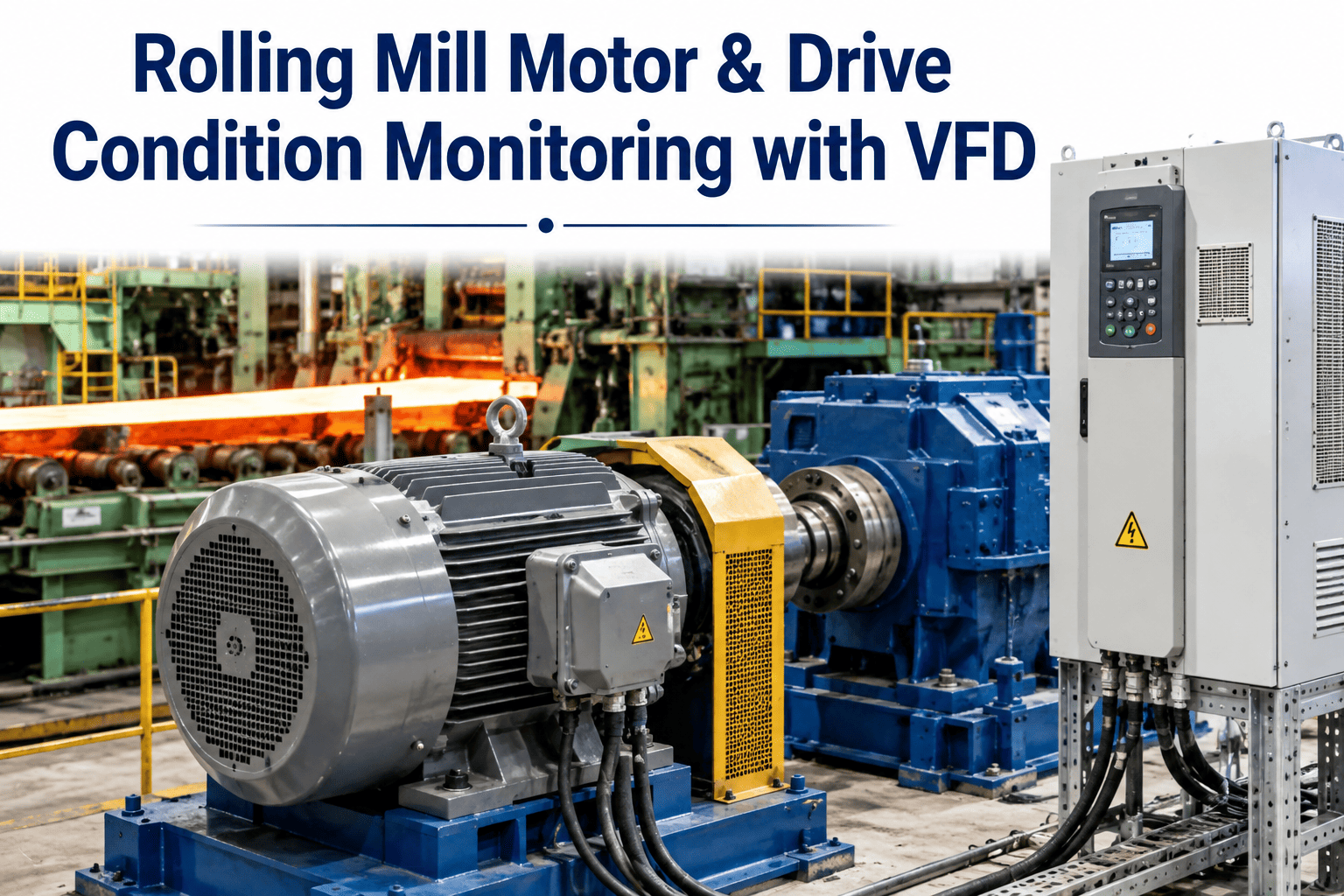
Condition monitoring is the discipline of measuring physical parameters of operating equipment — vibration, temperature, oil particle count, ultrasonic emission, motor current — to detect deterioration before it becomes failure. In steel plant operations, where a single unplanned failure on a critical asset can cost ₹80 lakh to ₹4 crore in lost production and repair, condition monitoring is not a nice-to-have programme — it is the primary financial justification for the entire maintenance budget. The challenge is that effective condition monitoring requires five distinct technologies, each detecting different failure modes on different asset types, integrated into a single programme that connects findings to work orders and tracks trends over time. A vibration analyser without trend history is a one-time measurement. Oil analysis without action triggers is a laboratory cost with no ROI. iFactory's Condition Monitoring and Diagnostics platform integrates all five techniques — vibration, oil, thermography, ultrasonic, and motor current — into one platform where every reading, every finding, and every alert connects directly to SAP PM work orders and asset maintenance history.
Steel Plant Condition Monitoring Program: Vibration, Oil, Thermal & Ultrasonic Testing
Build a complete CBM program across all five condition monitoring techniques — with AI trend analysis, SAP PM integration, and failure prediction 4–12 weeks ahead of breakdown.
The 5 Condition Monitoring Techniques — What Each Detects & When to Use It
Each condition monitoring technique detects a specific set of failure modes. No single technique covers everything. A world-class steel plant CBM programme deploys all five — matched to the right asset type and failure mechanism. Request your CBM programme design — iFactory maps techniques to your specific asset register.
| Technique | Primary Failure Modes Detected | Key Assets in Steel Plant | Lead Time | iFactory Integration |
|---|---|---|---|---|
| Vibration Analysis | Bearing wear · imbalance · misalignment · looseness · gear mesh | All rotating equipment — motors, fans, pumps, compressors, rolling mill drives | 4–8 weeks | Online sensors + route-based · AI trend · SAP WO auto-create |
| Oil Analysis | Wear particle count · contamination · viscosity change · additive depletion | Gearboxes · hydraulic systems · compressors · transformer oil | 6–12 weeks | Lab result import · trend analysis · oil change WO scheduling |
| Thermography (IR) | Electrical hotspots · refractory thinning · insulation failure · bearing heat | Switchgear · bus bars · transformers · BOF/ladle shell · reheating furnace | 2–4 weeks | Thermal image import · hotspot alert · inspection WO trigger |
| Ultrasonic Testing | Compressed air/steam leaks · bearing lubrication condition · valve passing | Steam traps · compressed air lines · pipeline valves · bearing greasing routes | 1–3 weeks | Inspection route log · leak volume tracking · lubrication WO trigger |
| Motor Current (MCSA) | Rotor bar cracks · stator faults · load variation · air gap eccentricity | Large motors — EAF electrodes · mill drives · BF blowers · conveyor drives | 4–10 weeks | PLC current data feed · signature analysis · motor health score in SAP |
How Early Can Each Technique Detect Failure? — Average Lead Times in Steel Plants
The earlier a failure is detected, the lower the intervention cost. A bearing detected by vibration analysis 6 weeks before failure costs ₹45,000 to replace during planned maintenance. The same bearing failing in service costs ₹8–22 lakh in secondary damage and lost production. Lead time is the most important metric in condition monitoring programme design.
Which Technique for Which Asset — Steel Plant Deployment Map
Deploying condition monitoring without an asset-technique map wastes budget on the wrong tests. iFactory's CBM programme design starts with a structured asset criticality ranking — then assigns the right combination of techniques to each asset class based on failure mode analysis and consequence severity.
How iFactory AI Elevates Condition Monitoring Beyond Route-Based Inspection
Traditional condition monitoring produces data. iFactory AI produces decisions — analysing trends across all five techniques simultaneously, correlating findings between techniques, and predicting remaining useful life per asset. See AI-driven CBM in action on your plant's asset data.
Automated Trend Analysis
iFactory tracks every reading against the asset's own historical baseline — not a fixed threshold. A 15% increase in overall vibration on a fan that normally runs at 2.1 mm/s is flagged; the same reading on a fan that runs at 4.8 mm/s is not. Asset-specific baselines eliminate false alarms.
Cross-Technique Correlation
A bearing showing both rising vibration amplitude AND elevated iron particle count in oil analysis has a much higher failure probability than either indicator alone. iFactory correlates findings across techniques per asset — raising alert confidence and reducing unnecessary inspections.
Remaining Useful Life Prediction
iFactory's ML model calculates remaining useful life per asset — expressed in days and confidence interval — updated after every new measurement. This drives precision scheduling: replace the component at the optimal window, not too early or too late.
Auto Work Order Generation
When iFactory's AI determines an asset requires intervention — based on trend rate, RUL estimate, and technique correlation — it creates a SAP PM work order automatically with the diagnostic data, recommended parts, and suggested maintenance window attached.
What a Reliability Engineer Said
We had vibration data, oil analysis results, and thermal surveys — all in three separate systems with no connection between them. When a gearbox failed on our hot strip mill, we found that all three techniques had been showing deterioration for 11 weeks, but nobody had correlated them. iFactory now shows all three on one screen per asset. We caught the next at-risk gearbox 9 weeks early. That one intervention paid for iFactory for two years.
Frequently Asked Questions
How many assets should a steel plant include in its CBM programme at launch?
Start with the top 20–30 critical assets by failure consequence — typically rolling mill drives, caster oscillators, BF blowers, and key gearboxes. iFactory's CBM programme generates positive ROI from the first 10 assets if they are correctly identified as high-consequence. Expand after 6 months when ROI from Phase 1 is documented.
Can iFactory import oil analysis results from external laboratories?
Yes — iFactory accepts oil analysis results from all major laboratory formats including Intertek, Bureau Veritas, SGS, and in-house spectrometers. Results upload via CSV template or API, and are automatically trended against the asset's historical baseline and compared to ISO 4406 cleanliness targets.
What vibration measurement standards does iFactory's analysis follow?
iFactory applies ISO 10816 and ISO 20816 severity classifications for overall vibration, and follows ISO 13373 for route-based data collection protocols. Spectral analysis follows ISO 13374 for data formats. Alert thresholds are configurable per asset class and can be set to ISO standard levels or plant-specific values.
How does iFactory handle condition monitoring data from assets in areas without Wi-Fi?
Route-based inspectors collect readings on the iFactory mobile app in offline mode — vibration readings, ultrasonic measurements, and oil sample references are entered on the device and synced automatically when the inspector returns to a connected area. Online sensors in dead zones use LoRaWAN or cellular backhaul.
Build Your Steel Plant CBM Programme with iFactory
Free programme design — technique selection, asset mapping, and ROI estimate for your plant.