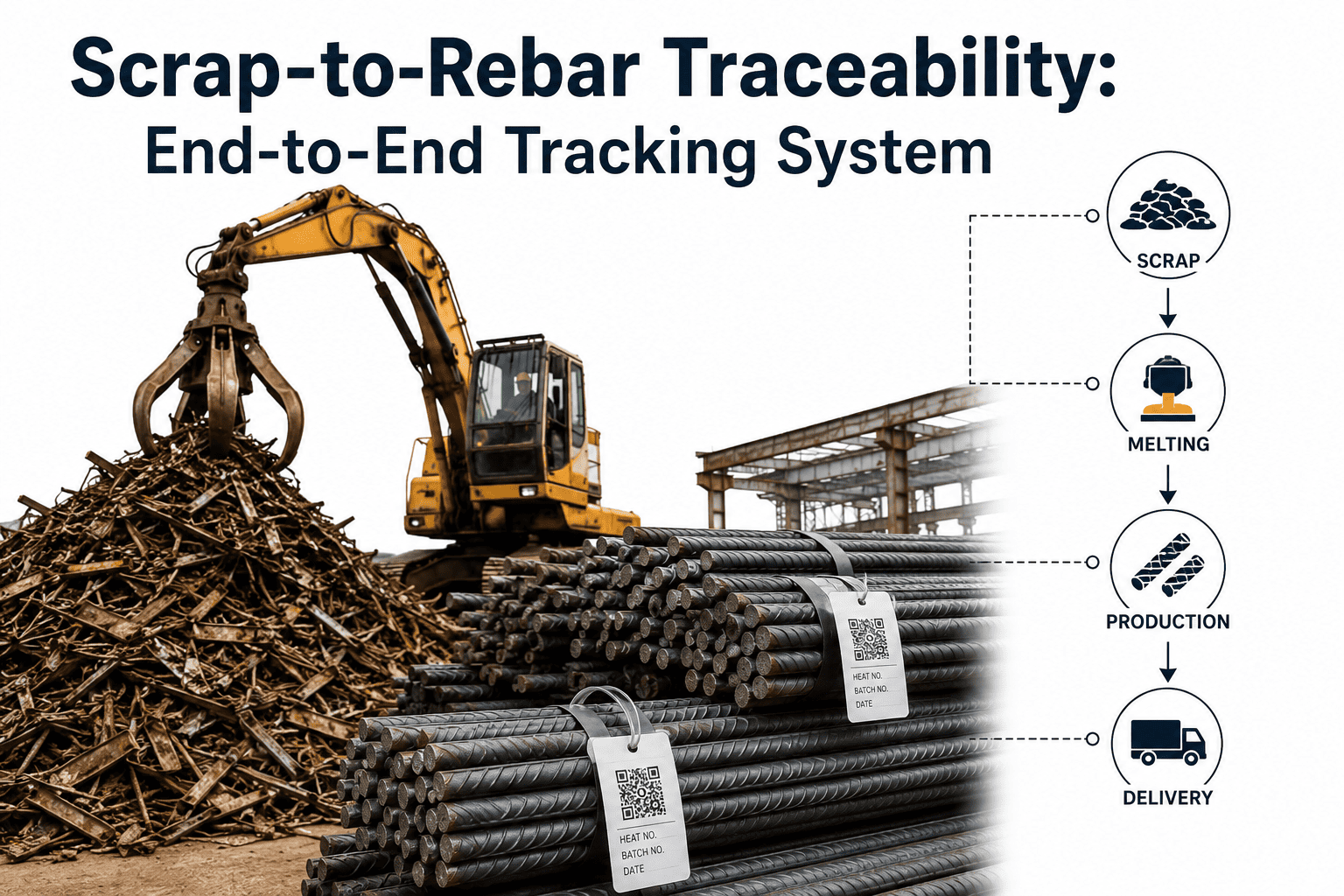
The scrap-to-rebar production route — scrap yard → EAF melting → ladle refining → continuous billet casting → rolling mill → finished rebar — is one of the most complex materials transformation chains in modern manufacturing. Every tonne of rebar that leaves the mill carries the chemical, thermal, and dimensional history of 15–20 distinct process steps, each of which can affect the final product's mechanical properties and compliance with IS 1786 or ASTM A615 standards. Yet in most minimill operations, this traceability exists only on paper, in disconnected SCADA systems, or not at all. When a customer raises a quality claim, the mill cannot trace which heat, which billet, and which rolling pass produced the defective bar. iFactory's Process Tracking and Digital Twin platform creates a single continuous digital thread from scrap charge to finished rebar bundle — linking heat chemistry, casting parameters, rolling temperatures, and dimensional measurements into one traceable production record per coil and per bundle.
Scrap-to-Rebar Smart Manufacturing: End-to-End Digital Process Tracking
EAF heat tracking, billet casting monitoring, rolling mill integration & full quality traceability from scrap charge to finished rebar bundle — with iFactory Digital Twin.
The Digital Production Thread — Every Stage iFactory Tracks
iFactory creates a continuous digital record across all seven stages of the scrap-to-rebar route — linking PLC data, SCADA readings, quality measurements, and operator inputs into a single heat-traceable production record. Request a process tracking demo for your minimill configuration.
Heat Traceability Dashboard — What Operators See Per Heat
Every heat in iFactory has a dedicated production record — visible to operators, supervisors, and quality managers in real time. When a quality hold is raised on a bundle, the full trace from scrap to finished product is available in 3 clicks.
Technologies That Enable End-to-End Digital Tracking
Connecting seven production stages into one digital thread requires deep integration with existing plant systems — not a separate overlay. iFactory connects directly to EAF PLCs, caster SCADA, mill automation, and SAP PP/QM using standard industrial protocols.
PLC / SCADA Integration
OPC-UA and Modbus direct connection to EAF, LRF, caster, and mill PLCs — process parameters captured automatically without operator input, eliminating manual data entry errors.
Digital Twin per Heat
iFactory creates a live digital twin for each heat — simulating solidification in the caster, predicting mechanical properties from chemistry and thermal history, and flagging parameter deviations before they cause quality issues downstream.
AI Vision Surface Inspection
AI camera systems on the rolling mill exit detect surface defects — laps, seams, slivers — per bar in real time. Defective bars are tagged automatically and segregated before bundling, eliminating defect escape to the customer.
SAP PP/QM Integration
Production orders in SAP PP are linked to iFactory heat records — actual vs planned chemistry, yield, and cycle time write back to SAP PP. QM inspection results flow directly to SAP QM usage decision, triggering release or hold automatically.
Results at a 0.8 MTPA Minimill After 14 Months
What a Quality Manager Said
A major infrastructure contractor raised a quality claim on a rebar shipment — claimed the bars were outside IS 1786 yield strength spec. Before iFactory, we would have spent 2 weeks pulling paper records trying to identify which heats were in that shipment. With iFactory, I had the complete heat trail — scrap charge, EAF chemistry, caster parameters, rolling records, and UTM test data — in 8 minutes. The bars passed. We kept the contract.
Frequently Asked Questions
How does iFactory link scrap charge data to the finished rebar bundle if there is no barcode on the scrap?
iFactory uses heat ID as the continuous link — created at EAF tap and propagated through every downstream stage. Scrap charge is linked to the heat by batch number, supplier delivery record, and charge timestamp from the EAF PLC.
Can iFactory generate IS 1786 or ASTM A615 mill certificates automatically from the heat record?
Yes — iFactory generates digitally signed mill test certificates from the heat record, including chemistry, mechanical test results, and dimensional data. Certificates are QR-code linked to the full production record in iFactory for customer verification.
How does the digital twin predict mechanical properties before UTM testing is complete?
iFactory's model uses verified correlations between chemistry (C, Mn, Si, S, P), rolling exit temperature, quenching rate, and mechanical properties — trained on 50,000+ heat records. Prediction accuracy is within ±15 MPa for yield strength at 95% confidence.
What happens when a process parameter falls outside spec during production?
iFactory raises a real-time alert to the operator and quality supervisor, automatically places the affected billets or bundles on quality hold in SAP QM, and adds a deviation record to the heat ID — ensuring no out-of-spec material reaches the customer without review.
Connect Your Scrap-to-Rebar Route in iFactory
Demo includes live heat tracking on your EAF and caster data — connected in 3 weeks.