Every finished rebar bundle carries a genealogy stretching back through seven distinct process stages — scrap charging, EAF melting, ladle refining, continuous casting, reheating, rolling, and final inspection — and a heat number assigned at the point of melt is what's supposed to anchor that entire history to a single traceable record. In practice, that anchor breaks in specific, well-understood places: the transition zone where one heat's steel mixes with the next during continuous casting, the point where material from one heat splits across different rolling lines, and the moment remnant or scrap material re-enters the melt shop with no record of its prior heat. Building traceability that actually survives these break points, rather than assuming a heat number alone solves it, is the real engineering problem — and it's precisely the kind of gap that only surfaces when a customer complaint forces someone to actually trace a specific bar back through the full chain. See how iFactory links heat, billet, and coil records across your scrap-to-rebar production chain, including through the specific points where traceability commonly breaks.
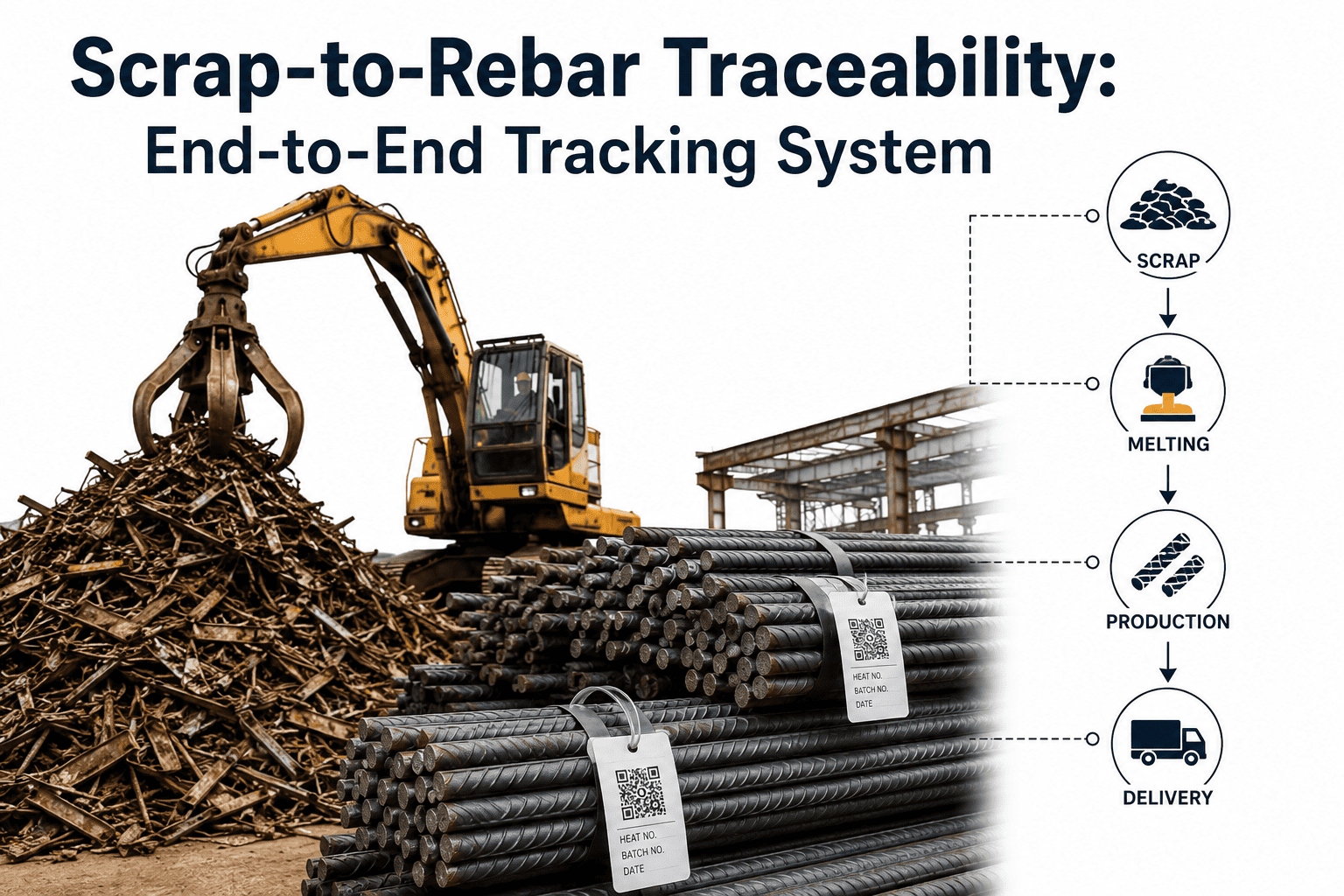
Scrap-to-Rebar Traceability: End-to-End Tracking System
Lot linking, heat tracing, and quality data connected from scrap charging through EAF melting, casting, and rolling to finished rebar — including the specific points where that chain commonly breaks.
The Single Identifier Every Downstream Record Ties Back To
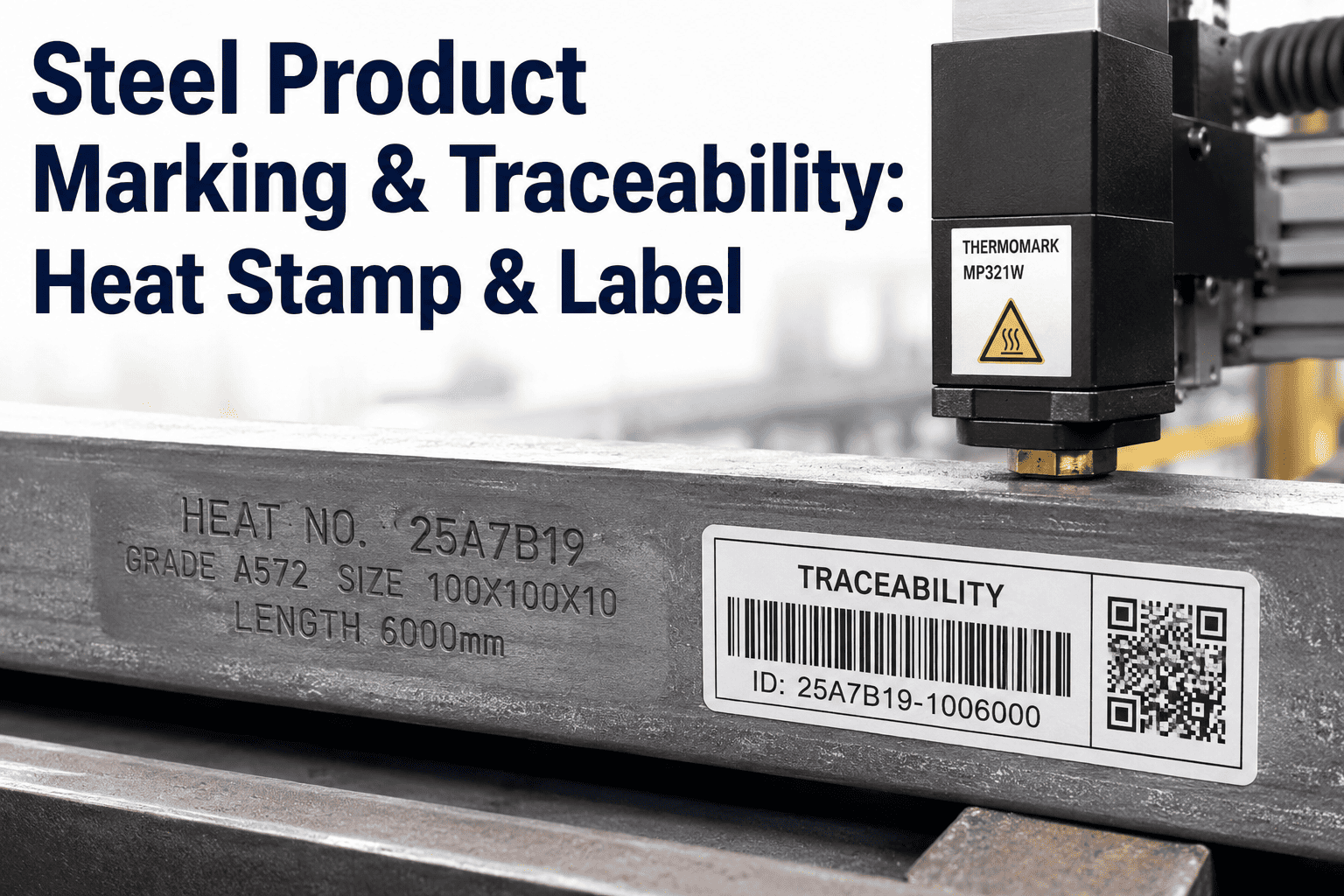
A heat number is assigned at the point of melt and is meant to carry through every subsequent stage — casting, rolling, testing, and dispatch — as the single identifier that connects a finished bar's chemistry, thermal history, and dimensional record back to the specific melt it came from. This is the identifier that, in principle, lets a quality manager trace a customer complaint on a finished bundle back to the exact heat, billet, and rolling pass responsible. It's also the identifier every mill certificate, material test report, and compliance document ultimately references.
The complication is that steel production doesn't happen in the tidy, single-heat batches the identifier implies. A single heat generates hundreds of data points across dozens of operations, and the physical steel itself doesn't always stay cleanly within one heat's boundary as it moves through continuous processes — which is exactly where a traceability system either holds up or quietly loses the thread. Understanding that a heat number is a starting point, not a guarantee, is the first step toward building a system that actually closes these gaps rather than assuming they don't exist.
Transition Pieces, Process Splitting, and Remnant Material
Three specific, well-documented failure points account for most real traceability gaps in a scrap-to-rebar chain, and each requires an explicit rule, not an assumption that the heat number alone will cover it. All three share a common trait: the physical steel genuinely doesn't respect the clean single-heat boundary the record-keeping system assumes, and the gap only becomes visible when someone actually needs to trace a specific piece of material back through it.
All three rule options in this diagram are legitimate approaches used across different mills, and none is universally correct — the right choice depends on how conservative a given customer's specification requires the mill to be, and how much transition material a sequence cast actually generates relative to total output. What isn't legitimate is applying the rule inconsistently, letting it default to whichever operator happens to be logging the billet at that moment, or having no documented rule at all until the ambiguity surfaces during an actual customer trace request.
Traceability Fails at Transitions, Not in the Middle of a Clean Heat
iFactory applies explicit rules at transition pieces, process splits, and remnant re-entry — so the trace doesn't quietly go cold at exactly the points where it matters most.
What Each Stage Adds to the Record
Each of the seven stages between raw scrap and a finished, certified rebar bundle adds its own layer of data to the traceability record — and carries its own specific risk for where that record can break, independent of the others.
| Stage | What Gets Recorded | Traceability Risk |
|---|---|---|
| Scrap Charging | Scrap grade mix (HMS, shredded, prompt), charge weight, source lot | Tramp element risk from mixed or unverified scrap sources |
| EAF Melting | Heat number assignment, chemistry, power profile, tap-to-tap time | The anchor point — every downstream record depends on this being correctly assigned and carried forward |
| Ladle Refining | Chemistry trimming, desulfurization, temperature homogenization | Chemistry adjustments need to update the heat record, not just the physical steel |
| Continuous Casting | Billet ID, casting parameters, sequence position | Transition pieces between heats — the single most common traceability break point |
| Reheating | Furnace temperature profile, soak time per billet | Billet ID needs to survive physical handling between casting and reheat |
| Rolling | Rolling pass data, dimensional measurements, mill temperatures | Process splitting — one heat's billets routed across different rolling lines |
| Finished Bar / Dispatch | Mechanical test results, mill certificate, bundle assignment | Final record needs every upstream link intact to produce a defensible certificate |
Why a Broken Link Anywhere Upstream Shows Up at Dispatch
A mill certificate is only as defensible as the weakest link in the chain that produced it — the chemistry, mechanical test results, and heat number printed on that document are meaningless if any upstream stage recorded an ambiguous or broken trace. A certificate built on a transition piece with no documented rule, or a billet whose ID became illegible somewhere between casting and rolling, is technically issued but not actually defensible if a customer or auditor asks to verify it against the underlying production record.
This is why traceability gaps that seem minor at the point they occur — a faded stencil, an undocumented transition-piece call, an untracked remnant re-entry — become genuinely serious problems only much later, at the exact moment a certificate needs to be defended. The cost of fixing the gap at its source, during production, is a documentation discipline. The cost of discovering it during a customer dispute is a credibility problem that's much harder to resolve after the fact.
Beyond a Heat Number Alone
These four practices are what actually close the gaps a heat number alone leaves open — none of them are complicated individually, but skipping any one of them is enough to leave a real hole in an otherwise disciplined traceability program.
Every mill I've worked with believed they had traceability because every heat had a number. The number was never the problem. The problem showed up at the caster, in the transition piece between two heats, where nobody had actually written down the rule for what to do with that steel. Some operators traced it to both heats. Some downgraded it. Some didn't think about it at all and it just became part of whichever heat happened to be running when someone logged the billet. That inconsistency is invisible until a customer complaint forces you to actually trace a specific bar back through the record, and that's exactly the wrong moment to discover the rule was never defined. Fixing it isn't expensive — it's a documented decision, applied consistently, that most mills simply never got around to writing down.
Frequently Asked Questions
Heat Linking That Survives Transitions, Splits, and Remnant Re-Entry
iFactory links heat, billet, and coil records across your full scrap-to-rebar chain, with explicit rules at the specific points — transition pieces, process splits, remnant re-entry — where traceability most commonly breaks.