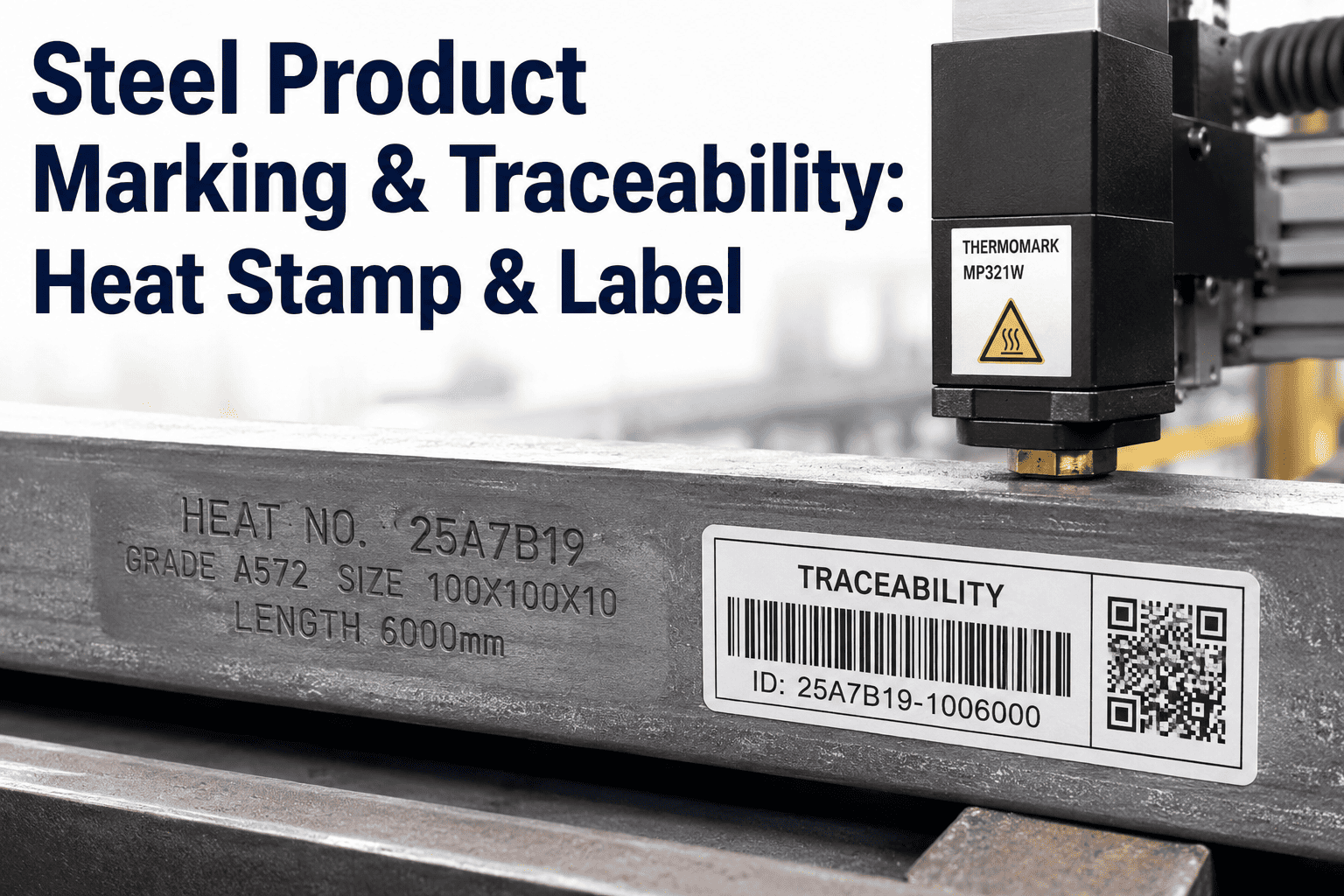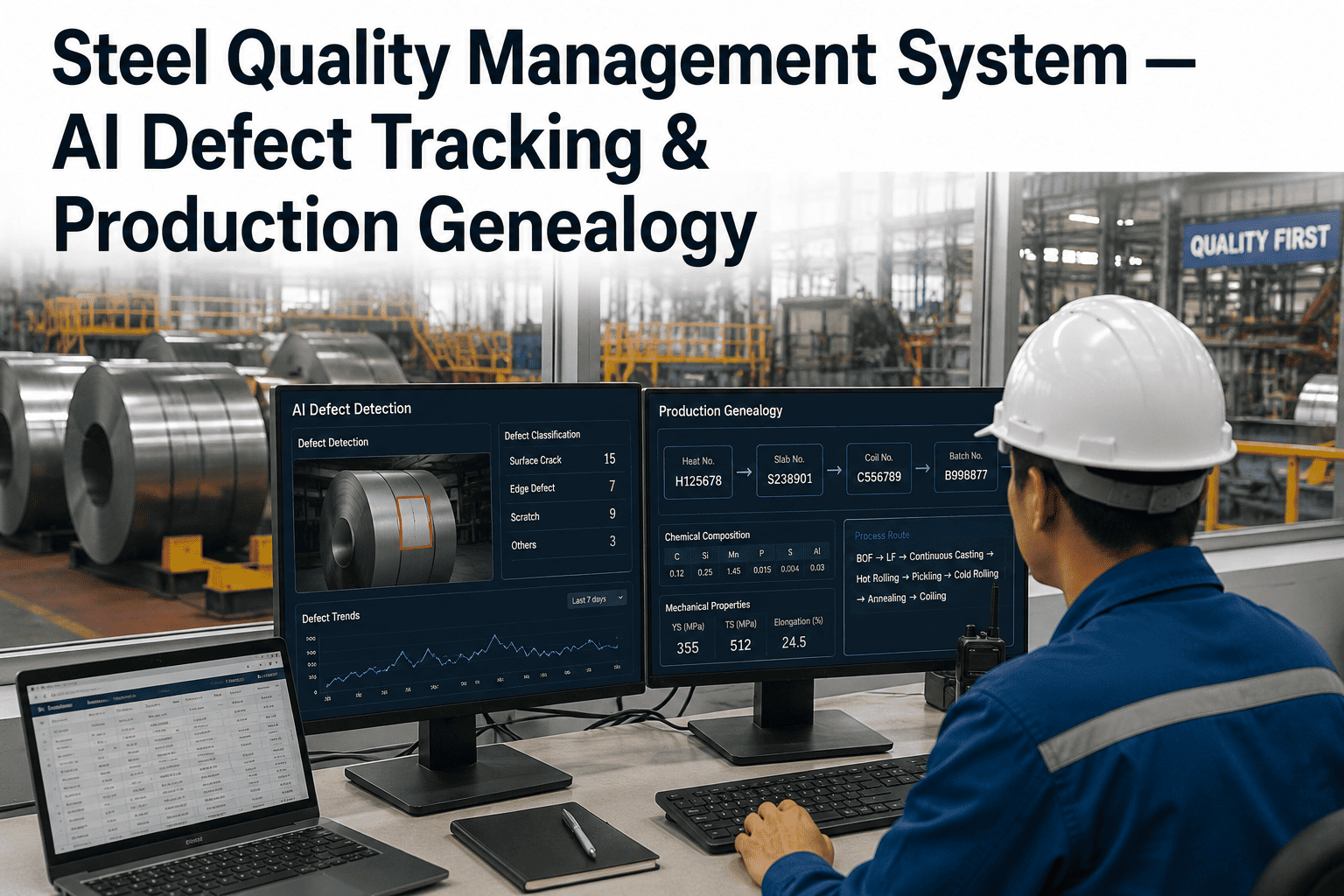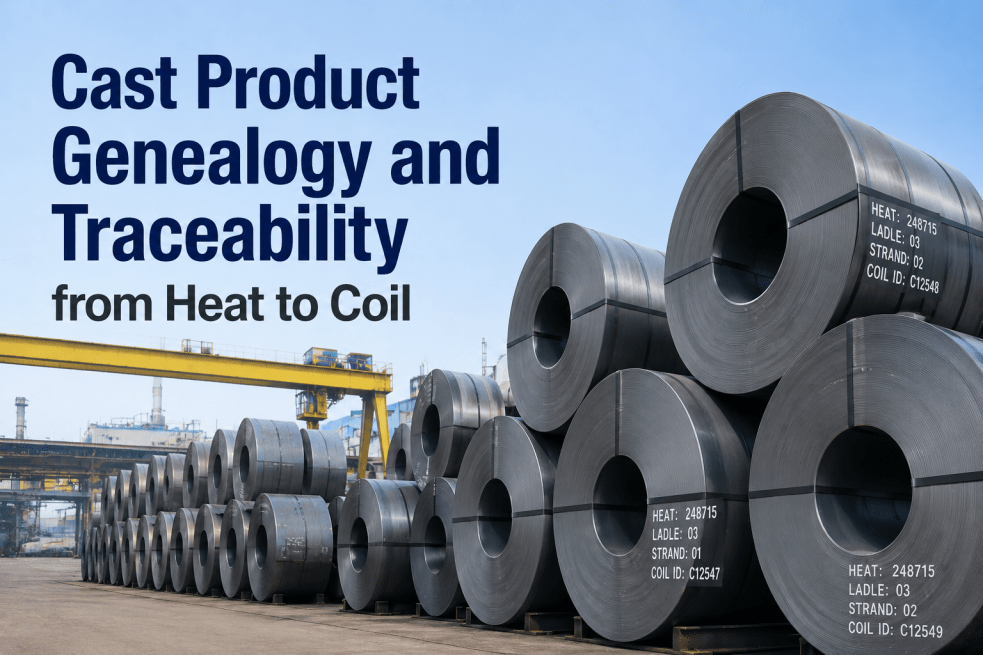
Steel product traceability — the ability to trace every finished coil, plate, bar, or billet back to the specific heat, ladle, tundish, strand position, and casting condition that produced it — is no longer optional for mills that serve automotive, energy, or construction markets. Customer quality claim investigations CBAM carbon accounting, and internal quality root cause analysis all require end-to-end genealogy data that most steel plants cannot produce today. The conventional approach — tracking at the heat level and assuming uniform quality across every product from that heat — breaks down when a single heat produces 50 to 200 slabs, each with different internal quality based on strand position, casting speed variation, and tundish temperature trajectory. iFactory's Steel Genealogy AI platform closes this gap by creating a digital twin of every product's casting history — from hot metal charge through ladle refining, tundish distribution, strand solidification, and final cutting — stored in an on-premise data lake with full API access for quality systems, CBAM reporting, and customer certification. Book a Demo to see iFactory's Steel Genealogy AI configured for your product mix and traceability requirements.
Why End-to-End Product Traceability Is Becoming a Business Requirement, Not a Quality Option
The gap between heat-level traceability and product-level genealogy is the most common root cause of prolonged quality claim investigations, failed CBAM carbon audits, and missed process improvement opportunities in modern steel mills. A quality claim arrives for a coil that was produced six months ago. The plant can identify the heat number from the coil ID, but cannot answer which strand position the slab was cast on, what the casting speed was at that moment, whether the tundish was at the beginning or end of its sequence, or what the mold heat flux profile looked like when that section solidified. Without this data, the quality investigation takes weeks instead of hours, and the root cause — a transient casting condition that affected a specific strand position — is never identified. The AI platform that captures every product's full casting genealogy at the strand-section level closes this data gap permanently, enabling hours-long claim investigations instead of weeks-long, accurate CBAM carbon footprint calculation, and data-driven quality improvement programs that target specific casting conditions. Book a Demo to model the traceability gap for your product mix and customer requirements.
Three Traceability Levels That Define Steel Product Genealogy
Steel product traceability operates across three distinct data levels — heat/ladle, strand/section, and product genealogy — each with different data sources, resolution, and business applications. The AI platform that integrates all three levels into a unified data lake enables the mill to answer any traceability question from heat charge through finished product shipment.
Steel Genealogy Data Layers and Business Applications
The Steel Genealogy AI platform captures and connects seven data layers across the steelmaking and casting process, each serving specific business applications from quality root cause analysis through regulatory compliance. Book a Demo to see how the genealogy data lake is configured for your plant's process routing and product types.
| Data Layer | Source Systems | Key Data Elements | Business Applications |
|---|---|---|---|
| Hot Metal & Scrap | BF / BOF / EAF PLC, scrap management system | Hot metal chemistry, scrap recipe, charge weights, hot metal temperature, desulfurization status | Charge-to-product carbon footprint, scrap optimization, hot metal ratio tracking |
| Ladle Refining | LRF PLC, alloy system, temperature logger | Ladle ID, alloy additions, CaSi wire feed, argon flow, temperature, treatment duration, slag condition | Alloy recovery analysis, inclusion engineering traceback, temperature control audit |
| Tundish Distribution | Caster PLC, tundish scale, thermal camera | Ladle change sequence, tundish level, tundish temperature, SEN design and depth, tundish cover powder | Sequence planning optimization, grade transition traceability, tundish wear correlation |
| Strand Solidification | Mold monitor, segment PLC, spray cooling | Mold heat flux per face, casting speed, oscillation marks, spray water flow, roll gap, segment alignment | Quality root cause by strand position, defect-to-parameter correlation, process capability analysis |
| Cut & Mark | Torch PLC, marking system, weighing scale | Cut position, section length, weight, unique section ID, torch cut quality, surface inspection result | Section-level quality tracking, cut-to-order optimization, yield analysis per section position |
| Downstream Processing | Reheat furnace, rolling mill, heat treat, finishing | Section-to-coil/plate/billet linking, rolling parameters, heat treat cycle, surface conditioning, inspection results | End-to-end genealogy from liquid steel to shipped product, full product passport generation |
| Quality & Certification | LIMS, NDT systems, dimensional inspection, customer portal | Tensile results, UT/ET inspection maps, dimensional measurements, chemistry verification, order specifications | Automated MTR generation, CBAM carbon passport, customer-specific certification, claim investigation data package |
Industry Expert Perspective: Why Product Genealogy Is the Missing Foundation for Quality and Compliance
I have managed quality systems across slab, bloom, and plate mills for 22 years, and the single most persistent operational frustration is that we cannot answer the most basic quality question: what were the exact casting conditions when this specific product section solidified? We have heat-level data, we have caster process data, and we have product inspection data — but they live in separate systems with different time stamps, different IDs, and no automated linkage between them. Every quality claim investigation becomes a manual data archaeology project. Every CBAM carbon report requires manual data extraction from three or four systems. Every process improvement initiative starts with the assumption that we cannot correlate product quality to casting conditions because the genealogy data does not exist. An AI platform that automatically creates the end-to-end genealogy for every product — from hot metal charge through finished coil — solves all three problems simultaneously. I have seen mills reduce claim investigation time from three weeks to three hours. I have seen CBAM reporting go from a month-long panic to an automated quarterly output. I have seen quality engineers discover correlations between specific strand positions and defect patterns that had been invisible for years.
Three Business Outcomes AI Product Genealogy Delivers
Beyond traceability compliance, AI-powered product genealogy creates measurable improvements in quality investigation efficiency, regulatory reporting accuracy, and process improvement capability.
Critical Steel Genealogy Implementation Pitfalls to Avoid
Steel genealogy systems underperform when implementation mistakes create data gaps that undermine the product-level linkage. These failure patterns are preventable with a structured approach. Book a Demo to review iFactory's genealogy AI deployment methodology for your mill configuration.
The Traceability Decision That Determines Your Quality Investigation and Compliance Capability
The gap between mills that track product genealogy at the heat level and those that track it at the strand-section level with AI-powered automation is the gap between weeks-long quality investigations and hours-long resolutions, between manual CBAM data collection and automated compliance reporting, and between process improvement programs that search for correlations at the heat level and those that find them at the section level. The data required for strand-section-level genealogy — caster PLC data, mold monitoring, cut-and-mark systems, and downstream processing — is already generated by every modern mill. The only missing element is the AI platform that links this data into a continuous product genealogy from liquid steel to finished shipment.