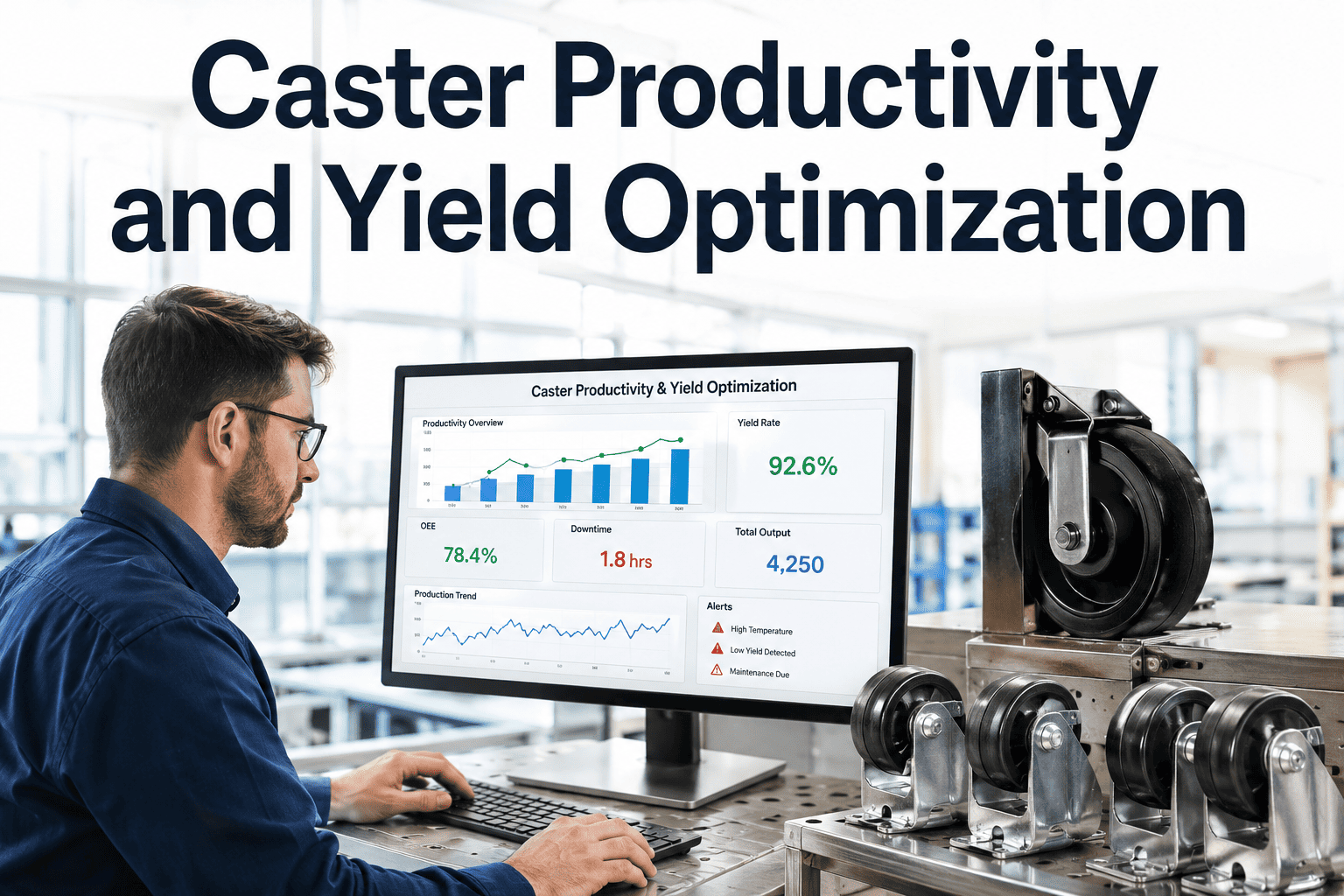
Caster yield — the ratio of saleable product to liquid steel poured — is the single most direct lever on steelmaking profitability, yet most plants accept yield losses of 3 to 6 percent as an unavoidable cost of the casting process. Head crop, tail crop, scarfing depth, cut-to-length tolerances, and quality downgrades each consume 0.5 to 2 percent of total production, and the decisions that determine these losses are made in seconds by operators relying on fixed rules and visual judgment. iFactory's Caster Yield AI platform replaces rule-of-thumb crop lengths, uniform scarfing depths, and post-casting quality sorting with predictive models that optimize every yield decision in real time — reducing head crop by 15 to 30 percent, optimizing scarfing depth per strand condition, and routing product to the highest-value quality grade based on predicted internal quality. The result is a 0.5 to 1.5 percentage point yield improvement that translates to $2 to $8 million in annual margin recovery at a typical 1-million-ton slab caster. Book a Demo to see how iFactory's Caster Yield AI is configured for slab, billet, and bloom casters.
Every Percentage Point of Yield Loss Represents a Seven-Figure Margin Leak
At a slab caster producing 1 million tons per year at an average selling price of $700 per ton, each 1 percent of yield loss represents $7 million in unrecovered revenue. A typical operation loses 3 to 6 percent of total production to crop losses, scarfing removal, surface conditioning, and quality downgrades. The yield losses are distributed unevenly across the caster output — head crop consumes 1.0 to 2.5 percent, tail crop 0.3 to 0.8 percent, scarfing removal 0.5 to 1.5 percent, cut-to-length overage 0.2 to 0.5 percent, and quality downgrades 0.5 to 2.0 percent. Each loss category has a different root cause and requires a different AI optimization approach, but the common pattern is that conventional fixed-rule decisions conservatively over-estimate the required crop length, scarfing depth, and length tolerance to avoid the risk of shipping defective product. AI yield optimization replaces these conservative fixed rules with dynamic predictions calibrated per strand, per grade, and per casting condition — recovering 15 to 30 percent of each loss category without increasing quality risk. Book a Demo to model the yield recovery opportunity for your product mix and caster configuration.
Four Yield Loss Categories That AI Converts into Margin Recovery
Caster yield losses fall into four distinct categories, each with different root causes and AI optimization strategies. The Caster Yield AI platform addresses all four simultaneously, with models trained on your specific caster geometry, steel grade portfolio, and downstream quality requirements.
Head crop is determined by the time required for the strand to reach steady-state shell thickness, temperature profile, and internal quality. Fixed crop lengths of 24 to 48 inches are typical, but the actual transient length varies by 30 to 50 percent depending on starting conditions, grade, and casting speed ramp. AI predicts the minimum safe crop length per heat by modeling the transient solidification profile from mold thermocouple data, casting speed ramp rate, and tundish temperature trajectory — reducing average crop by 15 to 30 percent without increasing the risk of shipping transient-quality product.
Conventional scarfing applies a uniform removal depth of 3 to 8 mm across the entire strand surface or uses fixed-rule depth adjustments per grade. This overcautious approach removes 0.5 to 1.5 percent of saleable product that could be recovered. AI predicts the required scarfing depth at each strand position based on surface quality prediction from mold heat flux, oscillation mark depth, and casting speed history — reducing average removal depth by 20 to 35 percent while maintaining or improving final surface quality.
Cut-to-length decisions balance maximizing plate or coil yield against the risk of producing undersized product that must be downgraded. Fixed length tolerances of 6 to 12 inches per cut are standard, accumulating 0.2 to 0.5 percent yield loss per caster. AI predicts the optimal cut position per heat based on predicted internal quality distribution along the strand, downstream order requirements, and surface quality variation — minimizing over-length while guaranteeing minimum acceptable product dimensions.
Internal quality defects — centerline segregation, internal cracks, and porosity — develop during solidification and are detected only after the strand is cut, cooled, and inspected. Fixed quality grades are assigned per heat based on statistical sampling, with 0.5 to 2.0 percent of product downgraded to lower-value grades or scrapped. AI predicts internal quality distribution along each strand from solidification model outputs, casting parameters, and steel chemistry — enabling dynamic routing of each section to the highest-value quality grade it will meet.
Caster Yield AI — Model Architecture and Data Integration
The Caster Yield AI platform combines four prediction models — crop prediction, scarfing depth prediction, cut optimization, and quality routing — into a unified yield optimization engine that receives real-time data from the caster PLC, mold monitoring system, and quality inspection stations. Each model is trained on historical yield data and continuously improved through an active learning loop that tracks actual yield outcomes against predictions. Book a Demo to review the model architecture configured for your caster type and product mix.
| Yield Model | Input Data Sources | Optimization Decision | Typical Yield Recovery |
|---|---|---|---|
| Crop Prediction | Mold thermocouple data, casting speed ramp, tundish temperature, SEN condition, grade transition status | Minimum head crop length per heat based on predicted transient solidification profile; tail crop length based on predicted quality degradation during tundish drain | Head crop reduced 15–30% saving 0.15–0.75% of total production |
| Scarfing Depth Optimization | Mold heat flux profile, oscillation mark depth sensor, casting speed history, grade surface quality requirements, scarfing machine feedback | Position-specific scarfing depth per strand section based on predicted surface defect depth; targeted scarfing coverage versus full-face scarfing where surface quality predictions permit | Scarfing removal reduced 20–35% saving 0.10–0.50% of total production |
| Cut-to-Length Optimization | Predicted internal quality distribution, surface quality prediction, downstream order book, length tolerance requirements, torch cut accuracy history | Dynamic cut position per heat minimizing over-length while meeting minimum order dimensions; defect-aware cutting that positions cuts to exclude predicted defect zones | Length overage reduced 25–40% saving 0.05–0.20% of total production |
| Quality Routing | Solidification model outputs (centerline segregation index, crack prediction), casting parameters, steel chemistry, thermal history, ultrasonic inspection samples | Real-time quality grade assignment per strand section enabling highest-value routing; dynamic product allocation based on predicted quality distribution versus fixed heat-level grading | Downgrade reduction 20–40% saving 0.10–0.80% of total production |
Industry Expert Perspective: Why Fixed-Rule Yield Decisions Leave Margin on the Table
I have managed casting operations across slab, bloom, and billet casters for 19 years, and the single most frustrating operational reality is that we make yield decisions based on rules written years ago by people who were trying to avoid quality claims at all costs. The rule says crop 36 inches on every head because one time a 30-inch crop produced a string of quality claims on a particular grade. The rule says scarf 5 mm across the entire strand because the metallurgists do not trust the operators to vary depth by position. The rule says add 8 inches to every cut length because the torch is not perfectly accurate. Every one of these rules is a conservative assumption that assumes the worst case and applies it uniformly, and the cumulative cost of that conservatism adds up to millions of dollars per year in lost yield. AI yield optimization does not ask operators to take risks — it uses actual real-time data to predict the crop length, scarfing depth, cut position, and quality grade that are appropriate for this specific strand, this specific grade, and this specific set of casting conditions. The operators trust the AI because it explains its reasoning — it shows the predicted quality profile, the confidence interval, and the risk-adjusted recommendation. I have seen 1.1 percent yield improvement across a three-strand slab caster within six months of deployment, and that number will only grow as the model learns from more data.
— Senior Casting Operations Manager, Integrated Steel Producer — 19 Years in Slab, Bloom, and Billet Casting Operations — iFactory Caster Yield AI Reference 2026Four Business Outcomes from AI-Driven Yield Optimization
Beyond direct yield recovery, AI-driven yield optimization creates compounding improvements in production planning, quality assurance, and operational consistency that amplify the margin impact across the entire casting operation. Book a Demo to see the yield improvement dashboard configured for your product mix.
Combining head crop reduction of 15–30 percent, scarfing depth reduction of 20–35 percent, cut-to-length optimization saving 25–40 percent of overage, and quality downgrade reduction of 20–40 percent delivers a total yield improvement of 0.5 to 1.5 percentage points. For a 1-million-ton slab caster at $700 per ton, this represents $3.5 to $10.5 million in recovered revenue per year.
AI yield optimization reduces quality risk rather than increasing it. Dynamic crop prediction ensures transient-quality sections are removed. Scarfing depth optimization targets the actual defect depth. Quality routing assigns the correct grade per section. The result is a 15–30 percent reduction in downstream quality claims and customer rejections.
Yield prediction accuracy improves from rough estimates to heat-specific forecasts with error margins of ±0.2 percent. Production planners can accurately predict the saleable output, scrap generation, and grade distribution from each heat, enabling more accurate order fulfillment, reduced inventory, and fewer rush orders for unexpected shortages.
The AI platform provides real-time decision recommendations displayed on the operator console — recommended crop length, scarfing depth map, optimal cut positions, and quality grade per strand section. Operators see the confidence level and risk assessment for each recommendation, building trust over time and reducing decision variability between shifts and operators.
Caster Yield AI — Deployment Timeline
iFactory's Caster Yield AI deployment follows a structured approach across four phases, designed to deliver measurable yield improvements within the first two months of live operation while building toward full yield optimization across all four model categories.
Conclusion
Caster yield is not a technical constraint — it is a decision-making problem. The crop length, scarfing depth, cut position, and quality grade assigned to each strand are decisions made by operators and yield engineers under uncertainty, and conservative fixed rules are the natural response to incomplete information. AI yield optimization removes the uncertainty by providing real-time predictions of strand quality distribution, surface defect depth, and internal soundness — enabling yield decisions that are aggressive enough to recover value and precise enough to avoid quality risk. The data required for AI yield optimization — mold thermocouple data, casting parameters, steel chemistry, and quality inspection records — is already available in every modern caster. The only missing element is the prediction models that connect that data to the crop, scarf, cut, and routing decisions that determine yield for every ton poured. Book a Demo to start a Caster Yield AI model validation study for your highest-priority product category.
Caster Yield Optimization with AI — Frequently Asked Questions
The AI model predicts the transient solidification profile from mold thermocouple data, casting speed ramp rate, tundish temperature trajectory, and grade-specific solidification characteristics. It identifies the strand position where shell thickness, temperature profile, and internal quality reach steady-state conditions — typically 15 to 30 percent shorter than fixed crop rules — and recommends the crop position with a confidence-based safety margin calibrated to the plant's quality risk tolerance. Book a Demo
Yes. The scarfing depth model predicts surface defect depth independently for the top, bottom, left, and right faces of the strand based on oscillation mark depth, mold heat flux distribution, and casting speed profile. The AI generates a four-zone scarfing depth recommendation per strand position, enabling deeper removal on faces with predicted deeper defects and shallower removal on faces where surface quality predictions are within specification.
The cut optimization model receives real-time downstream order data — required lengths, width and gauge specifications, quality grade requirements, and delivery dates — and optimizes cut positions to maximize the total value of the product assignment per heat. Sections with predicted quality suitable for high-value orders are prioritized for those orders, while sections near predicted defect zones are allocated to orders with broader tolerances.
No new sensors are required for the initial deployment. The Caster Yield AI platform integrates with existing mold monitoring systems, caster PLC data, quality inspection records, and production planning systems already installed on modern casters. Additional sensors — oscillation mark depth measurement or surface quality scanners — can be added to improve model accuracy but are not required for deployment.
Full ROI is typically achieved within 4 to 8 months, driven by yield improvement of 0.5 to 1.5 percentage points. At a 1-million-ton slab caster with a $700 per ton average selling price, a 0.8 percent yield improvement recovers $5.6 million in annual margin. The investment cost — including edge server hardware, model configuration, and deployment support — is recovered within the first 4 to 8 months of live operation. Book a Demo