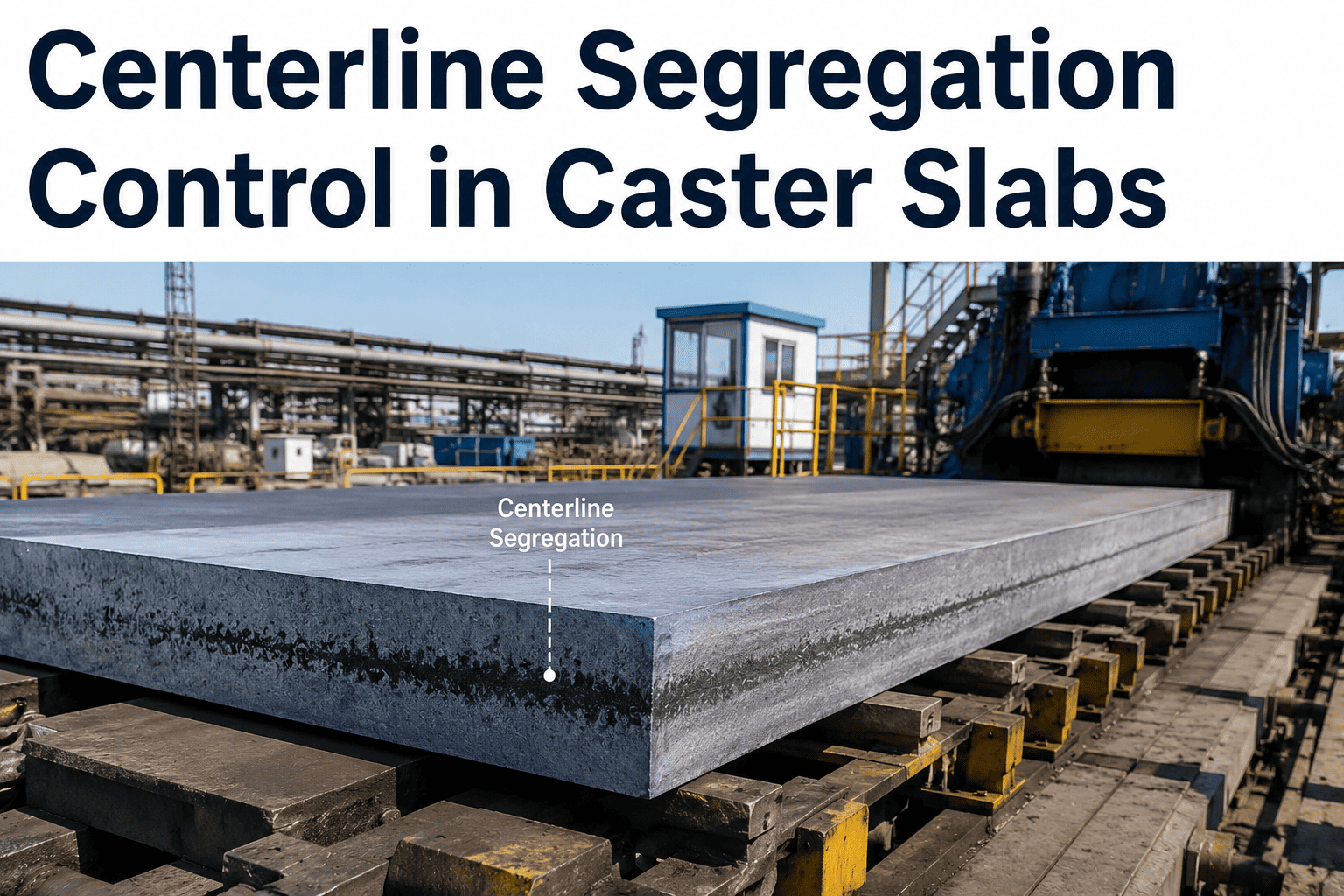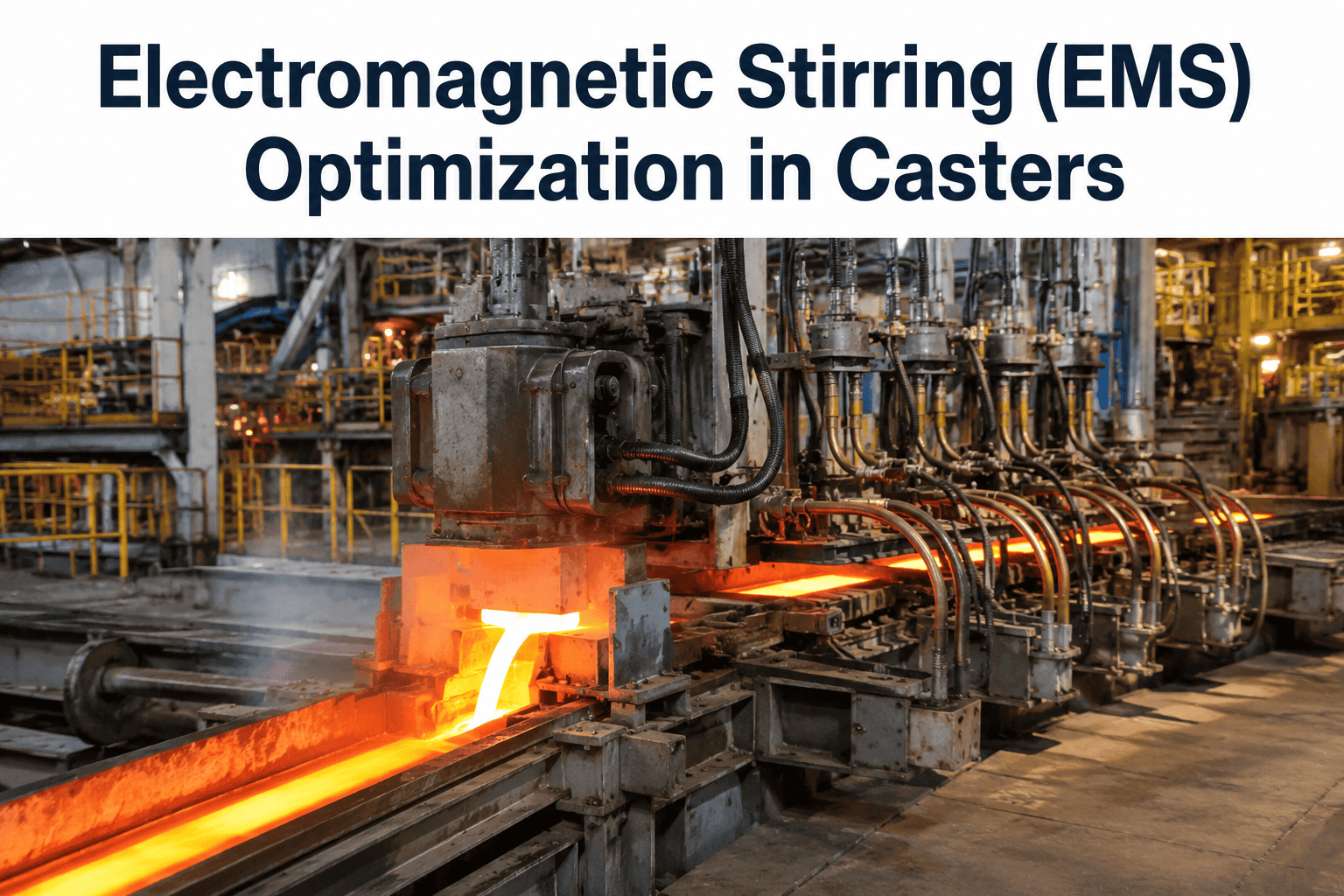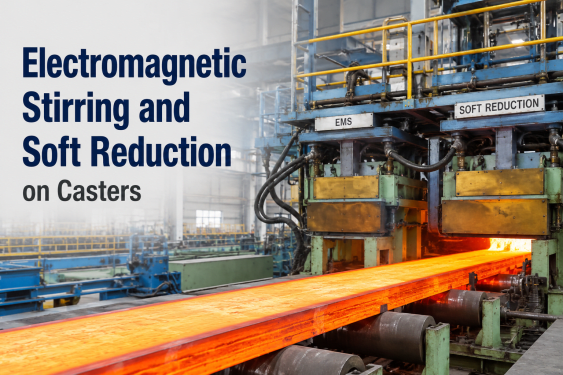
Centerline segregation, V-segregation, and internal porosity are the most persistent quality defects in continuously cast steel — and electromagnetic stirring (EMS) combined with soft reduction (SR) is the most effective countermeasure available. An optimally tuned EMS stirrer breaks up the columnar dendrite front and distributes solute-rich liquid across the solidification zone, while correctly applied soft reduction taper compensates for the final solidification shrinkage that concentrates solute at the slab or billet centerline. When both are dialed in together, internal quality ratings improve by one to two full ASTM or Mannesmann grades. The problem is that conventional EMS and SR tuning relies on fixed current settings mechanical taper adjustments made during maintenance campaigns, and quality feedback that arrives hours or days after the strand exits the caster — creating a persistent gap between the equipment's theoretical capability and its actual quality impact. iFactory's EMS/SR Optimizer closes this gap by combining real-time strand temperature modeling, predictive solidification profile analysis, and machine-learning-based parameter optimization into a single on-premise platform that continuously adjusts EMS current, frequency, and soft reduction roll gap to match the actual casting conditions of each strand section. Book a Demo to see how iFactory's EMS/SR Optimizer is configured for slab, bloom, and billet casters.
Is Your EMS and Soft Reduction Configuration Delivering the Internal Quality Your Caster Is Capable Of?
iFactory's EMS/SR Optimizer continuously adjusts EMS current, frequency, and soft reduction roll gap in real time based on strand temperature modeling and solidification profile prediction — improving centerline quality by one to two ASTM grades across slab, bloom, and billet casters on an on-premise NVIDIA edge server with read-only PLC connectivity.
Why EMS and Soft Reduction Tuning Is the Most Effective Lever for Internal Quality Improvement
Centerline segregation is a function of solidification rate, dendrite arm spacing, and the solute enrichment profile in the liquid pool at the final solidification point. The EMS stirrer influences all three by generating electromagnetic forces that wash the solidification front, breaking off dendrite tips and redistributing solute-rich liquid across a wider mushy zone. The soft reduction rolls mechanically compensate for the final solidification shrinkage by applying a slight taper — typically 0.3 to 1.5 mm per meter of strand length — that prevents the suction-driven flow of solute-rich liquid into the centerline pore space. The interaction between these two technologies is nonlinear: the optimal EMS setting depends on the section size, steel grade, casting speed, and superheat, while the optimal soft reduction taper depends on the liquid pool length, which changes with every variation in casting speed and superheat. Fixed parameter settings cannot capture this dynamic interaction, leaving internal quality performance well below the combined capability of the installed EMS and SR equipment. AI-driven optimization that adjusts both systems in concert against real-time strand conditions recovers 50 to 80 percent of the current gap between achievable and actual internal quality. Book a Demo to explore the EMS/SR optimization opportunity for your section sizes and grade portfolio.
Four EMS and Soft Reduction Optimization Areas That Define Internal Quality
Mold EMS (M-EMS) Current and Frequency Optimization
M-EMS generates a rotating magnetic field in the mold region that controls the initial solidification structure, influencing the equiaxed-to-columnar transition point, the subsurface inclusion distribution, and the oscillation mark depth. AI optimizes M-EMS current (typically 100 to 600 A) and frequency (2 to 8 Hz) based on mold heat flux profile, steel grade carbon content and peritectic behavior, casting speed, and superheat to maximize equiaxed zone fraction at the optimal dendrite arm spacing.
Strand EMS (S-EMS) Position and Intensity
S-EMS stirrers located below the mold influence the solidification structure deeper in the liquid pool, where the dendrite front is more advanced and the solute enrichment gradient is steeper. AI determines the optimal stirrer position, current, and frequency for each section of the strand based on the predicted liquid pool profile and the local solidification rate — breaking off dendrite tips at the position where solute redistribution delivers the maximum centerline quality benefit.
Final EMS (F-EMS) for Centerline Control
F-EMS stirrers positioned near the final solidification point provide targeted electromagnetic mixing at the critical zone where centerline segregation is determined. The AI platform predicts the liquid pool end position from the dynamic solidification model and adjusts F-EMS parameters to maintain optimal stirring intensity at the pool tip regardless of casting speed or superheat variations — preventing the centerline segregation spike that typically occurs when the pool tip shifts away from a fixed stirrer position.
Soft Reduction Taper Profile and Roll Force
Soft reduction applies a controlled taper through the segment rolls to compensate for final solidification shrinkage. AI optimizes the taper profile — roll gap reduction per meter of strand length — and the roll force distribution based on the predicted liquid pool thickness profile, steel grade solidification shrinkage coefficient, and casting speed. The taper is adjusted dynamically for each strand section, eliminating the fixed mechanical taper that can only be correct for one combination of operating conditions.
EMS and Soft Reduction Parameters — Conventional Setup vs. AI-Optimized Dynamic Control
The gap between fixed-parameter EMS/SR operation and AI-optimized dynamic control is visible across every parameter that determines internal quality. The comparison below maps each key parameter against its conventional setup method, the AI-driven optimization approach, and the resulting quality impact. Book a Demo to benchmark your current EMS/SR configuration against iFactory's optimization capability model.
| Parameter | Conventional Setup | AI Dynamic Optimization | Quality Impact | Implementation |
|---|---|---|---|---|
| M-EMS Current | Fixed per grade family; adjusted during grade trials | Adjusted per heat based on real-time mold heat flux, superheat, and casting speed | Equiaxed zone +8% to 15%; subsurface inclusions reduced 20% to 35% | Rolling |
| S-EMS Frequency | Fixed at installation; changed only during major upgrades | Continuously optimized for strand position solidification rate and dendrite arm spacing | V-segregation severity reduced 30% to 50%; macrosegregation index improved 0.1 to 0.3 | Rolling |
| F-EMS Position | Fixed stirrer location; cannot be moved without mechanical modification | Dynamic current profile compensates for pool tip shift; stirrer selection logic optimizes between multiple F-EMS units | Centerline segregation improved 0.5 to 1.0 ASTM grade; pool tip segregation spike eliminated | Rolling |
| SR Taper Profile | Fixed mechanical taper set during segment maintenance; single taper across all grades | Dynamic roll gap adjustment per strand position based on liquid pool thickness prediction; grade-specific taper profiles | Centerline porosity reduced 40% to 60%; internal quality consistency improved 25% to 40% | Segment |
| SR Roll Force | Fixed force per segment; adjusted during roll change campaigns | Position-dependent force distribution based on local solid fraction prediction; automatic compensation for thermal expansion of rolls | Internal crack rate reduced 30% to 50%; roll wear pattern improved | Segment |
| Pool Length Prediction | Calculated from fixed solidification constant (k = 25 to 30 mm/min0.5) | Dynamic model using mold heat flux, spray cooling profile, casting speed, superheat, and steel grade thermophysical properties | Pool length prediction accuracy ±0.3 m versus ±1.5 m for fixed k method | Model |
EMS/SR Optimizer Deployment — 5-Step Implementation Process
Deploying the EMS/SR Optimizer does not require replacing stirrers, modifying segments, or altering the caster mechanical configuration. The platform integrates with existing EMS power supplies and segment roll gap control systems through the caster level 2 automation layer, adding real-time optimization capability to the equipment already installed. Book a Demo to review the EMS/SR Optimizer integration requirements for your caster type and equipment configuration.
Caster Configuration Audit and Solidification Model Calibration
Document the caster geometry — section sizes, strand count, segment layout, roll pitch, spray cooling zone configuration, EMS stirrer type (M-EMS, S-EMS, F-EMS), stirrer position and electrical ratings, and soft reduction roll gap adjustment range. Calibrate the dynamic solidification model against historical pool length measurements from sulfur prints, nail board tests, or liquid pool measurement campaigns.
EMS Power Supply Integration and Communication Setup
Establish bidirectional communication between the AI platform and each EMS power supply unit via the level 2 network — typically through OPC-UA or Modbus TCP. Configure current setpoint, frequency setpoint, and stirrer selection write channels so that the AI platform can transmit optimized parameters. Implement read-back validation to confirm setpoint acceptance and actual output verification.
Soft Reduction Roll Gap Control Integration
Interface with the segment roll gap control system — typically a hydraulic servo-valve controller with position feedback from linear variable differential transformers (LVDTs) on each segment. Configure the AI platform to transmit dynamic taper setpoints per segment per strand position, with speed and force limits that respect the segment mechanical design envelope.
Model Training on Historical Quality and Process Data
Train the EMS/SR optimization model on 12 to 24 months of historical data — including EMS current and frequency settings, SR taper profiles, casting parameters, and corresponding internal quality ratings from ultrasonic inspection, macrostructure analysis, and sulfur print evaluation. The model learns the correlation between parameter settings and quality outcomes across the grade portfolio.
Live Optimization with Operator Dashboard and Quality Feedback Loop
Deploy the live optimization engine with a soft-start mode that gradually increases the parameter adjustment range over 2 to 4 weeks, allowing operators and quality engineers to verify that quality outcomes improve predictably. The operator dashboard displays current EMS and SR settings, the predicted quality impact, and real-time confirmation of quality outcome from downstream inspection data.
Industry Expert Perspective: Why Dynamic EMS and SR Control Produces Better Internal Quality Than Fixed Parameters
We asked Dr. James Pollard, a former Senior Process Engineer with 20 years of continuous casting experience across slab, bloom, and billet casters at integrated steel producers and equipment manufacturers, to assess the current state of EMS and soft reduction optimization in the steel industry and identify the most impactful areas for AI-driven improvement.
"The EMS stirrer is a powerful tool, but its effectiveness is entirely dependent on being at the right position relative to the solidification front — and that position changes with every heat," Pollard explains. "A fixed M-EMS current setting that works well at a casting speed of 1.2 m/min and a superheat of 30°C will produce different — and often worse — internal quality at 1.0 m/min and 45°C superheat. The same is true for soft reduction: the taper that perfectly compensates for shrinkage at a 12-meter pool length will be too aggressive for a 10-meter pool and insufficient for a 14-meter pool. The industry's conventional approach of using grade-averaged fixed parameters guarantees that the EMS and SR system is operating at its optimum for less than 30 percent of the heat time.
His primary recommendation for caster process engineers evaluating EMS/SR optimization technology is to prioritize the dynamic solidification model as the foundation. "Everything else — EMS current adjustment, SR taper optimization, pool tip tracking — depends on knowing the liquid pool profile in real time. If you invest in the solidification model first, the EMS and SR optimization follows naturally. Plants that start with the model and build the parameter optimization layers on top report internal quality improvements within the first week of live operation."
Three Business Outcomes AI-Driven EMS/SR Optimization Delivers
Beyond internal quality improvement, real-time EMS and soft reduction optimization creates measurable financial and operational outcomes that compound across every heat and every strand.
AI-optimized EMS current and frequency settings combined with dynamic soft reduction taper profiles reduce centerline segregation, V-segregation, and internal porosity severity by one to two full quality grades across the product mix. At a typical slab caster producing 1 million tons annually, this grade improvement reduces downgrade losses by $2 to $6 million per year.
Fixed-parameter operation produces internal quality that varies significantly with casting speed, superheat, and grade transition conditions. AI dynamic control maintains optimal EMS and SR settings across the full range of operating conditions, reducing the standard deviation of internal quality ratings by 40 to 60 percent and enabling more consistent product certification.
Conventional EMS/SR parameter optimization requires grade-specific trial campaigns — typically 20 to 50 heats per grade — to empirically find the best parameter settings. The AI platform predicts optimal settings from the solidification model and grade thermophysical properties, eliminating trial campaigns and accelerating new grade development by 60 to 80 percent.
Critical EMS and Soft Reduction Implementation Pitfalls to Avoid
EMS/SR optimization projects underperform when implementation mistakes create parameter adjustments that are mathematically correct but operationally ineffective. These six pitfalls are the most common failure patterns observed across caster optimization programs. Book a Demo to discuss how iFactory's EMS/SR Optimizer deployment methodology eliminates these risks from the start of your project.
The dynamic solidification model is the foundation of all EMS and SR optimization. A model calibrated on fewer than 10 pool length measurement points — or calibrated only on one grade and one section size — produces pool length predictions that are too inaccurate for reliable parameter optimization. Minimum calibration requires 15 to 20 measurements across the grade and speed range.
The communication path between the AI optimizer and the EMS power supply must support parameter updates at intervals shorter than the time scale of casting speed and superheat changes — typically under 5 seconds. Latency above 10 to 15 seconds means the EMS setting is always optimized for the previous heat rather than the current operating conditions.
Hydraulic servo-valve systems controlling segment roll gap have response times of 2 to 5 seconds. Optimization algorithms that attempt to change taper faster than the mechanical system can respond create oscillation in the roll gap that damages the strand surface and produces inconsistent internal quality.
EMS and SR effects are synergistic: changing the M-EMS current changes the solidification structure at the pool tip, which changes the optimal F-EMS and SR settings. An optimizer that adjusts only one parameter type while keeping others fixed operates in a constrained optimization space that cannot reach the global quality optimum.
The AI model learns from quality feedback — ultrasonic inspection results, macrostructure ratings, and sulfur print data. If quality data arrives more than 24 to 48 hours after casting, the correlation between parameter settings and quality outcomes becomes difficult to establish for transient conditions. Real-time or near-real-time quality feedback accelerates model improvement.
The EMS and Soft Reduction Decision That Determines Your Internal Quality Capability
The gap between casters that operate EMS and soft reduction with grade-averaged fixed parameters and those that optimize both systems dynamically in real time is the single largest controllable source of internal quality variability in modern continuous casting. Fixed-parameter operation guarantees that the EMS stirrer current and the SR taper profile are correct for less than 30 percent of the actual casting conditions encountered — and suboptimal for the other 70 percent. AI-driven optimization that adjusts EMS current, frequency, stirrer selection, and SR roll gap against a dynamic solidification model updated every 30 seconds eliminates this gap, delivering internal quality improvement that plant trials and grade campaigns cannot match through empirical parameter hunting alone. The technology is proven across multiple caster types, the integration path is non-invasive to existing equipment, and the quality and financial outcomes across early-adopter facilities are consistent and compounding. The only question is whether your caster will be among those that build this optimization capability now or among those that continue to operate at a persistent internal quality discount for the next decade.
Electromagnetic Stirring and Soft Reduction with AI — Frequently Asked Questions
Does the EMS/SR Optimizer require any modifications to existing stirrers or segment hardware?
No mechanical modifications to EMS stirrers, segment rolls, or hydraulic systems are required. The platform integrates with existing EMS power supplies and segment roll gap controllers through the level 2 automation network, transmitting optimized parameter setpoints that the existing equipment executes. The only installation requirement is network connectivity to the EMS and SR control systems.
How does the platform handle casters with multiple EMS stirrers of different types?
The optimizer manages all installed stirrer types — M-EMS, S-EMS, and F-EMS — simultaneously through a unified optimization model that accounts for the position and electrical characteristic of each stirrer. The platform coordinates current, frequency, and stirrer selection across all units to produce the optimal combined electromagnetic field profile along the full strand length.
What is the typical ROI timeline for EMS/SR optimization AI deployment?
Full ROI is typically achieved within 6 to 10 months, driven by internal quality improvement that reduces downgrade losses by $2 to $6 million per year at a typical 1-million-ton slab caster. Additional value comes from eliminated grade trial campaigns, reduced internal crack rate, and improved product certification consistency that reduces customer quality claims by 15 to 30 percent.
Can the platform optimize EMS and SR independently, or must both be connected?
The platform can optimize EMS and SR independently if only one system is available for integration, but the full quality benefit — one to two ASTM grade improvement — is achieved when both are optimized in concert. Plants with only EMS connectivity report 0.5 to 1.0 grade improvement; plants with only SR connectivity report 0.3 to 0.7 grade improvement through dynamic taper optimization alone.
How does the platform handle multiple steel grades with different solidification characteristics?
The optimization model incorporates grade-specific thermophysical properties — liquidus and solidus temperature, solidification shrinkage coefficient, thermal conductivity, and specific heat capacity — as input parameters that shift the optimal EMS and SR settings for each grade. Grade transitions are handled through a blending algorithm that smoothly ramps parameters between the optimized settings of adjacent grades.
Launch Your EMS/SR Optimization Pilot with iFactory Today
Caster process engineers across North America and Europe are using iFactory's EMS/SR Optimizer to improve internal quality by one to two ASTM grades through real-time AI-driven parameter optimization — without modifying stirrers, segments, or mechanical equipment. Book a demonstration to see the platform configured for your caster type, section sizes, and grade portfolio.