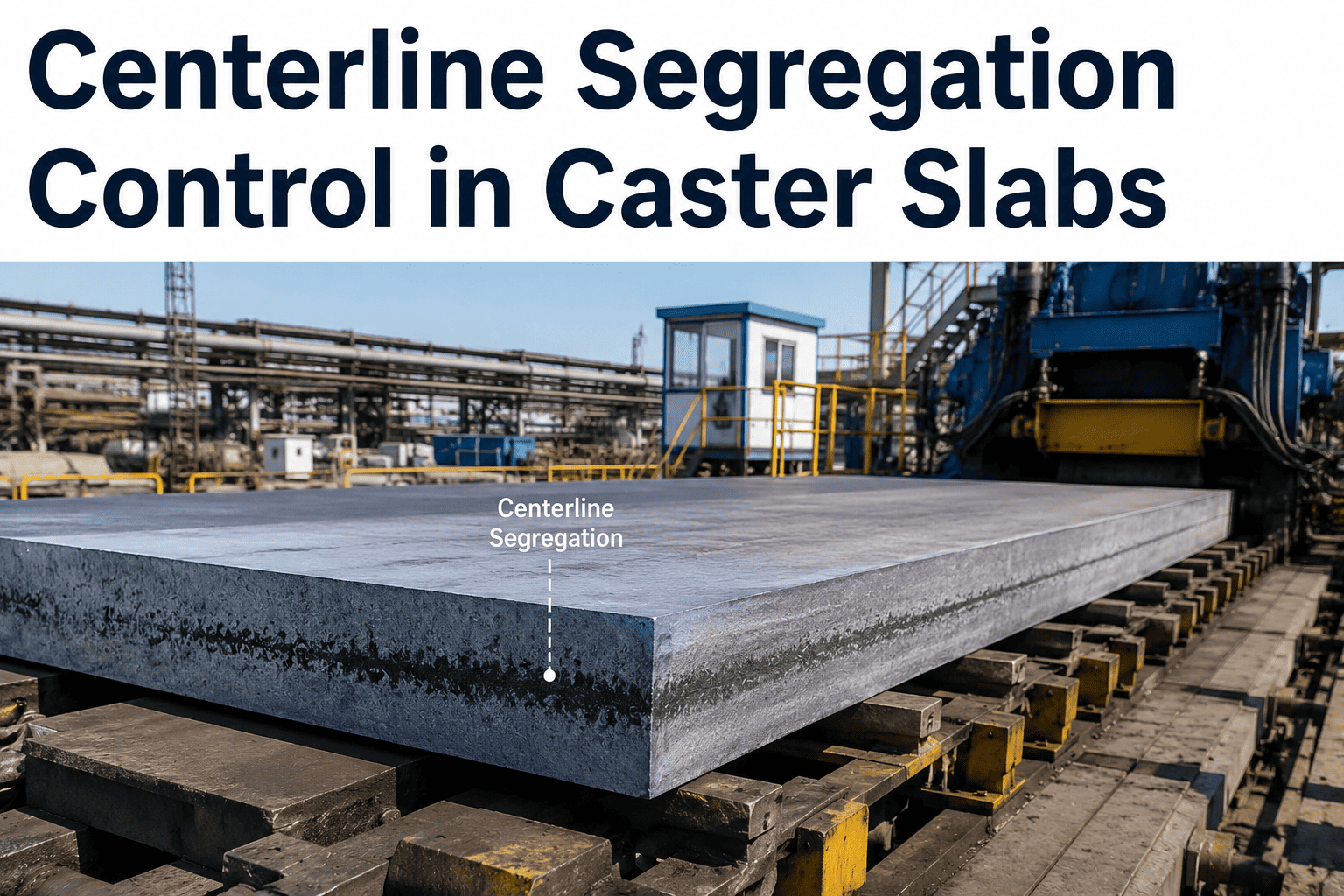
Centerline segregation isn't caused by one bad decision at the caster, it's the accumulated effect of four or five variables drifting slightly out of alignment at the same time: superheat running a little high, roll gap opening a fraction more than spec, soft reduction starting a few seconds late, spray water uneven across the width. Individually, each of these might be within tolerance. Together, at the exact moment the strand reaches final solidification, they combine into a segregation band that no amount of downstream inspection can undo. iFactory's segregation control module was built to catch that combination before it happens, not explain it after the sample comes back.
Segregation isn't one problem, it's four variables landing wrong at once
iFactory coordinates superheat, roll gap, soft reduction timing, and spray cooling in real time so the variables that cause centerline segregation stay aligned instead of drifting independently.
What actually controls where solute ends up
Metallurgical research on centerline segregation consistently points to the same set of controllable variables. None of them eliminates segregation on its own, and all of them interact, which is exactly why a caster running each lever off a separate, independently-set target struggles to control the outcome consistently.
Superheat
Lower superheat produces a wider equiaxed crystal zone, which is more resistant to segregation than the columnar structure that forms under high superheat casting.
Roll gap and alignment
Keeping roll gap constant and preventing strand bulging matters directly, since any movement of enriched liquid between dendrites during final solidification concentrates segregation.
Soft reduction timing
Soft reduction only reaches full effectiveness when it's applied precisely at the solidification end point, compensating for shrinkage without over- or under-pressing the strand.
Spray water cooling
Uneven or clogged spray nozzles change local cooling rate and shell thickness, which shifts where the solidification end point actually falls versus where the roll gap is set.
The difficulty is that these four levers are usually owned by different systems, and sometimes different teams. Superheat is set by ladle metallurgy, roll gap by mechanical maintenance, soft reduction by a separate control loop, and spray water by yet another system tuned during commissioning and rarely revisited. Segregation problems tend to persist precisely because no single view connects all four to the actual segregation outcome heat by heat.
The solidification end point is a moving target
Soft reduction has to meet the strand exactly where final solidification is completing, and that point moves with casting speed, superheat, and cooling rate. A soft reduction zone positioned for one set of conditions is frequently wrong for the next heat.
Research on thermal and mechanical soft reduction has found that when the solidification end point extends further downstream than expected in some part of the slab width, already-solidified material blocks effective reduction there, which is one of the more common ways a correctly-designed soft reduction program still underperforms in practice.
Independently-tuned levers versus a coordinated system
Independent Control
- Superheat, roll gap, soft reduction, and spray water each tuned separately
- Solidification end point estimated once at commissioning, rarely updated
- Segregation index measured only on periodic quality samples
- No single view connecting the four variables to the outcome
- Corrections happen after a customer complaint or downstream reject
iFactory-Coordinated Control
- Solidification end point tracked continuously from live casting conditions
- Soft reduction timing and roll gap recommendations update heat to heat
- Segregation index estimated before the strand leaves the caster
- All four levers visible together against the same segregation outcome
- Drift in any one variable flagged before it compounds with the others
Why segregation control keeps slipping even at well-run casters
Most casters running segregation-sensitive grades already have soft reduction, spray cooling control, and reasonable superheat practices in place. The gap isn't usually a missing capability, it's coordination. Soft reduction calculated for a solidification end point that assumed yesterday's casting speed and superheat will be misaligned today if either value has shifted, and by the time a quality sample flags the problem, dozens of heats have already cast under the same misaligned setup.
Grade transitions make this worse. A caster switching between a high-carbon segregation-sensitive grade and a lower-carbon commodity grade needs different superheat targets, different soft reduction pressure profiles, and sometimes different spray water patterns, all within the same shift. Manual recalculation of the solidification end point for each transition is realistic in theory but frequently skipped in practice under production pressure, which is exactly when segregation excursions cluster.
There's also a data visibility problem. Segregation index is typically measured from sulfur printing or drill-chip carbon analysis on a sampled basis, often days after casting, which means the feedback loop between a control decision and its actual quality outcome is too slow to catch problems before they repeat across many heats. Closing that loop with a live, heat-by-heat segregation estimate is what actually changes the economics of running these variables well.
Shift-to-shift variation compounds the coordination problem further. Even with written procedures for superheat targets and soft reduction setpoints by grade, different operating crews tend to develop slightly different habits around how aggressively they respond to caster alarms, how quickly they adjust for a casting speed change, and how much tolerance they give before escalating a spray nozzle issue. None of these differences show up as a formal procedure violation, but summed across a full production campaign they show up clearly in segregation index variance by shift, which is often the first pattern a coordinated monitoring system reveals that a periodic sampling program never could.
Most quality teams can tell you their average segregation index, but not which specific heats drove the worst outcomes or why. Book a walkthrough and we'll map your segregation excursions against the four control variables.
From live casting conditions to a coordinated recommendation
Track the solidification end point live
Casting speed, superheat, and secondary cooling data continuously update where the strand is actually finishing solidification.
Align soft reduction to that point
Reduction timing and pressure profile recommendations update as the end point shifts, instead of running against a fixed commissioning target.
Flag roll gap and spray drift
Deviations in roll gap or spray coverage that would misalign with the current soft reduction setup are surfaced before they compound.
Score predicted segregation
Operators see an estimated segregation index per heat, with enough lead time to intervene if it's trending outside target.
Confirm against lab results
Sulfur print and drill-chip results are matched back to predictions, sharpening the model for your specific caster and grade mix.
Some grades have almost no margin for error
High-carbon billet grades, line pipe steel destined for hydrogen-induced-cracking service, and heavy-section bloom products carry the tightest segregation tolerances in the industry, and for good reason. Line pipe steel in sour service applications faces some of the most stringent internal quality specifications in commercial steelmaking, since a segregation band can become a hydrogen trap that initiates cracking under service stress. High-carbon grades segregate more aggressively by nature, since carbon partitions strongly between solid and liquid during solidification, which means the same casting practice that's perfectly acceptable for a low-carbon commodity grade can produce a rejectable segregation index on a high-carbon product.
Bloom and large-section billet products add a geometric challenge on top of the chemistry challenge. Larger cross-sections take longer to fully solidify, which gives solute more time to migrate toward the centerline before soft reduction can act, and it also means the solidification end point sits further from the mold, in a section of the caster where roll gap control and spray coverage tend to be less tightly monitored than the upper strand. Coordinating soft reduction, roll gap, and spray cooling matters more on these products precisely because there's more distance, and more time, for the four control levers to drift out of alignment with each other.
Automotive advanced high-strength steel adds a somewhat different pressure. These grades often carry alloying additions that segregate readily, but customers evaluate quality less by a formal segregation index and more by downstream formability and consistency across a coil, meaning segregation-related variation can surface as a production yield problem at the stamping plant rather than a caster-side rejection. Steel producers supplying this segment increasingly need to demonstrate not just that segregation stays under a threshold on average, but that it stays consistent heat to heat, since inconsistency is often more disruptive to a customer's process than a slightly elevated but stable segregation level.
Segregation defects rarely stay contained to one line item
When a segregation defect surfaces, it almost never shows up as a clean caster-side rejection. More often it appears downstream, as a rolling mill reject on a coil that already consumed reheat furnace energy and mill time, or worse, as a field failure discovered by a customer months after shipment. The cost of a segregation defect roughly multiplies at each stage it survives past, which is why catching it at the source, before soft reduction and roll gap decisions are finalized, carries disproportionate value compared to catching it anywhere downstream.
There's a contract-risk dimension too. Steel producers bidding on segregation-sensitive business, sour service line pipe, heavy rail steel, pressure vessel plate, are increasingly asked to demonstrate process capability data, not just final product certificates. A caster that can show consistent, heat-by-heat segregation control, with the underlying casting parameters to back it up, is in a materially stronger position in those qualification conversations than one that can only point to periodic sample results.
Finally, segregation excursions have a way of triggering broader quality investigations even when only a small percentage of heats are actually affected. A single flagged coil often leads to hold-and-release procedures across an entire cast sequence while the root cause is traced, consuming inventory space and scheduling flexibility well beyond the actual defective tonnage. Reducing the frequency of excursions reduces this indirect cost as much as it reduces direct scrap.
What a segregation control pilot involves
Works with existing soft reduction hardware
No new pressing rolls or actuators required, the model recommends timing and pressure for equipment already installed.
Reads from existing sensors
Uses casting speed, temperature, and spray flow data already present in most modern caster control systems.
Historical calibration first
Model is built on past heat records matched to lab-confirmed segregation results before any live recommendations are used.
Shadow mode before live use
Recommendations are logged and compared against actual outcomes before operators act on them directly.
Grade-by-grade rollout
Starts with your most segregation-sensitive grade family and expands once the pilot proves out.
On-premise deployment
Runs on an NVIDIA appliance inside your plant network, keeping casting and quality data on site.
See where your four control levers are drifting apart
We'll pull recent heat records and show where superheat, roll gap, soft reduction, and spray cooling stopped agreeing with each other.
Segregation control, explained plainly
Stop finding out about segregation after the sample comes back
iFactory keeps superheat, roll gap, soft reduction, and spray cooling aligned to the same moving solidification end point, heat by heat. Book a demo and see it against your own data.