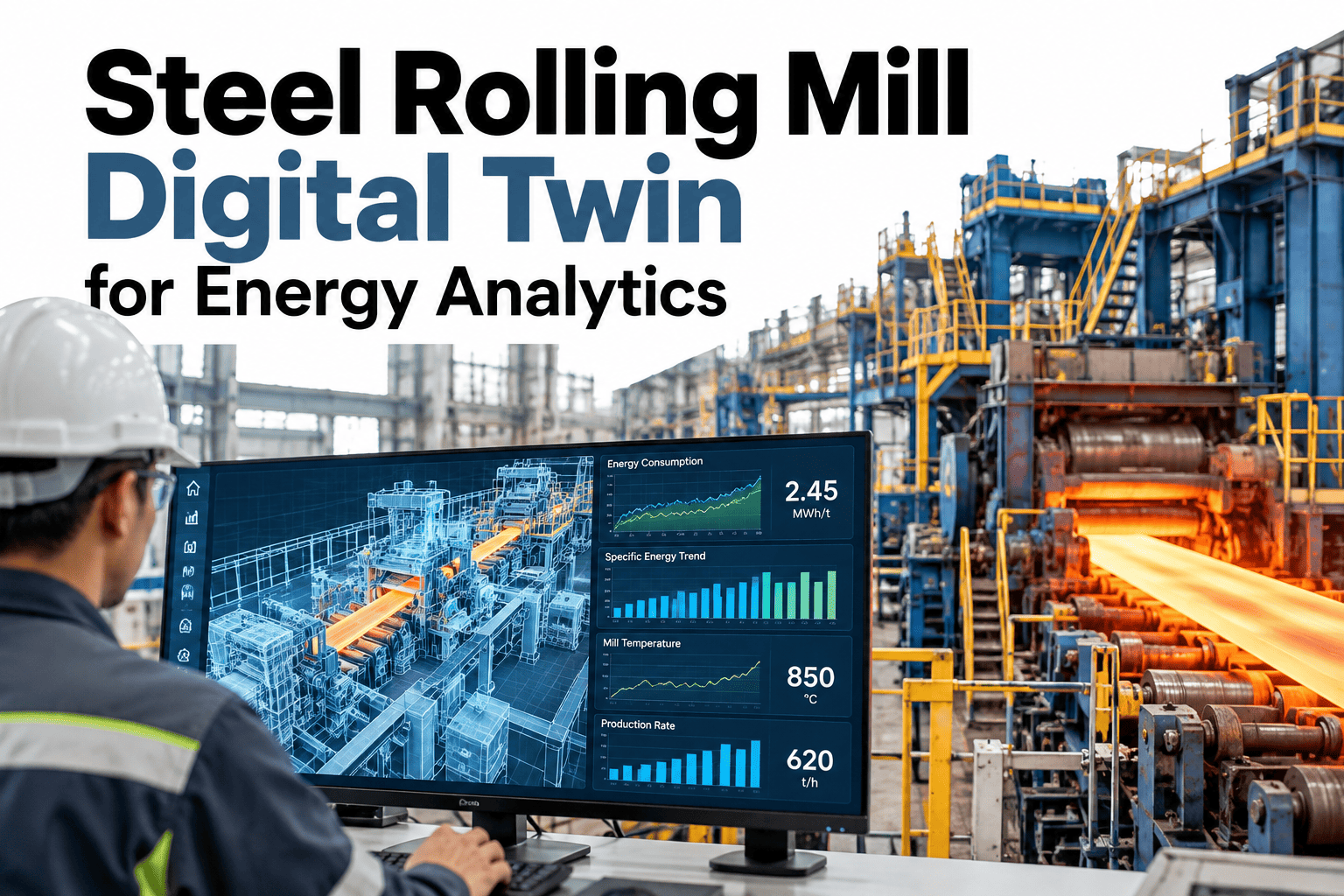
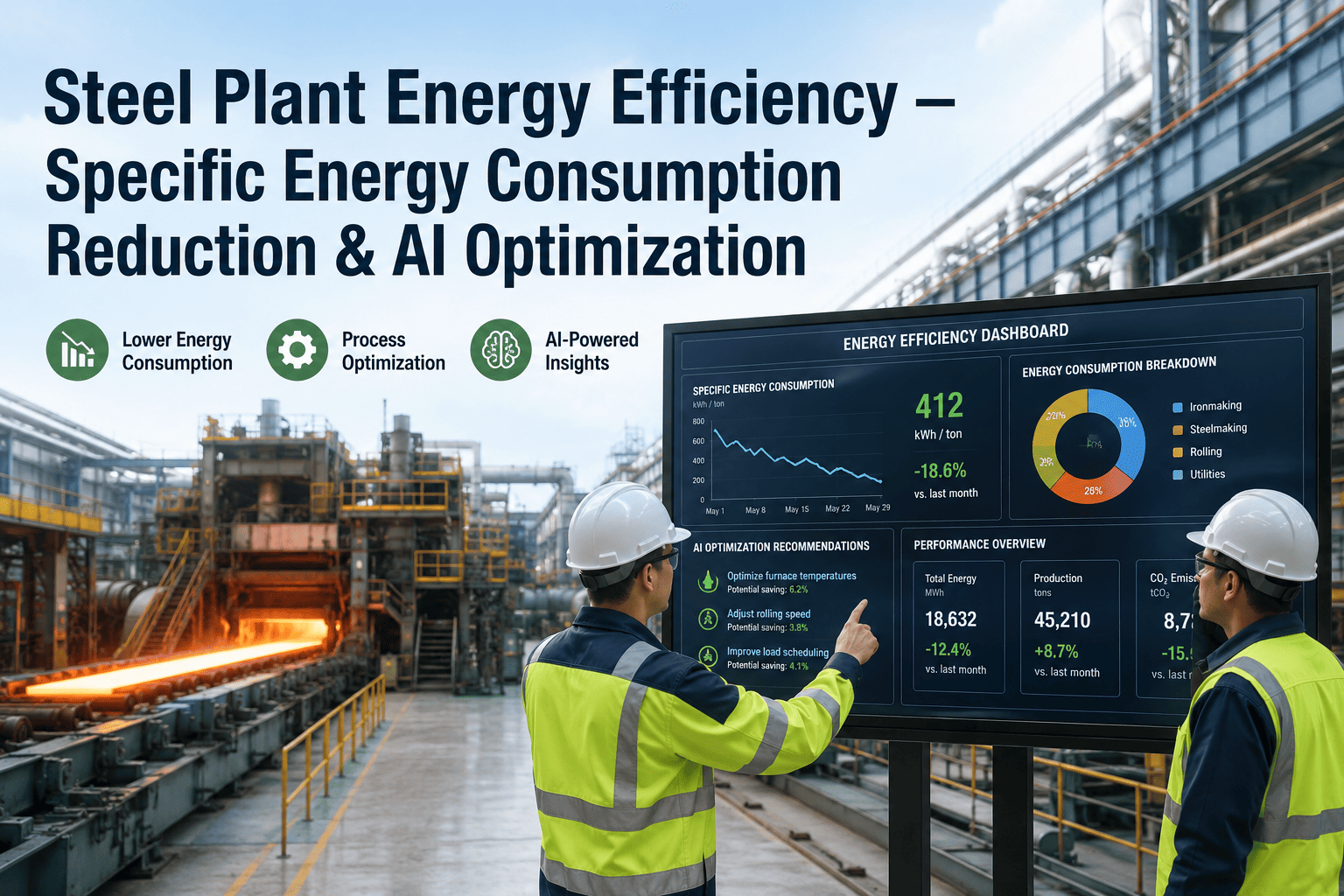
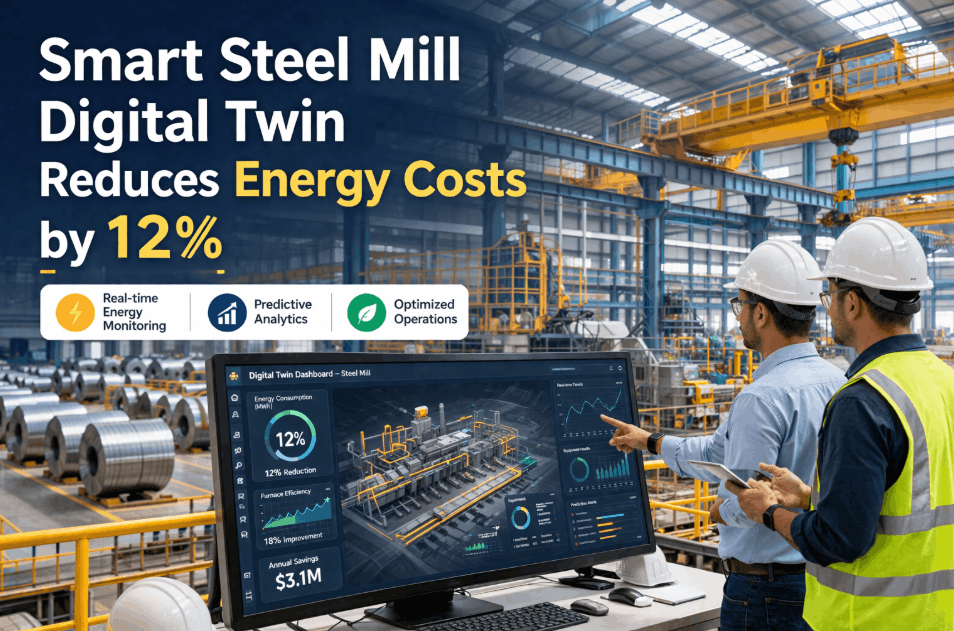
Steelmaking is the most energy-intensive stage of integrated steel production, accounting for 60-75% of total plant energy consumption across Basic Oxygen Furnace (BOF) Electric Arc Furnace (EAF) Ladle Refining Furnace (LRF), and continuous casting operations. Plant-wide AI deployment across the melt shop transforms steelmaking from a process controlled by operator experience and off-line laboratory analysis into a real-time model-predictive operation that optimizes energy input, liquid steel yield, and equipment utilization simultaneously. iFactory's Melt Shop Suite integrates plant-level sensor data, process control setpoints, and production scheduling into a unified AI analytics platform purpose-built for steelmaking environments. Book a Demo to see iFactory's steelmaking AI platform configured for your melt shop asset configuration and production mix.
Deploy Plant-Wide AI Across Your Steelmaking Melt Shop
iFactory's Melt Shop Suite integrates BOF, EAF, LRF, and caster operations with AI-driven energy optimization, yield improvement, and OEE analytics — deployed in 6-12 weeks with full-service implementation and on-premise deployment options.
Why Steelmaking Energy and Yield Optimization Requires Plant-Wide AI — Not Isolated Process Control
Steelmaking operates at the intersection of competing objectives: maximizing energy efficiency while maintaining steel quality, increasing liquid steel yield while meeting tight chemistry specifications, and improving equipment utilization while managing refractory wear and maintenance constraints. Each production unit — BOF, EAF, LRF, and caster — has independent control systems optimized for local objectives that suboptimize global melt shop performance. A BFO oxygen blow practice optimized for endpoint carbon alone may produce slag conditions that reduce yield at the caster. An EAF power input program designed for tap-to-tap time reduction may increase specific energy consumption (SEC) by 8-12% through over-optimistic foaming slag management. The gap between local optimization and plant-wide optimal performance represents 15-25% of melt shop value potential that only integrated AI analytics can capture. Book a Demo to see how iFactory's Melt Shop Suite closes this optimization gap across your entire steelmaking operation.
Steelmaking Production Units Where AI Delivers Measurable Energy and Yield Impact
AI optimization addresses distinct operating challenges across each steelmaking production unit — from hot metal pre-treatment through continuous casting. Each application produces measurable energy, yield, and productivity outcomes that compound when integrated through a plant-wide analytics layer. iFactory's Melt Shop Suite delivers AI models purpose-built for BOF, EAF, LRF, and caster operations with cross-unit optimization that no single process control system can achieve.
Basic Oxygen Furnace — BOF AI
AI models predict endpoint carbon and temperature with ±0.008% C and ±8°C accuracy using real-time off-gas analysis, lance position, and bath agitation data. Dynamic oxygen blow and coolant addition setpoints reduce reblow rates by 40-60%, cut tap-to-tap time by 3-5 minutes, and decrease iron loss in slag by 1.5-2.5%. Blow practice optimization reduces oxygen consumption by 4-7 Nm³ per ton of liquid steel.
Electric Arc Furnace — EAF AI
AI-optimized power input programs reduce SEC by 8-12% through real-time adjustment of arc length, power factor, and foaming slag conditions. Electrode consumption decreases by 10-15% through optimized current setpoints. Tap-to-tap time improves by 4-7 minutes through predictive scrap meltdown modeling. Off-gas temperature and composition analytics prevent over-tapping and reduce alloy addition costs by 5-8%.
Ladle Refining Furnace — LRF AI
AI models optimize heating schedules based on casting schedule demand, reducing LRF tap temperatures by 10-15°C while meeting tundish temperature requirements. Alloy addition optimization decreases Ferralloy consumption by 3-6% through predictive chemistry adjustment and scrap-to-alloy substitution modeling. Electrode consumption in LRF is reduced by 12-18% through optimized reheating practices.
Continuous Caster — Caster AI
AI-driven casting speed optimization increases throughput by 5-8% while maintaining mold level stability and breakout prevention. Tundish temperature prediction enables proactive superheat management, reducing centerline segregation and improving internal quality. Sequence length optimization models maximize the number of heats per tundish without exceeding refractory temperature limits, increasing yield by 1.5-2.5% per sequence.
Melt Shop Scheduling — Integrated AI
Plant-wide AI scheduling optimizes hot metal distribution, ladle tracking, and caster sequence alignment across all steelmaking units. AI models predict heat-by-heat demand and adjust unit-level targets for energy, yield, and quality. The scheduling layer resolves conflicts between BOF, EAF, LRF, and caster operations in real time, improving overall melt shop OEE by 8-12%.
Energy and Emissions Analytics
Melt shop SEC tracking at unit-level and plant-level with AI-driven consumption forecasting. Scope 1 and Scope 2 emissions monitoring with real-time carbon intensity per ton of liquid steel. Power demand optimization integrates with EAF melting schedules to reduce peak demand charges by 8-15% without affecting production throughput.
Steelmaking Optimization Approaches — From Manual Control to Plant-Wide AI
Selecting the right optimization approach for your steelmaking operation requires understanding the capabilities and limitations of each technology tier — from traditional operator-driven control through model-predictive process control to integrated plant-wide AI. The table below compares the key dimensions that determine melt shop performance outcomes.
| Optimization Approach | Energy Impact | Yield Impact | OEE Impact | Data Requirements | Deployment Timeline |
|---|---|---|---|---|---|
| Operator-Driven Control | Baseline SEC | Baseline yield | Baseline OEE | Operator experience only | Existing practice |
| Rule-Based Advisory Systems | 2-4% SEC reduction | 0.5-1% yield improvement | 2-4% OEE improvement | SCADA historian, lab data | 4-8 weeks |
| Model-Predictive Process Control | 4-7% SEC reduction | 1-2% yield improvement | 4-7% OEE improvement | Unit-level sensors + lab integration | 12-24 weeks |
| iFactory Plant-Wide AI Platform | 8-12% SEC reduction | 2-4% yield improvement | 8-12% OEE improvement | Cross-unit process data + product tracking | 6-12 weeks |
| Full Digital Twin Integration | 12-18% SEC reduction | 3-5% yield improvement | 10-15% OEE improvement | Real-time asset model + physics simulation | 16-32 weeks |
Conventional Steelmaking Control vs iFactory AI-Enhanced Melt Shop Optimization
The transition from conventional operator-guided steelmaking control to AI-enhanced plant-wide optimization represents a fundamental shift in how melt shop performance is managed. The comparison below makes the operational and financial impact explicit across the dimensions that matter most for steelmaking operations.
- Process setpoints determined by operator experience and static charge calculation models with ±15% prediction error on endpoint conditions
- Energy input based on fixed power programs or blow schedules that do not adapt to real-time scrap quality or hot metal composition variation
- Yield losses from over-oxidation, slag carryover, and reblow events detected after the heat is complete through laboratory analysis
- Production scheduling managed manually with spreadsheets; sequence conflicts resolved through supervisor experience rather than optimization
- Equipment utilization measured in aggregate monthly OEE without unit-level breakdown or root cause attribution for downtime
- Corrective action triggered by off-line laboratory results with 3-7 minute feedback delay; process drift uncorrected during the delay window
- Five-shift operation produces inconsistent performance; best-practice conditions from one shift rarely transferred systematically to the next
- AI models predict endpoint carbon and temperature with ±0.008% C and ±8°C accuracy; dynamic setpoints adjust every 30 seconds during the heat
- Energy input optimized in real time by AI models that incorporate scrap analysis, hot metal chemistry, slag conditions, and electrode wear state
- Yield losses predicted before they occur; AI alerts identify conditions leading to over-oxidation, slag foaming loss, or breakout risk 2-5 minutes before the event
- AI scheduling engine optimizes across BOF, EAF, LRF, and caster simultaneously; sequence conflicts resolved with optimality scores for every decision
- Real-time OEE tracking at unit level with AI-based downtime classification, bottleneck identification, and predictive maintenance integration
- Inferential sensing provides real-time process condition estimates between laboratory results; process drift corrected within the same control cycle
- AI models transfer best operating practices across shifts automatically; consistent performance regardless of operator experience level
iFactory Melt Shop Suite Architecture — From Plant Floor Data to AI-Optimized Setpoints
Deploying plant-wide AI across the steelmaking shop requires an architecture that bridges process control systems, laboratory information systems, and production scheduling with AI models that optimize across all units simultaneously. iFactory's Melt Shop Suite is designed for this cross-layer integration, with native support for Level 1 and Level 2 process control interfaces, LIMS integration, and MES/MOM connectivity in a single unified platform.
Process Data Integration Layer
Real-time data ingestion from BOF, EAF, LRF, and caster Level 1 and Level 2 control systems through OPC-UA, Modbus TCP, and vendor-specific APIs. Off-gas analysis systems, ladle tracking data, and continuous casting mold monitoring feed into the unified data lake. Laboratory information system integration provides chemical analysis, temperature readings, and inclusion measurements with time-stamped heat association.
AI Model Training and Inference Engine
Steelmaking-specific AI models are trained on historical heat data using hybrid physics-informed neural networks that incorporate mass balance, energy balance, and thermodynamic constraints. Models are deployed for real-time inference on edge servers located in the melt shop control room with sub-second latency. Model retraining occurs automatically as new heat data accumulates and process conditions evolve over time.
Cross-Unit Optimization and Scheduling
The plant-wide optimization layer receives unit-level AI predictions and computes optimal setpoints that balance energy consumption, yield performance, and production throughput across all steelmaking units. The scheduling engine aligns BOF and EAF production rates with LRF refining capacity and caster sequence requirements, minimizing waiting time and maximizing liquid steel flow continuity.
Operator Dashboard and Maintenance Integration
Real-time operator dashboards display AI-recommended setpoints, predicted endpoint conditions, and currently active constraints for each active heat. CMMS integration triggers predictive maintenance alerts for electrode wear, refractory condition, and caster segment roll degradation. Performance reporting delivers daily energy consumption, yield, and OEE metrics with AI-attributed improvement tracking.
Ready to move from operator-dependent steelmaking to plant-wide AI optimization? Book a Demo with iFactory's steelmaking team for a site-specific assessment of your melt shop energy and yield optimization potential.
Melt Shop AI Deployment Roadmap — From Assessment to Full Production Optimization
Deploying plant-wide AI across the steelmaking shop follows a structured four-phase methodology that delivers measurable value at each stage while building toward comprehensive cross-unit optimization. iFactory's deployment framework has been validated across integrated BOF meltshops, EAF mini-mills, and combined BOF-EAF configurations in North American, European, and Asian steel plants.
Melt Shop Data Assessment and AI Opportunity Modeling
Comprehensive review of existing process data availability, historian coverage, sensor condition, and laboratory data quality across BOF, EAF, LRF, and caster units. Historical heat data extraction and analysis to quantify current performance baselines for energy consumption, yield, and OEE. AI opportunity modeling identifies the highest-value optimization targets and predicts achievable improvement ranges for each production unit.
AI Model Development and Offline Validation
Steelmaking-specific AI models are developed using historical heat data with hybrid physics-informed neural network architecture. Models are validated against hold-out data sets covering the full range of product grades, steel chemistries, and operating conditions. Model accuracy is benchmarked against current process models and operator prediction performance. Integration testing with Level 1 and Level 2 interfaces verified in simulation.
Online Deployment and Operator Onboarding
AI models are deployed to melt shop edge servers with real-time inference enabled in advisory mode. Operator dashboards are configured with AI-recommended setpoints and predicted endpoint conditions. Two-week parallel operation period validates model performance against actual heat outcomes with operator feedback collection. Models transition from advisory to closed-loop setpoint optimization after validation.
Cross-Unit Optimization and Continuous Improvement
Plant-wide optimization layer activated with simultaneous optimization across BOF, EAF, LRF, and caster. Scheduling integration enables production sequence optimization based on AI-predicted unit-level performance. Monthly model retraining cycles incorporate new heat data and process condition changes. Continuous performance monitoring with automated value-capture reporting for energy, yield, and OEE improvements.
Measurable ROI — What Plant-Wide AI Delivers for Steelmaking Operations
The financial case for plant-wide AI optimization in steelmaking is built on four primary value drivers: energy cost reduction through SEC optimization, yield improvement through predictive process control, productivity gains through OEE improvement, and quality improvement through consistent process conditions. Each driver contributes independently to bottom-line financial performance in ways that compound through cross-unit optimization.
Energy Cost Reduction
- AI-optimized EAF power programs reduce SEC by 8-12% with real-time slag condition and scrap melting feedback
- BOF oxygen consumption reduced by 4-7 Nm³ per ton through dynamic blow practice optimization
- LRF tap temperature reduced by 10-15°C without tundish temperature impact, saving 5-8 kWh per ton
- Annual energy cost savings of $3-8 million for a typical 1 million ton per year melt shop operation
Yield Improvement
- BOF steel yield improves by 1.5-2.5% through reduced iron loss in slag and minimized over-oxidation
- EAF yield improves by 2-4% through reduced slag foaming loss and optimized scrap charge composition
- Caster yield improves by 1.5-2.5% through sequence length optimization and reduced transition slab tonnage
- Combined yield improvement of $4-10 million annual value per million tons of liquid steel production
Productivity and OEE Gains
- BOF tap-to-tap time reduced by 3-5 minutes per heat through AI-optimized blow practice and reduced reblow rate
- EAF tap-to-tap time reduced by 4-7 minutes through optimized power input and predictive scrap meltdown
- Melt shop OEE improves by 8-12% through reduced waiting time and optimized scheduling alignment
- Additional production capacity equivalent to 50,000-120,000 tons per year without capital investment
Performance Benchmarks — Before and After AI Melt Shop Optimization
Measuring the business impact of plant-wide AI optimization requires KPIs spanning energy consumption, yield performance, productivity, and financial outcomes. The benchmark table below provides the performance metrics iFactory tracks for each steelmaking production unit, with representative before-and-after ranges from industrial deployment across integrated BOF meltshops and EAF mini-mills.
| Production Unit | KPI Tracked | Baseline (Prior to AI) | With iFactory Melt Shop AI | Primary Value Driver |
|---|---|---|---|---|
| BOF Vessel | Re-blow rate | 18-25% of heats require reblow | 8-12% reblow rate achieved | Tap-to-tap time and oxygen consumption reduction |
| EAF Furnace | Specific energy consumption | 420-480 kWh per ton | 380-430 kWh per ton | 8-12% SEC reduction through optimized power programs |
| LRF Station | Tap temperature vs. target | ±18°C standard deviation | ±9°C standard deviation | Reduced reheating energy and alloy savings |
| Continuous Caster | Breakout rate | 3-6 breakouts per 100,000 tons | 0.5-1.5 breakouts per 100,000 tons | Yield improvement and production interruption reduction |
| Melt Shop | Overall OEE | 62-72% | 74-84% | 8-12% OEE improvement through cross-unit optimization |
| Melt Shop | Annual value improvement | Baseline operation | $10-20 million per million tons | Combined energy, yield, and productivity gains |
Industry Perspective — AI in Steelmaking Operations and Melt Shop Management
"I spent twenty-two years managing steelmaking operations across three integrated BOF meltshops and two EAF mini-mills in the United States. Our process control systems were considered advanced by industry standards — Level 2 models for BOF endpoint prediction, EAF electrode regulation with arc stability control, and caster mold level control within ±2mm. The fundamental limitation we could not overcome with traditional process control was the inability to optimize across units. Our BFO optimization was excellent for the vessel, but it did not consider the impact of its slag practice on caster yield. Our EAF power program minimized tap-to-tap time, but it did not account for the effect of higher tap temperatures on LRF refractory consumption and caster breakout risk. Plant-wide AI closes this cross-unit optimization gap that has persisted in steelmaking for decades. The technology to monitor every heat in real time, predict endpoint conditions with accuracy that exceeds operator estimates, and optimize setpoints across all units simultaneously now exists and is deployed in commercial steel plants. The remaining gap is adoption — and the plants that adopt first will have a 10-20% cost advantage that will persist for the life of their operations."
Deploy Plant-Wide AI Across Your Steelmaking Melt Shop with iFactory
From BOF endpoint prediction and EAF power optimization to caster yield improvement and melt shop scheduling — iFactory's Melt Shop Suite delivers complete steelmaking AI in one platform built for primary metals operations. Turnkey deployment in 6-12 weeks with full-service implementation support.
The Gap Between Unit-Level Control and Plant-Wide Optimization Is the Gap Between Cost Management and Competitive Advantage
Steelmaking operations that optimize BOF, EAF, LRF, and caster performance in isolation leave 15-25% of the value potential on the table — value that integrated plant-wide AI is now capable of capturing. The energy, yield, and productivity improvements that AI delivers are not incremental engineering refinements but step-change performance gains that transform melt shop economics.
iFactory's Melt Shop Suite provides the integrated AI platform that connects process control systems, laboratory analytics, and production scheduling into a unified optimization layer purpose-built for steelmaking operations. Book a Demo with iFactory's steelmaking team to build a site-specific AI deployment assessment for your melt shop operation.
Deploy Plant-Wide AI for Your Steelmaking Melt Shop with iFactory
iFactory's Melt Shop Suite integrates every BOF, EAF, LRF, and caster into a unified AI platform that optimizes energy consumption, improves liquid steel yield, and increases overall OEE — in one system built for primary metals reliability and production performance.
Steelmaking AI — Frequently Asked Questions
Existing Level 2 process control models operate at the individual unit level — a BOF endpoint model predicts carbon and temperature for the vessel only, without information about downstream caster requirements or upstream hot metal availability. Plant-wide AI integrates across all steelmaking units simultaneously, optimizing BOF, EAF, LRF, and caster setpoints together to achieve global melt shop objectives rather than local unit-level targets. The AI models also incorporate continuously updated process conditions that static Level 2 models cannot adapt to — real-time scrap quality variation, electrode wear state, slag condition changes, and caster sequence demand shifts.
The minimum data infrastructure requirement for iFactory's Melt Shop Suite is a process historian with at least six months of heat-level data for each steelmaking unit, including process setpoints, measured variables, and laboratory results. OPC-UA or Modbus TCP connectivity to Level 1 and Level 2 control systems is required for real-time data ingestion and setpoint delivery. Laboratory information system connectivity enables automated heat chemistry and temperature data integration. Additional sensors — off-gas analysis, continuous temperature measurement, slag monitoring — add value but are not prerequisites for initial deployment.
Measurable energy and yield improvements begin appearing within the first two to four weeks of online AI operation, during the parallel-run validation phase where AI recommendations are provided in advisory mode alongside normal operator-controlled operation. Initial improvements of 3-5% SEC reduction and 0.5-1% yield improvement are typically observed during this period as operators adopt AI-recommended setpoints for select process conditions. Full improvement targets of 8-12% SEC reduction and 2-4% yield improvement are achieved within 8-12 weeks of deployment, after the AI models transition from advisory to closed-loop setpoint optimization.
Yes. iFactory's Melt Shop Suite includes native integration adapters for major steelmaking MES platforms, including PSI Metals, SAP S/4HANA for Metals, and industry-specific scheduling systems from companies like Danieli, Primetals, and SMS Group. The platform integrates with existing caster sequence planning systems to receive production demand input and output optimized unit-level setpoints that align with the planned production schedule. The integration architecture supports two-way data exchange — the scheduling system communicates heat sequence requirements to the AI optimization layer.
A complete plant-wide AI deployment across a steelmaking melt shop — including iFactory Melt Shop Suite software license,edge server hardware,data integration services,AI model training,operator training,and ongoing model support —typically ranges from $450,000 to $1,200,000 depending on the number of production units covered and the existing automation infrastructure. For a typical 1 million ton per year melt shop with BOF,LRF and caster operations,the total investment falls in the $600,000 to $900,000 range.The payback period from combined energy savings,yield improvement,and productivity gains is typically 5 to 10 months for most steelmaking operations.