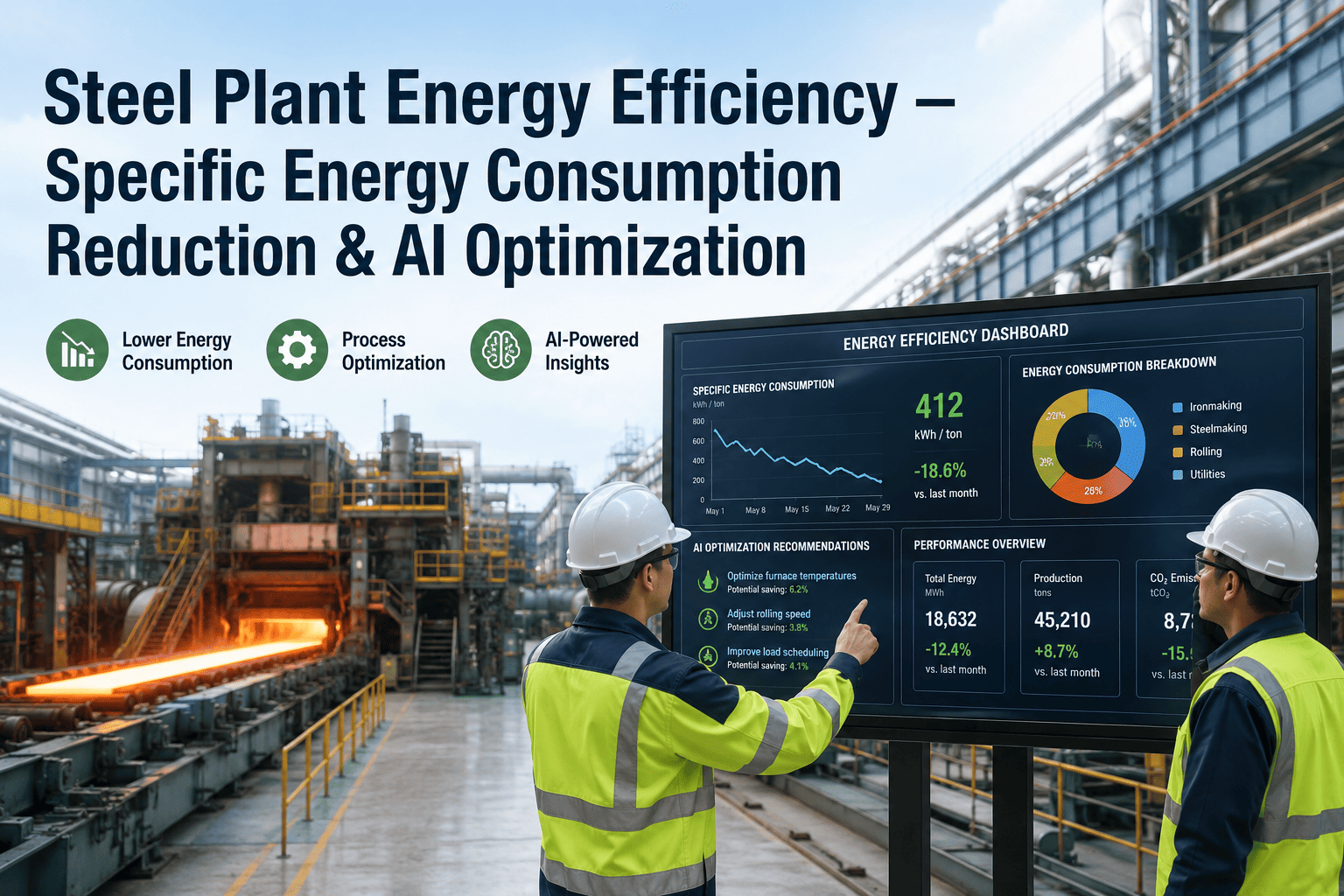
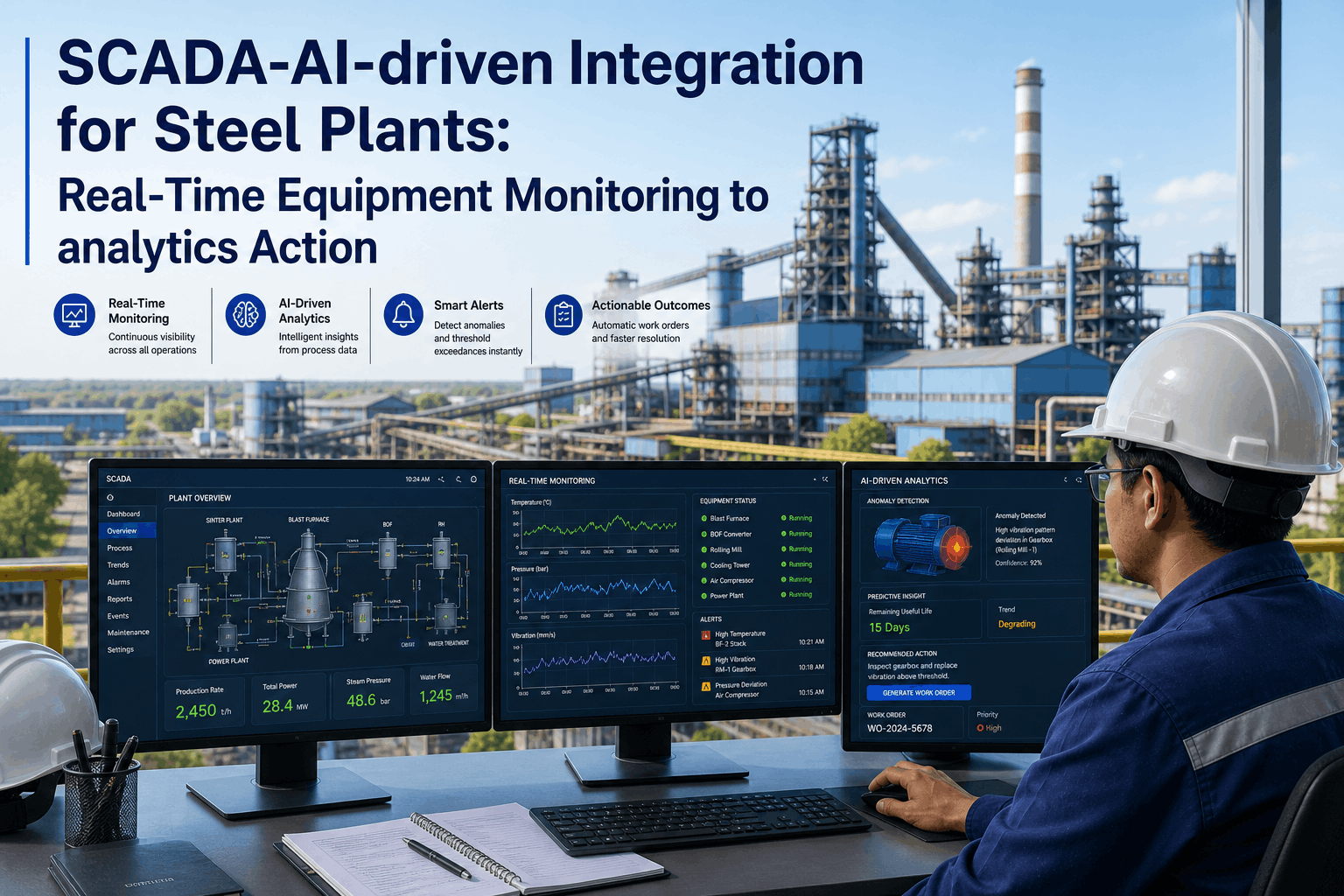
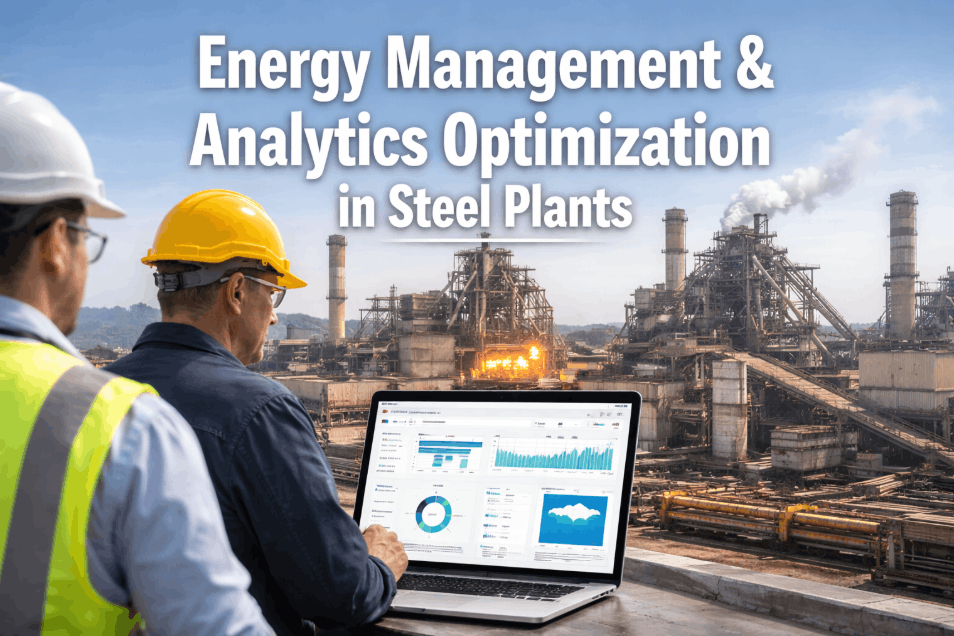
The steel industry accounts for 7% of global CO2 emissions and consumes approximately 8% of the world's total delivered energy. A modern BF-BOF integrated mill requires up to 25 GJ per tonne of crude steel. An EAF mini-mill consumes 10 GJ per tonne — 2.5 times less, but still equivalent to powering 500 homes for every hour a large furnace operates. Energy costs represent 20–40% of total steel production costs depending on route and region, and with electricity prices fluctuating 20–40% year-over-year, every kilowatt-hour of waste is a direct hit to profitability. Yet across the global steel industry, the gap between average energy performance and best-practice benchmarks remains 15–30% — meaning billions of dollars in energy waste are hidden in plain sight. AI-driven energy optimization closes this gap by monitoring every energy-consuming asset in real time, correlating consumption with production parameters, and continuously adjusting setpoints to eliminate waste no human operator can detect. iFactory deploys AI-powered energy analytics for steel plants — book a 30-minute consultation to see where your plant's energy waste is hiding.
Steel Plant Energy Analytics
Find Every Wasted
Kilowatt-Hour.
AI-Driven Energy Monitoring, Furnace Optimization & Sustainability Analytics for Steel Plants
Book a Free Consultation
20–40%
Of Steel Production Costs Are Energy
7%
Of Global CO2 Emissions from Steel Industry
15–30%
Gap Between Average and Best-Practice Energy Performance
25 GJ/t
Energy Required for Primary (BF-BOF) Steelmaking
Where Energy Disappears in a Steel Plant
A steel plant is a chain of thermal, electrical, and mechanical energy transformations — each with losses that cascade through the entire production chain. The largest energy consumers are not always the most obvious. AI maps every energy flow to identify the highest-ROI optimization opportunities.
EAF / BOF Steelmaking
300–400 kWh/tonne (EAF) | 0.5–1.0 GJ/tonne (BOF)
EAF electricity is the largest single energy cost in mini-mills. AI optimizes power curves, oxygen injection timing, and scrap preheating to reduce kWh/tonne by 5–15%. BOF off-gas energy recovery alone can displace 15–20% of plant electricity demand.
Blast Furnace & Ironmaking
12–16 GJ/tonne hot metal
Coke consumption is the dominant energy input. AI optimizes burden distribution, blast temperature, PCI (pulverized coal injection), and slag chemistry to reduce coke rate by 10–30 kg/tonne — saving $5–$15 per tonne of hot metal at current coke prices.
Rolling Mills & Reheating Furnaces
1.0–2.0 GJ/tonne (reheating) | 100–150 kWh/tonne (rolling)
Reheating furnaces waste 30–40% of input energy through flue gas losses, wall losses, and scale formation. AI optimizes slab scheduling, furnace temperature profiles, and walking beam timing. Direct hot charging from caster eliminates reheating entirely.
Auxiliaries & Utilities
10–15% of total plant energy
Compressed air, cooling water, ventilation, and material handling — individually small but collectively significant. AI detects compressed air leaks, optimizes cooling tower staging, and shifts non-critical loads to off-peak tariff periods.
AI Energy Optimization: What It Does That Manual Control Cannot
A skilled furnace operator manages 5–8 variables based on experience and periodic readings. AI manages hundreds of interdependent variables simultaneously, using real-time sensor data at sub-second intervals, correlated with production parameters, raw material quality, and energy tariff structures. The result is continuous optimization across every energy-consuming asset, 24/7.
Monthly utility bills analyzed at plant level
Quarterly energy audits catch problems after millions wasted
Fixed furnace setpoints regardless of scrap quality variation
Operator-dependent — performance varies by shift
Peak demand charges accepted as unavoidable
Energy and production treated as separate optimization targets
vs
Sub-minute energy monitoring at equipment level
Anomaly detection within minutes — not months
Dynamic power profiles adapting to charge composition in real time
Consistent optimization 24/7/365 across all shifts
AI-scheduled load shifting eliminates demand charge penalties
Energy optimized simultaneously with yield and quality targets
The 5 AI Optimization Zones for Steel Energy
AI energy optimization in a steel plant is not one model — it is five specialized optimization zones targeting the largest energy consumers and the highest-value recovery opportunities.
01
EAF Power Curve Optimization
5–15% kWh/tonne reduction
AI adjusts electrode regulation, power step profiles, and chemical energy inputs (oxygen, carbon, natural gas) dynamically based on scrap mix, melt progress, and off-gas composition. Minimizes tap-to-tap time and energy consumption simultaneously while maintaining target tap temperature.
02
Reheating Furnace Optimization
10–25% fuel reduction
AI optimizes slab scheduling, zone temperatures, combustion air ratios, and walking beam timing based on incoming slab temperature, target discharge temperature, and rolling schedule. Prevents overheating and excessive scale formation that wastes both energy and yield.
03
Waste Heat Recovery Optimization
15–25% of recoverable thermal energy
Steel plants generate massive waste heat streams — EAF off-gas at 1,200–1,600°C, BOF converter gas, coke oven gas, and blast furnace top gas. AI maximizes recovery by coordinating steam generation, power production, and scrap preheating across all available heat sources.
04
Peak Demand & Load Management
$500K–$2M/year in demand charge savings
EAF furnaces draw 40–80 MW during melting — creating massive demand spikes that trigger punitive utility charges. AI coordinates furnace power ramps, ladle furnace operations, and auxiliary equipment scheduling to flatten the demand profile and shift loads to off-peak tariff windows.
05
Blast Furnace Coke Rate Optimization
10–30 kg/tonne coke reduction
For integrated mills, coke is the single largest energy cost. AI optimizes burden distribution, hot blast temperature and humidity, PCI injection rate, and slag basicity to minimize coke consumption while maintaining stable furnace operation and hot metal quality.
$3–8M
Annual Energy Savings for a 1–2 Mt Steel Plant
45%
Reduction in Unplanned Downtime with Predictive Energy Analytics
38%
Of Non-Critical Loads Shiftable to Off-Peak via AI Scheduling
2.2→1.2
Tonnes CO2/Tonne Steel: BF-BOF vs DRI-EAF Route
The Energy Data Architecture: What AI Needs from Your Plant
AI energy optimization requires granular, real-time data from every energy-consuming asset — not monthly utility bills. The system connects to existing DCS, SCADA, PLC, and metering infrastructure via OPC-UA, Modbus, and MQTT without requiring any control system replacement.
Electrical Metering
Sub-minute power monitoring on EAF transformers, ladle furnaces, rolling mill drives, fans, and compressors. Captures kWh, kVA, power factor, and demand peaks at equipment level — not just plant-level utility meters.
Thermal Sensors
Thermocouples and IR pyrometers on furnace zones, slab entry/exit temperatures, off-gas temperatures, cooling water delta-T, and stack temperatures. Maps every thermal energy flow from source to sink.
Gas Flow & Composition
Flow meters and analyzers on natural gas, coke oven gas, blast furnace gas, converter gas, and oxygen supply lines. Combustion efficiency optimization requires knowing both volume and composition in real time.
Production Parameters
Charge weights, tap times, casting speeds, rolling schedules, and product mix. AI normalizes energy consumption against production output to separate genuine efficiency changes from volume effects.
Carbon & ESG: The Regulatory Imperative for Steel
The steel sector currently accounts for 7% of global CO2 emissions. Every kWh and GJ saved directly reduces Scope 1 and Scope 2 emissions. With EU CBAM targeting steel imports, carbon pricing expanding globally, and investors demanding Scope 1–3 transparency, energy optimization is no longer optional — it is a regulatory survival strategy.
Scope 1: Process Emissions
BF-BOF emits 2.2 tonnes CO2 per tonne of steel. AI-optimized coke rate reduction, alternative fuel switching, and process gas recovery directly cut Scope 1 emissions. Every 10 kg/tonne coke reduction saves approximately 30 kg CO2.
Scope 2: Electricity Emissions
EAF plants emit ~400 kg CO2/tonne from grid electricity (varies by grid mix). AI reduces kWh/tonne by 5–15% and shifts loads to low-carbon grid periods — directly cutting Scope 2 without capital investment in renewables.
CBAM & Carbon Pricing
EU Carbon Border Adjustment Mechanism requires importers to pay carbon prices equivalent to EU ETS rates. Plants with documented lower emissions gain competitive pricing advantage over higher-emitting competitors.
Real-Time ESG Dashboards
AI provides continuous CO2/tonne tracking feeding directly into GHG Protocol, CSRD, CDP, and SBTi reporting frameworks. Eliminates manual data collection that delays quarterly ESG reports by weeks.
Deployment: From Meters to Savings in 90 Days
Phase 1
Weeks 1–4
Connect & Baseline
Connect existing metering infrastructure, map energy flows, validate data quality, and establish per-unit energy baselines benchmarked against best practice (EAF: 350 kWh/t target, reheating: 1.2 GJ/t target).
Phase 2
Weeks 4–8
Monitor & Alert
Deploy real-time dashboards with anomaly detection. Operators see kWh/tonne, GJ/tonne, and specific energy consumption by asset with sub-minute granularity. Immediate value from detecting energy drift and equipment anomalies.
Phase 3
Weeks 8–12
Predict & Optimize
Activate AI models for EAF power optimization, reheating furnace control, and demand management. Advisory mode first — operators validate AI recommendations before transitioning to closed-loop optimization.
Phase 4
Ongoing
Continuous Optimization
Closed-loop AI writing setpoints to DCS within defined safety bounds. Models retrain automatically as scrap quality, product mix, and market conditions change. ESG dashboards provide continuous emissions tracking.
Frequently Asked Questions
How much can AI save on steel plant energy costs?
A typical 1–2 million tonne steel plant can achieve $3–8 million in annual energy savings through AI optimization. EAF power curve optimization delivers 5–15% kWh/tonne reduction. Reheating furnace optimization saves 10–25% fuel consumption. Peak demand management alone can save $500K–$2M annually in demand charge penalties. The IEA estimates that China's steel sector could save 6.1 GJ/tonne and the US could save 2.4 GJ/tonne through best available technology adoption.
Does AI energy optimization require replacing our existing control systems?
No. AI connects to existing DCS, SCADA, PLC, and metering infrastructure via standard industrial protocols — OPC-UA, Modbus, and MQTT. No control system modifications are required. Phase 1 deployment typically completes in 2–4 weeks with no production interruption. The system works with equipment from any era and any manufacturer.
How does AI handle the difference between EAF and integrated (BF-BOF) plants?
AI models are trained on your plant's specific production route, equipment, and operating patterns. For EAF plants, the focus is on power curve optimization, scrap preheating, and ladle furnace energy management. For integrated mills, the focus expands to blast furnace coke rate optimization, converter gas recovery, and coke oven energy balance. The analytics platform adapts to your specific energy profile.
How does iFactory deploy energy optimization in steel plants?
iFactory starts with an energy audit benchmarking your plant against global best practice, then deploys real-time monitoring dashboards, AI-driven anomaly detection, and closed-loop optimization models — delivering proven ROI within 90 days. Every deployment begins in advisory mode so operators build confidence before autonomous control activates. The same platform provides real-time ESG reporting for Scope 1 and Scope 2 emissions.
Your Furnace Is Running. Is It Running Efficiently?
iFactory deploys AI-powered energy analytics for steel plants — from EAF power optimization and reheating furnace control to waste heat recovery and real-time ESG reporting. Every kilowatt-hour tracked. Every gigajoule optimized. Every tonne of CO2 accounted for.