For independent steel plants, siloed maintenance and analytics software is an inefficiency; for a multi-plant enterprise, it is a multi-million-dollar compounding loss. When a leading industrial steel group acquired its fourth regional flat-products mill, the executive team faced a crisis of fragmentation. Four sites meant four different CMMS platforms, four disconnected spare part warehouses holding duplicates of $80K gearboxes, and four entirely different methodologies for defining "equipment reliability". By deploying iFactory’s Enterprise AI-driven platform across all four facilities, the group eliminated data silos, standardised preventative maintenance protocols, pooled multi-site inventory, and established a unified predictive analytics command centre. Within 14 months, the digital transformation yielded a verified $4.7M in annual recurring savings.
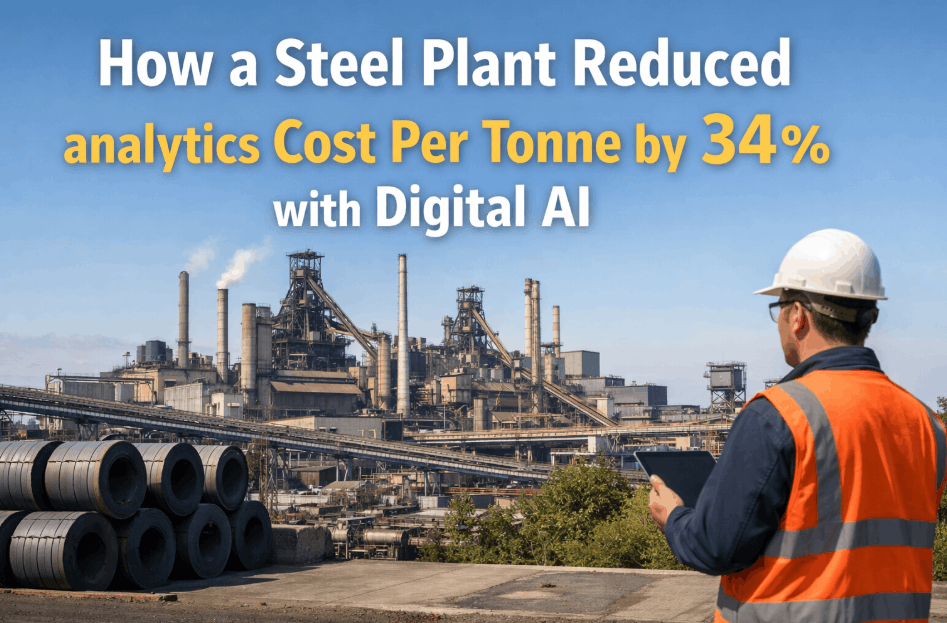
Digital Analytics Transformation Saves Steel Group $4.7M Annually
Standardised analytics processes, multi-plant spare parts pooling, and enterprise-wide predictive AI deployment across 4 regional steel mills.
The Cost of a Disconnected Enterprise
Before the iFactory deployment, the steel group was operating as four separate entities. If Plant A solved a recurring blast furnace defect, Plant B gained zero benefit from that knowledge. If Plant C urgently needed a critical motor, they ordered a new one while Plant D had an identical unit sitting obsolete in their warehouse. Audit your multi-site analytics capabilities today.
Sites unknowingly ordering expensive duplicate spares held inactive at sister plants.
Each site rating equipment criticality differently, skewing CAPEX requests.
Successful defect resolutions logged in paper notebooks, never shared across the group.
Four plants negotiating individual contracts instead of leveraging global group volume.
The Three Pillars of iFactory Multi-Plant Deployment
To achieve full enterprise synchronisation, iFactory rolled out the transformation across three core vectors: Process Standardisation, Inventory Pooling, and Predictive Data Centralisation.
| Process Standardisation Work Orders & PMs |
Shared Intelligence Predictive AI Models |
Asset Pooling Spares & Procurement |
|
|---|---|---|---|
| Phase 1: Baseline Months 1-3 |
Common KPIs
Migrated all 4 plants onto a single definition of MTBF and Schedule Adherence metrics.
|
Sensor Integration
Mapped existing SCADA and historian data into the central iFactory cloud.
|
Master Data Cleanse
Deduplicated 45,000 spare part SKUs to create a single global material taxonomy.
|
| Phase 2: Action Months 4-8 |
Mobile Field Rollout
Deployed rugged tablets to 280 technicians ensuring identical data collection formats.
|
Digital Twin Benchmarking
AI trained on similar assets across plants to flag anomalies faster.
|
Virtual Warehousing
Engineers at Plant A can now view and request critical spares held at Plant C.
|
| Phase 3: Value Months 9-14 |
SOP Syndication
Continuous improvement: Standard Operating Procedures solved at one plant automatically push to all.
|
Fleet-level AI
The AI model achieves 94% accuracy in predicting bearing failures across the enterprise.
|
Group Purchasing
Consolidated vendor negotiations leveraging true group-wide consumption analytics.
|
How iFactory Drives Cross-Plant Optimization
Achieving $4.7M in savings does not come from incremental dashboard improvements; it results from structural changes enabled by interconnected enterprise software. Discuss enterprise deployment mapping with our steel industry architects today.
Virtual Inventory Pooling
By connecting four SAP MM instances into one iFactory view, the group eliminated millions in duplicate critical insurance spares. Before buying a $100K motor, the system instantly cross-checks sister sites for available surplus.
Accelerated AI Training
Predictive AI models require vast amounts of data to achieve accuracy. By feeding the vibrational and thermal signatures of forty similar roughing stands into a single neural network, iFactory’s AI matured 400% faster than a single-site deployment.
Executive Global Command Centre
The Group CEO and Operations Director no longer wait for end-of-month PPT slides. The iFactory global dashboard provides live, standardised risk ratings (1-100) and PM compliance percentages for every facility, instantly highlighting underperforming maintenance departments.
Tracking the $4.7M Group Savings
The multi-million dollar return on investment was tracked and verified by the group's global financial controller, capturing hard cost avoidance and recovered production capacity twelve months post go-live.
What the Group Operations Director Said
We used to operate as four different companies that simply shared a logo. iFactory forced us to behave like a true enterprise. The most impactful moment wasn't just the AI dashboard—it was when a critical breakdown occurred at Plant 2, and the system instantly showed us that the exact replacement gearbox was sitting dusty in Plant 4’s warehouse. We flew the part in overnight instead of waiting 6 weeks for Germany. The system paid for its entire multi-site license from that single automated inventory cross-match.
Multi-Site Deployment FAQs
What happens if our 4 plants currently use different ERP versions?
This is standard. iFactory acts as a translation layer. We deploy API connectors to each distinct ERP/SAP instance, harmonising the schema within the iFactory cloud so executive leadership sees standardized, unified metrics regardless of the underlying backend.
How long does an enterprise data cleanse take?
Deduplicating spare parts catalogs and aligning asset hierarchies typically takes 6 to 8 weeks. iFactory uses proprietary NLP algorithms to identify identical SKUs hidden behind different local naming conventions across the plants.
Can we roll out the platform progressively?
Yes. Most enterprise clients deploy a "Pilot Factory" to establish the structural blueprint, test the SAP integrations, and train the master AI model for 90 days before pushing the identical configuration to the remaining sister plants over a 9-month schedule.
Does standardizing force plants to lose their local autonomy?
No. Strategic goals, KPIs, and part taxonomy are centralized to the group. However, execution permissions, workforce shifts, and day-to-day tactical scheduling remain entirely under the control of the local plant manager.
Schedule an Enterprise Analytics Mapping
Let our engineers show your executive team the financial slack hiding between your facilities.