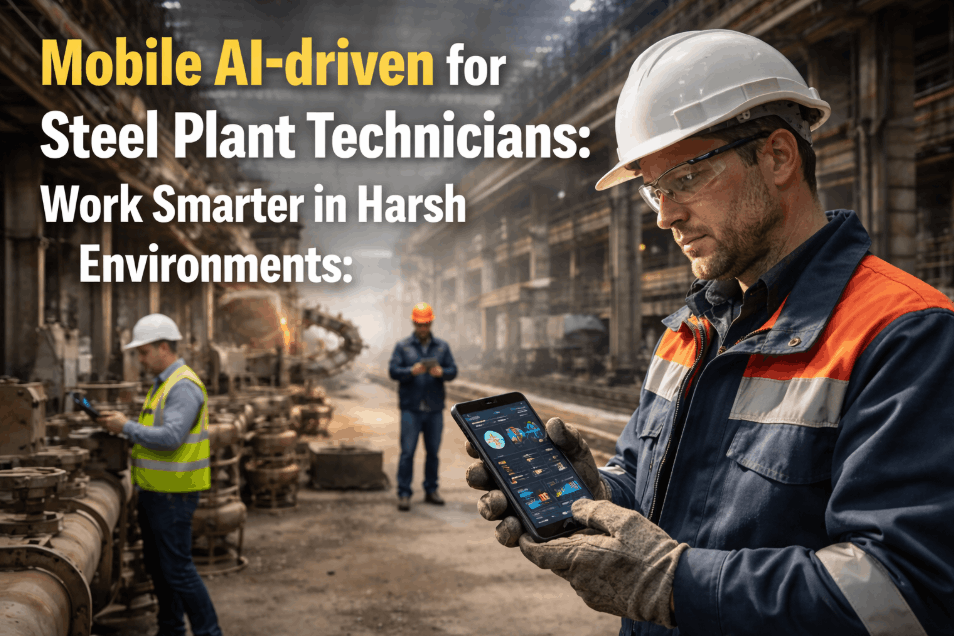
For a high-volume 5 MTPA integrated steel plant, the transition from paper-based maintenance to a fully autonomous digital ecosystem was once viewed as a multi-year risk. Managing over 150,000 work orders annually across Blast Furnaces, Casters, and Hot Strip Mills using carbon-copy forms and manual spreadsheets had created a "Data Graveyard" where critical failure patterns were buried under reams of paper. This is the definitive account of how this facility utilized iFactory's AI-Driven Transformation Suite to digitize its entire maintenance operation in just 18 weeks—improving maintenance labor productivity by 28% and achieving 100% digital traceability. By migrating legacy paper workflows into a real-time AI control tower, the mill has eliminated the 24-hour "information lag" and set a new global benchmark for Steel Plant Modernization. Book a Digital Transformation Audit to see how iFactory can migrate your legacy workflows.
Executive Summary: Overcoming the "Legacy Inertia"
In the steel industry, the greatest barrier to AI adoption is rarely the technology itself—it is the Legacy Inertia of paper-based cultures. For this 5 MTPA facility, the daily maintenance of 4,000+ assets was managed through a fragmented system of clipboards, whiteboards, and verbal handovers. This resulted in an average Maintenance Response Lag of 4.5 hours and a 12% "Repeat Failure" rate because technicians lacked access to historical repair data at the machine. By deploying iFactory's mobile-first architecture, the plant reclaimed nearly $2.2M in annual labor costs and reduced their Mean Time to Repair (MTTR) by 31%. This case study explores the structural shift from "Information Silos" to a "Unified Digital Nervous System."
The transition wasn't just about replacing paper with tablets; it was about Data Liquidity. iFactory's AI engine began analyzing the newly digitized work orders to identify "Chronic Bad Actors"—components that failed frequently but were previously overlooked due to fragmented reporting. Schedule a session to map your mill's digital roadmap.
Client Profile & Digital Baseline
The facility is an integrated steel works featuring 2 Blast Furnaces, a 3-vessel BOF shop, and a high-speed Hot Strip Mill. With a workforce of 1,200 maintenance personnel and 500+ contractors during outages, the "Paper Mountain" was generating over 400 new forms every single day. The pre-deployment audit revealed that 22% of work orders contained illegible or incomplete data, making long-term reliability trending impossible.
The Challenge: The Hidden Cost of Paper Analytics
Managing a steel plant on paper is a high-risk gamble. In this facility, the administrative burden of transcribing 150,000 work orders into a central system required 14 full-time data entry clerks, yet the data was still 48 hours old by the time it reached the Reliability Engineers. This "Hindsight Gap" led to several preventable gearbox failures because the early-warning signs noted on paper never reached the planning desk in time.
The Solution: iFactory's AI-Driven Migration Framework
iFactory deployed a three-layered Digital Migration Strategy designed to minimize production interference while maximizing technician adoption. By utilizing "Zero-Entry" data capture, we reduced the time technicians spent on their tablets compared to their old paper clipboards.
Used iFactory's proprietary OCR (Optical Character Recognition) to digitize 24 months of historical paper logs, providing the AI with an immediate 300,000-point "Experience Baseline."
Enabled technicians to log repair details via voice in noisy mill environments. AI autonomously categorizes these notes into specific "Failure Modes" for the engineering team.
Digital work orders now link directly to the warehouse inventory. Technicians see real-time stock levels of critical valves or bearings before they even leave the machine.
Replaced paper Permit-to-Work forms with geofenced mobile clearances. No worker can start a job until they are physically within the zone and the digital LOTO is verified.
AI automatically compiles "Unfinished Task Reports" and "Critical Asset Alarms" for the next shift, eliminating the 45-minute verbal briefing lag.
Integrated gamification and "Adoption Rewards" to encourage technicians to use the platform, resulting in a 98% active-user rate within the first 60 days.
Results: The 96% OEE Transformation
The transition produced measurable gains that shifted the plant's financial profile. By shortening the "Data-to-Decision" loop, the mill moved from reactive firefighting to predictive reliability.
Performance Summary Table: Legacy vs. AI-Driven Future
| Capability | Paper Model (Baseline) | iFactory AI Model | Strategic Impact |
|---|---|---|---|
| Data Latency | 24-48 Hours | Real-time (0.2s) | Instant intervention capability |
| Predictive Insights | Zero (Manual trending only) | Continuous (ML-driven) | Catastrophic failure prevention |
| Parts Integration | Manual phone/radio check | Automated live inventory sync | Zero "Wait-for-Part" stoppages |
| Safety PTW | Physical signatures (30min) | Digital/Geofenced (2min) | Higher LOTO compliance rate |
| Regulatory Audit | Weekly manual assembly | Instant 1-click export | 100% Digital Certification |
Frequently Asked Questions
How do you handle technicians resistant to digital change?
We use a "Technician-First" UI design and integrate gamification. In this case study, we identified "Champion Technicians" on every shift who trained their peers, resulting in a 98% adoption rate within 8 weeks.
Can iFactory digitize hand-written maintenance history?
Yes. Our AI-OCR engines are trained on industrial handwriting samples. We successfully ingested 24 months of legacy paper logs to provide the AI models with immediate context on "Chronic Failures."
Does the platform work offline in deep mill basements?
Absolutely. The iFactory app features a resilient offline mode. Technicians log data in shielded zones, and the app automatically syncs once they reach Wi-Fi or cellular coverage at the zone exit.
How long does a 150,000 work-order migration take?
The technical migration and initial AI baseline for a facility of this scale typically take 4-6 weeks. Full workforce adoption and "Paper-Zero" status is usually achieved in under 4 months.
Does this integrate with SAP or Maximo?
Yes. iFactory provides native bidirectional API connectors. We act as the "Execution Layer" for your CMMS, ensuring field data reaches your enterprise system without manual entry.
How does AI identify 'Chronic Bad Actors'?
By analyzing the text content and frequency of 150,000+ orders, iFactory's NLP (Natural Language Processing) identifies assets that require repetitive minor repairs that go unnoticed in monthly aggregate reports.
Is digital traceability enough for ISO 9001 audits?
Yes. iFactory's digital audit logs are cryptographically signed and geofenced, providing a level of evidence that far exceeds paper-based logs, resulting in faster and more successful audits.