Steel plant contractor safety management is one of the most consequential — and most inconsistently executed — programs in U.S. heavy industry. Contractors represent a disproportionate share of serious injuries and fatalities on multi-employer steel plant sites: in OSHA fatality data covering the primary metals sector through 2024 contractors accounted for 38% of deaths while representing far fewer total site-hours than the direct workforce. The gap between contractor fatality rates and employee rates at the same facility is not a contractor competency problem — it is a management system problem. Pre-qualification criteria, site orientation quality permit-to-work integration, and ongoing contractor performance monitoring are the four operational levers that determine whether your contractor safety program is a genuine risk control or a documentation exercise. This guide covers each lever in detail for U.S. integrated mills, EAF melt shops, and rolling and finishing operations. Book a Contractor Safety Program Review.
Why Contractor Safety in Steel Plants Requires a Dedicated Management Framework
A steel plant is not a generic industrial worksite. The hazard density — simultaneous overhead crane movements, molten metal transfers, confined space entries, high-voltage electrical work, refractory demolition, and hot mill operations — creates a multi-employer environment where contractor workers face hazards that are not typical of the environments they work in between steel plant assignments. A contractor pipe fitter who works at a food processing plant, a water treatment facility, and a steel melt shop in the same month encounters a fundamentally different hazard profile at the steel plant — and most contractor safety programs in the industry do not account for that variance.
The OSHA multi-employer citation policy means that steel plants can be cited for contractor incidents even when the contractor's own employees performed the unsafe act — if the controlling employer (the mill) failed to exercise reasonable oversight of site safety conditions. That regulatory reality, combined with the actual human cost of contractor incidents, makes a structured contractor safety management framework a business necessity, not an administrative preference.
Pre-Qualification Gap
Contractors selected solely on bid price without safety performance screening arrive on site with unknown incident histories, inadequate training programs, and safety management systems that cannot function in a steel plant environment.
Orientation Failure
Generic site orientations that cover fire exits and PPE requirements but do not address molten metal hazards, overhead crane exclusion zones, and work permit requirements leave contractor workers unprepared for the specific hazards they will encounter.
Permit-to-Work Gaps
Contractors performing high-hazard work — confined space entry, hot work, elevated work, energy isolation — without integration into the mill's permit-to-work system are the leading source of OSHA multi-employer citations at steel plants.
Performance Blindness
Most steel plants collect contractor safety records at pre-qualification and never update them. A contractor's recordable rate at year three of their relationship may be triple what it was at year one — and the mill's system doesn't know it.
Contractor Pre-Qualification: Setting the Safety Floor Before Work Begins
Pre-qualification is the gate through which every contractor must pass before they are eligible to perform work on your site. The purpose of pre-qualification is not to collect paperwork — it is to establish a minimum safety performance floor that protects your workers, your contractor workers, and your regulatory compliance posture. A pre-qualification system that approves any contractor who submits an OSHA 300 log is not a safety filter; it is an administrative burden with no protective value.
Effective pre-qualification for U.S. steel plant contractors combines quantitative safety performance thresholds with qualitative safety management system assessment. The quantitative thresholds screen out contractors with demonstrably poor safety records. The qualitative assessment screens out contractors whose safety management systems — regardless of past performance — cannot support safe operations in a steel plant environment. Book a Demo -to know how safety floor is already set before the work begins.
The standard quantitative pre-qualification screen for steel plant contractors uses three-year average TRIR (Total Recordable Incident Rate) and DART (Days Away, Restricted or Transferred) rate compared against BLS industry benchmarks for the contractor's NAICS code. For high-hazard work categories — crane rigging, confined space entry, refractory work, electrical maintenance — tighter thresholds apply. Contractors with TRIR above 1.5× the BLS industry average for their trade in any of the preceding 3 years are flagged for additional review; contractors above 2× the benchmark are disqualified from high-hazard work categories.
Safety management system assessment evaluates whether the contractor has functional programs — not just written programs — for the hazard categories present at your site. Required elements include: a written hazard communication program with current SDS management; a documented energy control (LOTO) program with written procedures for the equipment types the contractor will service; a confined space program with entry supervisors qualified under 29 CFR 1910.146; a hot work program; and documented training records showing employee completion of applicable OSHA-required programs. Contractors who submit generic programs without evidence of implementation — no training records, no procedure forms, no incident investigation examples — fail the qualitative screen regardless of their TRIR.
Third-party contractor prequalification platforms — ISNetworld, AVETTA, and BROWZ are the most widely used in U.S. heavy industry — provide centralized prequalification management that eliminates the administrative burden of collecting and verifying documentation from each contractor individually. These platforms standardize the prequalification questionnaire, verify submitted documentation, and maintain ongoing compliance tracking. For steel plants managing 50 or more active contractor relationships, platform-based prequalification is the only administratively viable approach to maintaining current, verified contractor safety data.
Prequalification is not a one-time event. Contractor safety performance and program quality change over time — sometimes dramatically. Annual re-qualification updates TRIR and DART data, refreshes insurance certificates and workers' compensation experience modifier (EMR), and requires re-submission of any safety programs that have been revised. Contractors who fall below the mill's performance thresholds at annual re-qualification are placed on a performance improvement plan with defined targets and timelines before their prequalified status is reinstated for the following year.
| Work Category | TRIR Threshold | EMR Maximum | Required Programs | Additional Requirement |
|---|---|---|---|---|
| General Maintenance | ≤ 1.5× BLS benchmark | ≤ 1.10 | LOTO, HazCom, PPE | OSHA 10-hr minimum for workers |
| Crane & Rigging | ≤ 1.0× BLS benchmark | ≤ 1.00 | LOTO, Rigging, Fall Protection | NCCCO-certified riggers required |
| Confined Space Entry | ≤ 1.0× BLS benchmark | ≤ 1.00 | Confined Space, LOTO, Rescue | Entry supervisor competency verification |
| Hot Work / Welding | ≤ 1.25× BLS benchmark | ≤ 1.05 | Hot Work, Fire Prevention, PPE | Plant fire watch certification required |
| Refractory / Demolition | ≤ 1.0× BLS benchmark | ≤ 1.00 | Silica, Asbestos, Heat Stress, LOTO | Respiratory protection program required |
| Electrical Work | ≤ 1.0× BLS benchmark | ≤ 1.00 | LOTO, Arc Flash, Electrical Safety | NFPA 70E qualified worker documentation |
Site Orientation: Preparing Contractor Workers for Steel Plant Hazards
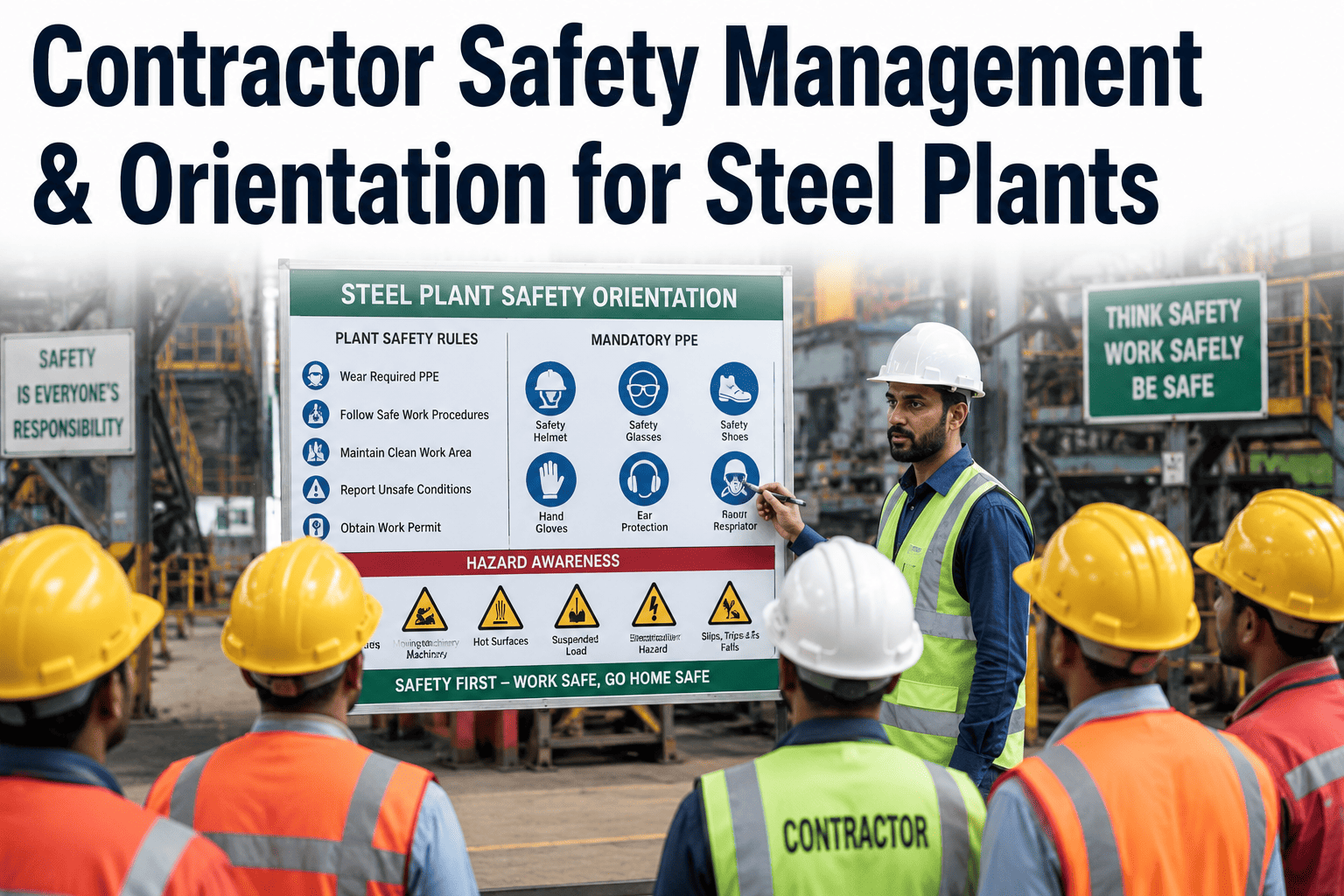
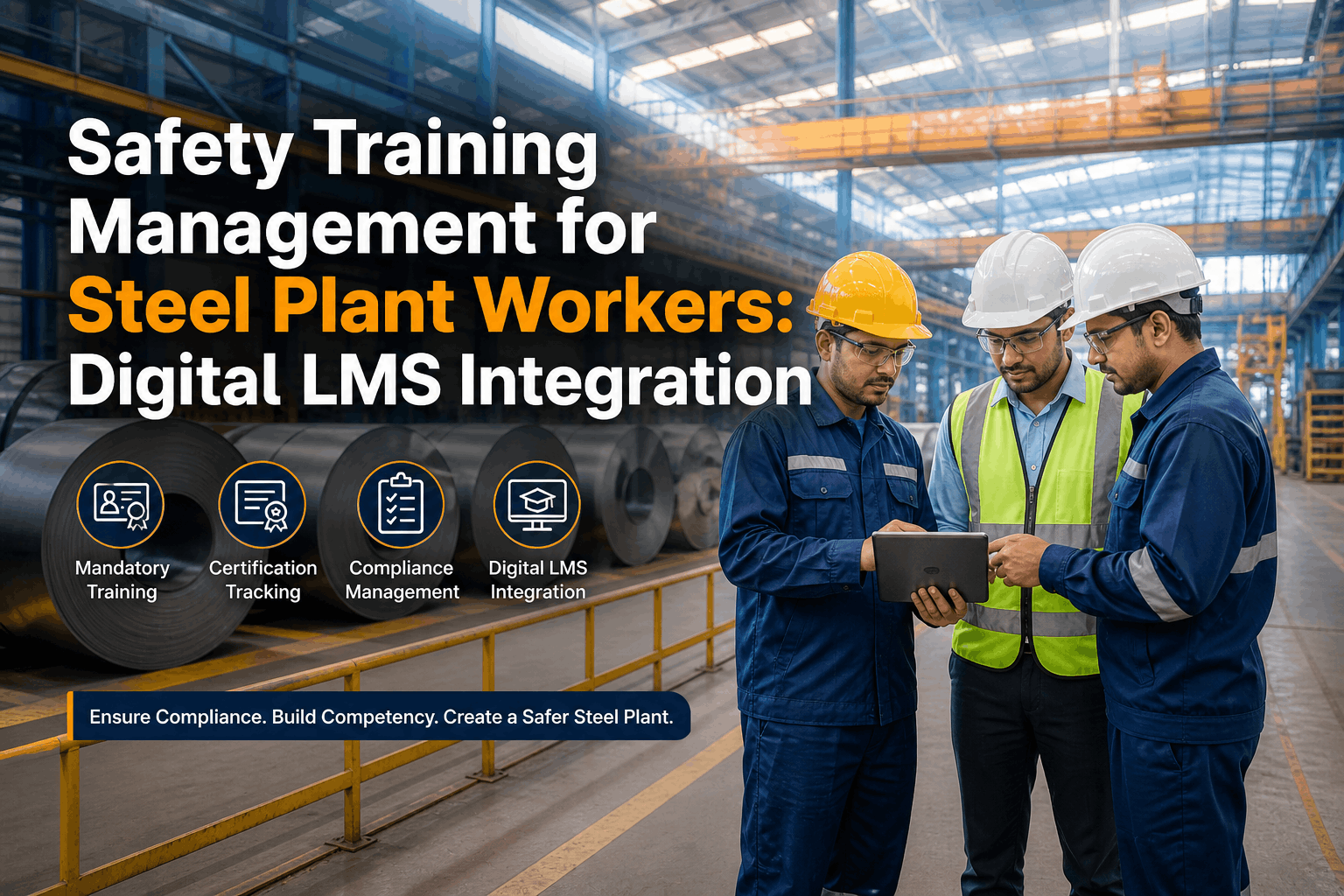
Site orientation is the first and most critical safety touchpoint between the mill and the contractor worker. It is the one opportunity to ensure that every contractor worker entering the site understands the hazards they will encounter, the safety rules that govern their work, and the emergency response procedures they must follow if something goes wrong. A 20-minute video followed by a quiz is not a steel plant site orientation — it is a documentation event.
Effective steel plant contractor orientation is structured in two tiers: a general site orientation covering hazards and rules that apply to all contractor workers on any part of the site, and a work-area-specific orientation covering the specific hazards of the area where the contractor will actually work. General orientation can be standardized and delivered efficiently. Work-area orientation must be conducted by someone who knows the specific hazards of that area — typically the plant supervisor responsible for that zone.
Permit-to-Work Integration: The Operational Core of Contractor Hazard Control
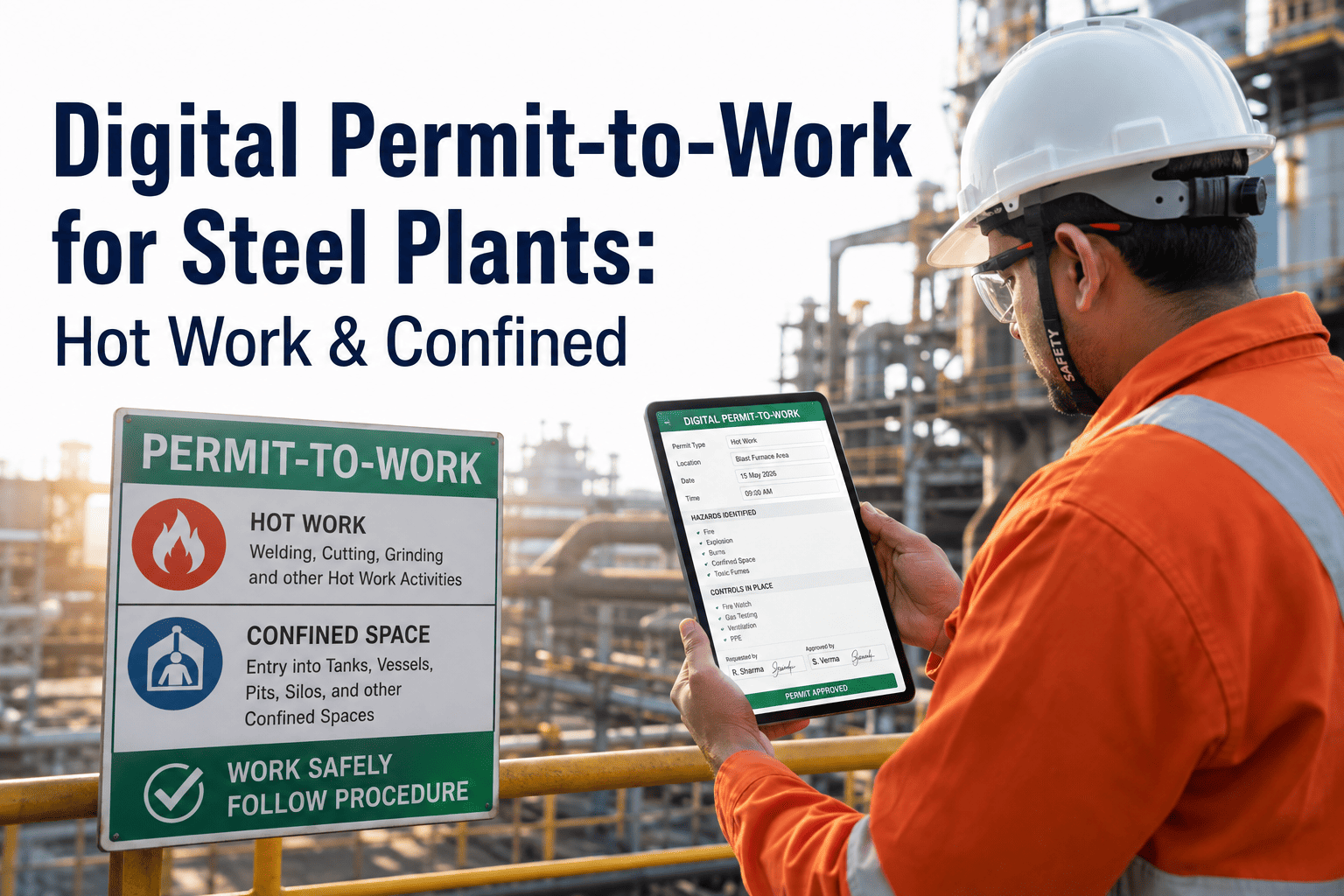
The permit-to-work system is the mechanism by which high-hazard contractor work is authorized, controlled, and closed out safely. It is also the system most frequently cited by OSHA in multi-employer situations — either because contractors bypassed the permit requirement, because permits were issued without adequate hazard review, or because permit closeout was not verified before energy was re-applied or work areas were re-opened to traffic.
Integrating contractors fully into the mill's permit-to-work system — not creating a parallel, simpler contractor version — is the operational standard that the highest-performing U.S. steel safety programs maintain. The permit system exists because the hazards it controls are capable of killing people; a simplified contractor version of that system that skips steps because the contractor is on a tight schedule defeats the purpose entirely.
| Permit Type | When Required for Contractors | Plant Requirement | Contractor Requirement | Closeout Standard |
|---|---|---|---|---|
| Energy Isolation (LOTO) | Any work on equipment with hazardous energy | Plant authorized isolator applies primary LOTO | Each worker applies personal lock | Plant verifies energy zero before removal |
| Confined Space Entry | Entry into any permit-required space | Plant entry supervisor issues entry permit | Contractor entry supervisor and attendant | Plant entry supervisor signs closeout |
| Hot Work | Any welding, cutting, or open flame | Plant fire watch authorization; area clearance | Contractor submits pre-task fire assessment | 30-minute post-hot work fire watch required |
| Elevated Work | Work above 4 feet from walking/working surface | Plant fall protection plan review | Contractor provides fall protection equipment | Scaffolding / equipment removal verified |
| Radiography / NDT | Any ionizing radiation use on site | Plant radiation safety officer approves | Licensed radiographer with current credentials | Area survey completed; dosimetry records filed |
Contractor Performance Monitoring: Keeping Safety Data Current Through the Relationship
Pre-qualification establishes a contractor's safety floor at the start of a relationship. Performance monitoring maintains visibility into whether that floor is holding as work progresses. U.S. steel plants with mature contractor safety programs treat contractor safety performance as a living metric — tracked continuously, reviewed formally at defined intervals, and used to make real contracting decisions about work scope, supervision requirements, and continued approval status.
Contractor near miss reporting is the most informative leading indicator of contractor safety performance — and the one most commonly absent from contractor monitoring programs. A contractor who works 5,000 hours on your site and reports zero near misses is not safe; they are not reporting. Near miss reporting rates below 0.5 per 100 worker-hours for contractors in high-hazard work areas are a signal of reporting culture failure, not an absence of hazards. Require contractors to submit near miss reports through the same plant system used for employee reports, and review contractor near miss rates alongside recordable rates in monthly performance monitoring.
Every stop-work event involving a contractor — whether initiated by plant safety, plant operations, or the contractor's own workers — is logged in the contractor performance record with the hazard category, location, corrective action required, and verification of closure. Contractors with three or more stop-work events in any 90-day period for the same hazard category are placed on immediate performance review. Contractors who dispute or resist stop-work actions by plant personnel are escalated immediately to contractor management at the senior level — this behavior is a categorical disqualifying factor regardless of the contractor's overall safety record.
Contractor safety performance consequences must be real to be effective. Performance improvement plans (PIPs) with defined metrics, timelines, and verification requirements are the standard response to performance below threshold. PIPs that are issued and then not followed up are worse than no PIP at all — they signal to the contractor that the consequences are not real. Disqualification — removal of approved status and termination of the contracting relationship — is the consequence for contractors who fail to achieve PIP targets, who have serious or fatal incidents on your site, or who demonstrate fraudulent safety reporting. Disqualification decisions should be documented and shared with the prequalification platform to prevent the contractor from reappearing under a different legal entity.
Expert Review: What Separates Top-Performing Steel Plant Contractor Programs
Steel plants achieving contractor TRIR below 1.0 — the benchmark that places them in the top quartile for multi-employer sites in primary metals — share five practices that the majority of U.S. mills have not yet implemented. First, they treat contractor safety performance as a procurement factor with the same weight as price and schedule. When a bid evaluation explicitly scores safety performance at 25% of the total award decision, contractor safety investment changes because the commercial incentive changes. Second, they conduct unannounced field audits of contractor work in progress — not during scheduled safety walks, but at random times during active work. The gap between what contractors do when they know they are being observed and what they do when they believe they are not is the true measure of their safety culture. Third, their permit issuers — plant supervisors who authorize high-hazard contractor work — receive the same permit-to-work competency training as the safety department. A permit issued by a supervisor who doesn't fully understand confined space atmospheric testing or LOTO energy verification is as hazardous as no permit at all. Fourth, they share site incident data with their contractors — both plant and contractor incidents — in monthly joint safety meetings. Contractors who know what incidents are happening on your site, and understand that their performance is being measured against that shared context, perform differently than contractors who receive safety feedback only when their own workers are injured. Fifth, they have eliminated the practice of allowing contractor supervisors to self-issue permits for their own crews' work. The conflict of interest in that arrangement — between production pressure and hazard control — is exactly the conflict that permit-to-work systems exist to resolve. The best programs resolve it by making the plant the issuing authority in every case.
— Industry Benchmark Review, U.S. Steel Plant Contractor Safety Management, iFactory Analytics Reference 2026Conclusion
Contractor safety management in a U.S. steel plant is not a program you can run once at pre-qualification and revisit when something goes wrong. The hazard density, multi-employer complexity, and regulatory exposure of a steel plant environment require continuous management across the full contractor lifecycle: rigorous pre-qualification that screens on performance and program quality, not just paperwork; structured two-tier orientation that prepares contractor workers for the specific hazards of the areas where they work; full integration of contractors into the plant's permit-to-work system rather than a simplified parallel version; and ongoing performance monitoring that treats contractor safety data with the same rigor as employee safety data.
The financial case for this level of investment is direct: a single fatal contractor incident generates costs — OSHA penalties, workers' compensation, litigation, production disruption, and reputational damage — that dwarf the full cost of a well-resourced contractor safety management program for a decade. Mills that manage their contractor relationships through administrative compliance rather than genuine safety partnership are not managing contractor risk — they are deferring it to the next serious incident.
Frequently Asked Questions
Yes — and this is one of the most important and most misunderstood aspects of contractor safety management for U.S. steel operations. OSHA's multi-employer citation policy distinguishes between the creating employer (who created the hazard), the exposing employer (whose workers are exposed), the correcting employer (responsible for correcting the hazard), and the controlling employer (who has general supervisory authority over the worksite). A steel plant that is the controlling employer on a multi-employer site can be cited for failing to exercise reasonable care to detect and prevent OSHA violations — even when only contractor workers were exposed and the contractor's own supervisors created the hazard. The controlling employer defense is that the steel plant took reasonable steps to require compliance, periodically inspect for violations, and correct violations promptly when found. A contractor safety management program with documented pre-qualification, orientation, and permit oversight is the factual record that supports that defense. Operations without that record have no defense when OSHA applies the multi-employer policy.
The right threshold depends on the work category, and it should always be expressed relative to the BLS industry benchmark for the contractor's specific NAICS code — not as an absolute number, because TRIR varies significantly by trade. A TRIR of 2.5 may be below average for heavy construction trades but above average for specialty industrial maintenance contractors. As a general framework for steel plant contractor pre-qualification: for low-hazard general maintenance work, use 1.5× the BLS benchmark for the trade as the disqualifying threshold; for high-hazard work — confined space entry, crane rigging, refractory demolition, electrical maintenance — use 1.0× the BLS benchmark. The experience modification rate (EMR) from workers' compensation is a useful complementary metric because it is independently calculated and harder to manipulate than self-reported TRIR. An EMR above 1.10 for any work category is a signal of above-average workers' compensation claim frequency that warrants additional scrutiny regardless of TRIR. Review TRIR and EMR together over a 3-year period to avoid rewarding contractors who had a good year before pre-qualification but consistently perform above average across a full cycle.
A steel plant general site orientation should run a minimum of 2 hours for a facility with significant molten metal operations, overhead crane activity, and a permit-to-work system. Orientations shorter than 90 minutes cannot credibly cover the overhead crane hazard profile, permit system overview, molten metal exclusion zones, emergency procedures, and PPE requirements in a way that achieves genuine comprehension rather than passive exposure. The work-area-specific orientation is additional and should run 30–60 minutes per area, delivered by the area supervisor or safety representative who knows the specific hazards of that zone. Required content for general orientation includes overhead crane safety, hot metal transport routes, permit-to-work system overview, emergency assembly points, PPE minimum requirements, incident reporting, and prohibited behaviors. Comprehension verification — a brief assessment, not a participation checkbox — should be administered at the end of general orientation, with workers who fail the assessment required to repeat the relevant sections before receiving site access. Annual re-orientation is required for any contractor who has not been on site in the preceding 12 months.
When contractors work on equipment that is covered by the plant's LOTO procedures, the plant's procedure governs — not the contractor's generic energy control program. OSHA's LOTO standard (29 CFR 1910.147(f)(2)) requires the host employer and contractors to inform each other of their respective lockout/tagout procedures and to ensure that their lockout/tagout programs are coordinated so they don't endanger employees. In practice, this means the plant's authorized isolator applies the primary LOTO to the energy sources identified in the plant's equipment-specific procedure, and each contractor worker who will perform work under that LOTO applies their own personal lock to the group lockout device. Contractors should not be applying their own primary LOTO to plant equipment unless they have been trained on the plant's specific procedure for that equipment and have been designated as authorized isolators by the plant. Contractor workers who arrive with a generic LOTO procedure and no equipment-specific training should not be authorized to perform primary isolation on any plant equipment — they should work under a plant-applied primary LOTO with their own personal locks added to the hasp.
Yes — and integration with the CMMS and permit system is where contractor safety management delivers its greatest sustained operational value. When contractor pre-qualification records, orientation completion data, and performance metrics are integrated into the same platform as the permit-to-work system, three things happen automatically that don't happen with standalone contractor management software: permit issuers can verify in real time that the contractor worker requesting a permit has a current, valid orientation record and is approved for the work category the permit covers; stop-work events and permit violations generate contractor performance records automatically rather than requiring manual data entry after the fact; and corrective actions from contractor incidents and near misses are tracked in the same CMMS environment as plant equipment maintenance — giving safety and operations leadership a unified view of safety performance and corrective action status across both the direct workforce and the contractor population. iFactory's platform is pre-built for this integration, with contractor management modules that connect directly to permit-to-work workflows, incident reporting, and corrective action tracking. Standard connectors support ISNetworld and AVETTA data feeds for pre-qualification synchronization.
-for-steel-plants-digital-compliance-framework.png)