-for-steel-plants-digital-compliance-framework.png)
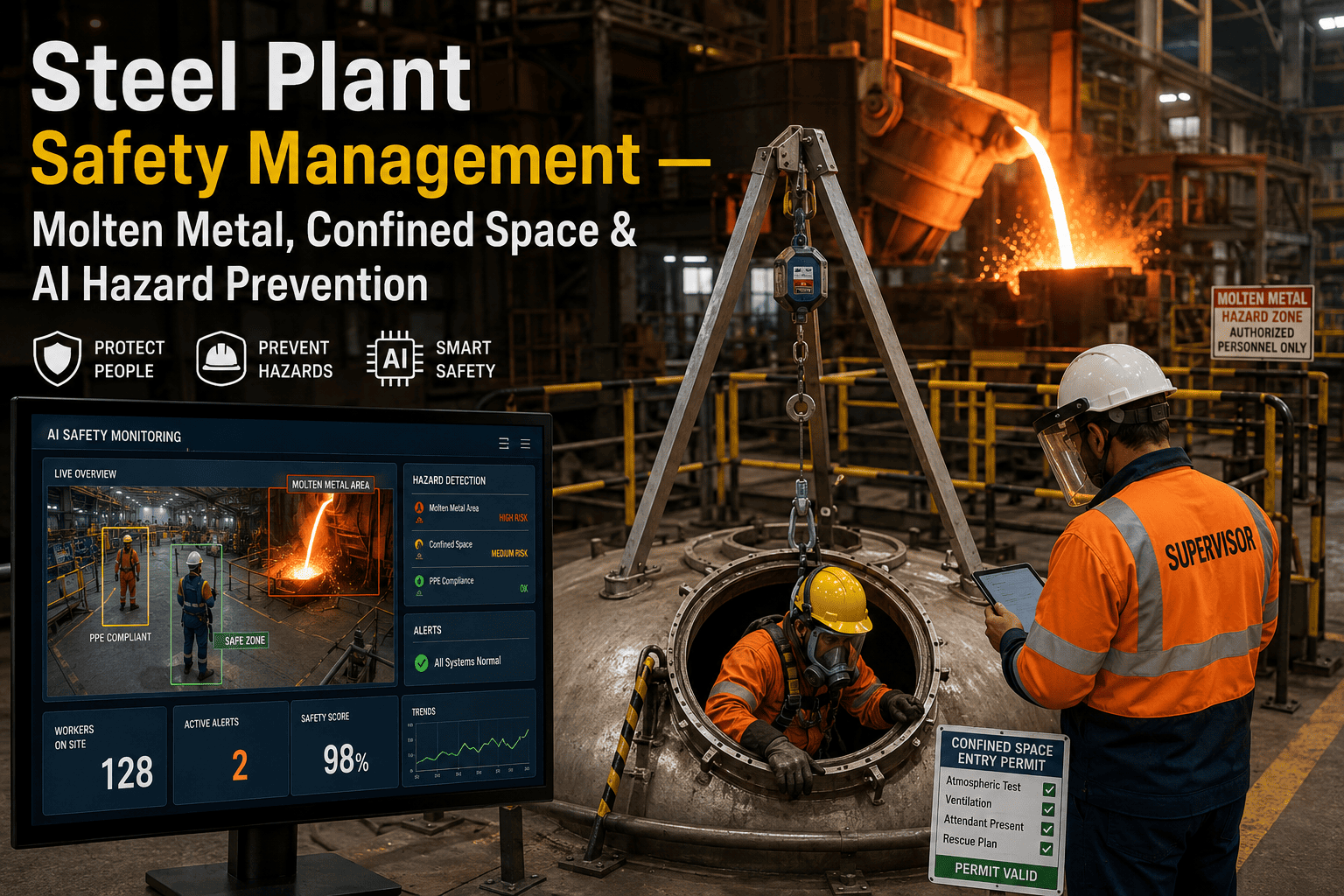
Operating a modern steel plant involves managing immense thermal energy, toxic gases like carbon monoxide and ammonia, and highly reactive chemical processes. Due to these extreme operational hazards, steel manufacturers must strictly adhere to OSHA's Process Safety Management (PSM) standard (29 CFR 1910.119) or equivalent international safety frameworks. Historically, maintaining compliance across the 14 PSM elements has relied on disconnected spreadsheets, physical binders, and fragmented email chains. This manual approach not only creates a massive administrative burden but also introduces dangerous compliance gaps that lead to severe OSHA citations or, worse, catastrophic plant incidents. Process Safety Management (PSM) for Steel Plants requires a robust, integrated digital framework. iFactory digitizes your entire PSM workflow, directly tying Management of Change (MOC) approvals, Process Hazard Analysis (PHA) outcomes, and Mechanical Integrity (MI) inspections to our core Enterprise Asset Management (EAM) engine. By centralizing safety data, plant managers ensure an immutable audit trail and real-time visibility into the plant's safety posture. Schedule a PSM Software Audit to safeguard your workforce and your bottom line.
Digitize Your 14 Elements of Process Safety
Replace vulnerable paper binders with iFactory's digital safety module. Automate MOC routing, enforce mechanical integrity inspections, and guarantee audit-readiness across your steel enterprise.
The Danger of Paper-Based Process Safety Management
In the high-stakes environment of steel manufacturing, managing OSHA PSM compliance via paper records is a severe operational liability. When a blast furnace undergoes a mechanical modification, the management of change (MOC) process requires updates to Piping and Instrumentation Diagrams (P&IDs), revised operating procedures, and updated operator training. In a paper-based system, these updates are frequently delayed or forgotten. A modified valve might not be logged, meaning the next maintenance shift operates under outdated Process Safety Information (PSI), setting the stage for a critical failure.
Furthermore, manual compliance management completely isolates safety from actual maintenance execution. A safety inspector might identify a corroded pipe during a routine Process Hazard Analysis (PHA), but if that finding is trapped in an Excel spreadsheet on an HSE manager's laptop, the actual repair work order might sit in a backlog for months. iFactory eliminates this fatal disconnect. By integrating PSM digital management directly into the plant's EAM, safety findings immediately trigger high-priority, trackable work orders that cannot be closed until physical verification is digitally signed off.
Relying on legacy methods also makes surviving an OSHA PSM audit a nightmare of administrative scrambling. Preparing for an audit often requires weeks of tracking down physical signatures and collating training logs from different departments. iFactory’s PSM compliance framework maintains a continuous, immutable digital ledger. When an auditor arrives, the plant manager can generate a comprehensive compliance report, demonstrating strict adherence to all 14 elements, with just a few clicks.
By adopting iFactory's safety module, heavy industries move from reactive compliance—doing the bare minimum to avoid fines—to proactive risk elimination. This digital CAPA (Corrective and Preventive Action) approach protects your most valuable asset: your workforce.
Identifying the Gaps: Where Traditional PSM Fails
Before digitizing your safety framework, it is crucial to recognize the specific failure points inherent in traditional compliance tracking within a steel mill.
- Siloed Mechanical Integrity (MI): Safety teams perform inspections, but maintenance teams execute the repairs. When these two systems don't communicate digitally, critical safety-critical equipment (SCE) repairs fall through the cracks.
- Broken MOC Workflows: Management of Change requires cross-departmental approval (Engineering, Maintenance, HSE, Operations). Paper MOC forms get lost on desks, causing either unauthorized changes to be made or critical operational improvements to be stalled for months.
- Outdated Training Records: Ensuring that every operator has acknowledged the latest Standard Operating Procedure (SOP) update after a process change is incredibly difficult to track manually across multiple rotating shifts.
iFactory addresses these gaps by centralizing PSM documentation, enforcing digital approval routing, and physically preventing work order closure until all safety prerequisites and training acknowledgments are electronically verified.
Digitizing the Core PSM Elements with iFactory
While the OSHA standard contains 14 distinct elements, iFactory focuses on digitizing the most operationally demanding workflows, seamlessly integrating them into your daily maintenance routines. Request a PSM Module Demo.
Management of Change (MOC) Workflows
iFactory provides a fully digitized MOC engine. When a change is proposed to a coke oven or chemical handling system, the software automatically routes the digital form to the required stakeholders based on predefined matrices. It blocks the execution of the physical work order until Engineering, HSE, and Plant Management have provided cryptographically verified electronic signatures.
Mechanical Integrity (MI) via Integrated EAM
You cannot separate PSM from maintenance. iFactory ties safety inspections directly to asset management. If a thickness test on a hazardous pipeline falls below the threshold, the system automatically generates an emergency corrective work order. The system tracks the lifecycle of Safety Critical Equipment (SCE), ensuring preventive maintenance is never deferred.
Process Safety Information (PSI) & Document Control
iFactory serves as the single source of truth for all PSI, including block flow diagrams, safe upper/lower limits, and material safety data sheets (MSDS). Because the platform is mobile-first, maintenance workers accessing a work order for a hazardous pump can instantly view the required lockout/tagout (LOTO) procedures and chemical hazards directly on their tablets.
Incident Investigation & CAPA Tracking
When near-misses or incidents occur, the iFactory safety module guides teams through structured root-cause analysis (e.g., 5-Why or Fishbone). More importantly, the system tracks the resulting Corrective and Preventive Actions (CAPA) as assignable, trackable tasks with strict deadlines, escalating to management if a corrective action is overdue.
Compliance ROI: Reactive Paper PSM vs. Digital PSM
Investing in a digital PSM framework is not just about avoiding OSHA fines—though a single willful violation can cost over $150,000. It is about operational efficiency. Comparing manual tracking to iFactory's automated module reveals massive reductions in administrative overhead.
| Compliance Process | Paper / Spreadsheet Approach | iFactory Digital Framework | Administrative Benefit |
|---|---|---|---|
| MOC Approval Cycle | Weeks (Lost physical forms) | Days (Automated digital routing) | Accelerates safe operational changes |
| Audit Preparation Time | 2-3 Weeks of dedicated labor | Instant (Real-time dashboard export) | Reclaims hundreds of HSE labor hours |
| Safety Work Order Linking | Disconnected (Manual data entry) | Automated (Directly tied to EAM) | Ensures critical repairs are never missed |
By digitizing your compliance workflows with iFactory, your HSE team stops acting as file clerks and starts acting as strategic safety analysts, fundamentally improving the safety culture of the steel plant.
Five Key Safety Dashboards for Plant Managers
Visibility is the cornerstone of accountability. iFactory translates complex compliance data into highly visual, role-specific dashboards designed for immediate comprehension by plant leadership. Audit Your Safety Visibility.
1. The MOC Approval Backlog Matrix
A real-time visualization showing all active Management of Change requests, identifying exactly whose "digital desk" is currently holding up the approval process, preventing operational bottlenecks.
2. Overdue Safety Work Orders Alert
A critical dashboard prioritizing maintenance work orders that have been flagged as "Safety Critical." Any overdue task in this category flashes red, ensuring management can instantly redirect labor to mitigate high-priority risks.
3. Continuous Audit Readiness Score
An aggregate algorithmic score evaluating the plant's current compliance health based on PM completion rates, open CAPAs, and up-to-date training logs, giving the Plant Manager an immediate pulse on audit vulnerability.
4. Contractor Safety & Certification Verification
Tracks all third-party vendors operating on the plant floor. The dashboard flags any contractor whose specific safety inductions, welding certifications, or insurance documents are approaching expiration.
5. Operator Training & SOP Expiry Tracking
After an MOC is completed, new standard operating procedures must be acknowledged. This dashboard tracks which specific operators across all shifts have successfully completed the updated digital training module.
OSHA Audit Readiness & Immutable Records
When an OSHA inspector arrives at a steel plant, their primary goal is to verify that your documented safety plans match your actual physical practices. "If it isn't documented, it didn't happen." iFactory provides the rigorous, immutable data governance required to pass strict federal and international audits without panic.
iFactory Compliance Data Integrity
Our platform ensures your safety data is defensible, traceable, and secure.
- CFR Part 11 Compliant e-Signatures: All MOC approvals, work order closures, and training acknowledgments use secure, cryptographically verifiable electronic signatures that meet strict regulatory standards.
- Time-Stamped Audit Trails: Every change made to a safety document or procedure is recorded in a tamper-proof ledger, tracking exactly who made the change, when, and why.
- Centralized Document Vault: Eliminates version control nightmares. Inspectors are guaranteed to see the single, most recent, approved version of a P&ID or hazard analysis, not an outdated printout from three years ago.
- Automated Escalation Rules: If a high-severity corrective action is not addressed within the mandated timeframe, the system automatically generates an email escalation to the VP of Operations.
60-Day Digital PSM Deployment Roadmap
Digitizing process safety is a structured transition. iFactory utilizes a phased approach to ensure your data is secure and your workforce is trained without disrupting ongoing steel production.
We begin by importing your existing Process Safety Information, standardizing your hazard codes, and mapping your current MOC approval hierarchies into the iFactory digital routing engine.
We link the safety module directly to your maintenance work orders. Simultaneously, we deploy intuitive mobile tablets to your HSE inspectors and maintenance crews, ensuring they can access digital LOTO procedures and safety documents on the floor.
As digital MOCs and inspections begin flowing through the system, the dashboards go live. Our implementation team works with your HSE director to fine-tune automated alerts, ensuring the plant is fully audit-ready by the end of the quarter.
Stop Failing Safety Audits.
Replace vulnerable paper binders with an immutable, digital process safety framework that protects your workers and ensures OSHA compliance.
"Before implementing iFactory, our PSM compliance was held together by Excel spreadsheets and physical signatures. An OSHA audit meant three weeks of absolute panic trying to locate updated P&IDs and prove that maintenance actually completed safety inspections. By digitizing our MOC workflow and tying Mechanical Integrity directly into the iFactory EAM work orders, we closed the loop. We recently passed a comprehensive federal audit with zero citations. The auditor explicitly praised our digital traceability."
— Health, Safety & Environment (HSE) Director, Tier-1 Steel Manufacturer
Frequently Asked Questions: PSM & Compliance
Does iFactory replace our current ERP or EAM?
iFactory is a comprehensive EAM with a built-in safety module. If you are already using an ERP like SAP, iFactory acts as the dynamic, mobile-first execution layer on the plant floor. We integrate seamlessly, pushing safety-verified work order completion data back into your corporate ERP.
How does the digital MOC routing work?
The system uses customizable logic matrices. If an engineer proposes a change to a high-pressure gas line, the system automatically flags it as high-risk and routes the digital approval form to the Plant Manager, HSE Director, and Chief Engineer, refusing to generate a work order until all three electronically sign.
Are the electronic signatures legally compliant for audits?
Yes. iFactory utilizes secure authentication protocols that comply with standards like FDA 21 CFR Part 11 and OSHA documentation requirements, ensuring that every digital signature is cryptographically tied to a specific authenticated user and time-stamped.
Can workers access safety documents if the WiFi goes down?
Yes. The iFactory mobile application features offline-sync capabilities. Critical Process Safety Information (PSI), such as LOTO procedures and MSDS sheets, are cached on the device, ensuring mechanics can work safely even in the deepest, disconnected parts of the steel mill.
How does the system track operator training for PSM?
When an MOC changes an operating procedure, iFactory automatically generates digital training tasks for all assigned operators. Supervisors can view a dashboard showing exactly who has read and acknowledged the new SOP, preventing untrained personnel from operating modified equipment.
Does the software help with Process Hazard Analysis (PHA)?
While teams still conduct the intellectual work of a PHA (like HAZOP studies), iFactory stores the resulting documentation and, most importantly, tracks all the corrective action items (CAPAs) generated by the PHA, ensuring they are executed as maintenance work orders.
How secure is our highly sensitive plant schematic data?
Extremely secure. All Process Safety Information and P&IDs are stored in iFactory’s secure cloud infrastructure using AES-256 encryption. Access is strictly controlled via Role-Based Access Control (RBAC), ensuring only authorized engineers can view or edit critical schematics.
Can we customize the incident investigation forms?
Absolutely. iFactory provides a robust digital form builder. You can digitize your exact corporate incident investigation templates—whether you use 5-Why, Fishbone, or TapRooT—ensuring your team uses familiar frameworks within a centralized digital system.
Compliance is Not Optional. Make it Effortless.
Consolidate your safety procedures and maintenance execution into a single, audit-proof digital platform with iFactory.