Every AI-driven analytics platform connected to a steel plant's operational technology network is also a potential entry point for a cyberattack — and for CISOs and plant cybersecurity leaders, that statement defines the fundamental tension in digital manufacturing. The same historian read connection that allows an AI-driven predictive maintenance platform to pull DCS data in real time can, if improperly architected, allow an adversary to traverse from the analytics layer into the control network. In a steel mill — where a compromised OT network can trigger molten metal spills, crane collisions, furnace explosions, or deliberate manipulation of safety interlock settings — the consequence of an analytics platform introducing a network pathway from IT to OT is not a data breach. It is a physical safety incident. The pressure to deploy AI analytics in steel plants is real and economically justified. AI-driven platforms that monitor blast furnace refractory wear, caster mold oscillation degradation, and rolling mill bearing condition prevent multi-million dollar forced outages and safety incidents. The security question for steel plant CISOs is not whether to deploy AI — it is how to deploy AI in a secure-by-design architecture that captures the full analytical value of OT data without introducing the network exposure that adversaries actively exploit. This guide explains exactly what OT cyber risks exist in steel plant analytics deployments, how on-premise and air-gapped deployment architectures satisfy IEC 62443 and NIST CSF requirements, and what steel plant cybersecurity leaders should demand from any analytics vendor claiming to be OT-safe.
Why OT Cybersecurity Is Fundamentally Different in Steel Plant Environments
Industrial control system networks at steel mills were designed for reliability and determinism, not security. Protocols like Modbus, Profibus, and proprietary DCS protocols were built for closed-network environments where the primary threat was hardware failure, not adversarial intrusion. When AI-driven analytics platforms connect to these networks — even with read-only historian access — they introduce IT-layer software with internet-facing update dependencies, cloud telemetry channels, and vendor remote access capabilities into an environment that was never hardened against those threat vectors. In a steel mill, the blast furnace control network, caster Level 2 system, and rolling mill drive network operate on deterministic control loops where milliseconds matter. An analytics platform that introduces latency, packet inspection overhead, or — worst case — a bidirectional communication channel between the OT network and an internet-connected analytics server changes the risk profile of every connected system. For CISOs evaluating AI analytics for their steel plant, understanding exactly how the deployment architecture prevents OT network exposure is the prerequisite for any procurement decision. Book a Demo to Review the Secure Architecture
- OT data transmitted to cloud infrastructure — process parameters, equipment configuration, production schedules leave the plant perimeter
- Vendor remote access with persistent VPN channels — no session recording, no plant-initiated connection control, no MFA enforcement
- Analytics server deployed on same network segment as OT historian — no DMZ isolation, no read-only protocol enforcement at architecture level
- Software updates delivered via automatic cloud push — no change management integration, no patch evaluation window, no staged deployment capability
- No documented Electronic Security Perimeter — analytics system boundary undefined, CIP/NIST alignment unverified, audit evidence incomplete
- Supply chain risk unassessed — vendor SBOM unavailable, SOC 2 report not provided, vulnerability disclosure process undocumented
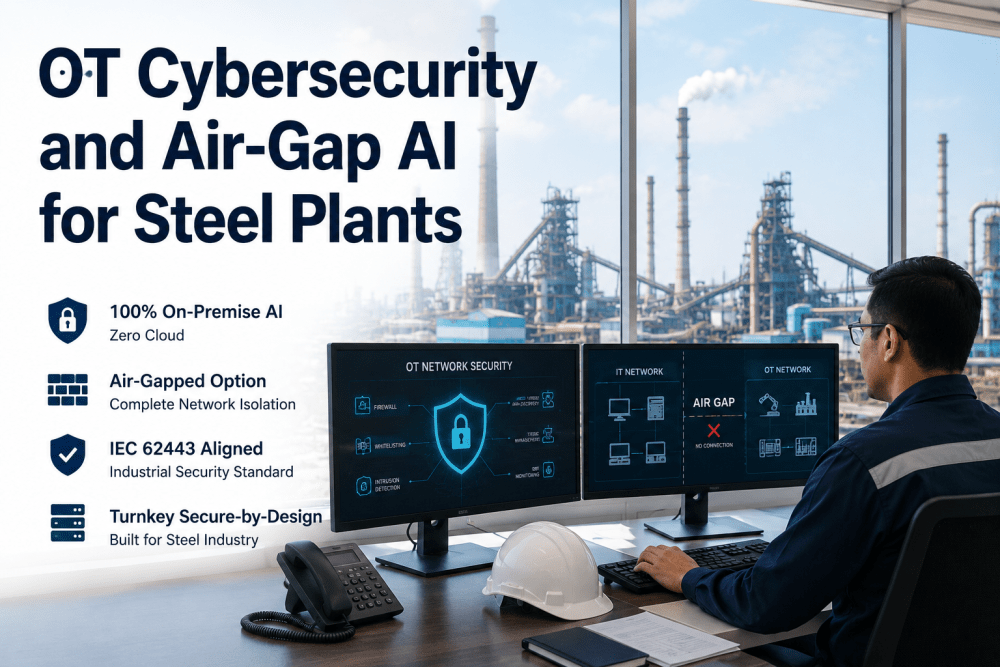
- 100% on-premise deployment — zero OT data leaves the plant perimeter. Air-gapped option available with hardware-enforced one-way data diode
- Vendor access via plant-initiated jump server with MFA, session recording, least-privilege scoping, and complete audit trail — vendor cannot initiate connections
- Analytics server deployed in dedicated DMZ segment with protocol-level read-only historian connection — no network path from analytics server back to OT segment
- Software updates delivered through plant's change management process — no automatic cloud push. Staged deployment with SBOM verification and rollback capability
- IEC 62443 aligned deployment architecture with documented Electronic Security Perimeter, access control matrix, and incident response integration — compliance evidence artifacts delivered at deployment
- Complete vendor security package — SOC 2 Type II report under NDA, SBOM with dependency inventory, vulnerability disclosure policy, and CIP-013 supply chain risk questionnaire responses
Air-Gap Architecture: On-Premise and Air-Gapped Deployment Options Compared
The cybersecurity posture of an AI analytics platform deployment in a steel plant is primarily determined by its network architecture — specifically, where the analytics compute runs, where process data is stored, and what network paths connect the analytics layer to the OT historian and the internet. Three deployment architectures are available for steel plant AI analytics, each carrying a distinct risk profile, security capability, and operational characteristic that the CISO must evaluate against the plant's IEC 62443 target security level, OT network topology, and organizational risk tolerance. iFactory supports all three deployment models within a single analytics platform, enabling the plant to select the architecture that matches its specific security requirements and compliance obligations. Schedule a Technical Review of Deployment Architecture Options
IEC 62443 Alignment: Security Controls for Steel Plant AI Analytics
The IEC 62443 series of standards defines the cybersecurity framework for industrial automation and control systems. For steel plant CISOs evaluating AI analytics platforms, the relevant standard requirements fall into four control categories — network segmentation, access control, supply chain security, and incident response — each with specific requirements that the analytics deployment architecture must satisfy to achieve the plant's target security level. iFactory's platform is designed for IEC 62443 alignment from the network architecture up, with each control implemented at the deployment layer rather than at the application layer, ensuring that the security posture is architectural and verifiable rather than dependent on software configuration that can be changed. Book a Demo to See the Security Architecture
Secure Deployment Workflow: From Architecture Assessment to Operational Handover
Deploying a secure AI analytics platform in a steel plant OT environment is not a software installation — it is a network architecture project that requires structured progression from current-state assessment to production deployment with security validation at every stage. iFactory's deployment team follows a proven 5-stage workflow that aligns with the plant's existing OT security processes — network change management, security review board approval, and operational readiness verification — ensuring that every deployment is documented, validated, and audit-ready from day one.
Compliance & Risk Mitigation Framework: Mapping Attack Vectors to Security Controls
The cybersecurity value of a secure AI analytics platform is measured not by the features it claims but by the specific attack vectors it eliminates through architecture and controls. The following framework maps the most relevant OT attack vectors for steel plant analytics deployments to the specific security controls iFactory implements, with the risk reduction outcome that each control achieves. CISOs who book a security architecture review typically find that this control-to-threat mapping is the most valuable artifact for their procurement security evaluation.
| Attack Vector | iFactory Security Control | Implementation Mechanism | Risk Reduction | IEC 62443 Reference |
|---|---|---|---|---|
| IT-to-OT Lateral Movement | DMZ Architecture with Protocol-Level Read-Only Historian Access | Analytics server in dedicated DMZ. Historian connection uses read-only OPC-UA through firewall rule with no return path. No bidirectional connections between OT network and analytics server. | Eliminated | IEC 62443-3-2 Zone/Conduit |
| Vendor Remote Access Abuse | Plant-Initiated Jump Server with MFA and Session Recording | Vendor cannot initiate connections. All access through plant-controlled jump server with least-privilege scoping, MFA, and complete session recording. Access sessions time-limited and auditable. | Eliminated | IEC 62443-2-4 Access Control |
| Software Supply Chain Compromise | SBOM, Signed Releases, Change-Managed Updates | Complete software bill of materials with dependency inventory. All releases signed with SHA-256 verification. Updates delivered through plant change management — no automatic cloud push. Rollback capability for every release. | Managed | IEC 62443-4-1 Supply Chain |
| Data Exfiltration via Analytics Channel | 100% On-Premise Data Persistence | All process data stored on plant-hosted server. No OT data transmitted to cloud infrastructure. Analytics outputs published to IT layer through unidirectional data flow with no raw OT data exposure. | Eliminated | IEC 62443-3-3 Data Protection |
| Credential Theft and Privilege Escalation | Identity Provider Integration with Role-Based Access Control | All user authentication through plant's Active Directory, Azure AD, or LDAP. Role-based access control mapped to organizational roles. No shared accounts. Quarterly access review per CIP-007 R5 requirements. | Managed | IEC 62443-2-1 Account Management |
| Unauthorized Configuration Change | Change Management Integration with Configuration Baseline | All platform configuration changes — software updates, model deployments, user access changes — documented through plant's change management process. Configuration baseline maintained for audit comparison per CIP-010 R1 requirements. | Managed | IEC 62443-2-4 Change Management |
Expert Perspective: What Steel Plant CISOs Tell Us About OT-Safe AI Deployment
When we started evaluating AI analytics platforms for our hot strip mill, I had one non-negotiable requirement: the platform had to deploy entirely inside our OT perimeter with zero cloud data transmission and no persistent vendor access to our control network. I reviewed six vendors. Five of them could only offer cloud-hosted architectures with data residency commitments and VPN-based vendor access — which in my assessment meant the OT data was leaving the plant and the vendor had a network path that our firewall team could not fully control. iFactory was the only vendor that came to the first meeting with a documented on-premise architecture diagram showing exactly where the analytics server would sit, what firewall rules would be required, how vendor access would be plant-initiated, and what compliance evidence artifacts they would deliver at deployment. We deployed in our DMZ with a read-only PI historian connection. The platform has been running for 14 months. Zero security incidents. Zero compliance findings. And we have $3.2 million in documented avoided maintenance costs from the predictive analytics the platform delivers. In my experience, any vendor that cannot describe their deployment architecture in network terms — DMZ placement, firewall rule direction, protocol-level access — before the first meeting is not ready for a steel plant OT environment.
Frequently Asked Questions: OT Cybersecurity for Steel Plant AI Analytics
On-premise deployment places the analytics server in a DMZ segment with a network-based read-only connection to the OT historian. Air-gapped deployment physically isolates the analytics server with no network connection at all — data is transferred via one-way hardware data diode or portable media. Both architectures keep OT data inside the plant perimeter. Air-gapped is used for the highest-consequence assets where zero network-based OT exposure is required.
iFactory's deployment architecture aligns with IEC 62443-3-2 zone and conduit requirements through documented DMZ segmentation and historian read-only access controls. Access control implementation satisfies IEC 62443-2-4 requirements for vendor remote access, and software supply chain controls align with IEC 62443-4-1 requirements for secure development and update integrity. Alignment documentation is delivered as compliance evidence artifacts at deployment.
Yes. Software updates and AI model improvements are delivered through the plant's standard change management process using signed release packages with SHA-256 hash verification. Updates are downloaded to a secure staging server on the IT network, verified against the SBOM, reviewed through the plant's change control board, and deployed during a scheduled maintenance window. No automatic cloud-push updates are permitted to the OT-adjacent analytics server.
The analytics server is deployed in a dedicated DMZ segment with no network path back to the OT control network. The historian connection uses a protocol-level read-only OPC-UA session through a firewall rule that permits only outbound historian polling from the DMZ — the OT network never accepts inbound connections from the analytics server. In air-gapped configurations, there is no network connection at all between the analytics server and the OT network.
iFactory provides a SOC 2 Type II audit report under NDA, a complete software bill of materials with dependency inventory, a documented vulnerability disclosure policy with defined notification timelines, network architecture diagrams for each deployment model, an IEC 62443 alignment mapping document, and a vendor security questionnaire response covering supply chain security, software development practices, and incident response procedures.
Conclusion: AI Analytics Value and OT Security Are Not in Conflict
The economic case for AI-driven predictive analytics in steel plants is well-established — the avoided forced outage costs, maintenance labor savings, and quality improvement that purpose-built AI platforms generate are measurable and significant. The cybersecurity concern that prevents many steel plant CISOs from deploying those platforms is equally real. But the concern is architectural, not fundamental. The same analytical outcomes that cloud-deployed platforms achieve are fully attainable in on-premise and air-gapped configurations that never expose OT data to internet-connected infrastructure, never create bidirectional network paths between analytics software and OT control systems, and never introduce vendor access channels that fall outside the plant's security monitoring and access management controls. Steel plants that have treated OT security and AI capability as mutually exclusive have been choosing between two valid objectives when they did not need to.
iFactory's secure-by-design AI analytics platform delivers on-premise deployment with zero cloud dependency, protocol-level read-only OT historian access, plant-initiated vendor access controls, and air-gapped configuration options — purpose-built for the OT security requirements of modern steel plants operating under IEC 62443, NIST CSF, and organizational cybersecurity policies. The result is a predictive analytics capability that delivers full AI-driven equipment monitoring, quality prediction, and maintenance optimization within a security architecture that satisfies the most stringent OT security requirements — with the first validated deployment completed within 4 weeks of project kickoff and no OT data leaving the plant perimeter at any time. The analytics value is already proven. The security architecture just needs to be air-gapped to it.