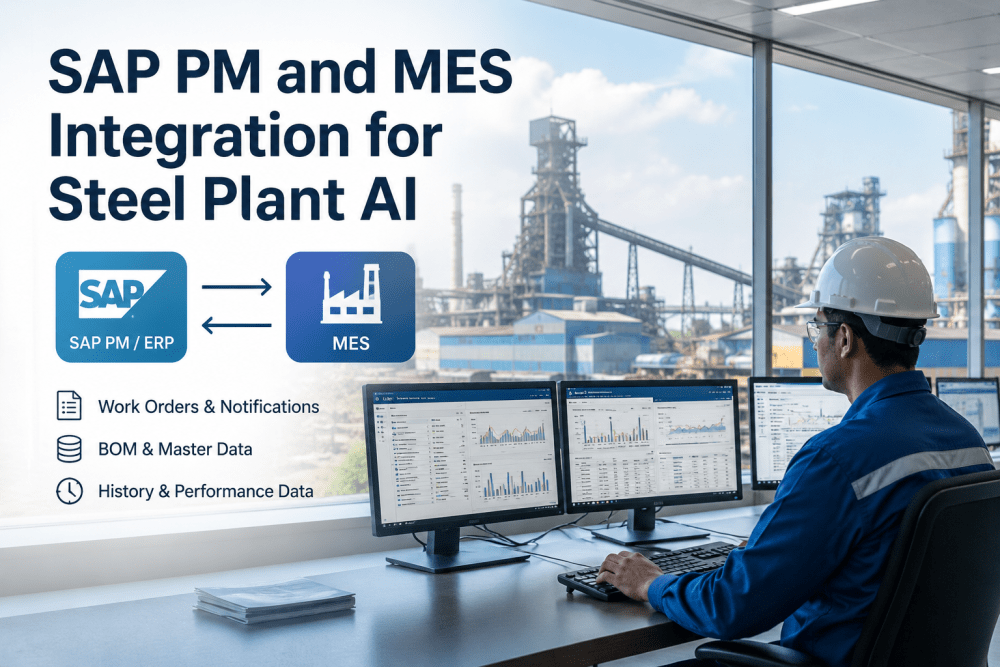
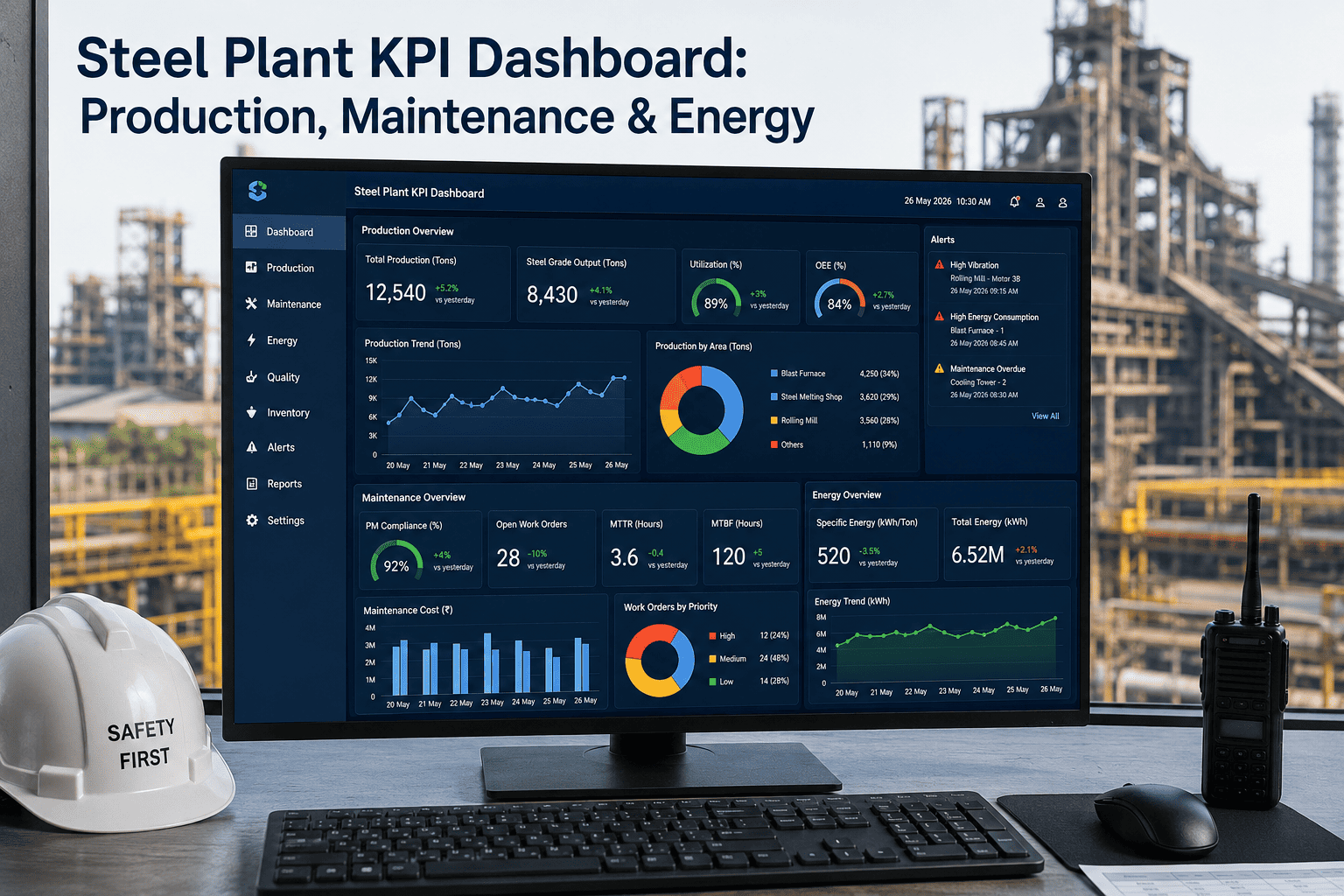
Every steel plant operates with at least two systems of record that were never designed to share data with each other. SAP PM (Plant Maintenance) manages work orders, equipment master data, spare parts inventory, and maintenance history using transaction codes and material numbers. The MES (Manufacturing Execution System) tracks production in real time using heat numbers, cast sequences, and rolling schedules. In the absence of automated integration, IT directors manage a fragmented landscape where maintenance notifications created in SAP must be manually re-entered into the MES, equipment history accumulates in disconnected silos, and the production context — what grade was being cast or rolled when a failure occurred — is lost between systems. This manual integration gap is not a minor inconvenience. It is the primary cause of delayed maintenance response, inaccurate equipment lifecycle data, and the reporting blind spots that prevent steel plant IT teams from building the unified operational visibility that modern digital manufacturing demands. iFactory's SAP/MES integration platform bridges this gap by providing a bidirectional, real-time data connection between SAP PM and the MES — automatically synchronizing work orders, notifications, equipment BOMs, and maintenance history across both systems with an AI layer that enriches integrated data with predictive insights from process monitoring and equipment condition analysis. IT directors evaluating SAP/MES integration for their steel plant can book a demo to review how the platform connects SAP and MES data without requiring custom middleware development or proprietary integration tooling.
3–5×
Faster work order processing cycle time with automated SAP-MES bidirectional sync at integrated steel mills
100%
Elimination of manual data re-entry between SAP PM and MES systems for work orders, notifications, and equipment history
2–4 hrs
Time saved per shift per maintenance team by automating notification-to-work-order conversion and status synchronization
$1.2–3.8M
Annual maintenance workflow cost savings from integrated SAP-MES deployment at a typical 2M TPY integrated steel mill
Evaluating SAP-MES integration architecture for your steel plant's digital transformation roadmap? Book a 30-minute integration architecture assessment with iFactory's steel industry SAP and MES integration team.
Why SAP-MES Integration Is the Foundation of Steel Plant Digital Transformation
The core challenge in steel plant systems integration is the structural difference between SAP's transactional data model and the MES's time-series production data model. SAP PM organizes data around the equipment object — each asset has a functional location, equipment number, BOM, task list, and maintenance plan. The MES organizes data around the production unit — each heat, cast, or coil is tracked through process stages with timestamps, quality measurements, and equipment assignments. When an electric arc furnace tap-to-tap cycle extends beyond the standard duration, the MES records the event with millisecond precision against the heat number, but the extended cycle information — which is directly relevant to refractory condition assessment and electrode consumption tracking — does not automatically reach the SAP PM equipment history record for the furnace transformer or the electrode regulation system. The maintenance team may never see that the extended tap event occurred unless someone manually cross-references the MES production log against SAP work order records, which rarely happens at the required frequency. iFactory's integration platform eliminates this gap by mapping the MES's production event schema to SAP's equipment data model in real time, creating a unified equipment history that includes production context with every maintenance record.
Manual Work Order Re-Entry
Maintenance notifications created in SAP must be manually re-entered into the MES for production scheduling visibility. This introduces data entry errors, delays work order execution by 2 to 6 hours, and creates reconciliation work at shift handover.
HIGH IMPACT
Siloed Equipment History
Equipment maintenance history resides in SAP PM while operational event data — overload events, temperature excursions, vibration patterns — remains in the MES. Reliability engineers cannot correlate equipment failures with production conditions that preceded them.
HIGH IMPACT
Lost Production Context
When a caster mold failure occurs, the MES captures the exact steel grade, casting speed, and tundish temperature at the moment of failure — but this data is not automatically attached to the SAP maintenance notification, leaving the maintenance team without the production context needed for root cause analysis.
MEDIUM IMPACT
Delayed Maintenance Response
Without real-time SAP-MES synchronization, the maintenance team learns about equipment issues only when the operator manually reports them — typically 30 to 90 minutes after the event. Automated MES-to-SAP notification creation reduces response time to under 2 minutes.
MEDIUM IMPACT
Inconsistent Master Data
Equipment master data diverges between SAP PM and the MES when changes in one system are not reflected in the other. A functional location reassignment in SAP does not propagate to the MES asset hierarchy, causing misrouted work orders and inaccurate equipment history tracking.
MEDIUM IMPACT
Limited Reporting Visibility
IT directors cannot build cross-system operational reports because SAP and MES data cannot be joined without manual extraction and reconciliation. Equipment availability calculated from SAP PM work orders does not match MES production uptime data, creating reporting discrepancies that erode decision-making confidence.
The integration architecture between SAP PM and the MES determines more than data flow speed — it determines data integrity, maintenance workflow reliability, and the IT support burden over the life of the deployment. Steel plants have implemented SAP-MES integration using four fundamentally different architectures, each with distinct characteristics in terms of development effort, maintenance overhead, data freshness, and scalability. The comparison below maps the specific trade-offs IT directors must evaluate when selecting an integration approach for their plant's SAP landscape and MES environment.
Architecture
How It Works
Development Effort
Data Freshness
Maintenance Overhead
Scalability
Manual Data Entry
Operators and maintenance staff manually re-enter work orders, notifications, and equipment data between SAP and MES using the native interface of each system.
Zero development cost. Unlimited labor cost.
2–6 hours lag for work orders. 24+ hours for equipment history updates.
High — data reconciliation required at every shift handover. Error correction is continuous.
Zero — every additional SAP transaction or MES event increases manual workload linearly.
Custom Middleware
In-house or SI-developed middleware using SAP BAPI, RFC, or web services to read from and write to both SAP and MES databases through a custom integration layer.
4–9 months of custom development. 2–4 FTEs during build phase.
Near-real-time (1–5 min cycles). Subject to middleware processing capacity.
Very high — custom code requires dedicated support. Each SAP upgrade or MES version change triggers middleware rework.
Moderate — scales with middleware server capacity, but each new interface requires custom development.
Point-to-Point API
Direct API connections between SAP and MES using SAP OData or MES REST APIs for specific data objects — work orders, notifications, equipment master.
2–5 months per connection. Separate API connection required for each data object.
Real-time (event-driven) for each connected object.
Medium — each point-to-point connection is independent. API version changes require individual updates.
Limited — each new integration object requires a new API connection with independent development and testing.
iFactory AI Integration Platform
Pre-built SAP PM and MES connectors with bidirectional data mapping engine, schema transformation layer, and AI enrichment module that adds predictive context to every synchronized data object.
2–4 weeks for connector configuration. 1–2 weeks for data mapping validation.
Real-time event-driven sync. Sub-60-second latency for work order and notification propagation.
Low — SAP adapter and MES connector maintained by iFactory. No custom code, no vendor-dependent rework during SAP or MES upgrades.
Full — adding new data objects requires configuration only. Unified connector handles all SAP and MES object types through the same integration pipeline.
Evaluating SAP-MES integration architecture for your steel plant's digital transformation roadmap? Book a 30-minute integration architecture assessment with iFactory's steel industry SAP and MES integration team.
Key Integration Capabilities for Steel Plant SAP and MES Environments
A complete SAP-MES integration deployment covers eight core data synchronization capabilities that span the full maintenance lifecycle — from equipment master data alignment through work order execution and history archiving. Each capability addresses a specific data flow gap between SAP PM and the MES that, when automated, eliminates manual work and creates a unified operational data foundation that IT directors can build reporting dashboards, KPIs, and AI-driven analytics on top of without cross-system data reconciliation work. The following checklist maps the specific integration capabilities iFactory delivers for each data domain, with the steel plant operational context that makes each capability important for a typical integrated or EAF-based facility.
SAP-MES Integration Capability Checklist — Steel Plant Data Domains
Bidirectional Work Order Sync: SAP PM work orders and their status changes propagate to the MES in real time. MES-generated maintenance requests create SAP notifications automatically. Status updates — released, in-progress, completed, technically completed — synchronize bidirectionally within 60 seconds.
Automated Notification Creation: MES events — equipment alarms, process deviation triggers, production stop events — generate SAP PM notifications automatically with full production context including heat number, grade, and process parameters at the time of the event.
Equipment BOM Synchronization: SAP PM equipment BOM structures — functional location hierarchies, equipment-to-assembly relationships, and spare part assignments — are mirrored in the MES asset hierarchy for consistent cross-system referencing.
Maintenance History Integration: Completed SAP PM maintenance orders with their associated measurement points, confirmation text, and document attachments are published to the MES equipment history record. MES operational event data is appended to the SAP PM equipment history in the notification text and long-text fields.
Spare Parts Availability Check: When a work order is created in SAP PM, the integration platform checks spare parts availability against the SAP inventory management module and includes the availability status — in stock, pending delivery, or out of stock — in the work order data synchronized to the MES.
Labor Time Posting: Maintenance labor hours recorded in the MES — including crew assignments, overtime, and craft specialization — are posted to the corresponding SAP PM work order as confirmation data, enabling accurate labor cost tracking without duplicate data entry.
Document Attachment Sync: Photos, inspection reports, and PDF attachments added to SAP PM work orders or notifications are transferred to the MES document store and linked to the corresponding equipment or production event. MES-generated inspection images are attached to the SAP PM notification record.
Real-Time Status Dashboard: A unified SAP-MES integration status dashboard displays data flow health for each synchronized object type — work order sync latency, notification creation throughput, equipment master alignment status, and error log for failed transactions requiring manual intervention.
Connect SAP PM and MES Without Custom Middleware — Full Bidirectional Sync in Weeks, Not Months
iFactory's SAP/MES integration platform delivers pre-built SAP PM and MES connectors with bidirectional data mapping, schema transformation, and AI enrichment — eliminating manual data entry, custom middleware development, and cross-system reconciliation work at steel plants worldwide.
Implementation Workflow: From SAP Interface Specification to Bidirectional Sync
Deploying a production SAP-MES integration does not require months of custom middleware development or a multi-million dollar SI engagement. iFactory's implementation team follows a structured 6-stage workflow that progresses from SAP interface configuration to live bidirectional synchronization within 4 to 6 weeks for a typical steel plant deployment. Each stage is designed to validate data mapping accuracy before the next stage begins, ensuring that the go-live integration is reliable, tested, and aligned with the plant's SAP PM configuration, MES schema, and IT security requirements.
01
SAP Interface Specification and Configuration
iFactory's integration team works with the plant's SAP BASIS team to configure the SAP RFC and web service connections required for the integration adapter. SAP PM authorization objects for work order creation, notification processing, equipment master data access, and confirmation posting are verified. The SAP connector is installed on the SAP application server or PI/PO middleware layer depending on the plant's SAP architecture.
02
MES Connector Deployment and Schema Mapping
The iFactory MES connector is deployed against the plant's MES database or API layer. The MES schema — production event tables, equipment hierarchy structures, process parameter definitions — is mapped to the SAP PM data model using iFactory's schema transformation engine. Data type conversions, unit of measure mappings, and cross-reference key relationships are configured during this stage.
03
Data Mapping Validation and Test Load
A representative set of SAP PM work orders, notifications, equipment master records, and BOM structures are loaded through the integration pipeline to validate data mapping accuracy. MES production events from a selected time window are processed to verify notification creation, production context attachment, and equipment history updates. Mapping discrepancies are corrected and re-validated.
04
Bidirectional Sync Activation and Monitoring Setup
Bidirectional synchronization is activated for all configured data objects — work order status updates, notification creation, equipment master changes, confirmation postings, and document attachments. Real-time monitoring dashboards are deployed to track data flow latency, transaction success rates, and error conditions for each synchronization object type.
05
User Acceptance Testing and Process Validation
Maintenance planners, production supervisors, and IT support teams execute a pre-defined user acceptance test script covering each synchronized data object and workflow scenario. Work order creation in SAP is verified against MES visibility. MES-generated notifications are confirmed to reach SAP with correct production context. UAT sign-off is collected from each stakeholder group.
06
Go-Live Cutover and Operational Handover
The bidirectional integration is promoted to production during a planned cutover window. iFactory's support team monitors data flow health during the first 72 hours of live operation, addressing any integration edge cases that emerge in the production environment. The plant's IT team receives operational handover documentation, monitoring dashboard access, and escalation procedures for integration support.
Measured Outcomes at Steel Plants Running Integrated SAP-MES Workflows
The operational improvements from automated SAP-MES integration are measurable within the first month of deployment and compound as the integration data foundation supports additional use cases — AI-driven predictive maintenance, cross-system reporting, and unified equipment lifecycle analysis. The following outcomes are documented across iFactory's steel plant SAP-MES integration deployments at integrated and EAF-based facilities in North America and Europe.
Zero
Manual Work Order Re-Entry
After SAP-MES integration go-live at steel plants using iFactory's bidirectional sync — all work orders, notifications, and status updates flow automatically between systems.
<60 sec
Bidirectional Sync Latency
Average time from SAP PM work order creation to availability in the MES, and from MES event detection to SAP notification creation, across all connected data objects.
4–6 wks
Deployment Timeline
From project kickoff to live bidirectional synchronization at a typical steel plant with existing SAP ECC or S/4HANA and a compatible MES environment.
100%
SAP S/4HANA Compatible
iFactory's SAP connector supports both SAP ECC 6.0 and SAP S/4HANA environments, including conversion-phase deployments where ECC and S/4HANA coexist during migration.
8
Integrated Data Objects
Work orders, notifications, equipment master, BOM, confirmations, documents, measurement points, and spare parts availability — all synchronized bidirectionally through a single integration pipeline.
Zero
Custom ABAP Code Required
iFactory's SAP connector uses standard SAP RFC, BAPI, and web service interfaces — no custom ABAP development, no modification of SAP standard objects, no impact on SAP upgrade paths.
ECC + S/4
Dual SAP Support
Single connector supports both SAP ECC 6.0 and S/4HANA environments
60 sec
Sync Latency Target
Bidirectional data propagation within one minute of source system change
No ABAP
Zero Custom Code
Standard SAP interfaces only — no impact on SAP upgrade compatibility
SOC 2
Certified Security
Type II audit available under NDA for procurement security review
Expert Review: What Steel Plant IT Directors Tell Us About SAP-MES Integration
We had been running SAP ECC for maintenance management and a separate MES for production tracking since 2016. The two systems were completely disconnected. Every day, our maintenance planners would print SAP work orders and hand them to the production supervisors, who would manually enter the work into the MES so the operators could see what was scheduled. When the work was completed, the supervisor would mark it in the MES, and then a data entry clerk would update the SAP work order status at the end of the shift — if they remembered. We estimated that 25 percent of completed work orders never had their status updated in SAP, which meant our equipment history and reliability metrics were based on incomplete data. iFactory's integration platform connected SAP and the MES in five weeks. Work orders now appear in the MES within 30 seconds of release in SAP. MES-generated maintenance notifications — motor overload events, hydraulic pressure drops, caster speed deviations — create SAP notifications automatically with complete production context. Our equipment history is finally complete, and we eliminated three part-time data entry positions that existed only to bridge the gap between the two systems.
IT Director
Integrated Steel Mill — 2.6M TPY Capacity, U.S. Midwest — SAP S/4HANA Migration Complete 2024
The technical concern I had before deploying iFactory's SAP-MES integration was data integrity during network interruptions. Our mill has areas where the MES network drops connectivity for 10 to 30 seconds during equipment power cycles, and I needed to know that no work order updates would be lost during those windows. iFactory's integration architecture uses a store-and-forward queue pattern — every transaction is persisted locally until delivery confirmation is received from the target system. We have tested this under simulated network interruption conditions and confirmed zero data loss across 24-hour periods with multiple connectivity gaps. For an IT director managing a 24/7 steel operation where data integrity is non-negotiable, that architecture reliability was the difference between approval and hesitation.
Director of IT and Operational Technology
EAF Mini-Mill — 1.2M TPY Capacity, U.S. Southeast
Frequently Asked Questions
iFactory's SAP connector requires SAP PM (Plant Maintenance) to be licensed and configured for work order management, notification processing, and equipment master data management. The SAP connector communicates through standard SAP BAPI and RFC interfaces — no additional SAP modules, no SAP PI/PO middleware, and no custom ABAP development are required. For plants using SAP for spare parts management, MM (Materials Management) integration is optional and adds spare parts availability check capability to the work order synchronization workflow.
iFactory's schema transformation engine maps SAP PM's functional location and equipment number hierarchy to the MES asset structure using a cross-reference table that is populated during the data mapping validation phase. The mapping can be configured for one-to-one, one-to-many, or many-to-one relationships depending on how the plant has structured its equipment master data in SAP versus the MES asset hierarchy. Once configured, the mapping is maintained automatically — changes to SAP equipment numbers or functional location assignments are detected and propagated to the MES asset hierarchy within the standard sync window.
Yes. iFactory's SAP connector supports both SAP ECC 6.0 and S/4HANA environments through the same integration pipeline, including dual-system configurations where both ECC and S/4HANA are operational during a phased migration. The connector automatically detects which SAP environment is active for each transaction and routes data accordingly. For plants migrating from ECC to S/4HANA, the integration continues operating through the migration without reconfiguration — the connector adapts to the target system's interface without requiring changes to the MES connector or data mapping configuration.
iFactory's integration platform implements a store-and-forward architecture with persistent message queuing. Every transaction — work order creation, status update, notification, confirmation posting — is written to a local queue before transmission. The system retries failed deliveries with exponential backoff and configurable maximum retry count. Transactions that cannot be delivered within the configured retry window are flagged in the integration monitoring dashboard for manual review. This architecture has been validated under simulated network interruption conditions at steel plant deployments with zero data loss across connectivity gaps of up to 24 hours.
A complete SAP-MES integration deployment at a steel plant with existing SAP PM and MES systems is typically completed in 4 to 6 weeks, including SAP connector configuration, MES connector deployment, data mapping validation, user acceptance testing, and production cutover. Implementation services cost ranges from $28,000 to $52,000 depending on the number of integrated data objects, the complexity of the MES schema, and whether on-premise or cloud-hosted integration platform infrastructure is required. Annual platform subscription is $18,000 to $36,000 depending on the number of synchronized data objects and sites. Contact iFactory for a site-specific integration assessment and pricing estimate.
Unify SAP PM and MES Without Custom Code — Weeks, Not Months
iFactory's SAP/MES integration platform delivers pre-built bidirectional connectors for SAP PM and steel plant MES environments — eliminating manual data re-entry, custom middleware development, and cross-system reconciliation at plants worldwide. Full bidirectional synchronization in 4 to 6 weeks with zero custom ABAP code required.
Conclusion: SAP-MES Integration Is the Data Foundation Steel Plant Digital Transformation Requires
The integration gap between SAP PM and the MES is not a technical problem that requires a custom software development project to solve — it is a data architecture gap that pre-built integration connectors with mature schema transformation engines can close in weeks, not months. Steel plant IT directors managing disconnected SAP and MES environments are managing a fragmented data landscape where maintenance history is incomplete, production context is lost between systems, and every cross-system report requires manual data extraction and reconciliation. The automation opportunity is not incremental — it is structural. Bidirectional SAP-MES integration that synchronizes work orders, notifications, equipment master data, and maintenance history within 60 seconds transforms the maintenance workflow from a manual, error-prone, data-losing process into an automated, reliable, complete data pipeline that IT directors can build AI-driven predictive maintenance and cross-system operational reporting on top of without data reconciliation work.
iFactory's SAP/MES integration platform delivers pre-built SAP PM and MES connectors with bidirectional data mapping, schema transformation, store-and-forward resilience, and zero custom ABAP development requirements — purpose-built for the complexity of steel plant IT environments ranging from SAP ECC 6.0 to S/4HANA, from integrated mills to EAF mini-mills. The result is a unified operational data foundation that eliminates manual data entry, completes equipment history with production context, and provides IT directors with the integrated data visibility they need to build the next generation of steel plant digital manufacturing capabilities — with the first bidirectional data flowing within 4 weeks of project kickoff and full operational integration achieved by week 6. The data is already there. The systems just need to talk to each other.