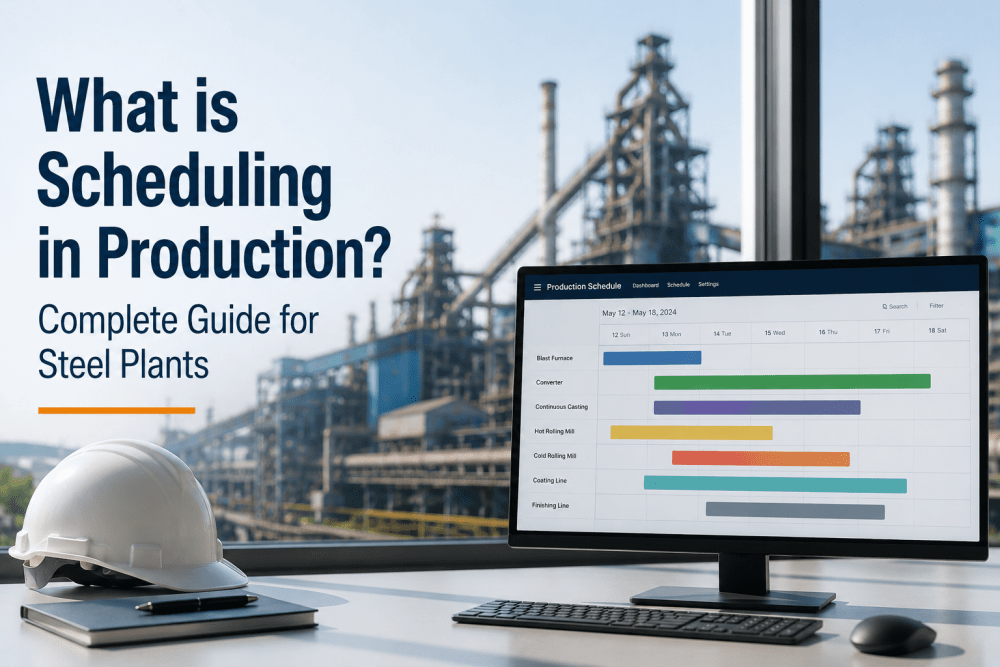
Production scheduling in steel manufacturing has moved from a back-office planning function to one of the most consequential operational disciplines on the plant floor — because the gap between a well-scheduled mill and a poorly scheduled one no longer measures in single percentage points of throughput. It measures in 10 to 20% of total plant capacity, 15 to 19 percentage points of OEE, and $4 to $9 per tonne in avoidable production cost. A 1.8 million tonne facility leaving 15% throughput on the table through poor scheduling is leaving 270,000 tonnes of production unrealized every year — production that could ship to customers, generate margin, and amortize fixed costs without a single dollar of additional capital investment. The best practices that separate top-performing U.S. steel mills from median performers are not theoretical. They are documented operational disciplines — finite-capacity scheduling that respects physical constraints rather than assuming infinite expansion, bottleneck-protected sequencing that subordinates every other resource to the constraint, buffer placement at the right points rather than distributed evenly, schedule-maintenance alignment that prevents PM deferrals from compounding into reactive failures, and dynamic AI-driven adjustment that absorbs disruption without losing the planning structure. Steel mills that have implemented these practices through iFactory's production scheduling and AI optimization platform report 11 to 18% throughput gains on bottleneck assets, 38% reduction in unplanned schedule disruptions, and on-time delivery improvement from 73% baseline to 94% sustained over 12-month measurement windows — all without capital investment in new production equipment.
Why Steel Scheduling Best Practices Look Different From Generic Manufacturing Scheduling
Steel manufacturing scheduling cannot be transplanted from discrete assembly operations. The continuous, asset-coupled, chemistry-constrained nature of the process means that a heat in the EAF is connected by liquid metal flow to the caster, and a single sequencing gap of 30 minutes at the caster can generate $126,000 in lost production through cascading downstream impact. Generic ERP scheduling modules built around infinite-capacity assumptions produce plans that look optimal on paper but fall apart on the plant floor because they ignore roll wear curves, minimum furnace heat soak times, ladle cycling limits, refractory remaining life, and crane availability windows. The best practices below are the ones that have emerged specifically from steel operations where these physical constraints are non-negotiable — and where the cost of ignoring them is measured in tonnes of lost production per shift.
The Four Foundational Practices: How Top Steel Mills Build Schedules That Survive Execution
The first four best practices form the structural foundation of effective steel plant scheduling — the disciplines that determine whether a generated schedule is physically achievable or merely theoretically optimal. iFactory's scheduling platform delivers each foundational practice as a configurable capability inside the same unified planning view. Book a Demo to see each practice configured against your facility's specific bottleneck profile and asset constraints.
Practice 01 — Finite-Capacity Scheduling With Physical Constraint Modeling
Infinite-capacity scheduling assumes production can expand to fill any demand plan. In steel manufacturing, this assumption is false and expensive. Finite-capacity scheduling builds hard physical constraints directly into the planning engine — roll wear curves that determine campaign length, minimum furnace heat soak times that determine heat-to-heat cycle, ladle cycling limits that determine fleet throughput, refractory remaining life that determines when relining must occur, and crane availability windows that determine material movement throughput. Every generated schedule is physically achievable rather than theoretically optimized, eliminating the gap between plan and execution that destroys throughput in disconnected scheduling systems.
Practice 02 — Bottleneck Identification and Constraint Protection
Every steel plant has one asset that limits total throughput more than any other — typically the hot strip mill in a flat-rolled facility, the continuous caster in an integrated operation, or the EAF in a mini mill. The Theory of Constraints discipline says every other resource should be subordinated to the bottleneck's productivity, but most facilities schedule each asset independently and discover the constraint conflicts during execution. iFactory's scheduling engine explicitly models the constraint, generates schedules that subordinate all upstream and downstream resources to bottleneck protection, and tracks the bottleneck's actual utilization in real time. Maintenance on upstream equipment is scheduled only during planned bottleneck outages, never during active campaigns. This practice alone delivers 11 to 18% throughput gains at facilities where the bottleneck was previously being starved or flooded by uncoordinated upstream and downstream scheduling.
Practice 03 — Strategic Buffer Placement at Constraint Points
No production schedule survives contact with reality unchanged. Equipment alarms fire, quality holds occur, raw material deliveries slip, and order changes arrive mid-week. The question is not whether the schedule will be disrupted but how the schedule absorbs disruption without losing the planning structure. The best-practice answer is strategic buffer placement — 10 to 15% buffer time concentrated at constraint resources and before critical milestones, not distributed evenly across the schedule. iFactory's buffer management module identifies the constraint resources and milestone points, sizes the buffer based on historical disruption frequency and magnitude, and tracks buffer consumption in real time so planners can see whether the schedule is operating in safe, caution, or critical zones.
Practice 04 — Schedule-Maintenance Alignment Inside One Planning View
In most U.S. steel mills, production schedules are locked first and maintenance windows are negotiated into the remaining gaps — a pattern that consistently produces PM deferrals and the compounding reactive failures that follow. The best-practice alternative is to plan production and maintenance together in the same scheduling interface, with PM windows, predictive RUL-driven interventions, and shutdown campaigns visible alongside the heat sequence and rolling campaigns before commitments lock. iFactory tracks cumulative PM deferral risk scores and automatically escalates to plant management when the threshold is crossed — removing the deferral decision from the weekly meeting where production pressure typically wins by default. The outcome is a 46% reduction in reactive maintenance hours from PM deferrals and the protection of bottleneck availability that drives every other throughput gain.
The Eight-Practice Implementation Pathway: From Audit to Sustained Top-Quartile Performance
The four foundational practices above are necessary but not sufficient — they need to be deployed inside a structured implementation pathway that builds the data foundation, sequences the capability rollout, and converts initial throughput gains into sustained operational performance. iFactory's deployment framework structures the work into a five-step pathway designed to deliver measurable results inside the first 90 days while building toward the full operational transformation.
Scheduling Gap Audit and Bottleneck Identification
The first step is auditing existing scheduling practice against the eight best practices — identifying which departments have the highest unplanned stoppage rates, which assets are currently constraining throughput, and where the highest-cost scheduling gaps live. Typical high-value starting points include melt shop heat sequencing, hot mill roll change planning, and quality hold clearance workflows. The audit produces a prioritized improvement roadmap focused on the two or three practices that will deliver the fastest throughput ROI for the specific facility — rather than attempting full transformation in a single phase.
Data Foundation Build — Standard Times, Constraints, and CMMS Linkage
A schedule is only as good as the data it rests on. iFactory's deployment includes a structured data foundation build that captures and validates standard cycle times, setup times, asset constraints, and CMMS asset hierarchy linkage to production lines. Standard times are audited and validated rather than accepted as-is, because times drift over the years as processes change and old standards systematically underestimate the constraints the schedule needs to respect. This step typically takes 3 to 5 weeks and is the difference between a scheduling engine that works on paper and one that works on the plant floor.
Finite-Capacity Engine Configuration and Constraint Calibration
With the data foundation in place, the finite-capacity scheduling engine is configured against the facility's specific bottleneck profile and constraint set. Roll wear curves, heat soak times, ladle cycle limits, and refractory life inputs are calibrated to the facility's actual operating data — not generic industry assumptions. The engine is initially run in shadow mode against the existing schedule for 2 to 3 weekly cycles, validating that generated schedules are physically achievable before being adopted as the operational plan.
AI Optimization and Dynamic Adjustment Activation
Once the deterministic finite-capacity scheduling is delivering consistent results, the AI optimization layer is activated — bringing machine learning models that predict bottlenecks 4 to 24 hours ahead based on scheduled production, equipment health trends, and historical patterns. The AI layer recommends schedule adjustments before disruption occurs and learns from every cycle which adjustment patterns produced the best outcomes. This is where the 38% reduction in unplanned schedule disruptions originates — not from better human reaction, but from the AI catching deviations earlier than human attention can.
KPI Tracking, OEE Attribution, and Continuous Improvement
Sustained top-quartile performance requires converting the initial throughput gains into a continuous improvement discipline. iFactory's scheduling analytics module tracks OEE losses attributable to scheduling decisions — the availability losses from buffer starvation, the quality losses from campaigns running past roll wear limits, the unplanned stops following deferred PMs. Planners can see which scheduling decisions drove which OEE outcomes and adjust the next planning cycle accordingly. The result is a planning process that improves through use rather than one that repeats the same conflicts every week.
Best Practice Benchmark Matrix: Where U.S. Steel Plants Stand on Each Discipline
The benchmark table below compares standard practice against top-performer practice across the eight scheduling disciplines that collectively determine plant throughput, on-time delivery, and production cost per tonne. Each row shows the operational impact attributable to closing the gap and the iFactory capability that drives the movement. Book a Demo to see your facility positioned against these benchmarks using your current scheduling data.
| Scheduling Practice | Standard Practice | Top Performers | iFactory Capability | Operational Impact |
|---|---|---|---|---|
| Finite-Capacity Modeling | Infinite-capacity assumptions; constraints discovered at execution | Physical constraints modeled explicitly in the planning engine | Constraint-aware scheduling engine with roll, ladle, and refractory inputs | +11–18% bottleneck throughput |
| Bottleneck Protection | Each asset scheduled independently; constraint conflicts at runtime | All resources subordinated to bottleneck productivity | Theory of Constraints sequencing with bottleneck-aware PM placement | +14 OEE points on constraint asset |
| Buffer Placement | Buffer time distributed evenly or absent from schedule | 10–15% buffer concentrated at constraints and milestones | Buffer management module with real-time consumption tracking | +21 points on-time delivery |
| Maintenance Alignment | Production schedules locked; maintenance fits in remaining gaps | Production and PM planned together in shared interface | Unified scheduling with PM deferral risk scoring and auto-escalation | –46% reactive maintenance hours |
| AI-Driven Adjustment | Manual schedule rebuild; takes hours when disruption occurs | AI predicts and recommends adjustments 4–24 hours ahead | Machine learning bottleneck prediction with adjustment recommendations | –38% unplanned schedule disruptions |
| Standard Time Accuracy | Standard times set at commissioning; rarely re-audited | Quarterly re-audit with actual cycle data driving updates | Cycle time analytics with auto-flagging of drift from baseline | +8% schedule attainment rate |
| KPI-Driven Improvement | OEE tracked at asset level; scheduling losses invisible | Scheduling-attributable OEE losses tracked and addressed | Scheduling decision-to-OEE attribution analytics by reason code | Sustained quarter-over-quarter gains |
| Energy-Aware Scheduling | Energy consumption not considered in sequencing decisions | Furnace idle time minimized, EAF cycles optimized for energy | Energy-aware heat sequencing with demand management coordination | –12–18% natural gas per tonne |
Expert Review: What Steel Plant Production Leaders Have Learned From Implementing These Practices
After 19 years of running production planning at U.S. steel mills — flat-rolled, long products, and one specialty operation — the lesson I would pass to anyone implementing scheduling best practices is that the practices are not the hard part. The list of best practices has been published in operations research journals for decades. Finite-capacity scheduling, Theory of Constraints, buffer management, schedule-maintenance alignment — none of this is new. What is hard is having a platform that operationalizes these practices inside the daily reality of a steel mill, where the bottleneck shifts based on product mix, where chemistry constraints interact with width transitions in non-obvious ways, and where the disconnect between scheduling and maintenance has been so deeply embedded in the organizational culture that even people who agree with the principles cannot make them stick. The transformation we achieved was not because we discovered new practices. It was because we got a system where the planner, the melt shop foreman, the rolling mill supervisor, and the maintenance coordinator all worked from the same view of the schedule — and where the AI flagged the bottleneck shift before any human noticed it. The throughput gain from finite-capacity scheduling alone was 13% on our hot mill. The on-time delivery improvement from buffer placement was 18 points. But the gain that surprised our CFO was the maintenance cost reduction from PM deferral discipline — 23% reduction in reactive maintenance labor in the first year, because the schedule did not allow the deferrals that had become routine. That is the gain that pays for the platform many times over and never shows up in scheduling pitch decks.
— Director of Production Planning, U.S. Flat-Rolled Steel Operations — 1.8 Million Ton Annual Capacity — 19 Years — APICS CSCP CertifiedConclusion
Steel manufacturing scheduling best practices are not a list of ideal theoretical approaches — they are documented operational disciplines that separate the top-quartile U.S. steel mills from the median, with measured outcomes that include 11 to 18% throughput gains, 38% reduction in unplanned disruptions, 14-point OEE improvements on constraint assets, and 21-point on-time delivery gains. The practices themselves have existed in operations research literature for decades. What has changed in the last few years is the availability of a scheduling and AI optimization platform that operationalizes these practices inside the daily reality of a steel plant — where bottlenecks shift, chemistry constrains sequencing, and maintenance must align with production rather than fight it.
iFactory's scheduling platform delivers each best practice as a configured capability built natively for steel manufacturing — finite-capacity scheduling with explicit constraint modeling, Theory of Constraints sequencing with bottleneck protection, strategic buffer placement at the right points, schedule-maintenance integration with PM deferral discipline, AI-driven dynamic adjustment, and KPI-driven continuous improvement. The throughput, delivery, and cost gains documented at comparable facilities are the result of moving scheduling from a fragmented coordination exercise to a structured operational discipline. Book a Demo to see how iFactory's platform would perform against your facility's current scheduling architecture.
Frequently Asked Questions
Infinite-capacity scheduling assumes production can expand to meet any demand plan. Finite-capacity scheduling builds physical constraints — roll wear, heat soak times, ladle cycling limits — directly into the engine, so every generated schedule is physically achievable rather than theoretically optimal.
Best practice is 10–15% buffer concentrated at the bottleneck constraint and before customer delivery milestones — not distributed evenly across the schedule. Concentrated buffers protect the throughput-limiting resource and the on-time delivery commitment that customers actually measure.
Rule-based scheduling applies fixed constraints to produce one optimal plan. AI scheduling predicts bottleneck shifts 4–24 hours ahead from equipment health trends and product mix, recommending adjustments before disruption occurs and learning which patterns produce the best outcomes.
iFactory integrates with SAP, Oracle, Infor, and major MES platforms via REST API — pulling order book, production data, and equipment status into the scheduling engine without requiring system replacement. The platform sits as the unifying scheduling layer above existing systems.
Full deployment of the finite-capacity engine, bottleneck protection, buffer management, and maintenance alignment runs 10 to 14 weeks at a typical U.S. mid-size steel mill. Measurable throughput gains appear within the first two planning cycles after go-live.