The morning shift supervisor at a 4.5-million-ton integrated steel mill sees the same red flag every Tuesday: the hot strip mill is scheduled to roll 304 stainless, but the melt shop’s latest cast from the LMF is still 20°C above tap temperature, and the slab yard has 1,200 tons of 201-grade billets blocking the reheat furnace access. Three different spreadsheets, two phone calls, and a walk to the control room later, he learns that the blast furnace hearth is running cold because the sinter plant lost a strand for two hours yesterday. The production plan that looked clean at 6:00 AM is already obsolete by 7:30. Across the global steel industry, this daily friction between raw material supply, hot metal logistics, casting sequencing, and rolling schedules erases an estimated $15–$30 per ton in energy waste, re-sequencing penalties, and missed order windows. The problem isn’t that steelmakers lack data — it’s that the data lives in disconnected silos, and no system connects the blast furnace output forecast to the rolling mill order book in real time.
From Blast Furnace to Dispatch: One Scheduling Engine for the Entire Integrated Steel Plant
iFactory connects raw material planning, hot metal routing, caster sequencing, rolling mill scheduling, and dispatch into a single, on-premise AI platform that updates every 60 seconds — so your production plan matches what the plant can actually deliver.
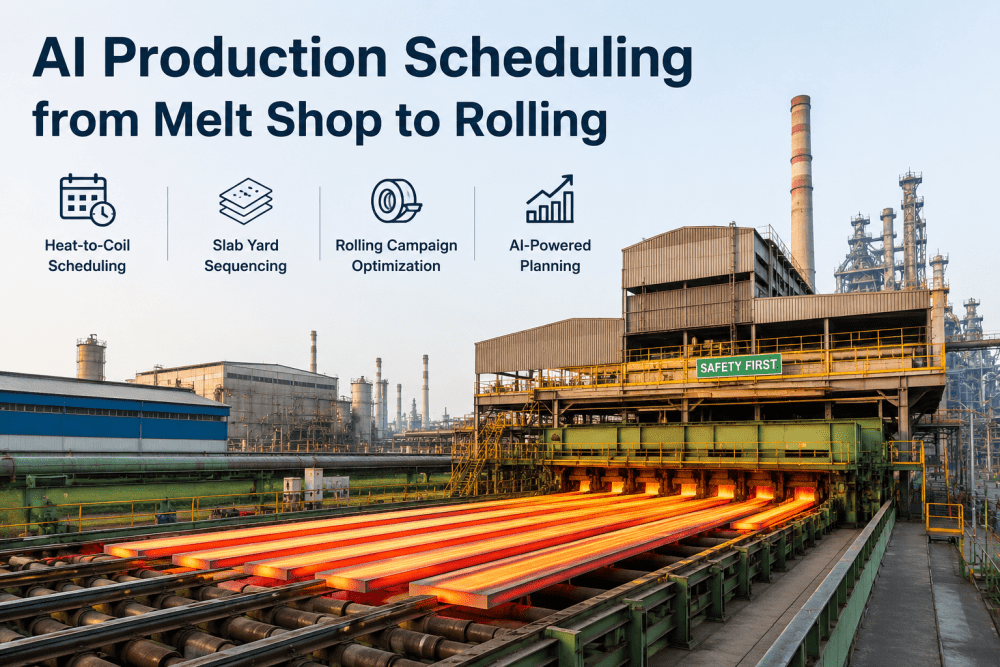
Production scheduling in an integrated steel plant is a multi-constraint optimization problem that spans eight physical domains: raw material yards, sinter plants, coke ovens, blast furnaces, BOF/LMF casters, slab yards, reheat furnaces, rolling mills, and dispatch. Each domain has its own cycle time, yield loss profile, and quality constraint. When one domain drifts — a blast furnace slip, a caster break-out, a slab yard crane breakdown — the ripple effect cascades through the entire schedule in minutes. Most plants attempt to manage this with a combination of a commercial MES module, an ERP production plan, and a spreadsheet that the scheduler updates by hand. The result is a plan that is already 6–8 hours old by the time it is published, and that assumes material availability that does not exist. iFactory replaces this patchwork with a single, real-time scheduling layer that ingests live data from every domain, runs constraint propagation every 60 seconds, and outputs a dispatchable schedule that the plant can actually execute.
One Platform. Eight Domains. Every Scheduling Constraint Covered.
iFactory’s production scheduling module covers every major decision point in the integrated steel value chain, from raw material blending to dispatch sequencing. Each capability is a configurable AI agent that respects your plant’s specific metallurgical rules, equipment limits, and order book priorities.
Burden Optimization & Sinter Sequencing
Aligns iron ore blend composition, sinter strand speed, and coke oven push schedule to the blast furnace’s hot metal demand. Adjusts burden mix within metallurgical limits when a sinter strand goes down — typically within 90 seconds.
Blast Furnace Tap Scheduling
Predicts cast start times, hot metal temperature, and silicon content for the next 12–24 hours. Re-sequences torpedo ladle assignments and BOF charge plans when a furnace hearth condition changes.
Caster Sequence & Ladle Logistics
Optimizes tundish life, sequence length, and steel grade transitions across multiple casters. Routes ladles from LMF to caster turret with real-time temperature tracking to avoid cold-heel delays.
Slab Inventory & Reheat Furnace Feed
Manages slab yard position, grade segregation, and reheat furnace charging order. Pre-computes crane moves and allocates slabs to rolling orders within 15 minutes of casting completion.
Rolling Mill Sequencing & Gauge Transitions
Sequences rolling campaigns to minimize coiler drum changes, gauge transitions, and edge-trim scrap. Respects mill force limits, crown targets, and downstream finishing line capacity.
Order Allocation & Shipping Sequencing
Matches finished coils and plates to open orders by grade, dimension, and surface quality. Sequences truck and rail loading to meet customer delivery windows while minimizing yard re-handles.
From Data Ingestion to Dispatchable Schedule in Four Steps
iFactory deploys on your plant network, connects to existing PLCs, historians, and MES systems, and begins producing actionable schedules within weeks — not quarters.
Connect & Ingest
iFactory connects to your plant’s existing data sources — Level 1 PLCs, Level 2 process models, LIMS, and ERP order book — via secure on-premise connectors. No cloud data egress, no network re-architecture.
Model Constraints
Our domain engineers configure the constraint model for your specific plant: blast furnace campaign rules, caster tundish life limits, rolling mill pass schedules, and dispatch lead times. Typically 2–3 weeks of configuration.
Schedule & Optimize
The AI engine runs a full constraint propagation every 60 seconds, balancing order priority, material availability, equipment health, and energy cost. Outputs a dispatchable schedule for every domain.
Execute & Adapt
The schedule publishes to operator dashboards, MES work instructions, and dispatch terminals. When a domain drifts — a blast furnace slip or a caster delay — the engine re-optimizes the remaining schedule within 90 seconds.
Every Unplanned Transition Costs Real Margin
When production scheduling is fragmented across spreadsheets and legacy modules, the hidden costs accumulate at every domain boundary. These are the three most expensive gaps that iFactory eliminates.
Hot Metal Temperature Loss
When blast furnace tap timing drifts and torpedo ladles wait, hot metal temperature drops from 1,480°C to below 1,420°C. Every 10°C lost requires an additional 2–3 minutes of BOF oxygen blow, costing roughly $1.50 per ton in energy and refractory wear.
Slab Yard Re-Sequencing
When the rolling mill schedule changes mid-shift and the slab yard is not notified, crane operators spend 25–40% of their shift re-handling slabs to find the right grade and dimension. This delays reheat furnace charging and reduces mill utilization.
Order Miss & Reroute Penalties
When dispatch does not know the rolling mill’s actual completion sequence, coils are shipped to the wrong customer or held for re-inspection. This triggers penalty fees, expedited freight, and customer credits that average $8–12 per ton.
Measured Results from Integrated Steel Plants Running iFactory
Every deployment is measured against baseline KPIs captured during the first two weeks of data connection. These are representative results from plants producing 3–6 million tons per year.
Your plant’s production schedule updates every 60 seconds — but your current system updates once per shift. Book a 30-min walkthrough and we’ll show you how a live steel plant connects blast furnace data to dispatch in real time.
Common Questions About Integrated Steel Plant Scheduling
Your Production Schedule Should Match What the Plant Can Deliver
Stop planning in spreadsheets and reacting in real time. iFactory connects blast furnace output to dispatch sequencing in a single, on-premise AI platform that updates every 60 seconds. Book a demo and we’ll show you your plant’s first integrated schedule in 30 minutes.