Steel manufacturing in 2026 demands AI-driven platforms that span the entire production chain — from raw material handling at the coke oven and sinter plant, through the blast furnace and basic oxygen furnace, across continuous casting and slab reheating, all the way to hot rolling, cold rolling, and finishing lines. Legacy setups that monitor a single zone — the blast furnace historian or the rolling mill vibration dashboard — are no longer sufficient. The best steel plant AI-driven platforms now offer multi-zone asset management, predictive analytics with zone-specific models, integrated safety permit workflows, and real-time quality tracking across every stage of the steelmaking process. This guide evaluates and ranks the leading AI-driven platforms across six critical production zones — blast furnace, steelmaking (BOF/EAF), continuous caster, reheating furnace, hot rolling mill, and cold rolling/finishing — so that plant managers, maintenance directors, and CIOs can make a data-backed platform selection decision. If your current software only covers one zone, you are already behind. Schedule a free multi-zone assessment to benchmark your current analytics maturity across all production areas.
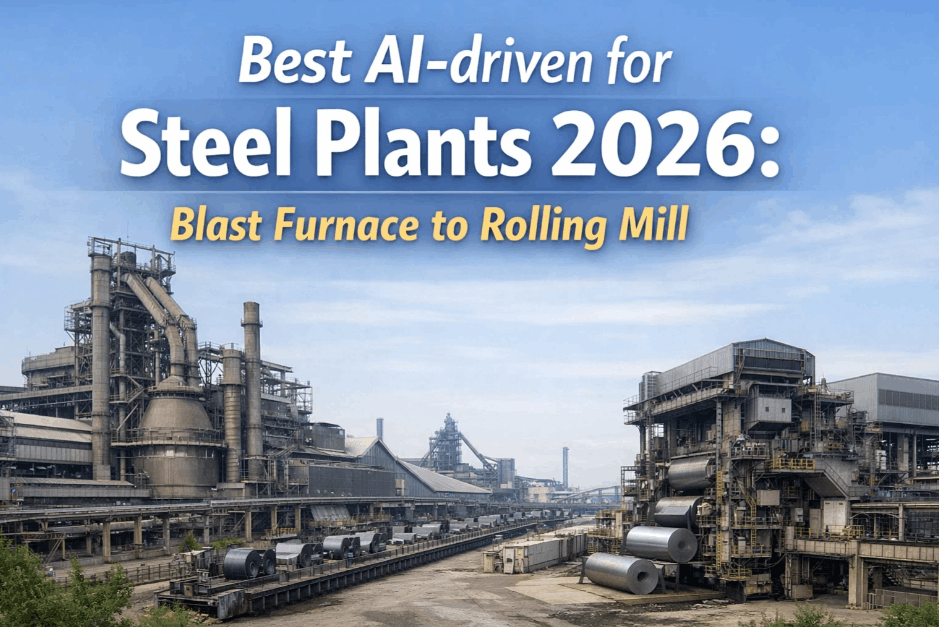
Best AI-Driven for Steel Plants 2026: Blast Furnace to Rolling Mill
Compare and rank leading AI-driven platforms across every steel production zone — blast furnace, caster, reheating furnace, hot strip mill, and finishing lines — with feature-by-feature scoring and real deployment data.
6 Production Zones Every Steel Plant AI Platform Must Cover End-to-End
A steel plant is not a single process — it is a chain of thermally violent, mechanically extreme, and chemically complex zones operating in sequence. Platforms that monitor only the blast furnace or only the rolling mill create blind spots between zones where 38% of unplanned downtime originates. The AI-driven platform you choose must provide continuous predictive coverage from coking to finishing. Talk to our steel specialists about multi-zone deployment.
Zone 1 — Blast Furnace & Hot Metal
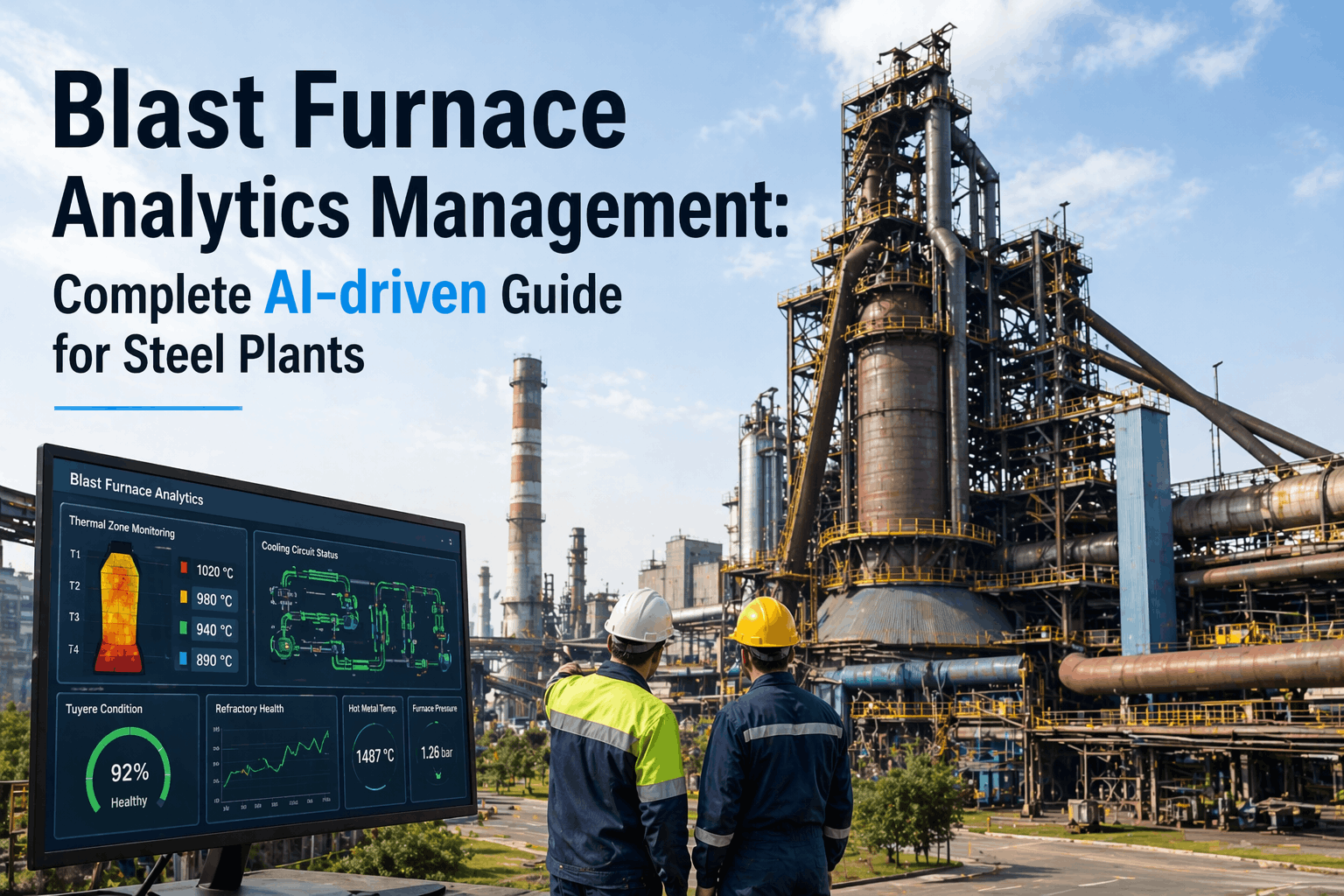
AI monitors tuyère condition, hearth wall temperatures (1,500°C+), burden distribution, slag chemistry, and hot metal silicon/sulphur prediction. Predictive models forecast hearth erosion 6–8 weeks ahead, preventing catastrophic breakouts. Platforms must ingest thermocouple arrays (200+ points), cooling stave flow data, and top gas composition in real time. Schedule a blast furnace analytics demo.
Zone 2 — Steelmaking (BOF / EAF)
Real-time lance position tracking, oxygen blow optimization, and end-point carbon/temperature prediction. For EAF plants, the platform must model electrode consumption, power-on/power-off cycles, and tap-to-tap time analytics. AI-driven BOF platforms reduce blown heat rejection by 22–31% through dynamic endpoint control. Get in touch for BOF/EAF analytics.
Zone 3 — Continuous Caster
Mould level control, breakout prediction (with sub-second response), segment roller alignment, spray cooling optimization, and slab quality scoring in real time. AI caster platforms must process mould thermocouple data at 100 Hz+ to detect sticker breakouts before they occur. Slab surface defect prediction at the caster exit reduces downstream rejection by 18–26%. Schedule a caster tracking demo.
Zone 4 — Reheating Furnace
Slab temperature uniformity tracking, fuel-air ratio optimization, scale loss minimization, and walking beam/pusher mechanical health monitoring. AI predicts slab discharge temperature within ±8°C accuracy, directly reducing rolling force variance and improving final gauge tolerance. Fuel savings of 4–7% are typical within 90 days of deployment. Contact us for energy analytics.
Zone 5 — Hot Rolling Mill
Roll force prediction, strip crown/flatness optimization, work roll thermal camber modeling, and looper tension control. AI-driven hot strip mills achieve ±0.05mm gauge accuracy and reduce cobble events by 40–55%. Vibration analytics on main drive gearboxes, spindles, and backup roll bearings provide 4–6 week failure prediction windows. Schedule a rolling mill analytics demo.
Zone 6 — Cold Rolling, Galvanizing & Finishing
Surface defect detection via AI vision (scratches, dents, rust stains, coating voids), thickness profile control, temper mill elongation optimization, and coil tracking through galvanizing and colour coating lines. AI vision systems inspect at line speeds of 1,200+ m/min with 94% classification accuracy across 40+ defect types. Get in touch for vision AI.
Zone-by-Zone AI Coverage Matrix — What Your Platform Must Monitor
This matrix maps the critical assets, failure modes, and AI capabilities required in each production zone. Any platform that shows gaps in more than one zone should not advance past shortlisting. Request a live iFactory multi-zone demo to see full coverage across your plant.
| Production Zone | Critical Assets Monitored | AI Capabilities Required | iFactory Coverage |
|---|---|---|---|
| Blast Furnace | Tuyères, cooling staves, hearth wall, top gas system, hot blast stoves, slag granulation | Hearth erosion prediction, burden distribution AI, hot metal chemistry forecast, stove dome temp modelling | ✓ Full coverage |
| BOF / EAF | Lance mechanism, vessel refractory, electrode arms, transformer, off-gas duct, ladle turret | End-point C/T prediction, refractory wear mapping, electrode consumption AI, tap-to-tap optimization | ✓ Full coverage |
| Continuous Caster | Mould oscillator, segment rollers, spray nozzles, tundish, ladle shroud, straightener rolls | Breakout prediction, mould level AI, slab quality scoring, spray cooling optimization | ✓ Full coverage |
| Reheating Furnace | Walking beam, burners, recuperator, pusher mechanism, skid pipes, refractory lining | Slab temp uniformity AI, fuel-air optimization, scale loss prediction, discharge temp control | ✓ Full coverage |
| Hot Rolling Mill | Work rolls, backup rolls, main drive gearbox, loopers, coilbox, laminar cooling headers | Roll force prediction, crown/flatness AI, cobble prediction, gearbox vibration FFT | ✓ Full coverage |
| Cold Rolling & Finishing | Tandem mill rolls, tension reels, galvanizing pot, air knives, temper mill, inspection cameras | Surface defect vision AI, thickness profile control, coating weight optimization, coil tracking | ✓ Full coverage |
ROI Analytics — Measurable Savings per Production Zone
Every zone delivers different ROI timelines and savings profiles. The blast furnace delivers the highest absolute savings (hearth protection), while the rolling mill delivers the fastest payback (quality rejection reduction). Use these benchmarks to build your business case. Schedule a ROI assessment tailored to your plant's production mix.
Multi-Zone Deployment Flow — From Pilot to Full Plant Coverage
Most steel plants deploy zone-by-zone, starting with the highest-ROI area. iFactory's architecture ensures that each zone deploys on the same data infrastructure — eliminating the integration debt that plagues multi-vendor approaches. Schedule a deployment planning session for your plant's phased rollout.
Site Assessment & Sensor Audit
Map existing instrumentation across all 6 zones. Identify sensor gaps, PLC connectivity, and network infrastructure. Produce a zone-priority scorecard based on downtime history and ROI potential.
Zone 1 Live — Highest ROI Area
Deploy edge servers, OPC-UA integration, and AI models for the first production zone (typically blast furnace or rolling mill). Predictive alerts and dashboards go live. Mobile field access enabled on Day 1.
Zones 2–3 Expansion + SAP Integration
Extend analytics to steelmaking (BOF/EAF) and continuous caster. Bi-directional SAP PM integration goes live — AI-generated work orders flow into SAP, completion status flows back. Safety permit workflows activated.
Zones 4–6 — Full Plant Coverage
Reheating furnace, hot rolling mill, and cold rolling/finishing lines brought online. Cross-zone correlation analytics activated — linking upstream quality events to downstream defects. Full OEE tracking across all zones.
Optimization & Knowledge Transfer
AI models retrained on 90+ days of plant-specific data. Shift-level KPI dashboards deployed. Maintenance team trained on mobile analytics. First quarterly business review with verified ROI data.
Integrated Safety Permit Management Across Steel Production Zones
Steel plants operate under some of the most hazardous conditions in manufacturing — molten metal, toxic gases, confined spaces, high-voltage equipment, and extreme temperatures. The best AI-driven platforms don't just monitor equipment; they integrate safety permit workflows directly into the maintenance execution cycle. Get in touch about safety compliance.
Hot Work Permits
Auto-generated when maintenance work orders involve welding, grinding, or torch cutting near combustible materials. Zone-specific fire watch requirements enforced digitally — BF area requires 4-hour post-work monitoring, rolling mill requires 2-hour.
LOTO Procedures
Lockout/Tagout workflows integrated with asset hierarchies. When a work order is issued for a rolling mill main drive, the platform auto-generates the LOTO sequence for all interlocked equipment — electrical isolators, hydraulic valves, pneumatic lines.
Confined Space Entry
Blast furnace belly inspections, BOF vessel entry, and caster segment pit access all require confined space protocols. AI monitors gas detector readings in real time and auto-revokes permits if H₂S, CO, or O₂ levels breach thresholds.
Height Work & Crane Permits
Overhead crane operations near molten metal ladles, BF top platform maintenance, and rolling mill roll change crane lifts all trigger automated height work permits with zone-specific PPE requirements and exclusion zone enforcement.
What Plant Leaders Say About Multi-Zone AI Deployment
We started with iFactory on our blast furnace — hearth erosion prediction alone justified the investment within 5 months. By month 8, we had rolled it into the caster and the hot strip mill. The cross-zone analytics is what changed everything: we discovered that 34% of our HSM cobbles were traceable to slab temperature non-uniformity from the reheating furnace. No single-zone platform would have caught that. Our unplanned downtime across the entire production chain dropped 47% in the first year.
Frequently Asked Questions
Can we deploy AI analytics on a blast furnace without upgrading existing Level 1/Level 2 automation?
Yes. iFactory connects to your existing PLC/SCADA infrastructure via OPC-UA, Modbus, or direct Ethernet/IP. The platform operates as a Layer 3/4 analytics overlay — it reads data from your existing Level 1 (PLC) and Level 2 (process control) systems without modifying them. Approximately 80% of blast furnace deployments use existing instrumentation with no new sensor installation required. Schedule a connectivity assessment.
How does iFactory handle the extreme temperature and electromagnetic interference in steel plant environments?
iFactory edge servers are deployed in plant server rooms or MCC/PLC rooms — not on the shop floor. All data ingestion occurs via hardened industrial Ethernet from your existing PLC infrastructure. For additional sensor deployment (vibration, ultrasonic thickness), we use IP67/IP68 rated industrial sensors with EMI-shielded cabling routed through existing cable trays. The software platform operates on standard server hardware — no special-purpose industrial PCs required.
What is the minimum data history needed to train zone-specific AI models?
Blast furnace hearth erosion models require 12–18 months of thermocouple history. Rolling mill vibration models require 60–90 days of continuous data. Caster breakout prediction models can operate from Day 1 using transfer learning from iFactory's cross-plant training dataset, with plant-specific fine-tuning completing within 30 days of deployment. Get in touch for model training details.
Can we start with one zone and expand without re-platforming or data migration?
Absolutely. iFactory's multi-zone architecture is designed for exactly this pattern. Zone 1 deploys on the same edge infrastructure, data lake, and security framework that all subsequent zones share. When you add Zone 2, the platform simply extends its data ingestion — no re-installation, no data migration, no new license server. Cross-zone analytics activate automatically as new zones come online.
How does the platform integrate safety permits with predictive maintenance work orders?
When iFactory generates a predictive maintenance work order (e.g., rolling mill gearbox bearing replacement), the platform automatically identifies the required safety permits based on the asset's zone, maintenance task type, and plant safety rules — hot work permit, LOTO sequence, confined space entry, or height work permit. Permits are routed to the safety officer for digital approval before the work order can be executed. Schedule a safety workflow demo.
See iFactory's Multi-Zone AI Analytics Live — Connected to Real Steel Plant Data
We'll demonstrate predictive analytics across blast furnace, caster, rolling mill, and finishing lines — in your plant's environment, with your data, on your timeline.