Steel plant planned analytics optimization and shutdown duration reduction are the most significant levers for improving annual EBITDA in the modern metals industry. For integrated mills, the cost of a planned outage is not merely the labor and parts—it is the astronomical loss of revenue, which can exceed $150,000 per hour during a Hot Strip Mill (HSM) or Continuous Caster shutdown. Historically, these turnarounds have been plagued by the "As-Found Surprise"—hidden mechanical failures that are only discovered once the machine is opened, leading to frantic parts sourcing and costly schedule overruns. This traditional approach to maintenance turnarounds is often referred to as the "Discover and Repair" cycle, a reactive loop that consumes up to 30% of a plant's annual maintenance budget in just a few weeks. Organizations that book a demo with iFactory are discovering that they can transition to a "Verify and Replace" model, compressing shutdown windows by 25-35% using AI-driven pre-outage diagnostics. By shifting from linear "Waterfall" scheduling to dynamic "Parallel Tasking" managed by real-time mobile workflows, iFactory ensures that your mill returns to full production speed hours, or even days, ahead of traditional projections, capturing millions in otherwise lost production capacity and stabilizing metallurgical quality during the volatile restart phase.
Recover 48+ Hours of Lost Production Every Shutdown Cycle
iFactory's Mobile AI-driven App delivers parallel task orchestration, predictive spares staging, and automated digital closeout to eliminate steel turnaround overruns.
Shutdown Optimization: The Digital Turnaround Framework
A comprehensive technical roadmap for deploying AI-driven scheduling and mobile-first execution to eliminate "As-Found" surprises and automate digital closeout across the HSM, Caster, and EAF zones.
The High Cost of Hindsight in Steel Mill Turnarounds
In high-tonnage environments, a "standard" shutdown is a misnomer. The sheer complexity of a mill—where a single Hot Strip Mill might have over 2,000 critical lubrication points and 500 hydraulic valves—means that traditional planning based on historical averages is mathematically flawed. When a master schedule is built in an office weeks before the event, it fails to account for the dynamic entropy of the floor. If a crane breaks down or a specialized welder is delayed, the entire critical path shifts, leading to thousands of man-hours of "Wait-Time Waste." Maintenance leads looking to harden their outage roadmap often begin by scheduling a consultation to see how live execution data eliminates these delays.
The Discovery Delay Trap
Traditional plans break when a seized bearing or cracked housing is found late. iFactory uses pre-shutdown vibration and thermal signatures to identify these needs 4 weeks early, allowing for pre-staged parts and zero-wait repairs.
Administrative Restart Lag
Restarting a furnace often waits hours for manual LOTO clears and paper signatures. iFactory's digital closeout automates safety verification, enabling an immediate "Green Light" for restart the moment work ends.
Contractor Sync Failures
With hundreds of contractors, miscommunication stalls dependent trades. Our mobile platform provides real-time "Handshake" notifications between crews, ensuring continuous parallel flow and 100% labor density.
The Legacy Outage Loop — Where Shutdown Duration Overruns
Blind Pre-Planning
Tasks scheduled based on calendar or "likely" wear. Spares are ordered on a best-guess basis.
Discovery Delay
Equipment is opened on Day 3. "Surprise" damage found. Critical path stalls while parts are air-freighted.
Linear Execution
Crews wait for supervisors to sign paper forms. Sequential handovers create massive "dead zones" in the schedule.
Ramp-up Crisis
Quality issues found during restart. Secondary stops required for calibration. Tonnage lost in ramp-up.
The "T-Minus 30" Readiness Protocol: Intelligent Pre-Shutdown
The true power of iFactory lies in the 30 days *before* the shutdown begins. While traditional planners are busy with logistics, iFactory's AI is performing a "Digital Audit" of the mill's health. We utilize High-Frequency MCSA and thermal modeling to look inside gearboxes and hydraulic manifolds while the mill is still at 100% load. This predictive layer ensures that the scope of work is 100% accurate before the first contractor arrives on site.
Vibration Fingerprinting
AI identifies rolling element bearing fatigue 30 days out. This ensures that the long-lead parts for Stand 1 or Stand 4 are on-site before the first crane lift, preventing the "Parts Panic."
Hydraulic Signature Audit
We monitor HAGC valve response times and pressure decay to identify internal leakage. Instead of "checking" valves during the outage, we only "replace" the ones the AI has flagged.
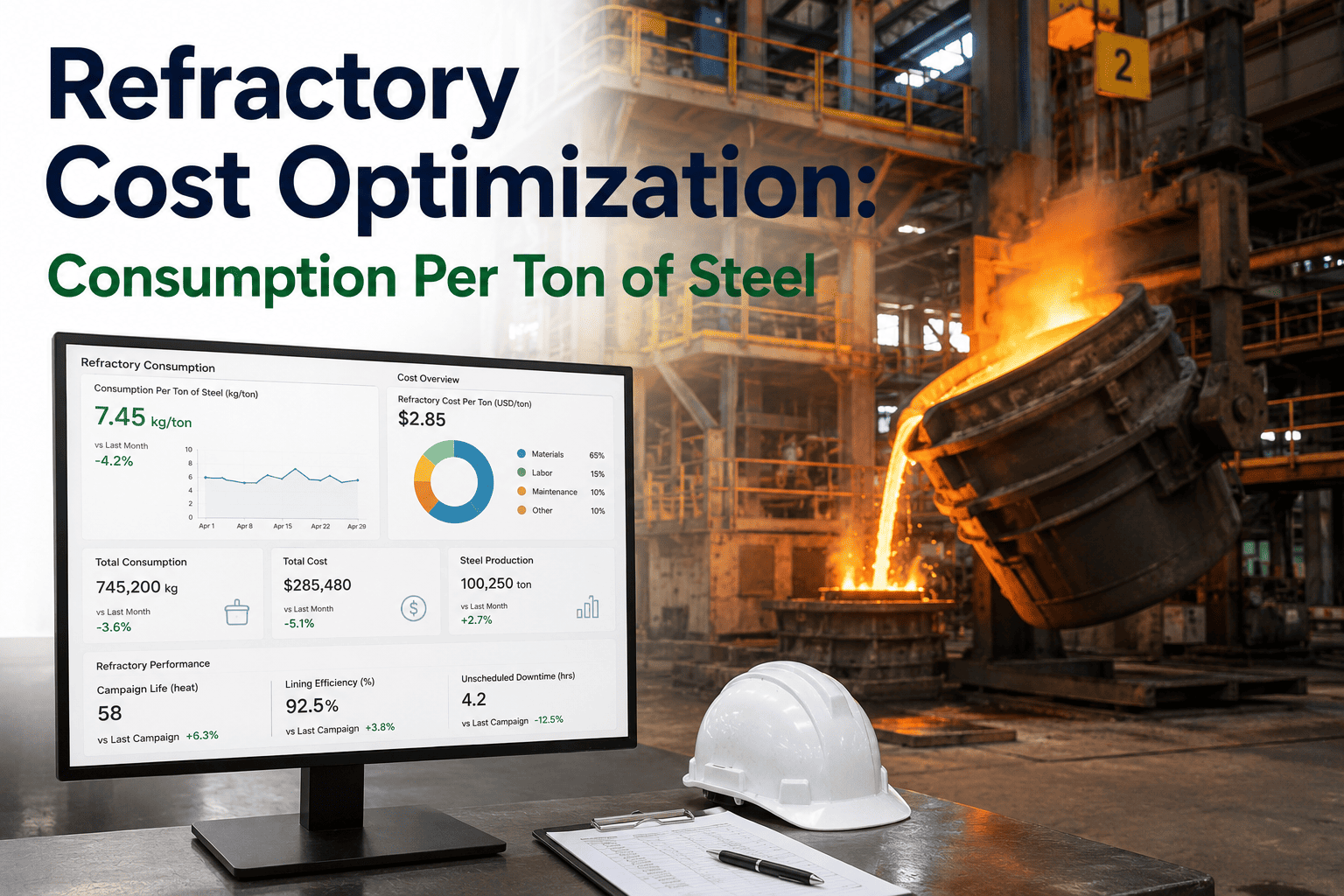
Thermal Refractory Scan
Identifying hotspots in the furnace shell allows for targeted refractory repair planning, eliminating the "As-Found" refractory surprise that often adds 48 hours to a critical shutdown.
Performance Comparison: Traditional Waterfall vs. iFactory AI Parallel
The economic argument for iFactory is centered on "Critical Path Compression." By enabling parallel workstreams that were previously impossible to synchronize safely, we effectively densify the productivity of the outage window. Every hour compressed on an HSM critical path is an extra $150k in prime coil capacity. Organizations exploring this shift often book a demo to view the ROI calculator.
Post-Outage Analytics: The Loop of Continuous Improvement
Shutdown optimization does not end when the mill starts. iFactory's post-outage module automatically compares the "As-Planned" schedule with the "As-Executed" digital reality. It identifies the specific contractors or equipment zones that caused friction, providing a data-backed blueprint for the *next* turnaround. This "Learning Outage" loop ensures that each subsequent shutdown is faster, safer, and more cost-effective than the last. Reliability directors looking to benchmark multi-site performance often choose iFactory for its cross-plant turnaround transparency. Book a free strategy session.
"We manage a complex 4-stand cold mill turnaround. Traditionally, our annual shutdown overran by 48 hours because of 'discovered' hydraulic valve issues. Last year, iFactory identified failing servo-valves two weeks before the outage. We had replacements on-site, compressed our schedule by 30 hours, and achieved prime quality in the first coil. It's the standard for modern turnaround excellence."
Outage Optimization — Frequently Asked Questions
Does iFactory replace our existing scheduling software like Primavera?
No. iFactory acts as the "Execution Layer." You import your master schedule, and our platform provides the real-time feedback and parallel synchronization that static tools cannot offer once the outage begins.
How does the AI predict 'As-Found' issues before the machine is opened?
We utilize "Process Fingerprinting"—specifically vibration harmonics, motor current signature analysis (MCSA), and thermal modeling—to identify assets exhibiting hallmarks of fatigue while still under load.
Can the mobile app handle high-traffic contractor onboarding?
Yes. iFactory includes a contractor module where technicians receive geofenced access to their specific work instructions and safety checklists, ensuring consistent World-Class standards.
What is the typical ROI for a single shutdown cycle?
Most mills achieve full ROI in their first outage. Reducing a 14-day shutdown by just 24 hours gains roughly $3.6M in recovered production capacity, far exceeding the annual cost of the platform.
How does digital closeout speed up the restart?
Traditional closeout requires physical sign-offs driven to a control room. iFactory's digital handover allows real-time verified completion, enabling restart the minute the final LOTO is removed.
Is the platform compatible with legacy mill equipment?
Absolutely. Our IoT gateways support legacy protocols (Modbus, Profibus) to digitize data for the AI engine, ensuring even older mills can benefit from predictive staging.
How does it ensure safety during parallel tasking?
The system uses "Safety Dependency Logic." The AI knows that a repair can occur *in parallel* only if specific isolation valves are verified digitally, eliminating handover delays while maintaining compliance.
Compress Your Turnaround Windows with iFactory AI
iFactory's Mobile AI-driven App delivers integrated outage modules, predictive spares staging, and autonomous closeout verification — built for steelmakers ready to maximize EBITDA.