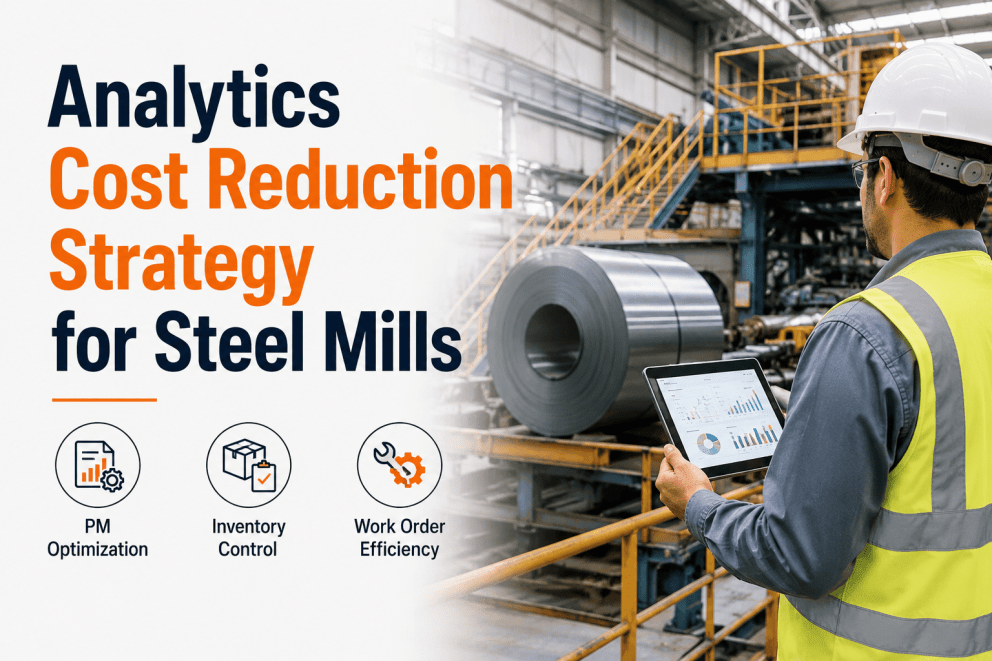
In the steel industry, a planned blast furnace or rolling mill shutdown costs between $500,000 and $5,000,000 per day in lost production alone, before accounting for parts, contractor labour, and heavy equipment rentals. Yet, many integrated plants still manage these monumental events using disconnected spreadsheets, static Gantt charts printed on A0 paper, and whiteboards that are out of date by 9:00 AM. When a single crane delay or missing critical spare part causes a cascading schedule slip on the critical path, the financial impact is devastating. iFactory's Turnaround Management module digitises the entire shutdown lifecycle. From initial scope freezing and contractor resource levelling, to real-time critical path tracking and mobile task-closures on the shop floor, the platform ensures every hour of your outage is executed with military precision — routinely returning plants to production 12 to 36 hours ahead of schedule.
Steel Plant Shutdown Management: Planning for Maximum Efficiency
Master turnaround execution with milestone scheduling, automated critical path analysis, and real-time contractor progress tracking to minimize outage duration.
Why Spreadsheets Fail During Steel Plant Turnarounds
Planning a 15,000-hour turnaround with 500 external contractors using static spreadsheets creates a brittle execution environment. A delay on Monday morning isn't visible to the Wednesday shift until it's too late. iFactory replaces silos with a single, live digital thread. Schedule an outage readiness assessment to find the hidden slack in your next shutdown.
Eliminate 18% of Outage Duration Through Digital Execution
Based on data from over 30 major steel plant turnarounds, shifting from spreadsheet planning to iFactory's interconnected execution model saves an average of 42 hours on a typical 10-day shutdown. The savings compound across four distinct phases of the turnaround lifecycle.
The iFactory Outage Execution Timeline
iFactory replaces morning whiteboard meetings with a live, interconnected system. When a boilermaker completes a weld, the subsequent scaffolding removal team is instantly notified. No waiting, no searching, no miscommunication.
All departmental work orders are amalgamated into a master outage scope. iFactory automatically cross-references required parts against SAP MM inventory, highlighting procurement deficits weeks before they become a crisis.
Zero missing-part surprisesThe critical path AI processes the sequence of 5,000+ tasks, levelling constraints on heavy cranes, specialised welders, and confined-space permits so contractors are never stacked on top of each other.
Eliminates spatial clashesShutdown commences. Safety engineers use tablets to instantly issue, track, and verify digital Lockout-Tagout (LOTO) and confined space permits. Contractors scan QR codes on barriers to confirm clearance.
Instantly compliant executionAs contractors update task completion via mobile, the boardroom dashboard projects a live S-Curve. If the critical path lags by 2 hours, the software auto-calculates the required resource surge to correct it.
Real-time situational awarenessEvery joint and fix verified with required photos. Automatic clearance sequences trigger, seamlessly guiding the plant from final inspection back into hot production without waiting for paper trails.
Guaranteed quality handoverInvestment vs. Early Startup Value
When a steel plant measures outage cost in thousands of dollars per hour, software that physically compresses the schedule delivers overwhelming financial returns. Below is a modelled return for a large BF/BOF integrated stoppage.
What the Head of Major Outages Said
Turnarounds used to age me a decade. A 300-tonne crane delay at 2 AM would quietly cascade, and we wouldn't know until the 8 AM review that our critical path was blown. With iFactory's live tracking, when a contractor updates a task completed at 2:15 AM, the next team in the sequence gets an automatic signal to mobilise. It’s no longer a reactive scramble; it’s a controlled, orchestrated factory. We beat the startup curve by 31 hours on our last Blast Furnace reline.
Frequently Asked Questions
How does iFactory handle thousands of temporary external contractors?
The system features a rapid contractor onboarding portal via QR code. External crews simply download a lite, secure mobile app wrapper that restricts access solely to their assigned tasks and safety permits. No extensive training or complex ERP access required.
Can iFactory import our existing outage plans from MS Project or Primavera P6?
Yes. You can import your master schedule directly from MS Project, Primavera, or SAP into iFactory. The platform creates the digital execution layer, feeding real-time progress percentages securely back to your master tracking tool.
How is the live S-curve generated if Wi-Fi drops on the shop floor?
The contractor mobile interface allows offline task sign-offs. Data syncs instantly via background caching the moment the supervisor walks into a Wi-Fi or local cellular mesh zone, updating the boardroom dashboard without their active intervention.
Does the platform manage the return sequence and testing parameters?
Absolutely. The startup sequence—hydro testing, cold runs, hot commissioning—is built as a dependent logic string. A unit cannot progress to hot startup until every preceding digital QA document, pressure test photo, and safety permit is cleared.
Build Your Digital Outage Blueprint
Let us run your past turnaround data through our system and simulate the slack time you could recover.