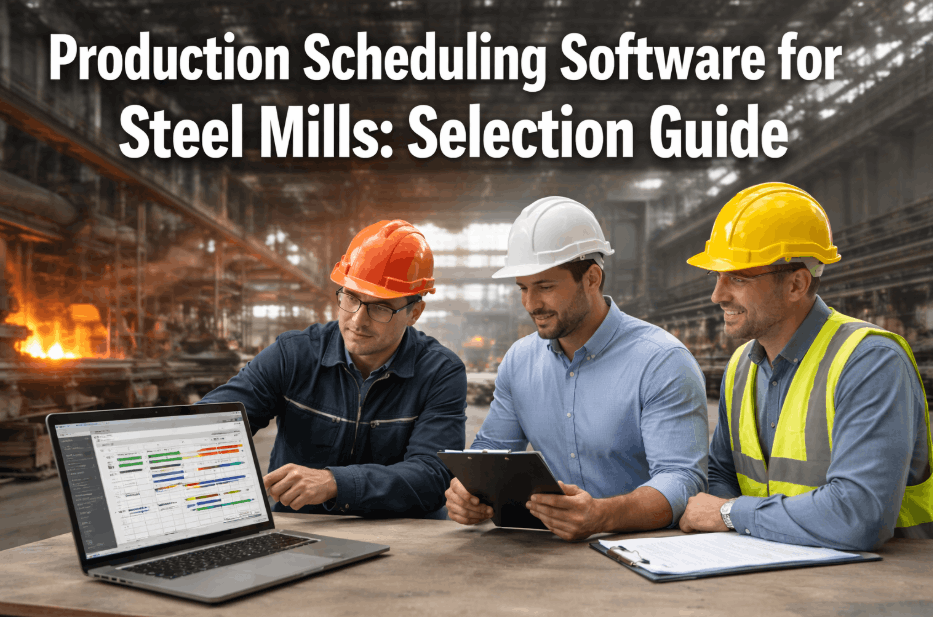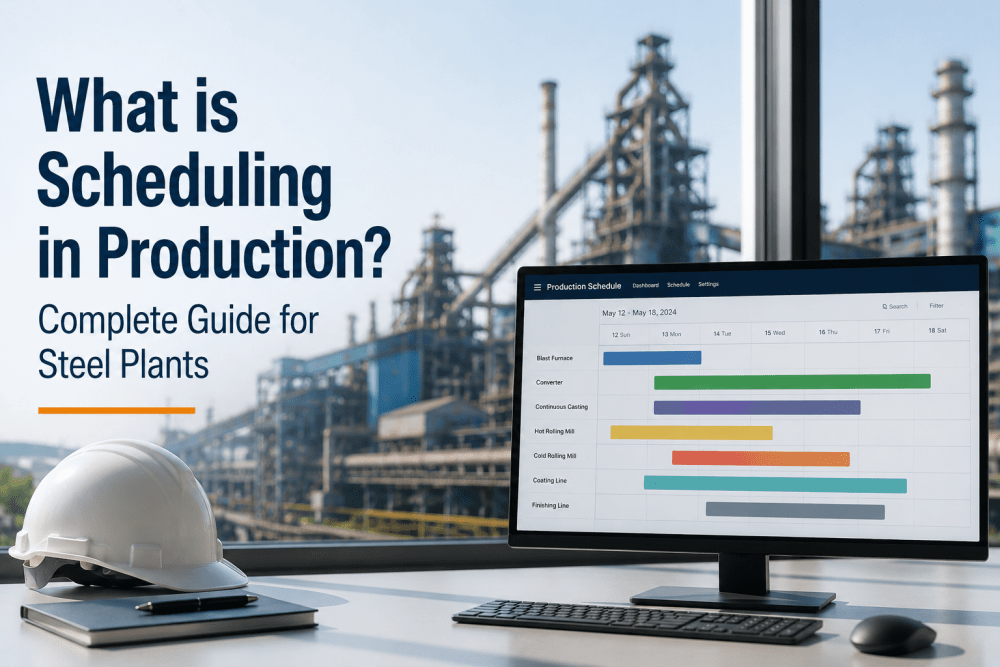
Walk into any U.S. steel mill at the start of a shift and ask the planner what's running on the caster in four hours, what the rolling sequence looks like, and which orders are at risk — and the quality of the answer tells you everything about the maturity of the plant's production scheduling. In a well-scheduled facility, the planner pulls up a Gantt view that shows the heat sequence, the cast width transitions, the rolling mill campaign, the planned PM window, and the quality hold positions in one connected picture — and can answer the question in under 60 seconds with confidence. In a poorly scheduled facility, the answer comes from three separate spreadsheets, two whiteboards in different buildings, a phone call to the melt shop foreman, and a best-guess estimate of where the order book actually stands. The difference between these two facilities is rarely the people. The planners in both plants are typically experienced and capable. The difference is whether the plant has implemented production scheduling as a structured, technology-supported discipline that connects melt shop sequencing, continuous casting, rolling mill campaigns, maintenance windows, and order fulfillment into a unified planning view — or whether scheduling is being done as a series of disconnected handoffs between functions that each optimize their own piece without visibility into the whole. iFactory's production scheduling platform, integrated with the analytics and CMMS layer that already manages maintenance and asset condition, converts steel plant scheduling from a fragmented coordination exercise into a unified planning discipline that drives measurable throughput improvement, on-time delivery performance, and reduced grade-change waste. Facilities that have deployed iFactory's production scheduling platform alongside the analytics and maintenance modules report 18 to 24% throughput improvement on bottleneck assets, 31% reduction in grade-change losses, and 92% on-time delivery performance from a baseline of 73 to 78%.
What is Scheduling in Production? Complete Guide for Steel Plants
Production scheduling in steel manufacturing is the discipline that determines whether your facility runs at 78% OEE or 93% — whether your order book ships on time or accumulates contract penalties, whether your grade changes consume 4% or 1.2% of available production time. iFactory's scheduling platform connects every layer of steel plant planning into one unified system.
What Production Scheduling Actually Means in a Steel Plant Context
Production scheduling in a steel plant is the systematic allocation of furnace capacity, caster sequences, rolling mill campaigns, workforce shifts, raw material availability, and maintenance windows across a defined planning horizon — typically structured across three time scales that operate as one connected hierarchy. Long-range capacity planning (monthly and quarterly) sets the strategic envelope of what the facility commits to produce against the order book and forecasted demand. Medium-range production sequencing (weekly heat schedules and rolling campaigns) translates that envelope into executable sequences that respect chemistry compatibility, width transition rules, and roll wear constraints. Short-range execution scheduling (shift-by-shift dispatch) drives the actual order of heats, casts, and rolling slots that the operations team executes — adjusted in real time as conditions change.
What makes steel plant scheduling fundamentally different from discrete manufacturing scheduling is the continuous, asset-coupled, chemistry-constrained nature of the process. A heat in the EAF is connected by liquid metal flow to a ladle, a tundish, a caster, and ultimately a hot strip mill where the slab will be rolled — and a single unplanned interruption anywhere in that chain cascades through every downstream operation. The scheduling engine cannot treat each asset as an independent unit; it has to model the entire production network as a synchronized flow problem with chemistry compatibility rules, width transition costs, temperature constraints, and asset condition limitations applied as simultaneous constraints. This is the problem that generic ERP scheduling modules — built for discrete assembly operations — cannot solve without industry-specific extensions that understand steel metallurgy, caster mechanics, and rolling mill campaign logic.
Long-Range Capacity Planning
Monthly and quarterly capacity allocation against the order book — balancing committed orders, forecasted demand, planned shutdowns, and major maintenance windows. Sets the strategic envelope within which weekly scheduling operates. Establishes the production targets that flow down to medium-range sequencing.
Medium-Range Sequencing
Weekly heat schedules and rolling campaigns built with chemistry compatibility, width transition rules, and roll wear constraints applied as simultaneous conditions. This is where the highest-leverage optimization decisions are made — minimizing grade jumps, building optimal campaign lengths, and protecting bottleneck asset utilization.
Short-Range Execution
Shift-by-shift dispatch and real-time schedule adjustment as conditions change — equipment alarms, quality holds, raw material delays, or customer order changes. The execution layer needs visibility into the medium-range plan but the flexibility to reorder within the day without losing the broader sequence integrity.
The Five Core Functions of Production Scheduling Steel Plants Cannot Operate Without
Production scheduling in steel manufacturing breaks down into five core functions that must operate as connected capabilities rather than as separate departmental responsibilities. iFactory's scheduling platform delivers each function inside the same unified data model — so the order book, the heat sequence, the maintenance plan, the quality hold register, and the dispatch view all reflect the same current state of the plant at every moment.
Want to see iFactory's heat sequencing engine and campaign builder configured against your facility's order book and asset profile? Book a Demo with iFactory's steel plant scheduling team.
Scheduling Maturity Benchmark: Where U.S. Steel Plants Stand and What Drives the Difference
The maturity of production scheduling in a steel plant can be assessed across six dimensions — system integration, sequencing intelligence, maintenance coordination, real-time adaptability, decision visibility, and feedback learning. The benchmark table below shows the typical distribution of U.S. steel plant scheduling practice across these dimensions, with the gap between standard practice and top-performer practice quantified by the operational outcome each capability drives.
| Scheduling Dimension | Standard Practice | Top Performers | iFactory Capability | Operational Impact |
|---|---|---|---|---|
| System Integration | Spreadsheets, whiteboards, disconnected MES and CMMS | Single unified scheduling platform with ERP, MES, CMMS connected | Production scheduling integrated with analytics, CMMS, and ERP in one data model | +18–24% throughput on bottleneck assets |
| Sequencing Intelligence | Manual heat sequencing by experienced planner; rules in planner's head | Algorithmic sequencing with chemistry, width, and tundish constraints applied | Constraint-aware sequencing engine with auto-revalidation on changes | –31% grade-change losses |
| Maintenance Coordination | Production schedules locked; maintenance fits in between | Production and PM windows planned together in shared interface | Unified production-maintenance scheduling with PM deferral risk scoring | –46% reactive maintenance from PM deferrals |
| Real-Time Adaptability | Schedule rebuild requires planner intervention; takes hours | Schedule auto-revalidates on alarms, holds, and order changes | Live revalidation with constraint preservation across rapid disruptions | +14 percentage points OEE on disrupted shifts |
| Decision Visibility | Planner decisions invisible to operations and maintenance | Schedule changes logged with reason codes visible to all teams | Decision audit trail with reason-code analytics for continuous improvement | Faster cross-functional alignment in weekly cycles |
| On-Time Delivery | 73–78% on-time delivery typical at mid-size U.S. mills | 92%+ on-time delivery sustained quarter over quarter | Order risk scoring and priority-aware sequencing across planning horizons | +14–19 points on-time delivery improvement |
The End-to-End Production Scheduling Workflow Inside iFactory
iFactory's production scheduling capabilities are delivered through a structured workflow that takes a steel plant from order intake to executed dispatch with every constraint and condition signal applied at the right step. The workflow below reflects the scheduling architecture that top-performing U.S. steel plants have built with iFactory — moving from a reactive, departmental coordination model to a proactive, unified planning model.
Order Intake and Priority Scoring
Customer orders enter the scheduling system from the ERP order book with grade, width, gauge, finish, and delivery date attributes. iFactory's priority scoring engine weighs contract penalty exposure, customer tier, and production efficiency to assign each order a scheduling priority — feeding the allocation step with a ranked order list rather than a flat queue.
Long-Range Capacity Allocation
The capacity allocation module distributes the order book across the monthly and quarterly horizon — balancing committed orders against forecasted capacity, planned shutdowns, major maintenance campaigns, and raw material availability. Output is a capacity-allocated production plan that establishes which orders will run in which week.
Heat Sequencing and Campaign Building
For each week in the plan, the sequencing engine builds optimal heat sequences that respect chemistry compatibility, width transition rules, and tundish life — then assembles those heats into rolling campaigns built around work roll wear curves and surface quality positioning. The sequencing run produces a validated weekly schedule ready for execution.
Maintenance Window Integration
The maintenance plan from the CMMS — including scheduled PMs, predictive RUL-driven interventions, and shutdown campaigns — is overlaid on the production schedule in the shared planning interface. PM deferrals are tracked with cumulative risk scores. Windows that conflict with critical production commitments are flagged for cross-functional review before the weekly cycle locks.
Real-Time Execution and Revalidation
During execution, the schedule auto-revalidates when alarms, quality holds, order changes, or equipment condition signals indicate a deviation from plan. The revalidation preserves sequencing constraints — chemistry compatibility is maintained, campaign integrity is protected, maintenance windows are honored — while reordering executable slots to absorb the disruption with minimum schedule loss.
Post-Cycle Analysis and Continuous Learning
After each weekly cycle, iFactory's analytics module produces a scheduling post-mortem showing plan-versus-actual performance, the OEE losses attributable to scheduling decisions, the grade-change costs incurred, and the on-time delivery results by order tier. The analysis feeds back to the priority scoring weights and sequencing constraints, continuously improving the planning model.
Ready to see the scheduling workflow configured against your steel plant's production network and order profile? Book a Demo and review your current scheduling architecture with iFactory's team.
Expert Review: What Steel Plant Production Planners Say About Unified Scheduling
I have been doing production scheduling in U.S. steel mills for 22 years — across two integrated facilities and one EAF mini mill — and the single biggest lesson I would pass to anyone responsible for planning is that the technology gap in steel plant scheduling is not where most people think it is. It is not in fancy AI sequencing algorithms or machine learning prediction models. It is in the basic act of having one system where the order book, the heat sequence, the rolling campaign, the maintenance plan, and the quality hold register all reflect the same current truth at the same time.
Conclusion
Production scheduling in a steel plant is not a clerical function or a back-office coordination task. It is the operational discipline that determines whether the facility runs at 78% OEE or 93%, whether the order book ships at 75% on-time or 92%, whether grade changes consume 4% of available production time or 1.2%. The difference between these outcomes is rarely the people or the equipment — it is whether the plant has implemented scheduling as a structured, technology-supported discipline that connects order allocation, heat sequencing, campaign planning, and maintenance integration into one unified planning view that every function trusts.
iFactory's production scheduling platform delivers that unified view — built natively for steel manufacturing with chemistry-aware sequencing, campaign-aware rolling planning, and maintenance integration that puts production and PM windows in the same scheduling interface. The 18 to 24% throughput improvement, 31% grade-change loss reduction, and 92% on-time delivery performance at comparable steel plant deployments are the documented result of moving scheduling from a fragmented coordination exercise to a unified planning discipline. Book a Demo to see how iFactory's scheduling platform would perform against your facility's current planning architecture and operational outcomes.
Frequently Asked Questions
Move Your Steel Plant Scheduling From Spreadsheets and Whiteboards to a Unified Planning Discipline.
iFactory's production scheduling platform delivers chemistry-aware heat sequencing, campaign-optimized rolling planning, and integrated maintenance windows in one connected system that every function trusts — converting fragmented departmental coordination into a unified throughput-driving capability.