Steel plants are among the most hazardous industrial environments in the United States — with fatality rates that run three to four times the all-industry average and OSHA enforcement actions that cost the sector more than $47 million annually in penalties, corrective measures, and citation-related production impacts. The regulatory obligations facing a U.S. steel facility are not simple to meet: OSHA's 29 CFR 1910 general industry standards, the 1910.147 lockout/tagout standard, 1910.146 permit-required confined space, 1910.252 hot work, and 1926 construction standards for capital projects all apply simultaneously — alongside ISO 45001 management system requirements for facilities operating under international quality certification, and state-plan OSHA programs in 22 states that add supplemental requirements on top of the federal baseline. Managing compliance across these overlapping frameworks manually — through paper permit books, printed inspection checklists, and spreadsheet-based audit tracking — is not just inefficient. It is the direct cause of the documentation gaps, permit omissions, and corrective action closures that drive OSHA citations at U.S. steel facilities. The pattern in steel plant OSHA inspection findings is consistent: the hazard was known, the control was established in the written program, and the failure was in execution and documentation — a lockout/tagout procedure that was not followed because the paper copy in the binder was outdated, a confined space entry that proceeded without a current atmospheric test record, a hot work permit that was not renewed when the shift changed. iFactory's Safety Compliance and Permit Management platform closes the execution gap — replacing paper-based safety workflows with digital permit issuance, real-time inspection tracking, automated corrective action routing, and audit trail generation that covers every OSHA and ISO 45001 requirement your facility operates under. Facilities deploying iFactory's safety compliance platform report 78% reduction in permit documentation deficiencies, 61% improvement in corrective action closure rates, and zero citation-related shutdowns at audited facilities in the 24 months following deployment.
Steel Plant Safety Compliance: OSHA, ISO 45001 & Analytics
Automate OSHA and ISO 45001 compliance across your steel facility — lockout/tagout, permit-to-work, confined space, hot work, and fall protection — with digital workflows that eliminate documentation gaps and generate audit-ready records in real time.
Why Paper-Based Safety Programs Fail in Steel Plant Environments
The structural failure mode in steel plant safety programs is not ignorance of the regulation — it is the gap between the written program and the documented execution on the floor. A facility can have a technically complete OSHA-compliant lockout/tagout program, a 200-page confined space standard operating procedure, and a hot work permit system that satisfies every 29 CFR requirement on paper — and still receive willful citations because the execution documentation does not match the written program. Operators work from outdated printed procedures. Confined space entry permits expire mid-shift and the renewal is undocumented. Hot work permits do not note the shift change. Corrective actions from the last safety audit are tracked in a spreadsheet that two people have access to, neither of whom is the maintenance supervisor who needs to close them. These are not failures of safety culture. They are failures of safety workflow infrastructure — and they are precisely the failures that iFactory's digital safety platform is designed to eliminate.
- Lockout/tagout procedures printed from binders that may not reflect the latest equipment modification
- Confined space entry permits completed on paper with no automated atmospheric test record linkage
- Hot work permits issued per shift without digital renewal tracking or fire watch documentation
- Safety inspection findings recorded on paper forms — corrective actions tracked in disconnected spreadsheets
- ISO 45001 audit documentation assembled manually each cycle from multiple disconnected sources
- No real-time visibility into permit status, open corrective actions, or overdue inspections
- LOTO procedures digitally linked to the current equipment record — always reflect the latest revision
- Confined space entry permits issued digitally with atmospheric test result fields and auto-expiry enforcement
- Hot work permits tracked in real time — shift change triggers automatic renewal requirement with notification
- Digital inspection findings auto-generate corrective action work orders routed to the responsible supervisor
- ISO 45001 audit packages auto-assembled from operational safety data — no manual compilation
- Live dashboard showing all open permits, overdue inspections, and unclosed corrective actions by area
Steel Plant Safety Compliance Coverage: iFactory by OSHA Standard and Permit Type
The table below maps each major OSHA standard and permit type applicable to U.S. steel operations to its core compliance requirement, the primary documentation obligation, and the iFactory feature that manages it. This coverage map reflects the actual regulatory landscape of an integrated or EAF mini mill operating under federal OSHA — not a generic industrial safety checklist. Book a Demo to see this coverage applied to your facility's specific compliance obligations and current documentation gaps.
| OSHA Standard / Permit Type | CFR Reference | Core Compliance Requirement | Documentation Obligation | iFactory Feature | Citation Risk Without Digital |
|---|---|---|---|---|---|
| Lockout / Tagout (LOTO) | 29 CFR 1910.147 | Written procedures for every energy source; annual inspection of each procedure | Equipment-specific LOTO procedure; annual audit record per procedure | Digital LOTO procedure library linked to asset record; automated annual inspection scheduling | High — #1 most-cited standard in steel; willful citations $15,625/violation |
| Permit-Required Confined Space | 29 CFR 1910.146 | Written permit program; atmospheric testing before and during entry; trained attendant and rescue | Entry permit with atmospheric test data, entrant/attendant names, hazards, and emergency contacts | Digital confined space permit with atmospheric result fields, auto-expiry, mobile entrant signature | Very high — missing atmospheric test records most common confined space citation |
| Hot Work Permit | 29 CFR 1910.252 / NFPA 51B | Permit issued before each hot work operation; fire watch during and 30–60 min after; area inspection | Permit with location, time, fire watch name, pre-work inspection checklist, and post-work sign-off | Digital hot work permit with shift-change renewal enforcement, fire watch assignment, and GPS location tag | High — shift change without documented renewal is a recurring citation trigger |
| Fall Protection | 29 CFR 1910.28 / 1926.502 | Protection at 4 ft (general industry) / 6 ft (construction); equipment inspection before each use | Harness inspection records; fall protection plan for leading-edge or unprotected edge work | Digital pre-use inspection checklist with defect flagging; fall protection plan linked to work order | Moderate-high — equipment inspection record gaps and missing written plans |
| Hazard Communication (HazCom) | 29 CFR 1910.1200 | SDS for every chemical; training records; labeled containers | SDS library with access documentation; training completion records by employee | Digital SDS library integrated with work order and permit system; training record management | Moderate — SDS access gaps and outdated training records common in steel |
| ISO 45001 Management System | ISO 45001:2018 | Documented OHS management system; risk assessment; audit; management review; continual improvement | Risk register, internal audit records, corrective action log, management review minutes, KPI trends | Auto-assembled audit packages; corrective action tracking with closure verification; KPI dashboard | Certification risk — audit package gaps trigger nonconformances; corrective action backlog triggers major NCs |
Digital Permit Management: How iFactory Eliminates the Execution Gap
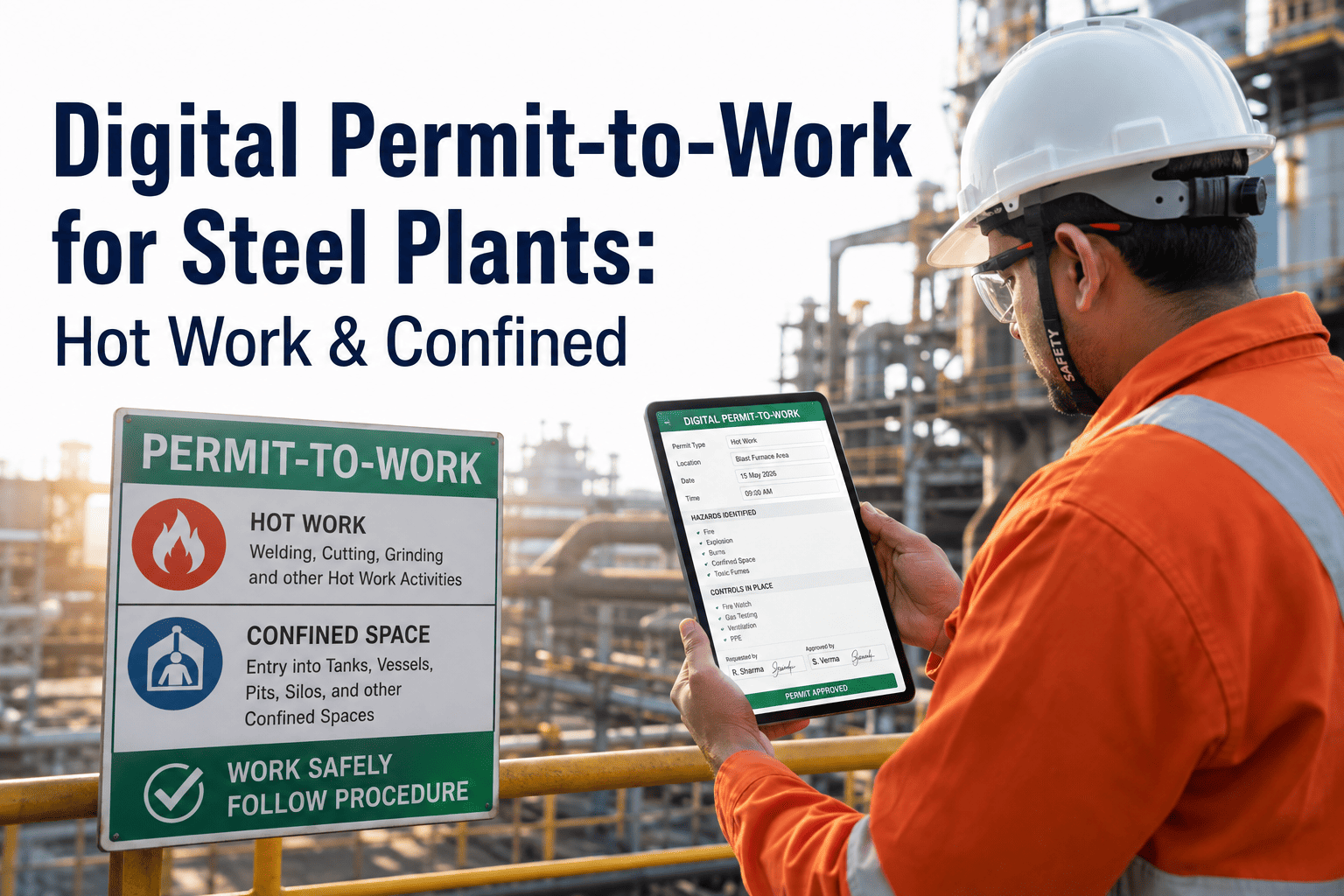
The permit-to-work system is the most operationally critical safety workflow in a steel plant — and the most common source of OSHA citations. A permit-to-work failure is rarely a failure to have a permit system; it is almost always a failure in execution: a permit issued without the pre-work inspection completed, a confined space entry started before the atmospheric test was recorded, a hot work permit that was not closed out after the job. iFactory's digital permit management platform is built to close these execution gaps through mandatory field completion, real-time permit status visibility, and automatic escalation when permits approach expiry without documented renewal.
ISO 45001 Compliance Analytics: From Management System Documentation to Continual Improvement
ISO 45001:2018 requires more than a documented safety management system — it requires a demonstrable management system, with evidence that hazard identification, risk assessment, operational controls, internal auditing, corrective action, and management review are functioning continuously rather than existing only in written procedures. The most common nonconformances in ISO 45001 third-party audits at steel facilities are not missing policy statements — they are missing evidence that the system is operating as documented: corrective actions from internal audits that were not closed, risk assessments that were not updated after process changes, management review meetings that occurred but whose outputs were not documented and acted upon. iFactory's compliance analytics layer tracks every element of the ISO 45001 operational cycle and provides the evidence trail that certification auditors require.
Safety Inspection Workflows: From Scheduled Checklist to Closed Corrective Action
Safety inspections are the leading-indicator backbone of any OSHA-compliant safety program and the primary evidence source for ISO 45001 internal audit requirements. But their value depends entirely on the quality of the execution-to-action pipeline: an inspection that identifies a deficiency and generates no corrective action, or generates a corrective action that is tracked on a spreadsheet with no escalation logic, produces no safety improvement and no compliance documentation. iFactory's inspection management workflow closes the pipeline from scheduled inspection through deficiency finding, corrective action assignment, evidence-based closure, and trend reporting — in a single digital thread with complete audit traceability.
Expert Perspective: What Safety and Compliance Leaders Learn From Steel Plant Deployments
I have managed safety compliance programs at three U.S. steel facilities over 16 years — one integrated mill and two EAF operations — and served as the lead EHS manager during two OSHA programmed inspections and one ISO 45001 certification audit in the same 18-month period. The insight I would share with any steel plant safety manager considering a digital compliance platform is this: the most expensive safety failures I have witnessed in this industry were not failures to have a program. They were failures to execute the program and document that execution. We had a citation for 1910.147 that cost the facility $68,000 in penalty, corrective measures, and audit costs — not because we did not have a lockout/tagout program. We had one of the most comprehensive LOTO programs I have written in my career. The citation was because the annual inspection for three procedures had not been documented in the required format, and we could not produce the records on the inspector's timeline. That $68,000 citation would not have occurred if we had been running a digital LOTO management system that auto-scheduled and tracked those annual inspections. The same logic applies to confined space. Our atmospheric test records were on paper permit forms that accumulated in a file box in the safety office. When OSHA asked for the records for a specific entry event, we found the entry but could not locate the atmospheric test page because it had been separated from the permit at filing. That is a documentation gap citation — not a safety failure, a paperwork failure. Digital permit systems with mandatory atmospheric test fields eliminate that class of citation entirely. The ROI on a digital safety compliance platform in a steel plant is not calculated against the cost of the platform. It is calculated against the cost of the citations you will not receive and the incident costs you will prevent by actually closing the corrective actions your inspection program is already identifying but currently not tracking to verified closure."
Conclusion
Steel plant safety compliance in 2026 is not a documentation problem that more paper can solve. The facilities that are receiving OSHA citations despite having comprehensive written safety programs are experiencing execution and documentation gaps that paper-based workflows structurally cannot close — because paper systems have no mandatory field enforcement, no automatic expiry or renewal logic, no corrective action escalation, and no audit trail that survives a file drawer reorganization. Digital safety compliance platforms are not a luxury or a nice-to-have for large integrated mills. They are the infrastructure that closes the gap between a well-written safety program and the documented execution that OSHA inspectors require and ISO 45001 auditors measure.
iFactory's Safety Compliance and Permit Management platform delivers that infrastructure for U.S. steel operations — covering lockout/tagout procedure management and annual inspection automation, confined space permit issuance with mandatory atmospheric test documentation, hot work permit shift-change enforcement, ISO 45001 audit package auto-assembly, and the corrective action tracking workflow that turns inspection findings into verified closures rather than spreadsheet entries. The 78% reduction in permit documentation deficiencies, 61% improvement in corrective action closure rates, and zero citation-related shutdowns at deployed facilities are the documented results of replacing paper execution with digital enforcement. Book a Demo to see how iFactory's safety compliance platform applies to your facility's specific OSHA obligations and ISO 45001 certification requirements.
Frequently Asked Questions
Replace Paper Permit Books and Spreadsheet Safety Tracking With a Platform Built for Steel Plant OSHA and ISO 45001 Compliance.
iFactory's Safety Compliance and Permit Management platform enforces execution, documents every step, and generates the audit trail that OSHA inspectors and ISO 45001 certification auditors require — without manual compilation or coordinator overhead.