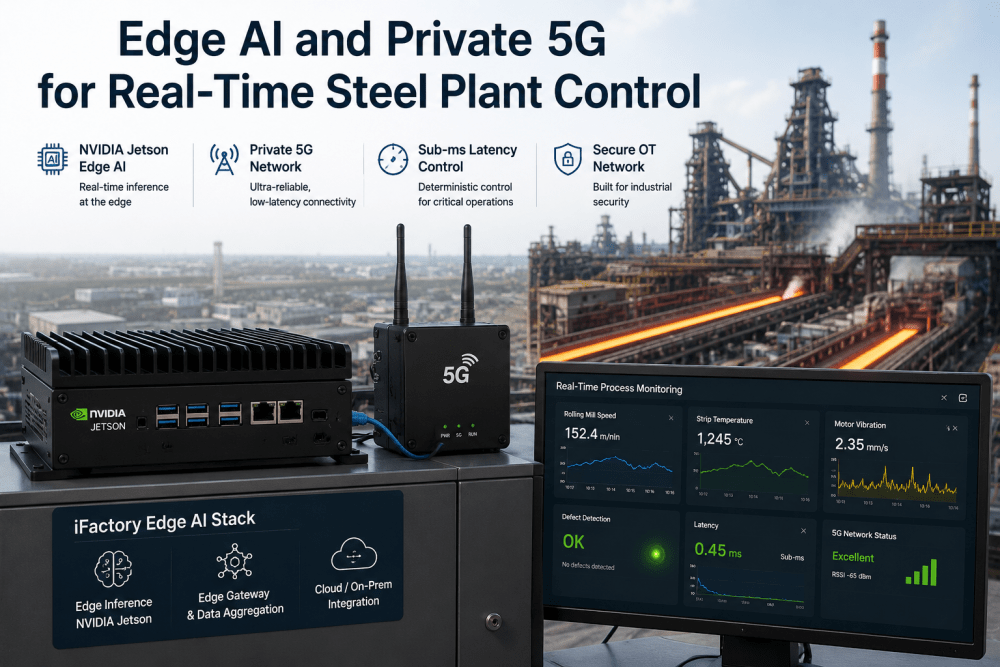
The latency requirement for closed-loop process control in a steel plant is measured in milliseconds — a rolling mill's automatic gauge control system must adjust roll gap within 5 to 10 milliseconds of a thickness deviation, a continuous caster's mold level control must respond to tundish weight changes within 20 milliseconds, and a hot strip mill's finishing temperature control must adjust cooling header flow within 50 milliseconds of the pyrometer reading. Cloud-based AI inference, even with the fastest 5G public network connectivity, introduces 20 to 100 milliseconds of round-trip latency — too slow for closed-loop control and dependent on network reliability that steel plant environments cannot guarantee. iFactory's Edge AI Stack solves this problem by deploying NVIDIA Jetson-based inference nodes at the plant floor level connected through a private 5G network, delivering sub-millisecond AI inference latency with deterministic network performance, on-premise data processing, and turnkey integration with existing PLCs, DCS, and sensor infrastructure — all without any dependency on public cloud or internet connectivity. IT and OT managers evaluating edge AI infrastructure for their facility can book a demo to review the Edge AI Stack hardware specifications, private 5G network design, and integration timeline for their specific plant topology and control requirements.
Edge AI Architecture for Steel Plant Process Control
The architecture of iFactory's Edge AI Stack is designed around a fundamental constraint of steel manufacturing: AI inference must happen at the edge, within the deterministic latency window required by each control loop, without depending on connectivity to a centralized server room or cloud data center. The comparison below illustrates how the edge AI architecture differs from the centralized cloud-based architecture that IT teams have evaluated and rejected for real-time process control applications.
- Sensor data transmitted from plant floor to cloud via public internet or VPN — round-trip latency of 20–100 ms for inference, exceeding the control loop window for gauge control, mold level, and temperature regulation
- AI inference depends on internet connectivity and cloud service availability — a network outage, congestion event, or cloud provider failure renders AI-based control inoperable across all process stages
- Plant data transmitted outside the facility for inference — process parameters, equipment configurations, and quality measurements are processed on third-party infrastructure that OT managers cannot audit or control
- Scaling AI inference to additional process stages increases cloud compute costs linearly — deploying AI across 50 control loops means 50x the inference cost, making plant-wide deployment economically prohibitive
- Integration with existing PLC and DCS control loops requires custom API development for each system — cloud AI platforms have no native connectivity to plant-floor industrial protocols like PROFINET, EtherCAT, or OPC-UA
- NVIDIA Jetson inference nodes deployed at the process zone level with private 5G connectivity — sub-millisecond inference latency with deterministic delivery, meeting the tightest control loop requirements in rolling, casting, and finishing
- Zero dependency on internet or cloud — private 5G network and edge inference nodes operate independently of facility internet connectivity, maintaining AI-based control during network outages or provider disruptions
- All inference runs on on-premise Jetson nodes with no data leaving the plant floor — raw sensor data, inference results, and control commands remain within the facility's OT network boundary from sensor to actuator
- Fixed-cost edge hardware with unlimited inference capacity per node — deploying AI across 50 or 500 control loops requires additional edge nodes but at a predictable capital cost without per-inference pricing
- Native connectivity to industrial protocols via Jetson I/O modules — direct PROFINET, EtherCAT, EtherNet/IP, Modbus TCP, and OPC-UA connectivity without middleware or protocol gateways, enabling drop-in integration with existing PLC and DCS infrastructure
Private 5G Network Infrastructure for Deterministic Industrial Connectivity
Private 5G is the enabling connectivity layer that makes plant-wide edge AI deployment practical in steel plants. Unlike Wi-Fi, which suffers from interference, signal degradation through steel structures, and non-deterministic latency, or wired Ethernet, which requires costly cabling to every edge node location and cannot support mobile equipment like cranes and ladle cars, private 5G delivers deterministic sub-10-millisecond latency, massive device density, and seamless mobility across the facility. The deployment process for a private 5G network covering a typical integrated steel plant is organized into six phases that IT and OT managers execute in partnership with iFactory's deployment team. IT and OT managers evaluating private 5G for their facility can book a demo to review RF coverage plans, spectrum availability, and integration timelines specific to their plant layout.
NVIDIA Jetson Edge Inference Nodes: Specifications and Selection Guide
The NVIDIA Jetson platform provides the compute foundation for iFactory's Edge AI Stack, offering a range of modules from the power-efficient Jetson Orin Nano for sensor-level inference to the Jetson AGX Orin for multi-model, multi-camera fusion workloads. The table below maps each Jetson module to typical steel plant edge AI use cases with key specifications that IT managers use for hardware selection and capacity planning.
| Jetson Module | AI Performance | Power Budget | Typical Steel Plant Use Cases | Private 5G Integration | Unit Cost |
|---|---|---|---|---|---|
| Jetson Orin Nano | 40 TOPS INT8 | 7–15 W | Single-sensor AI inference — vibration analysis on individual pumps and motors, pyrometer temperature validation on single stands, thermographic spot monitoring on electrical cabinets | Integrated 5G modem module; connects to private 5G network via embedded SIM; sub-2 ms edge-to-core round trip | $800–$1,200 |
| Jetson Orin NX | 70–100 TOPS INT8 | 10–25 W | Multi-sensor process zone inference — mold level and tundish weight fusion on continuous caster, roll force and torque monitoring across a finishing mill stand group, cooling header flow distribution optimization | Integrated 5G modem module with dual SIM for redundancy; deterministic sub-1 ms edge-to-core round trip on private 5G network slice | $1,500–$2,500 |
| Jetson AGX Orin | 200–275 TOPS INT8 | 15–60 W | Multi-camera + multi-sensor fusion — AI vision for surface defect detection across 8+ camera streams combined with process data from DCS historian, integrated quality prediction combining vision and process parameters, digital twin orchestration at the process zone level | Integrated 5G modem module with carrier aggregation; sub-500 microsecond edge-to-core round trip on dedicated network slice; supports time-sensitive networking (TSN) for deterministic delivery | $4,500–$7,500 |
| Jetson AGX Orin Industrial | 275 TOPS INT8 | 25–75 W | Zone-level AI orchestration — coordinating multiple AGX Orin nodes across a process zone, running ensemble models for cross-zone optimization, hosting the edge AI inference gateway that aggregates results from multiple Jetson Nano and NX nodes before sending summarized insights to the plant MES | Integrated 5G modem with TSN; redundant dual-network connectivity (private 5G + wired industrial Ethernet); sub-500 microsecond inference-to-control latency; industrial IP65-rated enclosure for direct plant floor deployment | $9,000–$14,000 |
Measured Impact of Edge AI and Private 5G on Steel Plant Operations
The metrics below represent average results from iFactory Edge AI Stack deployments across steel plants over 12-month validation periods. Individual results vary based on facility size, process complexity, existing automation maturity, and deployment scope.
IT and OT Manager's Perspective: Why Edge AI with Private 5G Is the Infrastructure Standard
I manage IT and OT infrastructure for an integrated steel plant that produces 3.2 million tons annually, and my team has spent the last four years evaluating AI platforms for process control applications. Every vendor came in with a cloud-based architecture — sensors to cloud, inference in a data center somewhere, results back to the plant floor. And every time, the answer was the same: the latency is too high, the network dependency is too risky, and the data security requirements cannot be met. The plant manager was not going to approve a system that stops working when the internet goes down, and the OT team was not going to approve a system that sends process data to a server they cannot control. iFactory's Edge AI Stack was the first architecture that addressed both constraints. The Jetson nodes run inference at the process zone with sub-millisecond latency, private 5G delivers deterministic connectivity without relying on the plant's existing Wi-Fi or wired network, and every byte of data stays on the plant floor. From an IT perspective, the deployment was straightforward — the private 5G core runs on a standard server in our OT data center, the Jetson nodes are managed through a centralized dashboard that shows inference performance, model accuracy, and hardware health for every node. The integration with our existing Siemens and Rockwell PLCs was the part I was most worried about, and it turned out to be the simplest — the Jetson I/O modules connect directly via PROFINET and EtherNet/IP with no protocol gateway required. We are now running 22 AI models across 7 process zones, and the total infrastructure cost — including the private 5G network, all Jetson hardware, and three years of licensing — was less than what we would have spent on cloud inference fees in the first 18 months alone.
Conclusion: Edge AI with Private 5G Is the Infrastructure Foundation for Real-Time Steel Plant Control
The transition from centralized cloud AI to edge AI with private 5G represents a fundamental architectural shift in how steel plants deploy machine learning for process control — moving inference from distant data centers to the plant floor, from shared internet circuits to dedicated industrial spectrum, from per-query operating costs to fixed-capital infrastructure, and from data that leaves the facility to data that never crosses the OT network boundary. For IT and OT managers evaluating how to bring real-time AI to their steel plant, the Edge AI Stack provides a complete, turnkey infrastructure solution that addresses the three requirements that have prevented cloud-based AI from achieving plant-floor adoption: deterministic sub-millisecond latency for closed-loop control, zero dependency on external networks for AI inference, and on-premise data processing that meets the strictest OT security and compliance requirements. The architecture is deployable today, the hardware is commercially available from NVIDIA, the private 5G spectrum is accessible in most industrial regions, and the integration path to existing PLC and DCS infrastructure is direct and proven.