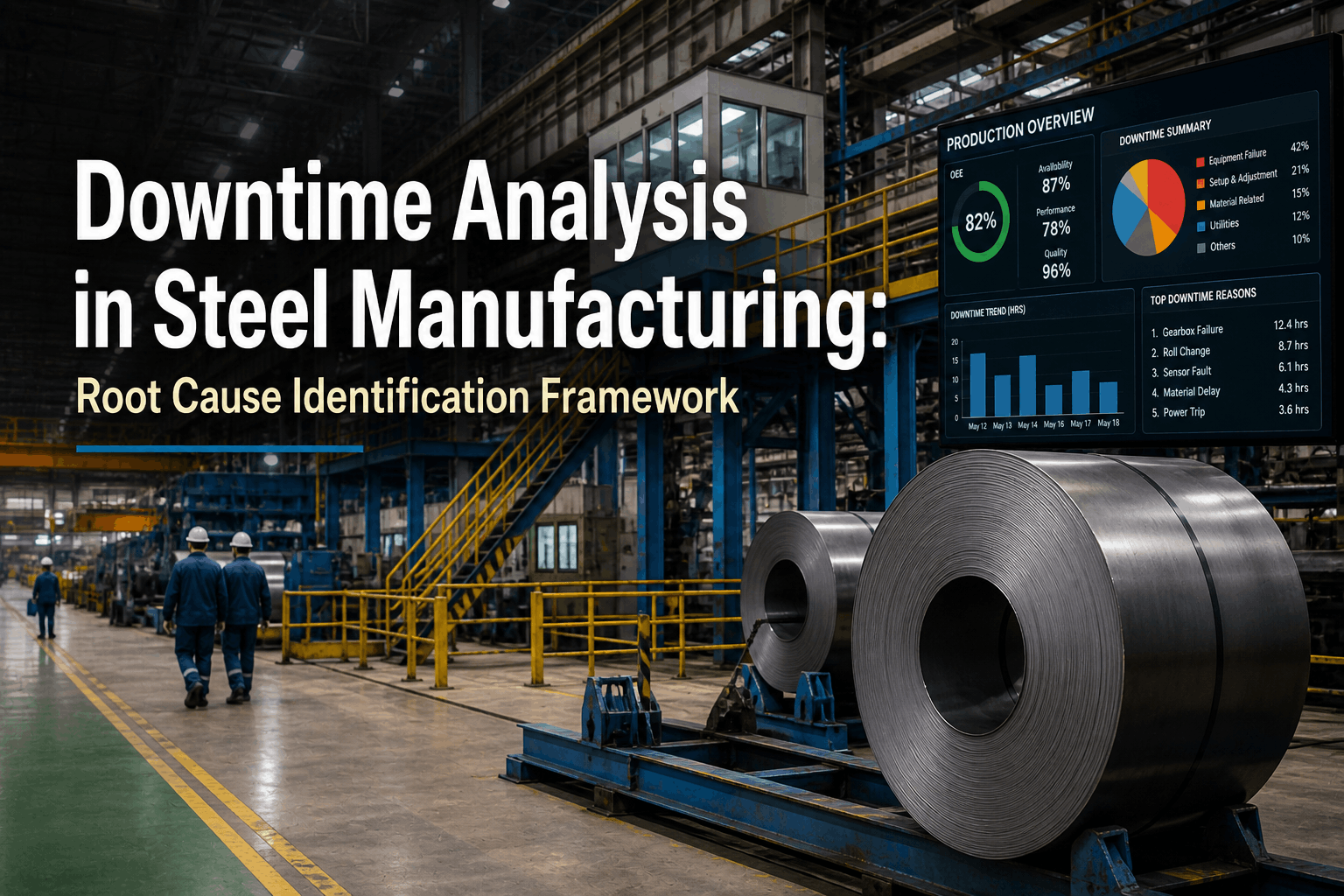
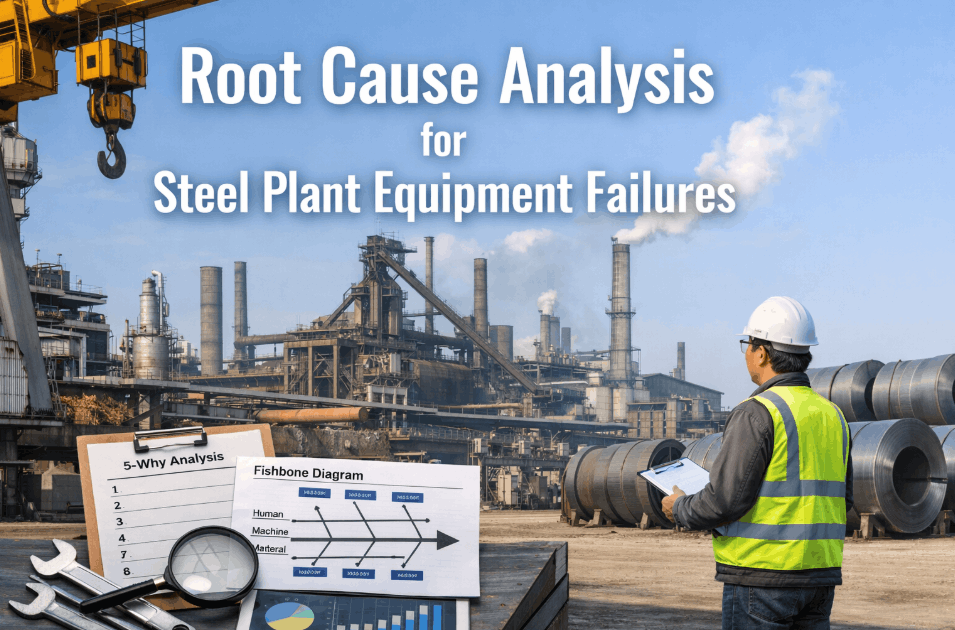
Root Cause Analysis (RCA) for steel plant equipment failures has undergone a fundamental transformation, shifting from a post-mortem "blame game" into a high-velocity reliability strategy that defines integrated mill profitability. In an environment where a single cracked electrode in an Electric Arc Furnace (EAF) or a seized bearing in a Hot Strip Mill (HSM) can trigger a chain reaction of operational delays, the ability to rapidly identify the "Physical Human and Latent" causes of failure is the difference between a resilient plant and one crippled by recurring downtime. In 2026, leading steelmakers are no longer satisfied with simple manual reports; they are demanding an operational intelligence layer that integrates 5-Why, Fishbone, and FMEA methodologies with real-time AI-driven failure history. If your facility still relies on fragmented spreadsheets to investigate mechanical breakdowns, Book a Demo to see how iFactory's RCA templates convert raw breakdown data into a permanent repository of reliability wisdom.
Turn Every Equipment Failure Into a Reliability Asset
iFactory's industrial analytics platform unifies failure history, automated RCA templates, and predictive diagnostics into a single reliability control tower — purpose-built for integrated steel mills.
Why Steel Plant RCA Has Outgrown the Manual Spreadsheet Model
For most of the last two decades, RCA in steel manufacturing was defined by its latency. Disconnected plant historians, maintenance logs that lacked technical depth, and a reliance on the "tribal knowledge" of senior technicians meant that investigations were often completed weeks after the equipment was already back in service. This reactive model served to satisfy insurance requirements but failed to influence the physical state of the mill in real time. The true root causes — often hidden in high-frequency thermal transients or subtle lubrication pressure drops — remained invisible to the manual 5-Why process.
That model is now becoming economically untenable. The catalysts are structural: the push for "Prime-Yield-at-Gauge" requires absolute equipment precision, and the rising cost of scrap and energy means that even a 2% increase in unplanned downtime can erase an entire quarter's margin. Steel manufacturers who are successfully absorbing these pressures share a single tactical advantage — their RCA process has been repositioned from a clerical task to a strategic reliability engine. By utilizing AI-driven failure history analytics, they can correlate a pump failure on Day 30 with a thermal excursion on Day 1, identifying the true causal chain before the replacement part even arrives on site.
What a Strategic Reliability Control Tower Means for Mill Turnarounds
The concept of a Reliability Control Tower describes a centralized intelligence layer that provides real-time visibility into why assets are failing across the full operational network. For a multi-site steel group, a true RCA software architecture means that a bearing failure in a rolling mill in Ohio, a motor burn-out in a caster in Germany, and a hydraulic leak in a furnace in India are all visible — simultaneously, in context, with common failure signatures flagged across the fleet. This allows for "Horizontal Learning," where a fix in one plant prevents a failure in another facility thousands of miles away.
This is categorically different from basic maintenance dashboards that merely count breakdowns. A manufacturing intelligence software control tower is predictive and investigation-linked. When a ladle crane in facility four shows an early acoustic signature consistent with a cable-drum fatigue, the system does not just log the alarm — it opens a pre-populated RCA template, pulls the last six months of inspection photos, and triggers a "Safety Stop" if the risk profile matches a previous incident. To see how this architecture operates across a real-time steel mill network, Book a Demo and walk through a live investigative workflow.
The Five Pillars of a Modern Steel RCA Framework
Building a high-performance reliability engine requires architectural decisions that go beyond simple software selection. The iFactory platform focuses on five foundational capabilities that distinguish strategic RCA from conventional reactive maintenance.
Digital RCA Templates & Mobile Evidence Capture
Ditch the paper clipboards. iFactory provides technicians with mobile-optimized 5-Why and Fishbone templates that allow for real-time photo and video evidence capture. This ensures that the "As-Found" condition of a failed asset is documented before the grease and scale are cleaned away, preserving critical forensic data.
AI-Driven Failure History Correlation
iFactory's AI engine scans years of maintenance logs to identify recurring "Ghost Failures." By correlating specific sensor deviations (like a 5Hz vibration spike) with historical work orders, the platform predicts the root cause of a current event with 90% accuracy before the investigation even starts.
Integrated FMEA & Risk Priority Numbering
Transition from static FMEA binders to a live Risk Priority Number (RPN) system. As the AI identifies new failure modes in the field, it automatically updates your EAF or Rolling Mill FMEA, ensuring that your preventive maintenance (PM) strategy is always aligned with actual field physics.
Cross-Site Benchmarking & Lessons Learned
Unify your reliability engineers. iFactory allows for the automated sharing of "Lessons Learned" across the entire corporate fleet. If an EAF electrode positioning fix is found in Plant A, it is pushed as a recommended technical bulletin to Plants B through Z, eliminating knowledge silos.
Closed-Loop Corrective Action (CAPA) Tracking
An investigation is only as good as its implementation. iFactory's digital RCA module links directly to your CMMS (SAP/Maximo) to ensure that corrective actions are not just "suggested" but "executed," with automated follow-up audits to verify the fix is permanent.
Failure Diagnostics: Where Analytics Generates Immediate Yield ROI
Production performance in a steel mill is often limited by "Micro-stoppages"—minor, recurring events that never trigger a full RCA but cumulatively destroy OEE. iFactory identifies the correlation between these micro-events and larger system failures. For integrated facilities still operating on manual reporting, the financial cost of these "death by a thousand cuts" failures is staggering.
Servo-Valve Drift and Gauge Variation RCA
Correlate HAGC cylinder response times with oil cleanliness data to identify the exact moment a servo valve begins to silt-lock. Eliminates gauge-related rejections by identifying hydraulic contamination as the root cause before the strip goes out of spec.
Electrode Breakage Pattern Recognition
Analyze the correlation between scrap density, arc-current stability, and electrode vibration. AI-driven RCA identifies if breakage is caused by specific scrap-loading patterns or regulator latency, reducing electrode consumption costs by 15%.
Strand Speed vs. Friction Anomaly Detection
Use 100Hz mold thermocouple data to perform an instant RCA on strand sticking events. Identifying the root cause — whether it is mold-powder chemistry or oscillation-table misalignment — prevents costly spills and ensures 100% caster availability.
AI-Driven Visibility vs. Traditional Investigations: A Direct Symmetrical Comparison
| Capability Dimension | Traditional Manual RCA | iFactory AI-Driven RCA | Operational Impact |
|---|---|---|---|
| Investigation Latency | Days to weeks post-event | Immediate/Real-time data pull | Intervention happens while evidence is fresh |
| Failure Prediction | No predictive capability | Days to weeks advance warning | Catastrophic failures converted to planned PMs |
| Evidence Integrity | Memory-based, paper logs | Photo/Video/IoT time-stamped logs | Audit readiness is a permanent state |
| Trend Identification | Manual spreadsheet review | Automated ML pattern recognition | Chronic failure modes are eliminated permanently |
| Executive Visibility | Monthly report summaries | Real-time reliability control tower | Capital decisions based on live asset data |
| CMMS Integration | Manual work order entry | Automated API-based CAPA loops | Zero administrative friction in closeout |
The Competitive Divide: Analytics as a Structural Advantage in Steel
The steel industry is entering a period of performance divergence. Companies investing in manufacturing intelligence software and structured RCA platforms are building a "Digital Memory" that takes years to replicate. They negotiate better insurance terms because they have documented failure mitigation histories. They respond to customer quality inquiries in minutes because their data is traceable. The gap between reliability leaders and laggards is not closing — it is accelerating. Manufacturers ready to build a formal business case for RCA investment can Book a Demo to see the ROI modeling framework.
Ready to Close the Reliability Gap with Real-Time RCA?
See how iFactory's control tower platform gives steel plant managers the failure history, asset health, and investigative intelligence to operate smarter than the competition.
Frequently Asked Questions: Steel Plant RCA Strategy
What is a Steel Plant RCA Control Tower and how does it differ from standard maintenance logs?
A Steel Plant RCA Control Tower is a unified intelligence platform that links real-time IoT sensor data directly to investigative templates. Unlike standard logs that just record 'what' happened, a control tower reveals 'why' by correlating high-frequency process transients with mechanical health scores across all facilities simultaneously.
Does iFactory support industry-standard RCA methods like 5-Why and Fishbone?
Yes. iFactory includes pre-built digital templates for 5-Why, Ishikawa (Fishbone), and FMEA. These are integrated with your plant data, meaning the AI can automatically pull relevant sensor trends and past failure modes into your investigation, saving hours of manual data mining.
Can the platform predict a failure mode before the breakdown occurs?
Absolutely. iFactory's 'Failure Mode AI' identifies the early-stage signatures of fatigue, such as specific vibration harmonics or current spikes. By identifying these patterns weeks in advance, the platform allows you to perform an 'RCA on a Trend' rather than an 'RCA on a Breakdown,' preventing the stoppage entirely.
How does the platform integrate with our existing SAP or Maximo CMMS?
We utilize native APIs to sync with your CMMS. When a work order is created in SAP, iFactory can automatically trigger an RCA investigation based on the asset criticality. Once the RCA is completed, the corrective actions (CAPA) are pushed back to the CMMS as trackable maintenance tasks.
Is the system compatible with older mill equipment that lacks digital sensors?
Yes. Our IoT gateways act as 'Digital Enablers.' We can bridge legacy PLC protocols or add non-invasive vibration and thermal sensors to older equipment, bringing your brownfield assets into the same reliability control tower as your newest lines.
Does structured RCA help reduce mill insurance premiums?
Many industrial insurers offer better terms to facilities that can prove they have a 'closed-loop' reliability system. iFactory provides the permanent, auditable record of investigation and permanent correction that insurers look for during risk assessments.
How long does it take to deploy iFactory's RCA module?
The basic digital template and evidence-capture module can be live in 1-2 weeks. Training the AI on your specific site failure history typically takes 30-60 days of data ingestion to achieve peak predictive accuracy.
Build the Reliability Control Tower Your Strategy Requires
iFactory's industrial analytics platform transforms raw breakdown data into a unified strategic control tower — giving steel plant executives the real-time visibility and predictive intelligence to lead operations with precision.