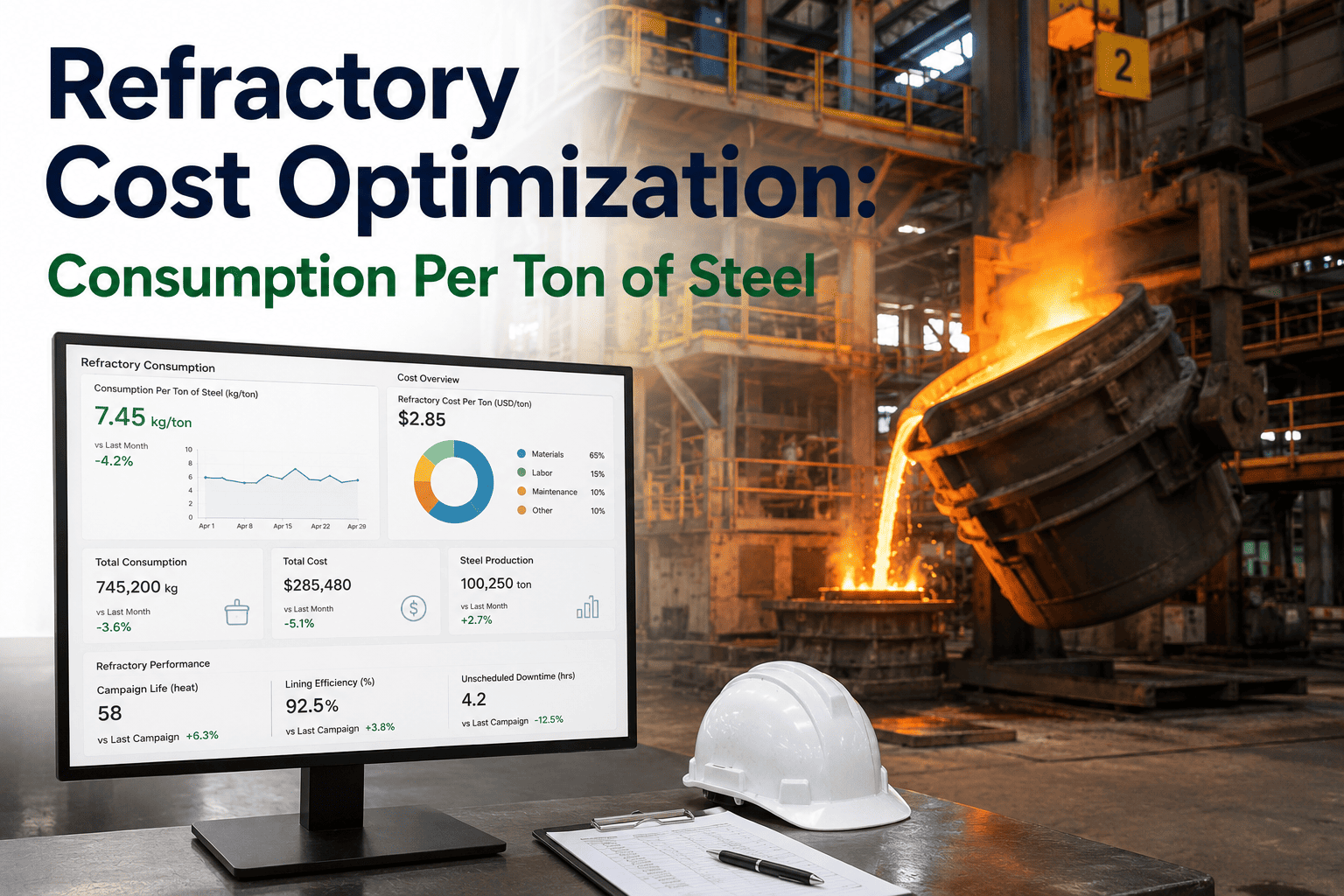
Refractory materials are the silent protection layer between liquid steel at 1,650°C and the steel shell of every furnace, converter, ladle, and tundish in your plant. When refractory management works well, it is invisible — campaigns run to their planned limits, relinings happen during scheduled stops, and refractory cost per tonne of steel is controlled and predictable. When it fails, the consequences range from emergency production shutdowns costing ₹2–15 crore to catastrophic vessel failures with life safety implications. The challenge in managing refractory across a complete steel plant is complexity at scale — a 4 MTPA integrated plant may have 80–120 distinct refractory applications across BOF converters, ladles, tundishes, blast furnace hearth and bosh, reheating furnaces, and EAF shells — each with different materials, different wear mechanisms, different suppliers, and different inspection requirements. iFactory's Refractory Management System brings all of this into one platform: heat-by-heat campaign tracking, wear-rate trending, predictive reline scheduling, supplier performance benchmarking, and full refractory cost-per-heat analytics — connected directly to SAP PM maintenance plans and purchase orders.
Refractory Management System for Steel Plants — Lining Life Tracking, Cost Optimisation & Reline Scheduling
Track refractory consumption, campaign life, and wear rates across all vessels — with AI-predicted reline scheduling, supplier benchmarking, and full cost-per-heat analytics.
Refractory Consumption — Where Your Plant Spends the Most
Understanding refractory spend by vessel type is the first step to optimisation. Most plants discover that 60–70% of total refractory cost is concentrated in just 2–3 vessel types — making targeted campaign life improvement in those vessels the highest-leverage intervention. Request a refractory cost breakdown for your plant — iFactory delivers it free within 5 days using your SAP MM data.
Heat-by-Heat Campaign Tracking — Every Vessel, Every Zone
iFactory assigns a digital campaign record to every refractory lining — tracking heat count, zone-specific wear, and inspection findings from Day 1 of the new lining to the final heat before reline. The AI wear model updates the predicted end-of-campaign date after every new measurement, giving planners a rolling 60-day reline forecast.
Technologies That Power iFactory Refractory Intelligence
AI Thermal Camera
Fixed thermal cameras on vessel shells detect hotspots indicating thin zones — feeding continuous wear data to iFactory between physical laser measurements, without stopping production.
Digital Twin Wear Model
iFactory's vessel digital twin calculates zone wear from heat chemistry, oxygen content, temperature, and tap weight — predicting remaining lining life per zone 300–500 heats ahead for BOF, 20–30 heats for ladles.
Laser Profilometer Integration
Direct data import from vessel laser profilometers — thickness readings per zone per measurement campaign imported automatically. iFactory builds the wear curve and updates the AI prediction model after each survey.
SAP PM & MM Integration
Reline work orders created in SAP PM automatically when iFactory predicts end-of-campaign within 60 days. Refractory materials reserved in SAP MM against the planned reline — eliminating emergency procurement.
Refractory Supplier Performance — Cost Per Heat by Supplier & Grade
Refractory purchasing decisions are often made on unit price alone — ignoring that a cheaper brick lasting 3,800 heats costs more per heat than a premium brick lasting 5,200 heats. iFactory calculates true cost per heat per supplier per vessel zone — making the comparison objective and data-driven. See your supplier benchmarking report — built from your SAP MM data.
| Supplier / Grade | Application | Unit Price | Avg Campaign | Cost / Heat | iFactory Rank |
|---|---|---|---|---|---|
| Supplier A — MgO-C Premium | BOF Slag Zone | ₹4,200/t | 5,200 heats | ₹0.81/heat | Best Value |
| Supplier B — MgO-C Standard | BOF Slag Zone | ₹3,100/t | 3,800 heats | ₹0.82/heat | Comparable |
| Supplier C — MgO-C Economy | BOF Slag Zone | ₹2,600/t | 2,900 heats | ₹0.90/heat | Avoid |
| Supplier A — Al₂O₃-MgO | Ladle Slag Line | ₹5,800/t | 95 heats | ₹61/heat | Best Value |
| Supplier D — MgO-Spinel | Ladle Slag Line | ₹6,400/t | 110 heats | ₹58/heat | Best Value |
What a Refractory Engineer Said
We were buying Supplier C brick for the BOF slag zone because it was cheapest on unit price. iFactory's cost-per-heat analysis showed us we were actually paying ₹0.09 more per heat than with Supplier A's premium grade. Across 24,000 heats per year on three converters, that was ₹2.16 crore in unnecessary cost. We switched grades, extended campaign life from 2,900 to 5,200 heats, and also reduced our emergency relinings from 4 to 0 in 18 months.
Gunning & Repair Management — Extending Campaign Life Safely
Strategic gunning and hot repair extends BOF and EAF campaign life by 15–25% — but only when applied to the right zone at the right heat count. Premature gunning wastes material; delayed gunning risks accelerated wear beyond recovery. iFactory tracks every gunning event — quantity, zone, heat number, and material — and correlates gunning interventions with subsequent wear rate to optimise the gunning strategy over successive campaigns.
Gunning Event Logging
Every gunning application logged with zone, quantity (kg), material grade, and heat number. iFactory builds the cumulative gunning volume curve per campaign — identifying whether gunning is being used proactively or reactively.
Wear Rate After Gunning
iFactory measures wear rate per 100 heats before and after each gunning intervention — comparing across campaigns to identify the optimal gunning trigger point and the material grade that delivers the best wear rate recovery.
Gunning Schedule Optimisation
iFactory recommends gunning at the optimal heat count based on historical campaign data — preventing the common pattern of gunning too frequently (wasting material) or too late (failing to recover wear rate before campaign end).
Gunning Cost per Campaign
Total gunning cost tracked per campaign — material cost, application labour, and campaign life extension achieved. iFactory calculates whether the gunning investment extended campaign life sufficiently to justify the cost versus a shorter campaign with reline.
Frequently Asked Questions
How does iFactory track refractory wear between physical laser measurements?
iFactory's digital twin interpolates wear continuously using heat chemistry, temperature, and PLC data — calibrated against physical measurements. The model runs daily, giving planners an up-to-date thickness estimate without waiting for the next survey.
Can iFactory track multiple vessel types — BOF, ladle, EAF, and tundish — in one platform?
Yes — iFactory maintains separate campaign records, wear models, and material histories per vessel ID across all types. Each vessel has its own dashboard with heat count, zone wear status, predicted reline date, and full material consumption history.
How does iFactory help reduce emergency relinings?
iFactory provides 60-day advance warning of predicted campaign end — enough time to order materials, qualify contractors, and schedule the reline within a planned production stop. Emergency relinings typically result from less than 7 days notice; iFactory eliminates this by predicting end-of-campaign from wear rate data.
Does iFactory calculate refractory cost per heat automatically?
Yes — iFactory pulls material cost from SAP MM purchase orders, tracks quantity consumed per campaign from SAP MM material movements, and divides by actual heat count to calculate cost per heat per vessel, per zone, and per supplier — updated automatically after each campaign closes.
Start Your Refractory Management Programme
Cost-per-heat analysis delivered in 5 days using your SAP MM data — free.