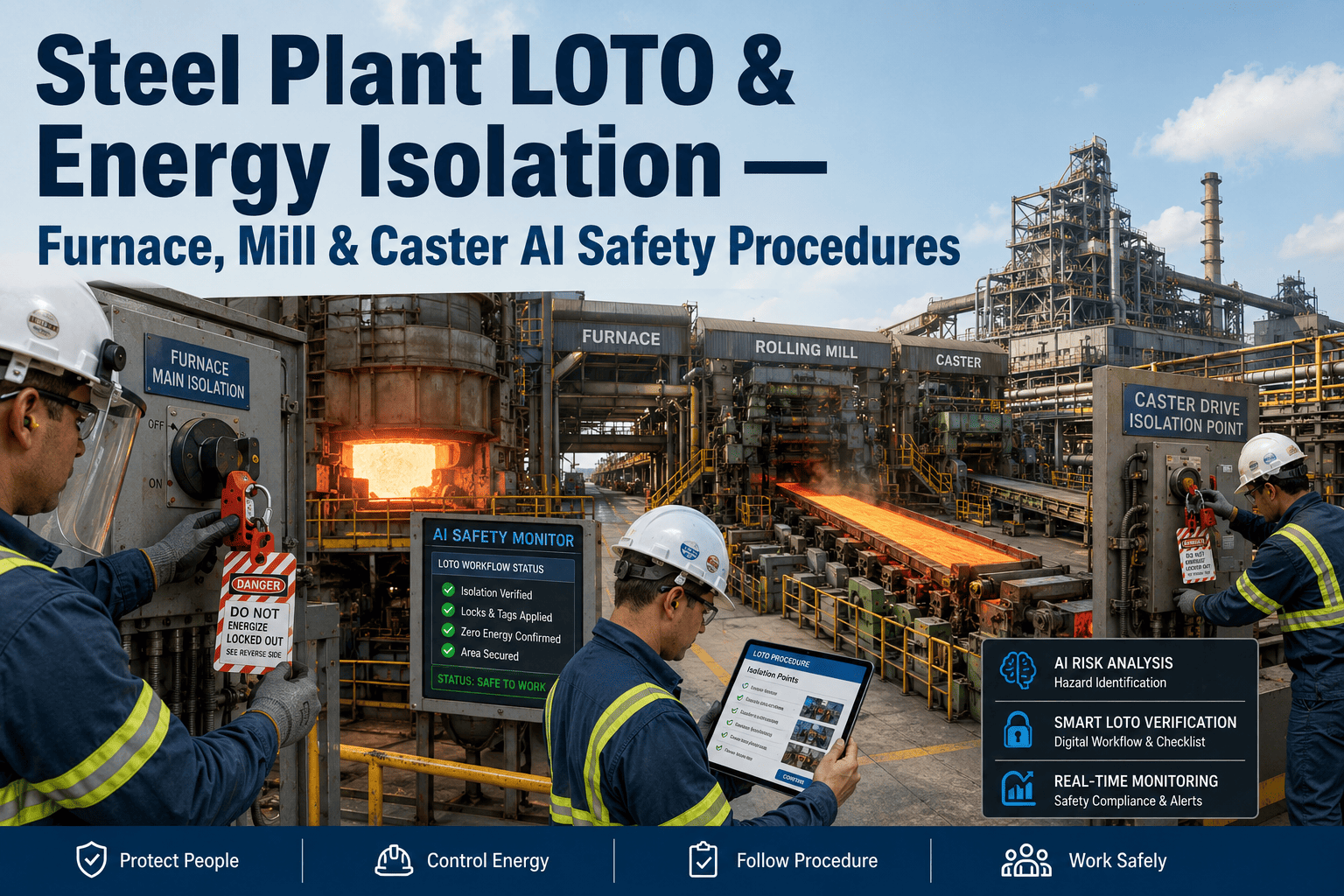
Steel plants are among the most hazardous industrial environments, where high-energy systems like blast furnaces, basic oxygen furnaces (BOFs), continuous casters, and rolling mills operate at extreme temperatures and pressures. Lockout-tagout (LOTO) procedures are critical to ensuring worker safety during maintenance, but traditional paper-based methods are slow, error-prone, and often fail to account for the unique isolation challenges of each system. This article explores how AI-powered safety workflows can transform LOTO compliance across steel plant operations, reducing downtime, preventing arc flash incidents, and eliminating the risk of engulfment or explosion. By integrating intelligent isolation verification, real-time energy monitoring, and automated procedure updates, steel manufacturers can achieve a new level of safety and operational efficiency. Discover how iFactory's AI safety platform can help your steel plant achieve zero LOTO violations.
Transform Your Steel Plant Safety Today
Book a demo to see AI-powered LOTO in action.
The High-Stakes Challenge of Steel Plant Energy Isolation
Steel production involves massive energy flows: molten iron at 1500°C, hydraulic pressures exceeding 300 bar, and electrical currents that can arc across meters of air. A single mistake in isolation can lead to catastrophic injuries, equipment damage, or fatalities. Traditional LOTO programs rely on manual lockout procedures, paper tags, and human verification, which are vulnerable to miscommunication, skipped steps, and incomplete isolation. In steel plants, the complexity is compounded by interconnected systems: a blast furnace requires isolating not just the furnace itself but also the stove system, gas cleaning plant, and slag handling equipment. Continuous casters involve multiple hydraulic, cooling, and electrical subsystems that must be locked out simultaneously. Rolling mills have massive motor drives, lubrication systems, and coil handling robots that pose unique entanglement risks. AI safety workflows address these challenges by digitizing the entire LOTO process, from procedure creation to isolation verification, and by using sensors and machine learning to confirm that every energy source is truly isolated before maintenance begins.
Unique Isolation Challenges in Steel Plant Systems
Blast Furnace Isolation
Blast furnaces operate continuously for years, producing molten iron. Isolation during maintenance requires shutting down the hot blast stoves, closing the tuyeres, purging the furnace gas, and locking out the skip hoist system. The furnace top is at high pressure, and residual gas can be explosive. AI workflows can monitor gas levels in real-time, verify that all valves are sealed, and ensure that the furnace is completely isolated before any entry. The system can also track the cooling water system, which must remain active even during shutdown to prevent refractory damage.
BOF Vessel Isolation
Basic oxygen furnaces use pure oxygen to convert iron to steel. The vessel tilts, and the oxygen lance must be retracted and locked. The slagging system, hood cooling water, and gas recovery system all require isolation. A missed lockout on the oxygen supply can result in a violent reaction. AI safety workflows can integrate with vessel tilt sensors, oxygen flow meters, and hood position switches to confirm isolation. The system can also generate a digital isolation certificate that is automatically shared with all maintenance teams.
Continuous Caster Isolation
Continuous casters solidify molten steel into slabs. They involve a tundish, mold, spray cooling, pinch rolls, and a torch cutter. Hydraulic systems control the mold oscillation and pinch roll pressure. Electrical drives power the withdrawal rolls. Isolation must cover all these subsystems, and the residual heat in the strand can cause burns. AI workflows can use thermal cameras and vibration sensors to verify that the strand has stopped and cooled before maintenance. The system can also lock out the tundish preheater and the ladle turret rotation.
Rolling Mill Isolation
Rolling mills reduce slab thickness through multiple stands. Each stand has massive electric motors, hydraulic screwdowns, roll cooling systems, and coil handling equipment. The mill can have stored mechanical energy in the form of tensioned coils. Isolation requires locking out the main drive, the screwdown hydraulics, the coil car, and the scale breaker. AI safety workflows can monitor motor current, hydraulic pressure, and coil tension to confirm zero energy state. The system can also generate a lockout sequence that must be followed in order to prevent unexpected movements.
Step-by-Step: AI-Enhanced LOTO Procedure for a Blast Furnace Stove Repair
Identify All Energy Sources
The AI system scans the stove area using a digital twin and lists all energy sources: gas supply, combustion air fan, cooling water, hydraulic stove door mechanism, and electrical controls. It cross-references with maintenance work orders to ensure nothing is missed.
Shut Down and Isolate
Operators follow the AI-guided sequence to shut down the gas valve, stop the fan, close the cooling water isolation valve, and lock out the electrical panel. Each step is verified by sensors: gas flow meter reads zero, fan current drops to zero, water pressure is zero, and electrical disconnect is confirmed.
Verify Zero Energy State
The AI system runs a zero-energy verification protocol. It checks that the gas line is purged with nitrogen (monitored by gas analyzer), that the stove temperature has dropped below 50°C (using thermocouples), and that the hydraulic door mechanism is depressurized (pressure transducer). Only when all conditions are met does the system generate a clearance.
Apply Locks and Tags
Each operator applies their personal lock to the designated lockout points. The AI system tracks which locks are applied and by whom. It also generates a digital tag with a QR code that, when scanned, shows the current isolation status and the list of authorized workers.
Maintenance and Restoration
During maintenance, the AI system monitors the stove area for any changes, such as a pressure spike in the gas line or an unexpected temperature rise. When maintenance is complete, the system guides the restoration sequence in reverse order, ensuring that all locks are removed and all energy sources are restored safely.
Key AI Safety Workflow Features for Steel Plant LOTO
Sensor-Driven Isolation Verification
Integrate with existing plant sensors (pressure, temperature, flow, position, current) to automatically confirm that each energy source is isolated. The AI system can detect a partially closed valve or a residual pressure that a human might miss.
Digital Twin Integration
Use a 3D digital twin of the steel plant to visualize the exact location of each lockout point. Operators can see which systems are isolated and which are still live, reducing the risk of human error.
Automated Procedure Generation
The AI system can generate LOTO procedures automatically based on the equipment type, maintenance task, and energy sources involved. This ensures consistency and compliance with OSHA and company standards.
Real-Time Compliance Monitoring
Track the status of every LOTO procedure in real time. Managers can see how many procedures are active, how long they have been running, and whether any steps are overdue. This helps identify bottlenecks and improve safety culture.
Incident Prediction and Prevention
Machine learning models analyze historical LOTO data to predict where incidents are most likely to occur. The system can proactively suggest additional isolation steps or alert supervisors to high-risk conditions.
Ready to Eliminate LOTO Violations?
See how AI safety workflows can reduce downtime and improve compliance.
Frequently Asked Questions About Steel Plant LOTO
How does AI improve LOTO compliance in steel plants compared to manual methods?
AI improves LOTO compliance by eliminating human error in procedure execution and verification. Manual methods rely on paper checklists that can be lost, skipped, or incorrectly filled. AI systems use sensors to confirm each isolation step, generate digital records that are tamper-proof, and provide real-time dashboards for managers. In a steel plant, where multiple energy sources must be isolated simultaneously, AI can ensure that no step is missed. For example, during a blast furnace stove repair, the AI system can verify that the gas valve is closed, the fan is stopped, and the cooling water is isolated before allowing any worker to enter. This level of verification is impossible with manual methods. Additionally, AI can learn from past incidents and near-misses to improve procedures over time, creating a continuous improvement loop that paper systems cannot provide. To learn more about how iFactory can implement AI LOTO in your steel plant, visit our support page.
What are the specific energy isolation risks in continuous casters that AI can address?
Continuous casters have multiple energy sources that must be isolated simultaneously: the tundish preheater (gas), the mold cooling system (water at high pressure), the pinch roll hydraulics (hydraulic oil at 200 bar), and the torch cutter (electric and gas). The strand itself can still be hot (over 800°C) for hours after casting stops. AI can address these risks by monitoring each energy source in real time. For instance, the AI system can use thermal cameras to verify that the strand has cooled below a safe temperature before maintenance begins. It can also monitor hydraulic pressure and lock out the pump if a drop is detected, preventing unexpected movement of the pinch rolls. The system can generate a lockout sequence that must be followed in order, and it can alert operators if the sequence is broken. This reduces the risk of arc flash, hydraulic fluid injection, and burns. To see a demo of how iFactory's AI handles caster isolation, book a demo today.
How can AI LOTO systems integrate with existing steel plant control systems like DCS or PLC?
AI LOTO systems can integrate with distributed control systems (DCS) and programmable logic controllers (PLCs) using standard industrial protocols like OPC UA, Modbus TCP, or Profinet. The AI system reads data from the DCS/PLC to determine the status of each energy source: valve position, motor current, pressure, temperature, etc. It can also send commands to the DCS/PLC to initiate shutdown sequences or lock out specific drives. For example, when a maintenance request is submitted for a rolling mill stand, the AI system can automatically send a command to the PLC to disable the main drive and apply a brake. The PLC then sends back confirmation that the drive is stopped and the brake is applied. This integration ensures that the LOTO procedure is executed consistently and that the isolation state is verified by the control system itself. The AI system can also generate a digital isolation certificate that is logged in the DCS historian for compliance. For more details on integration, contact our support team.
What is the typical ROI for implementing AI LOTO in a steel plant?
The ROI for AI LOTO in a steel plant is typically driven by reduced downtime, fewer incidents, and lower compliance costs. Steel plants that have implemented digital LOTO report a 30-50% reduction in maintenance downtime because procedures are executed faster and with fewer errors. For example, a blast furnace stove repair that used to take 8 hours for isolation and restoration can be reduced to 4 hours with AI-guided procedures. This translates to millions of dollars in additional production capacity per year. Incident reduction also has a significant financial impact: a single LOTO violation can result in OSHA fines of up to $13,000 per violation, not to mention the cost of equipment damage and worker compensation claims. AI LOTO systems also reduce the labor cost of maintaining paper records and auditing compliance. Most steel plants see a full ROI within 12-18 months. To calculate the potential ROI for your plant, book a demo with our team.
How does AI handle LOTO for mobile equipment like ladle cars or slag pot carriers?
Mobile equipment in steel plants, such as ladle cars, slag pot carriers, and scrap charging machines, present unique LOTO challenges because they move around the plant. AI systems can use geofencing and wireless lockout devices to manage these assets. When a ladle car enters a maintenance bay, the AI system detects its location and automatically initiates a LOTO procedure. The car's diesel engine or electric motor is shut down, the brakes are applied, and the hydraulic systems are depressurized. Wireless sensors on the car confirm the isolation state and transmit the data to the AI system. Operators can then apply their personal locks to a lockout box that controls the car's energy sources. The AI system tracks the car's location and prevents it from being moved until all locks are removed. This ensures that mobile equipment is isolated just as thoroughly as fixed equipment. For more information on mobile equipment LOTO, visit our support page.
Take the Next Step Toward Safer Steel Production
Implement AI-powered LOTO and energy isolation in your plant today.
-procedures-for-steel-plant-equipment-digital-management-system.png)
-procedures-for-steel-plant-equipment-complete-implementation-guide.png)