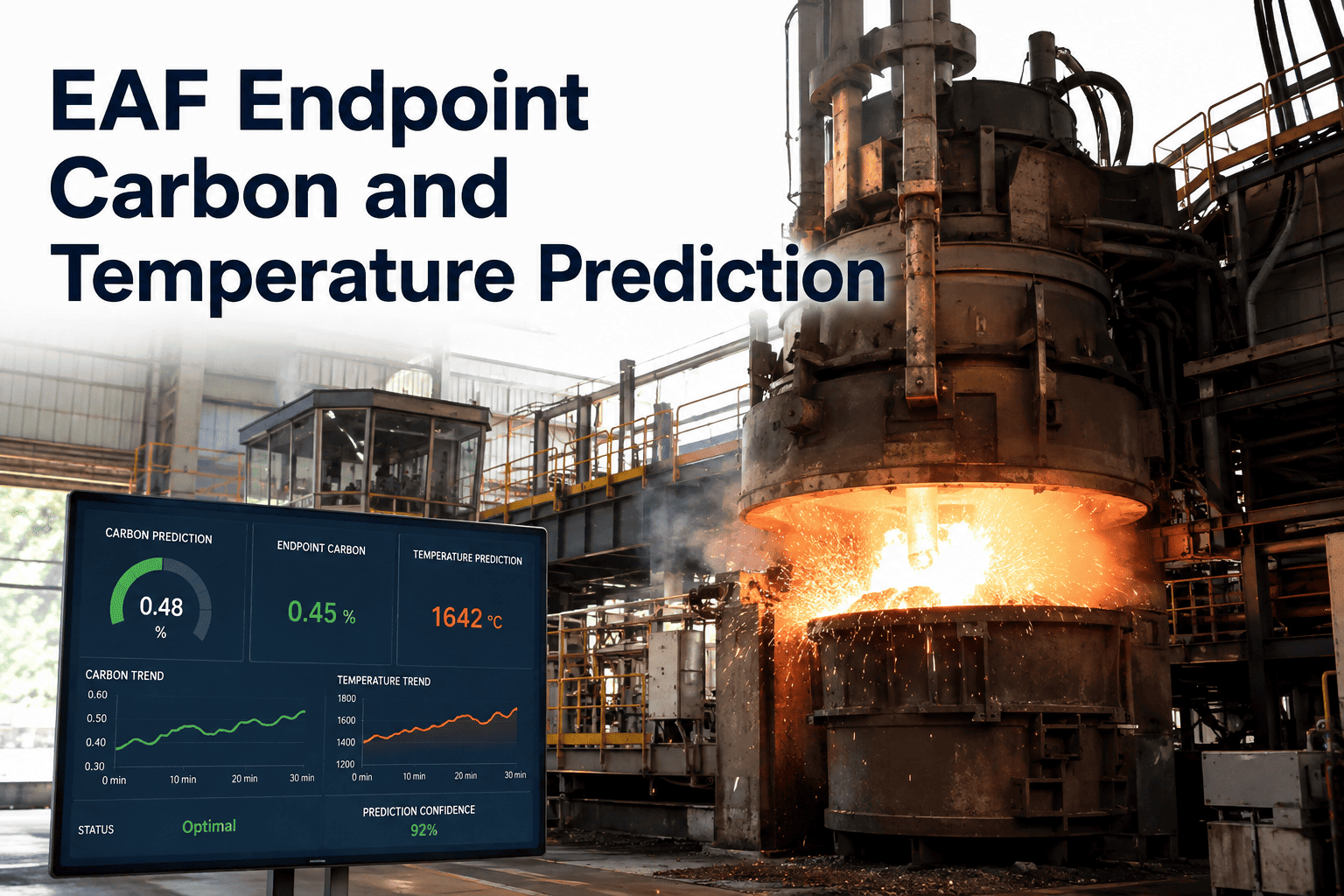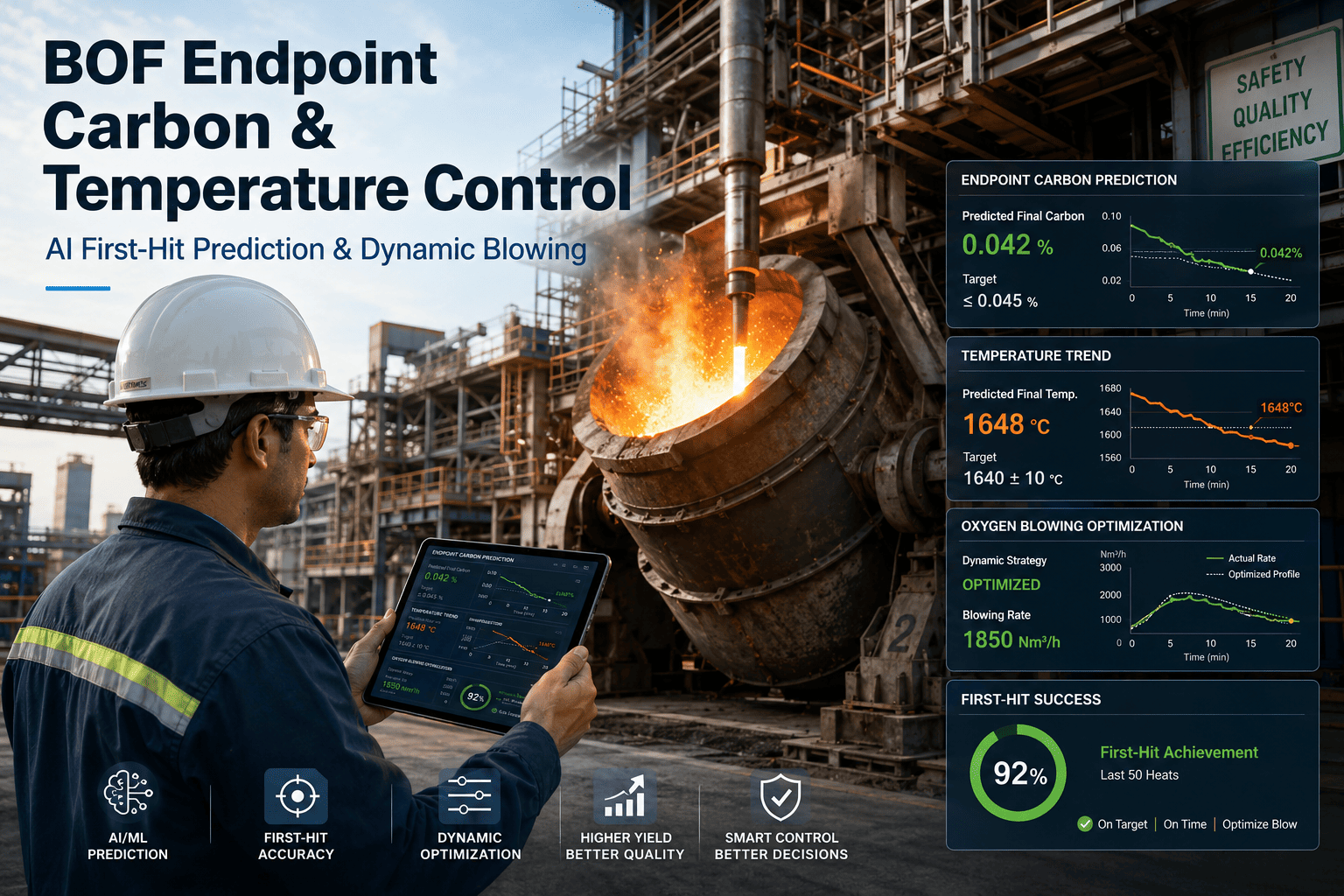
Hitting carbon and temperature targets on the first try at BOF endpoint is one of the hardest control problems in steelmaking, because the blow reaction is not directly observable until the vessel is turned down and sampled — by which point any correction requires a costly reblow. Process engineers who combine sublance measurements, heat balance modeling, and offgas analysis into a single AI prediction are pushing first-hit rates well past what static charge models alone can achieve. The modeling approach behind that improvement is detailed at ifactoryapp.com/support.
Why Endpoint Control Is Still Mostly Guesswork
A static charge model calculates an initial oxygen and flux target based on hot metal chemistry and scrap ratio, but it cannot see what actually happens during the blow — decarburization rate, slag foaming behavior, and heat losses all vary heat to heat in ways a pre-blow calculation cannot capture. Most plants compensate with a mid-blow sublance check, but a single measurement only tells the process engineer where the heat is at that moment, not how it will finish. The result is a first-hit rate that depends heavily on operator experience and, even then, plateaus well below what the data actually supports.
Three Data Streams, One Endpoint Prediction
AI endpoint prediction earns its accuracy by fusing three data sources that are each individually useful but far more powerful combined. Explore what each contributes below.
What it measures: Mid-blow temperature and carbon content taken directly from the bath via a single sublance dip, giving one hard data point partway through the blow.
What the model adds: Rather than treating this as a static checkpoint, the model uses it to recalibrate its decarburization curve in real time, correcting for how this specific heat is deviating from the pre-blow prediction.
What it measures: Thermal and mass balance across hot metal, scrap, flux additions, and oxygen blown, tracking where energy is being generated and lost throughout the blow.
What the model adds: Continuous heat balance tracking flags when actual thermal behavior diverges from the charge model's assumptions, often the earliest signal that a reblow risk is developing.
What it measures: CO and CO2 concentration and flow rate in the offgas, which reflects the decarburization rate continuously throughout the entire blow, not just at one sampling point.
What the model adds: Offgas data fills the biggest gap in traditional endpoint control — continuous visibility into carbon removal rate between sublance dips, catching decarburization slowdowns immediately.
Endpoint Accuracy, Before and After
| Metric | Static Charge Model Only | AI Endpoint Prediction |
|---|---|---|
| First-Hit Rate (Carbon + Temp) | 55-70% | 88-93% |
| Average Reblow Frequency | 1 in 4-5 heats | 1 in 12-15 heats |
| Carbon Prediction Error | ±0.03-0.05% | ±0.008-0.015% |
| Temperature Prediction Error | ±15-20°C | ±5-8°C |
What Improved First-Hit Rate Actually Saves
Every reblow adds oxygen consumption, extends vessel occupancy time, and increases refractory wear from extended blowing — costs that compound across a full production schedule. Book a Demo to model the throughput gain against your own current reblow frequency.
Deployment Without Disrupting the Blow Cycle
The prediction model runs alongside the existing basic automation system, reading sublance, heat balance, and offgas data as it is already generated rather than requiring new sampling procedures or additional vessel dips. Recommendations for oxygen cutoff and final flux additions are presented to the operator as an advisory during a validation period, with the option to move to closed-loop automation once accuracy is confirmed against live production.
Frequently Asked Questions
No, the model is designed to work with your existing sublance dip frequency and does not require additional dips to achieve improved accuracy. The gain in accuracy comes primarily from combining that single mid-blow measurement with continuous offgas analysis and heat balance tracking, which fills in the gaps between dips rather than requiring more of them. Some plants choose to add a second sublance dip once they see the accuracy improvement, purely to further tighten prediction confidence, but it is not a requirement to get started. The system is built to add value on top of your current operating procedure first.
Hot metal chemistry — silicon, manganese, phosphorus, and sulfur content — is one of the primary inputs to the pre-blow prediction, and the model is trained specifically to account for how these variations change the decarburization curve and thermal balance for each heat. Heats with unusual hot metal chemistry outside the model's trained range are flagged with lower confidence scores rather than presented as high-confidence predictions, giving the process engineer a clear signal when extra caution is warranted. Over time, as more heats with varied chemistry are processed, the model's trained range expands and confidence improves across a wider variety of hot metal conditions. This adaptive range expansion happens automatically through the continuous learning loop.
Yes, integration is designed to layer on top of standard BOF basic automation systems including Primetals, SMS group, and Danieli platforms through standard OPC-UA or vendor-specific interfaces without replacing the existing automation logic. During the initial deployment, the model operates in advisory mode, presenting its prediction alongside the existing automation system's recommendation so operators can compare both before deciding. Once accuracy is validated, the level of automation can be increased incrementally based on your team's comfort and internal approval process. No changes to the underlying basic automation vendor platform are required.
Confidence typically drops when input data quality is degraded — for example, an offgas analyzer reading outside its calibrated range, a sublance measurement that appears inconsistent with the heat balance trend, or hot metal chemistry that falls outside the model's well-trained range. Every low-confidence flag is shown with the specific reason so the process engineer understands whether the issue is a sensor problem or a genuinely unusual heat condition. This transparency is intentional — a model that silently produces a low-quality prediction with no warning is far more dangerous than one that flags its own uncertainty. Sensor-related confidence drops usually point to a maintenance item worth investigating on the affected instrument.
A minimum of 30-60 days of heat records including sublance readings, offgas data where available, and final tap chemistry and temperature results is sufficient to build an initial model, though more historical data generally produces a stronger starting baseline. If offgas analysis has not historically been logged, the model can still be deployed using sublance and heat balance data alone at a somewhat lower initial accuracy, with offgas integration added once analyzers are connected. ifactoryapp.com/support can review what data your plant currently has available and confirm the fastest path to an accurate starting model.