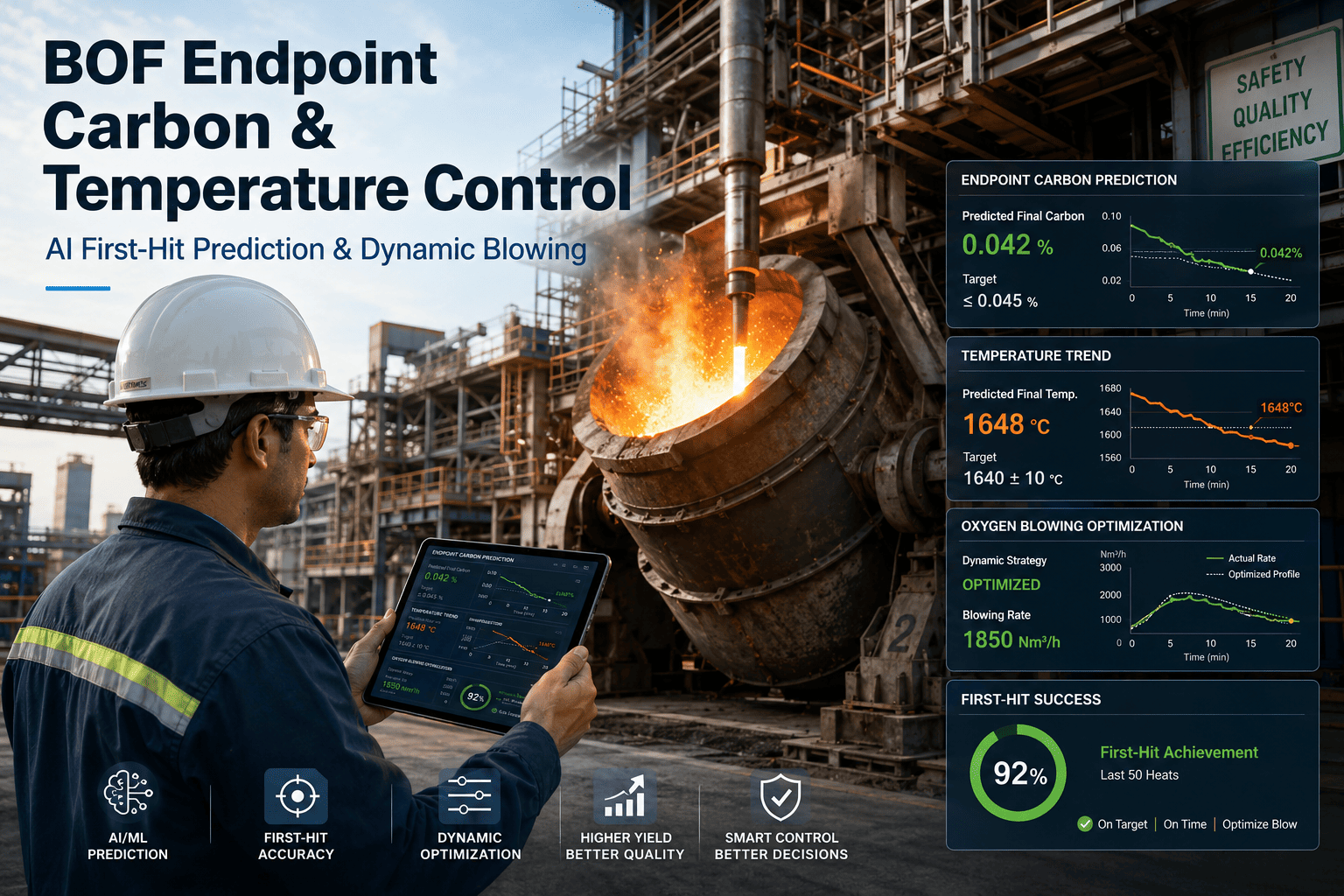
An EAF heat runs its whole cycle toward one moment: the endpoint. The furnace superintendent has to decide, from limited real-time information, whether the bath has hit target carbon and temperature before tap. Guess wrong and the heat either goes long, burning extra electrode and power for a correction, or taps early into a chemistry the caster or rolling mill will fight for the rest of the process. Most shops still lean on a mix of static energy models, operator experience, and periodic lance samples to make that call, which leaves a wide accuracy band on heats that run through unusual scrap mixes or oxygen profiles. Our EAF process specialists can walk through what a data-driven endpoint model would do differently on your last month of heat logs.
Steel Making — EAF Endpoint Control
Know the Endpoint Before the Lance Confirms It
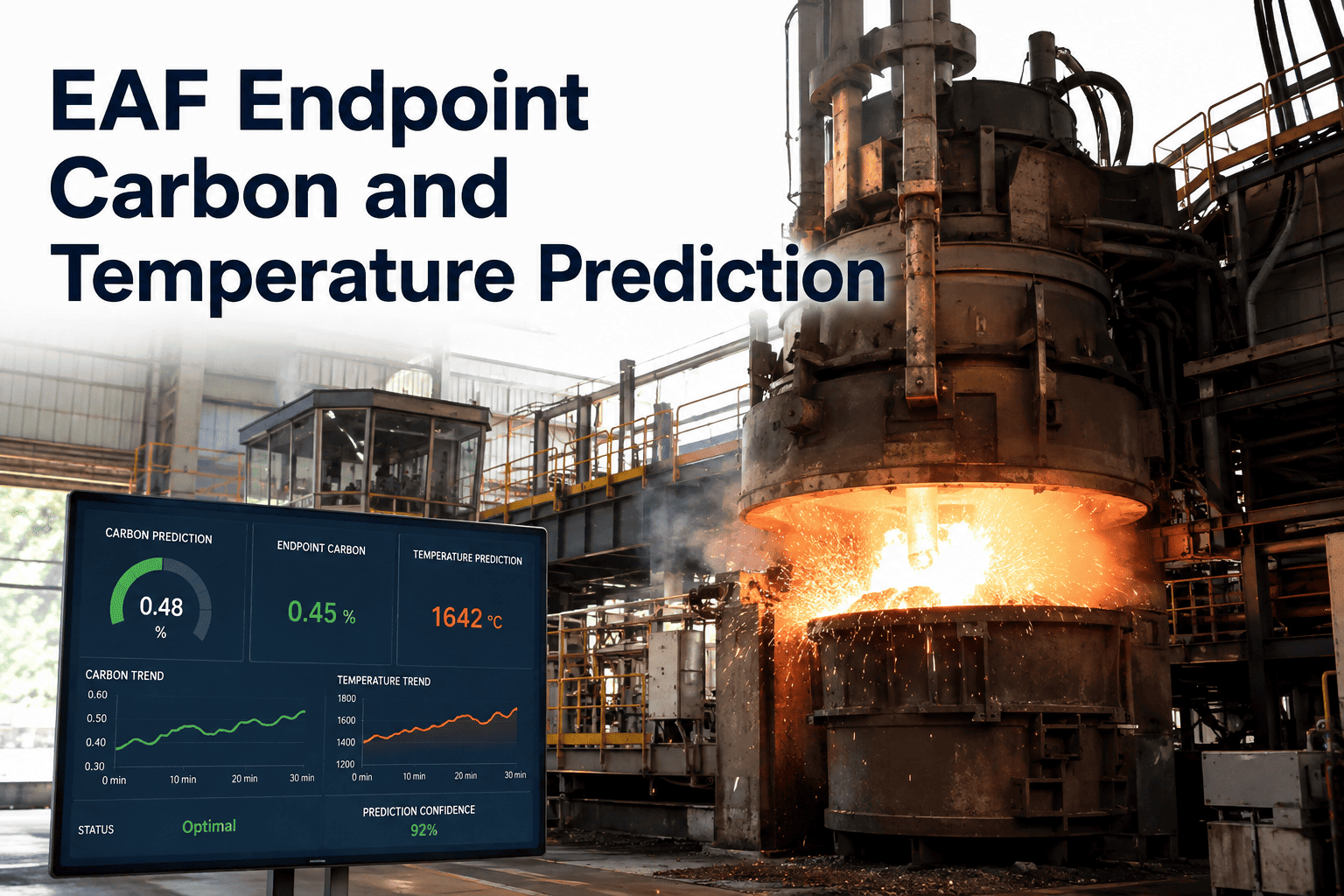
Energy input, off-gas composition, and bath chemistry already carry the signal for endpoint carbon and temperature minutes before tap. An AI model reads that signal continuously instead of waiting on a single lance sample.
Live Readout Example
Predicted Carbon0.041%
Predicted Temp1642°C
Confidence Band±0.006% / ±9°C
Minutes to Tap6.5
Model confidence rising as off-gas trend stabilizes
Why Endpoint Hit Rate Is So Hard to Nail Consistently
Endpoint carbon and temperature are the product of everything that happened earlier in the heat: scrap mix and density, charge bucket sequencing, oxygen lance practice, foamy slag behavior, and electrical input all interact in ways that shift heat to heat even on the same grade. A static energy balance model built once and left alone drifts out of accuracy as scrap yards change composition or as electrode wear alters arc behavior, which is why so many shops still fall back on operator judgment calls for the last few minutes before tap.
The cost of a missed endpoint call shows up in two directions. Undershooting temperature or overshooting carbon means a reblow or a hold period that burns extra power and electrode at the most expensive part of the heat cycle. Tapping early into an off-target chemistry pushes the problem downstream to the ladle furnace or caster, where it is more expensive and time-consuming to correct.
40-60%
of heats tap outside the tightest endpoint carbon window on non-modeled EAFs
3-5 min
typical reblow time added per missed endpoint
85%+
endpoint hit rate achievable with continuous model prediction
2-4
data streams typically underused by static energy models
The Signal Is Already There, Before the Lance Sample
Off-gas CO and CO2 ratios, real-time power draw, electrode position trends, and cumulative oxygen injection all shift in ways that correlate closely with where the bath actually sits on carbon and temperature. A model trained on historical heat data learns those correlations directly instead of relying on a fixed thermodynamic assumption that has to be manually re-tuned every time scrap quality or practice changes.
Off-Gas Composition
CO/CO2 ratio trends track decarburization rate in near real time, ahead of any physical sample.
Cumulative Energy Input
kWh delivered against scrap mass and mix gives a running estimate of bath temperature trajectory.
Oxygen Lance Profile
Injection rate and duration correlate directly with decarburization progress and slag foaming state.
Electrode Behavior
Arc voltage and electrode position stability flag when bath conditions are shifting unexpectedly.
Curious what your own off-gas and power logs already show about endpoint predictability?
Book a walkthrough and we'll run a sample heat through the model together.
From Raw Signal to a Tap-Ready Call
The model doesn't replace the superintendent's decision, it narrows the uncertainty they're deciding against. Instead of a single lance sample taken a few minutes before the planned tap, the furnace crew sees a continuously updating prediction with a confidence band that tightens as the heat approaches its natural endpoint.
01
Ingest off-gas, power, oxygen, and electrode data continuously through the heat
02
Compare live trend against the trained model's endpoint trajectory for this scrap mix
03
Surface predicted carbon and temperature with a live confidence band to the pulpit
04
Flag when the bath is trending toward a reblow before the lance sample confirms it
What Changes on the Furnace Floor
Superintendents stop treating the lance sample as the only source of truth and start using it as a checkpoint against a prediction they've already been watching trend toward for several minutes. That shift changes the rhythm of the last part of the heat: oxygen and energy trim decisions get made earlier and with more confidence, because the crew isn't waiting on a single data point to tell them what's already been visible in the trend.
| Decision Point | Traditional Approach | Model-Assisted Approach |
| Confirming approach to endpoint |
Wait for scheduled lance sample |
Continuous trend visible from mid-heat onward |
| Deciding on energy trim |
React after sample comes back off-target |
Trim proactively as prediction trend shifts |
| Reblow decision timing |
Made after tap prep has already started |
Flagged minutes earlier, before prep begins |
| Handling scrap mix changes |
Manual re-calibration of energy model |
Model adapts using recent heat history |
Why This Compounds Across a Melt Shop
A single heat's worth of avoided reblow time looks like a modest saving in isolation, but a melt shop running dozens of heats a day multiplies that saving directly into furnace availability. Every minute of reblow time is a minute the furnace isn't charging its next heat, which on a shop already running near capacity translates into real throughput headroom rather than just an energy line-item improvement.
Fewer Reblows
Direct reduction in extra power and electrode consumption per heat.
Higher Throughput
Reclaimed furnace-on time compounds across every heat in a shift.
Tighter Handoff
Ladle furnace and caster receive more consistent starting chemistry.
Frequently Asked Questions
Does this replace the lance sample entirely?
No, the lance sample remains part of the process as a verification checkpoint rather than being removed outright, since it's still a direct physical measurement and a useful reference for keeping the model calibrated over time. What changes is how much the crew is relying on that single sample as their only source of information, because by the time it comes back they've already been watching a live prediction trend for several minutes. Over time, as the model's accuracy on your specific furnace and scrap mix is validated against repeated lance samples, some shops choose to reduce sampling frequency, but that's a decision made gradually and by the metallurgical team.
Reach out to our team to discuss how this would fit your current sampling protocol.
How much historical heat data is needed to train an accurate model?
Model accuracy improves with more historical heats, but a useful starting model can typically be built from several months of heat logs that include off-gas, power, oxygen, and lance sample records, provided that data was captured consistently. Furnaces running a wide variety of scrap mixes or grades generally need a broader historical sample to cover that variation adequately, while shops running a narrower product mix can reach useful accuracy faster. The model also continues learning as new heats are logged, so accuracy on your specific furnace tends to improve steadily after initial deployment rather than being fixed at a single point.
Book a demo to review what data your current historian already captures.
What happens when scrap quality shifts significantly heat to heat?
Significant scrap mix variation is exactly the scenario where a data-driven model tends to outperform a static energy balance, because the model has learned from a range of historical heats rather than assuming a single fixed scrap composition. When a heat's early off-gas and energy trend diverges from what a typical mix would produce, the model's confidence band widens accordingly rather than delivering a falsely precise prediction, which gives the crew an honest signal about how much to trust the read at that point in the heat. This behavior is part of why continuous trending matters more than a single-point prediction.
Talk to our team about how this handles your specific scrap yard variability.
Can this integrate with our existing Level 2 automation system?
Endpoint prediction models are generally designed to sit alongside existing Level 2 systems, reading the same off-gas, power, and oxygen data streams the automation system already has access to rather than requiring a separate sensor installation. The prediction output is typically surfaced to the pulpit as an additional display rather than replacing existing furnace control logic, which keeps the rollout low-risk since operators retain full authority over tap timing and energy decisions throughout. Integration specifics depend on the automation vendor and data historian in use at your shop.
Book a walkthrough to see how this would connect to your current Level 2 setup.
Does this work the same way for different steel grades on the same furnace?
Grade-specific endpoint targets are handled by training the model against the historical heat data for each grade family, since carbon and temperature targets, along with the typical scrap mix used to hit them, differ meaningfully between grades. Shops running a wide grade mix on one furnace generally see the model differentiate its predictions by grade automatically once enough historical heats exist for each one, though newly introduced grades take longer to reach the same prediction confidence as established ones. This is a normal part of onboarding a new grade into the model rather than a limitation specific to any one furnace.
Reach out to discuss your current grade mix and rollout sequencing.
Stop Reacting to a Single Sample
See Your Endpoint Trend Before the Lance Confirms It
Share a month of heat logs and we'll show you what a continuous endpoint model would have predicted, heat by heat, against your actual lance samples.