Wire rod finishing runs faster than almost any other process in a steel plant, with rod exiting the Morgan block at speeds that leave almost no margin for a slow reaction. A bearing starting to fail in a finishing block or a laying head running a fraction out of alignment doesn't announce itself with a loud noise — it shows up as a cobble, a coil of scrap, and a line down for hours. Reliability engineers who wait for vibration to become audible are already too late. AI predictive maintenance catches the drift days earlier, giving your team a real window to act before the next high-speed incident.
The Finishing End Fails Fast. Your Warning Shouldn't.
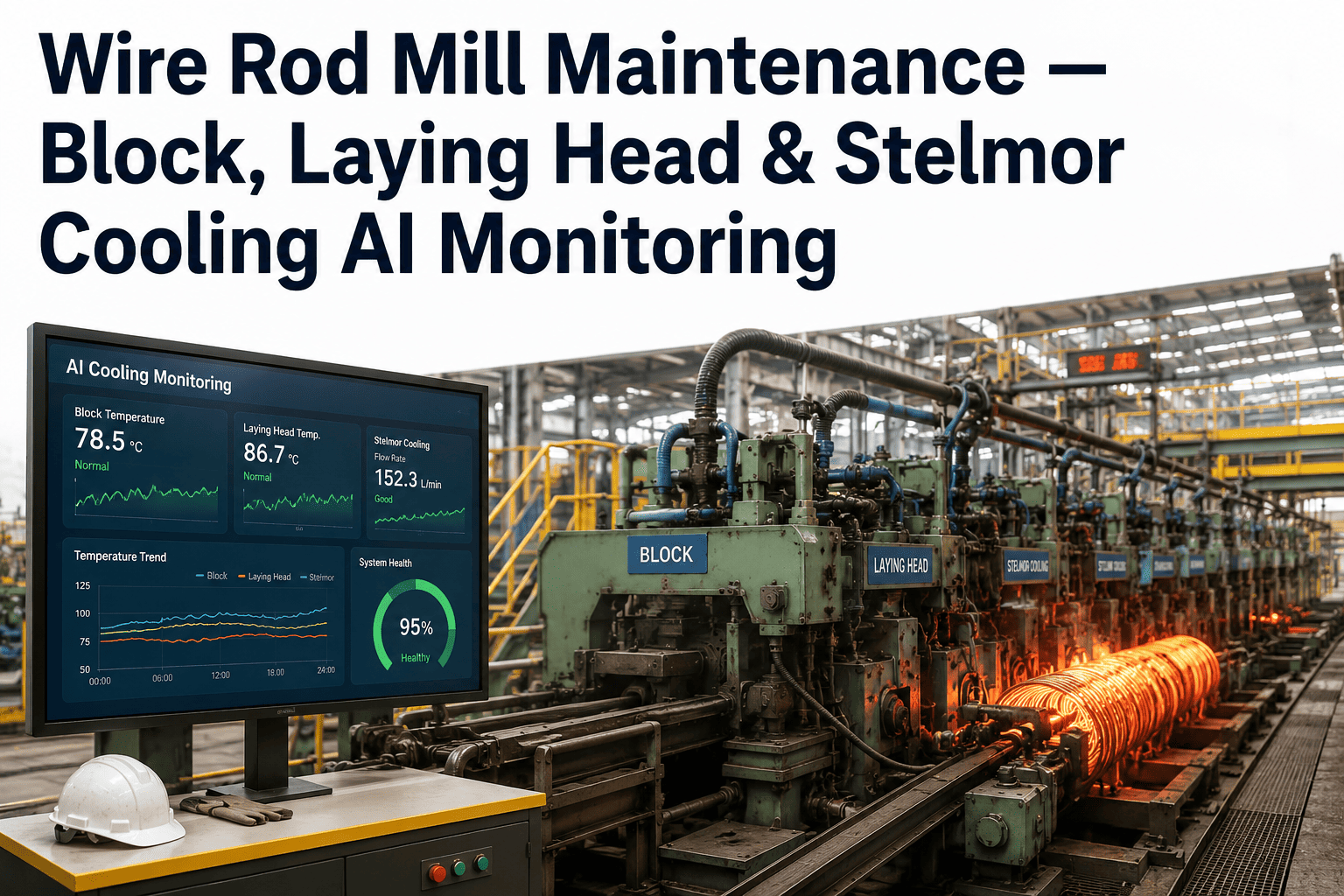
Morgan blocks, laying heads, and Stelmor conveyors run at the edge of mechanical tolerance every shift. AI predictive maintenance tracks the early drift that precedes a high-speed rolling incident.
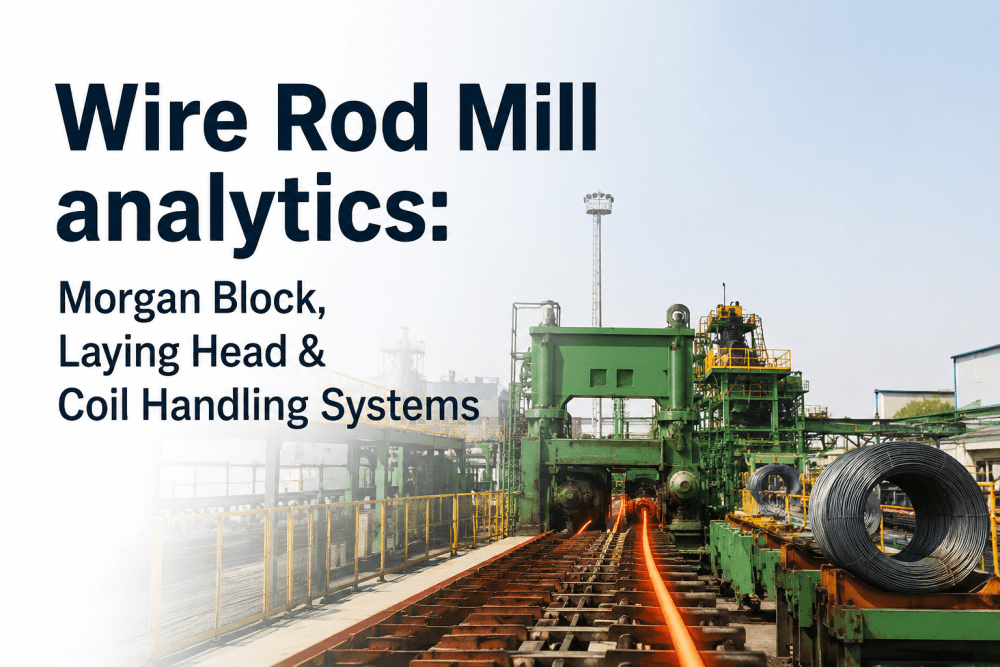
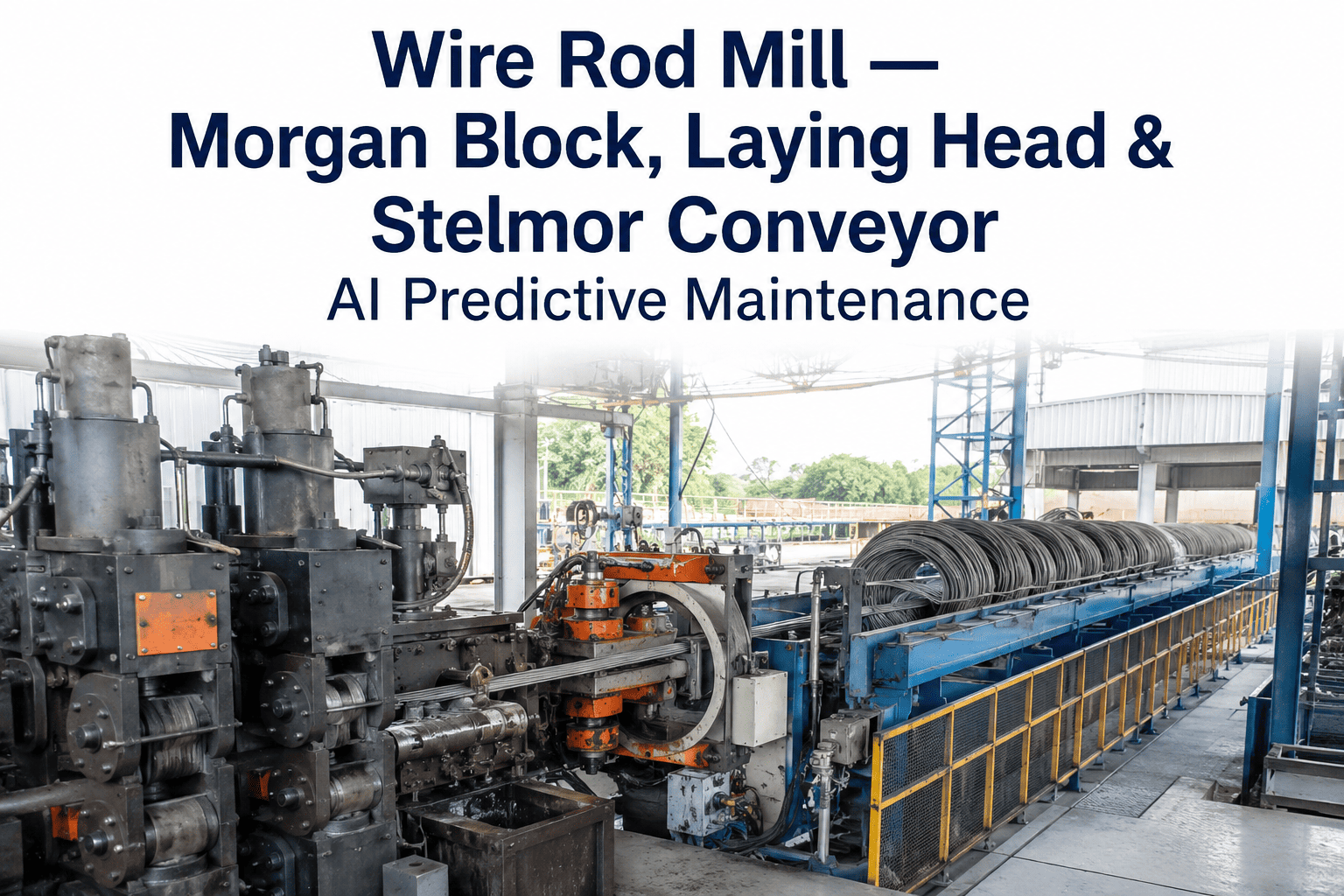
Three Assets, One High-Speed Failure Window
Everything downstream of the last rolling stand depends on these three components staying in tolerance at speed.
Morgan Block
Multi-stand finishing blocks reduce rod to final size at the highest speeds in the mill. Bearing wear here directly drives dimensional variation and surface defects on every coil.
Laying Head
The laying head forms rod into rings for the Stelmor conveyor. Misalignment or drive wear produces inconsistent ring spacing that cascades into cooling defects downstream.
Stelmor Conveyor
Controlled cooling on the conveyor sets final mechanical properties. Conveyor drive or fan degradation shows up as inconsistent microstructure across a coil before anyone visually notices it.
How a Cobble Actually Develops
The incident on the floor is the last step in a sequence that usually starts days earlier in the vibration signature.
Bearing wear begins generating a subtle vibration signature invisible to manual inspection rounds.
Vibration amplitude increases at specific frequencies tied to the failing component's rotational speed.
AI flags the anomaly against the asset's healthy baseline, well before the drift is audible on the floor.
Without intervention, the wear progresses to dimensional variation, cobbles, and unplanned downtime.
What AI Monitors on Each Finishing Asset
Different components fail differently — the monitoring approach has to match the failure mode, not just the asset type.
| Asset | Common Failure Mode | Leading Indicator |
|---|---|---|
| Finishing block bearing | Race wear from high-speed cyclic load | Vibration amplitude at bearing pass frequency |
| Laying head drive | Gearbox tooth wear | Gear mesh frequency sidebands |
| Laying head pipe | Guide wear from ring formation stress | Ring spacing consistency trend |
| Stelmor conveyor drive | Motor bearing degradation | Current draw and vibration correlation |
| Cooling fan bearing | Imbalance from debris buildup | Rising vibration at fan rotational speed |
Catch the Bearing Before It Costs You a Coil
iFactory deploys AI predictive maintenance across finishing blocks, laying heads, and Stelmor conveyors, flagging vibration anomalies days before they become a cobble or a scrapped coil.
What Reliability Engineers Protect by Catching Drift Early
The value isn't just avoiding a breakdown — it's protecting rod quality and mill throughput at the same time.
Coil Quality Consistency
Stable finishing block and Stelmor performance keeps dimensional tolerance and microstructure consistent across every coil.
Fewer Unplanned Stops
Scheduled intervention on a flagged bearing replaces an unplanned line stop during a production run.
Reduced Scrap Rate
Catching drift before it produces a cobble avoids the scrap and cleanup time that follows a high-speed incident.
Extended Component Life
Early lubrication or alignment correction extends the service life of bearings and drives beyond reactive repair cycles.
Getting Monitoring Live on the Finishing End
Finishing-end assets are typically the first monitored on a wire rod mill because the cost of a miss is highest here.
Prioritize Finishing Assets
Identify the Morgan block, laying head, and Stelmor conveyor components with the highest failure cost and lowest current visibility.
Deploy Sensors
Install vibration and temperature sensors rated for high-speed rotating equipment and the mill's ambient conditions.
Establish Healthy Baselines
Capture normal operating signatures across several weeks of production to train accurate anomaly detection thresholds.
Act on Early Alerts
Route flagged anomalies into planned maintenance windows before they progress into a production-impacting failure.
Wire Rod Mill Predictive Maintenance — Questions Answered
What reliability engineers ask most often when evaluating finishing-end monitoring.
Q: How early can AI actually detect a bearing problem on a high-speed finishing block?
Vibration monitoring can typically identify early-stage bearing wear several days before it becomes audible or produces a measurable quality defect, since the frequency signature associated with race or roller wear shows up in the data long before it affects rod dimensions. The exact lead time depends on the specific failure mode and how consistently the asset has been baselined against healthy operation. Faster-developing failures, like a sudden lubrication loss, produce shorter warning windows than gradual wear. You can book a demo to see real detection timelines from comparable mills.
Q: Do sensors need to be installed directly on the Morgan block itself?
Yes, effective monitoring requires sensors mounted close to the bearing housings on the finishing block stands, since vibration signatures attenuate quickly with distance from the source. The high-speed rotating environment and ambient heat around a wire rod finishing block require sensors rated specifically for that duty cycle rather than general-purpose industrial sensors. Installation is typically done during a scheduled maintenance window to avoid any production disruption. Ask about sensor specifications for your specific block configuration.
Q: Can this system distinguish between a laying head problem and a Stelmor conveyor problem?
Yes, because each asset is monitored independently with its own sensor set and baseline, the system attributes an anomaly to the specific component generating it rather than flagging a generic mill-wide alert. This matters because laying head issues and Stelmor conveyor issues produce different downstream defects, and misattributing the source wastes valuable response time. Distinct alerts routed to the right maintenance team are one of the main reasons plants adopt asset-specific monitoring over a single vibration sensor per line.
Q: What's a realistic first deployment scope for a wire rod mill reliability team?
Most reliability teams start with the finishing block bearings and laying head drive, since these have the highest failure cost and the shortest reaction window when something starts to drift. The Stelmor conveyor drive and cooling fans are commonly added in a second phase once the finishing-end deployment has proven baseline accuracy. This phased approach keeps initial investment focused on the highest-risk assets. Our support team can help scope the right starting assets for your line.
Q: Does predictive maintenance require shutting down the mill to install?
Sensor installation is generally completed during existing planned maintenance windows rather than requiring a dedicated shutdown, since the mounting points needed are accessible without disassembling the finishing block or laying head. Wiring and data connectivity work can often be scheduled around normal operations. The exact installation window depends on your mill's specific access constraints and maintenance schedule, which is typically confirmed during the initial site assessment before any work begins.
Keep the Finishing End Running at Speed
Your Morgan block, laying head, and Stelmor conveyor don't get a second chance at speed. iFactory gives reliability engineers the early warning needed to intervene before a bearing failure becomes a scrapped coil.