Every rolling mill, caster, and finishing line in a steel plant depends on medium-voltage main drive motors and their associated drive systems as the primary energy conversion point between electrical power and mechanical work. A single MV motor failure on a roughing mill stand, a finisher stand, or a caster mold oscillator drive stops the entire production line within seconds — at a cost ranging from $120,000 to $480,000 per hour of unplanned downtime depending on the mill configuration and product mix. The challenge for electrical reliability teams is that MV motor failures rarely occur without warning signs — vibration trends, current signature anomalies, temperature elevation patterns, and gear coupling wear signatures that develop over days, weeks, or months before the catastrophic event. These warning signs are present in the data that most mills already collect from vibration sensors, motor protection relays, drive system controllers, and thermal monitoring systems. The gap is not data availability — it is the absence of a fused analytics layer that correlates vibration, current signature, temperature, and coupling condition data simultaneously to detect the compound failure signatures that single-parameter monitoring systems miss entirely. This guide covers the complete predictive maintenance methodology for mill main drives and motors and how iFactory AI's Drive & Motor PdM platform delivers continuous, automated condition monitoring that gives electrical reliability leads the failure prediction lead time that threshold-based alarm systems simply cannot provide. Book a Demo to See Drive & Motor PdM in Action
Why MV Motor and Drive Predictive Maintenance Requires Sensor Fusion, Not Single-Parameter Monitoring
The dominant failure modes of medium-voltage mill main drive motors — bearing degradation, rotor bar cracking, stator winding insulation breakdown, and gear coupling wear — each produce detectable signatures in different sensor domains. Bearing degradation appears first in vibration data, specifically in the acceleration envelope spectrum at bearing defect frequencies. Rotor bar cracking manifests in the motor current signature spectrum as sidebands around the supply frequency, visible only through high-resolution current signature analysis. Stator winding insulation deterioration produces a temperature elevation trend that is detectable in winding RTD data but only when compared against the motor's load-dependent baseline. Gear coupling wear generates a vibration signature at the coupling's meshing frequency that is distinguishable from normal gearmesh vibration only through trend analysis over time. Each of these failure modes produces a detectable signature — but no single sensor modality detects all of them. A mill that monitors vibration only will miss rotor bar cracking until the bar fractures and causes a catastrophic failure. A mill that monitors current signature only will miss bearing degradation until the bearing seizes and damages the rotor or stator. A mill that monitors temperature only will miss both bearing and rotor bar degradation until secondary damage from those failures produces a temperature excursion. Book a Demo to See Sensor Fusion
The sensor fusion architecture that iFactory's Drive & Motor PdM platform applies is designed specifically to address this multi-domain detection problem. The platform ingests data from three primary sensor streams — vibration (acceleration and velocity), motor current (high-resolution current waveform sampling), and temperature (winding RTD and bearing thermocouple data) — and fuses these streams through AI models trained on the specific failure mode signatures of mill main drive motors. The fusion layer identifies compound signatures that no single-parameter system can detect: for example, a simultaneous increase in vibration at the bearing defect frequency and a change in the current signature sideband pattern that together indicate an impending bearing failure with a rotor bar crack developing on the same motor. The combined signature has a longer prediction lead time than either signature in isolation, because the compound degradation process begins before either individual failure mode reaches the detection threshold of a single-parameter monitoring system.
- Vibration-only systems miss rotor bar and stator insulation degradation until secondary damage occurs
- Current signature analysis detects rotor bar issues but provides no bearing or coupling condition data
- Temperature monitoring detects failures only after they have progressed to significant thermal excursion
- Gear coupling inspections performed on fixed intervals, not actual wear condition
- Each sensor domain has independent alarm thresholds — no cross-domain correlation analysis
- Typical failure detection lead time: 0–7 days before catastrophic failure
- Vibration + current signature + temperature fused into unified motor health score per asset
- Rotor bar cracking detected at current signature sideband emergence — 3–8 weeks before bar fracture
- Bearing degradation identified at envelope spectrum onset — 4–10 weeks before bearing replacement needed
- Gear coupling wear tracked through vibration trend at meshing frequency — condition-based replacement
- Cross-domain anomaly detection identifies compound failure signatures earlier than single-parameter thresholds
- Typical failure detection lead time: 3–8 weeks before catastrophic failure
The Four-Layer Detection Architecture: Bearing, Rotor, Stator, and Coupling
iFactory's Drive & Motor PdM platform monitors four distinct motor and drive component layers simultaneously, each with a dedicated AI detection model trained on the specific failure mode signatures of that component class. The four-layer architecture ensures complete coverage of the dominant MV motor failure modes without requiring separate monitoring platforms for each component type. Electrical reliability leads who schedule a technical review find that this layered coverage is what finally allows them to replace their patchwork of standalone vibration, current, and temperature monitoring systems with a single, unified predictive maintenance platform.
Motor Current Signature Analysis: The AI-Enhanced Methodology for Rotor Bar and Eccentricity Detection
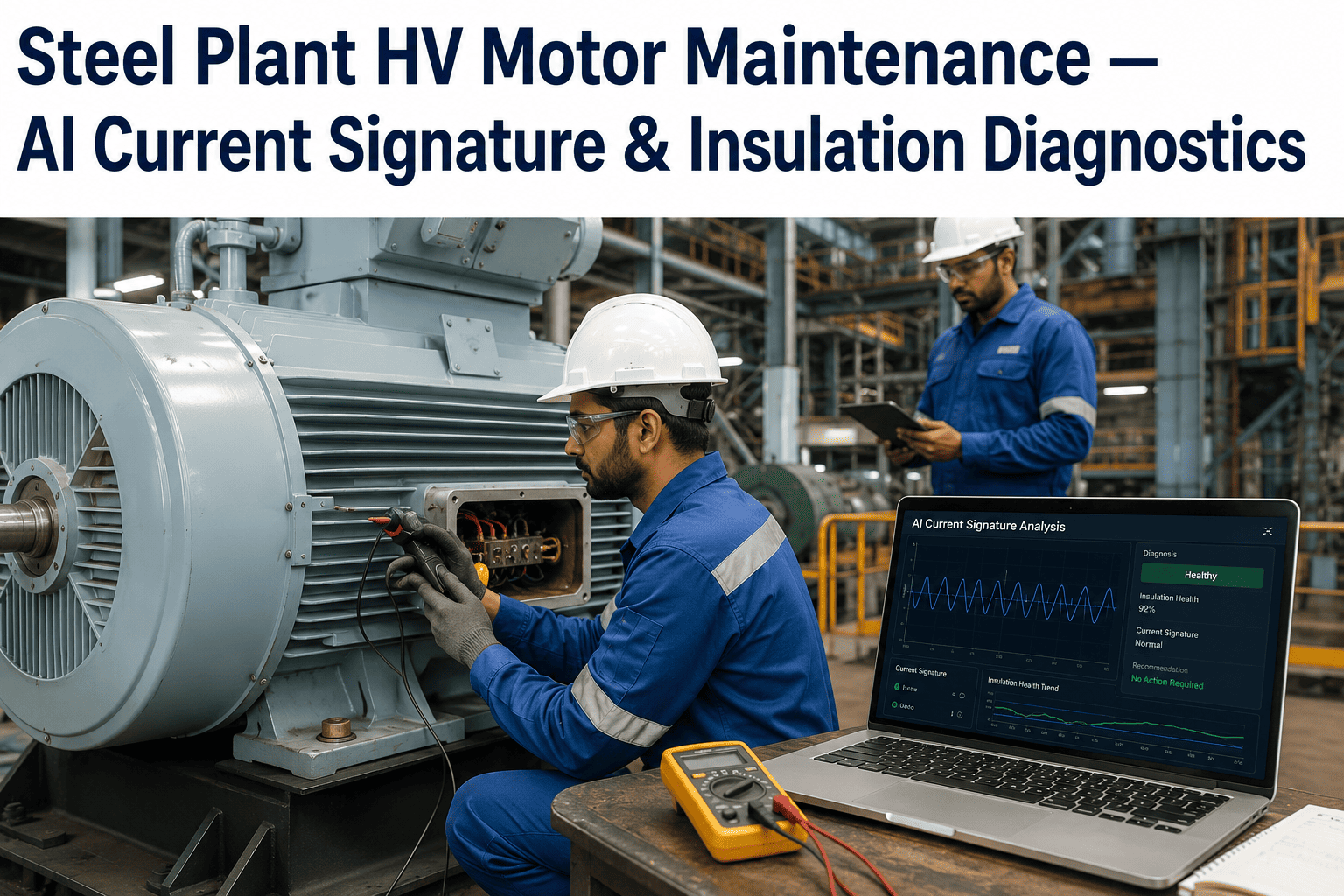
Motor current signature analysis is the most reliable method for detecting rotor bar degradation and air gap eccentricity in medium-voltage induction motors — but conventional MCSA implementation in steel mills produces high false positive rates that erode operator confidence and cause developing rotor bar issues to be dismissed as sensor artifacts or transient load events. The reason is that conventional MCSA applies fixed threshold detection to sideband amplitude — a method that works well under steady-load laboratory conditions but fails under the variable-load, variable-speed operating conditions typical of mill main drives. A roughing mill motor that cycles between 20% and 110% load every 45 seconds produces current signature sidebands from load variation that are indistinguishable from rotor bar sidebands under fixed-threshold analysis. Schedule a Technical Review of MCSA AI
iFactory's AI-enhanced MCSA methodology solves the variable-load false positive problem through a load-adaptive spectral analysis approach. The platform segments the motor's operating regime into load windows — 0–30%, 30–60%, 60–90%, and 90–110% of rated load — and maintains separate sideband baselines for each regime. Rotor bar sideband amplitudes are compared against the regime-specific baseline rather than against a fixed threshold, eliminating false positives from load-induced sideband variation. The regime-adaptive approach also enables detection of early-stage rotor bar degradation that would be invisible in aggregated sideband data, because the degradation signature is most pronounced at high load and may not exceed the fixed threshold when averaged across all load conditions. Plants using iFactory's regime-adaptive MCSA methodology report a false positive rate of 3.1% compared to 22–38% for fixed-threshold MCSA approaches, with a corresponding increase in rotor bar degradation detection lead time from 1–3 weeks to 4–8 weeks.
| Detection Method | Rotor Bar Degradation | Bearing Degradation | Stator Insulation | Gear Coupling Wear | Combined Failure Detection |
|---|---|---|---|---|---|
| Vibration-Only Monitoring | Not detected — vibration signature of rotor bar cracking is masked by magnetic noise | 4–8 week lead time at bearing defect frequencies | Not detected — thermal indicators only, no direct insulation measurement | 3–6 week lead time at meshing frequency | No cross-domain detection capability |
| Fixed-Threshold MCSA | 1–3 week lead time with 22–38% false positive rate | Not detected — MCSA provides no bearing condition data | Not detected — MCSA provides no insulation condition data | Not detected — MCSA provides no coupling condition data | No cross-domain detection capability |
| Temperature-Only Monitoring | Not detected until secondary thermal effects from fractured bars | 2–5 day lead time — temperature rises only after significant degradation | 3–7 day lead time — winding temperature elevation detected at advanced stage | Not detected — coupling wear does not produce significant temperature elevation | No cross-domain detection capability |
| iFactory Sensor Fusion AI | 4–8 week lead time with 3.1% false positive rate — regime-adaptive spectral analysis | 4–10 week lead time — vibration envelope + temperature cross-validation | 2–6 week lead time — temperature baseline + negative-sequence current correlation | 4–8 week lead time — trend analysis at coupling meshing frequency | Compound signature detection at 3–6 week lead time — all four layers fused |
Deployment Architecture: Connecting to Existing Sensor Infrastructure
iFactory's Drive & Motor PdM platform is designed to connect to the sensor infrastructure that most mills already have installed — vibration sensors on motor bearing housings, current transformers on motor feeder cables, RTDs embedded in motor windings, and thermocouples on bearing housings. The platform ingests data from these existing sensors through the plant's existing data acquisition infrastructure — vibration data from online monitoring systems or portable analyzers, current data from motor protection relays or dedicated MCSA hardware, and temperature data from the DCS or PLC. In most installations, no additional sensors are required to begin generating predictive alerts. For electrical reliability leads evaluating the platform for their specific motor fleet, booking a data readiness assessment provides a complete inventory of existing sensor coverage and identifies any gaps.
Measured Outcomes: Drive & Motor PdM Performance From Live Steel Mill Deployments
The following metrics represent aggregated results from iFactory Drive & Motor PdM deployments at five integrated and mini-mill steel plants in North America, covering 184 medium-voltage mill main drive motors across roughing mills, finishing mills, caster drives, and finishing line drives. Results are measured over 18 months of continuous production operation. For a performance projection based on your mill's specific motor fleet, duty cycles, and existing sensor coverage, book an ROI assessment.
| Motor Class | Motors Monitored | Failures Predicted | Unplanned Failures Avoided | Avg. Lead Time | Cost Avoided |
|---|---|---|---|---|---|
| Roughing Mill Main Drives | 38 | 14 | 12 | 5.2 weeks | $3.8M |
| Finishing Mill Stand Drives | 62 | 21 | 19 | 4.8 weeks | $5.1M |
| Caster Mold Oscillator Drives | 24 | 8 | 7 | 3.4 weeks | $1.6M |
| Finishing Line Drives | 42 | 11 | 10 | 6.1 weeks | $2.4M |
| Cooling Bed / Transfer Drives | 18 | 5 | 4 | 4.3 weeks | $0.9M |
| Total | 184 | 59 | 52 | 4.9 weeks avg. | $13.8M |
Expert Perspective: What Sensor Fusion Changes in MV Motor Reliability
We had been running vibration monitoring on our mill main drives for six years. The system detected bearing degradation reliably — we replaced bearings on schedule based on envelope spectrum trends and had reduced bearing-related failures by about 70% compared to our pre-vibration-monitoring baseline. What the vibration system never told us was that two of our finisher stand motors had developing rotor bar cracks that had been progressing for months. The first we knew about it was when a bar fractured on a finisher stand motor during a high-torque pass and the motor went into thermal overload. That failure cost us 14 hours of unplanned downtime and $420,000 in repair and lost production costs. When we deployed iFactory's MCSA overlay on the same motors, the system identified rotor bar sideband anomalies on both motors within the first week of data collection. One motor had four cracked bars that the AI estimated had been developing for 6 to 8 weeks. The vibration system had not detected any anomaly because the rotor bar cracking produced no measurable vibration signature until the bar fractured. The AI gave us 4 weeks of lead time on the motor with the most advanced degradation — we scheduled the rotor replacement during a planned outage and avoided a second catastrophic failure.
Frequently Asked Questions: Drive & Motor Predictive Maintenance
No additional sensors are required in most installations. The platform connects to existing vibration sensors (accelerometers), motor protection relays or current transformers, and winding RTDs or bearing thermocouples. For plants without MCSA capability in existing protection relays, iFactory provides a non-invasive current sensor that clamps around the motor feeder cable at the motor control center — installed in under 30 minutes per motor without de-energizing the circuit. A data readiness assessment conducted during the scoping phase identifies any sensor coverage gaps before deployment begins.
iFactory's AI models are drive-type-aware and adjust detection algorithms based on the motor's supply configuration. For variable-frequency drive applications, the platform tracks the fundamental frequency and adjusts the MCSA sideband analysis window dynamically — sidebands are calculated relative to the instantaneous fundamental frequency rather than a fixed 60 Hz or 50 Hz reference. For cycloconverter-fed motors, the platform applies a harmonic filtering pre-processing step that removes drive-induced spectral content before analyzing the residual spectrum for rotor bar and eccentricity signatures. The regime-adaptive baseline approach is particularly effective for VFD applications because the load windows are mapped against the variable speed and torque profiles that these drives produce.
The typical deployment timeline for a 20–50 motor fleet is 5 to 8 weeks from project kickoff to live predictive monitoring. Phase 1 (weeks 1–2) covers sensor discovery, data connectivity confirmation, and baseline data collection for the highest-priority motors. Phase 2 (weeks 3–5) covers AI model training for 10–15 motors per batch, model validation against historical failure data, and CMMS integration. Phase 3 (weeks 6–8) covers remaining motor onboarding, user training for electrical reliability and maintenance teams, and deployment sign-off with documented alert thresholds and escalation procedures.
iFactory ingests vibration data from existing online monitoring systems (CSI, Emerson, Bently Nevada, SKF) via standard API or OPC-UA connectors. For plants using portable data collectors, iFactory accepts route data uploaded from the collector and applies AI analysis to the collected vibration spectra — maintaining continuous model training even when data is collected on a periodic route basis rather than continuously. The platform cross-references route data against historical trends and MCSA data collected in the same time window, providing fused analysis results even when one sensor stream is collected less frequently than others.
iFactory Drive & Motor PdM deployments typically achieve full cost recovery within 6 to 12 months of go-live. The fastest payback cases occur when the platform detects a high-criticality motor failure mode — rotor bar cracking on a finisher stand motor or bearing degradation on a roughing mill drive — within the first 30 days of monitoring, allowing intervention before a catastrophic failure that would have cost $200,000 to $500,000 in unplanned downtime. Across the five-plant deployment base, the average annual unplanned downtime cost avoidance was $1.2 million per plant, representing an ROI of 4.8 to 8.2 times the annual platform cost. An ROI modeling session using your plant's specific motor fleet composition, historical failure data, and production economics is available at no cost.
Conclusion: Your MV Motor Fleet Is Telling You Its Condition Every Operating Cycle. iFactory Is the Only Platform That Listens to Every Sensor.
Every operating cycle of a mill main drive motor produces actionable condition data across multiple sensor domains — vibration spectra that reveal bearing condition, current signatures that expose rotor bar health, temperature trends that indicate insulation degradation, and coupling vibration patterns that track gear wear. Each of these data streams contains the precursors of failure events that will occur days or weeks in the future. The challenge for electrical reliability teams has never been the lack of condition data — it has been the absence of a fused analytics layer that correlates all four data domains simultaneously and identifies the compound failure signatures that no single-parameter monitoring system can detect.
iFactory's Drive & Motor PdM platform provides that fused analytics layer — combining vibration envelope spectrum analysis, regime-adaptive motor current signature analysis, load-compensated temperature trend monitoring, and gear coupling wear tracking into a single AI-driven condition monitoring platform for mill main drives and motors. The platform connects to the sensors you already have installed, deploys in 5 to 8 weeks across a 20–50 motor fleet, and delivers failure prediction lead times of 3 to 8 weeks that give your maintenance team sufficient time to plan interventions during scheduled outages. The sensor data is already flowing. The AI models are trained on the failure signatures of steel mill drive motors. The only missing piece is the decision to deploy it. Book your Drive & Motor PdM demo today.