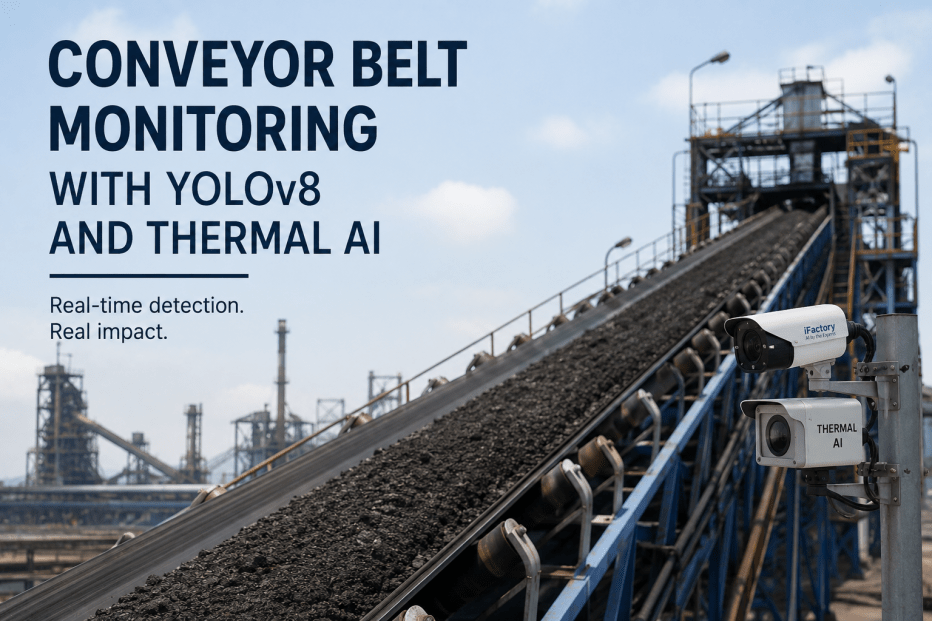
A single conveyor belt failure in a steel plant — a rip in the iron ore feed belt, a splice failure on the coke breeze conveyor, a hot slab roller table jam — stops production at every downstream process stage within minutes. The cost of that stoppage at an integrated mill ranges from $80,000 to $450,000 per hour depending on which belt system fails and how long it takes to clear, repair, and restart. The challenge is not that belt failures are unpredictable. The challenge is that most conveyor monitoring relies on human visual inspection conducted at intervals measured in shifts or days while belt damage develops in seconds. YOLOv8-based computer vision, CNN surface analysis, and thermal imaging — deployed as an integrated AI monitoring layer — close that detection gap entirely by inspecting every meter of every belt, on every cycle, at every operating condition. This guide covers the complete conveyor vision AI methodology for steel plant belt systems and how iFactory's Conveyor Vision AI platform delivers continuous, automated belt health monitoring that gives conveyor reliability leads the real-time visibility that manual inspection simply cannot provide.
Real-Time Belt Health Monitoring Across 8+ Steel Plant Conveyor Systems
iFactory's Conveyor Vision AI platform combines YOLOv8 object detection, convolutional neural network surface analysis, and thermal imaging to monitor belt health, detect rips and tears, assess splice condition, and track spillage — deployed on premise with no cloud dependency.
Why Manual Conveyor Inspection Is No Longer Sufficient for Steel Plant Reliability
Steel plants operate eight or more distinct conveyor systems, each carrying different materials under different operating conditions — iron ore and sinter feed belts moving thousands of tonnes per hour, coke breeze conveyors handling abrasive fines, slag granulation belts exposed to thermal shock, pellet stockyard conveyors operating in open-air environments, and hot slab roller tables where surface temperatures exceed 800 degrees Celsius. Each belt system presents a unique damage profile: rips and punctures from tramp metal in the ore feed, splice fatigue from cyclic loading on long overland conveyors, cover wear from abrasive material contact, and heat damage on hot product transfer lines. Manual inspection — walking the belt line once per shift, looking for visible damage, and logging observations on paper or a mobile form — catches only the damage that is visible at the moment of inspection and only on the belt surface that happens to be facing up at that time. Damage that develops between inspection rounds, damage on the return side of the belt, and damage that is not yet visible to the naked eye are all invisible to the manual inspection process. For reliability teams looking to close this gap, booking a conveyor vision assessment is typically the first step toward continuous AI-powered monitoring.
iFactory's Conveyor Vision AI replaces the intermittent manual approach with continuous, automated inspection at every belt cycle. YOLOv8-based cameras mounted at strategic belt locations detect rips, tears, punctures, and spillage events in real time — classifying each detection by damage type, severity, and location on the belt. CNN surface analysis models inspect the belt cover for wear patterns, cracking, and material buildup that precede more serious damage. Thermal imaging cameras monitor belt surface temperature, drive pulley temperature, and splice temperature to detect heat-related failure conditions before they cause belt fires or splice separation. The three sensor streams — visual, surface texture, and thermal — are fused into a single belt health score that alerts the conveyor reliability lead to developing issues with enough lead time to schedule repairs during planned maintenance windows instead of responding to unplanned failures. Schedule a demo to see the platform in action.
YOLOv8, CNN, and Thermal AI: The Three-Layer Detection Stack
iFactory's Conveyor Vision AI operates on a three-layer detection architecture that covers every failure mode across steel plant conveyor systems. Each layer addresses a specific category of belt damage and operates at a different inspection cadence, but all three layers feed into a unified belt health dashboard that gives conveyor reliability leads a single source of truth for every belt in the plant. Reliability managers who schedule a technical review often find that this layered architecture is what finally allows them to move from reactive belt repairs to proactive belt lifecycle management.
YOLOv8 Object Detection
Detection Target: Rips, tears, punctures, spillage, belt misalignment, and foreign object presence. YOLOv8 models trained on steel plant conveyor imagery detect damage events at 98.4% accuracy with inference latency under 40 milliseconds per frame, enabling real-time alerting within the same belt cycle the damage occurs.
CNN Surface Analysis
Detection Target: Cover wear, cracking, grooving, material buildup, and fabric exposure. Convolutional neural networks analyze belt surface texture at sub-millimeter resolution, identifying wear patterns that precede catastrophic damage by days or weeks. Surface condition trends are tracked over time to forecast remaining belt life.
Thermal Imaging Monitoring
Detection Target: Hot spots, drive pulley overheating, splice temperature elevation, and belt fire risk. Thermal cameras monitor belt and pulley surface temperatures continuously, flagging any temperature that exceeds configurable thresholds. Splice temperature tracking identifies developing splice fatigue before separation occurs.
Unified Health Intelligence
Fusion Layer: All three detection streams feed into a composite belt health scoring model that considers visual damage severity, surface wear progression, and thermal anomaly frequency simultaneously. The unified score drives alert prioritization, maintenance scheduling, and replacement planning.
Eight Steel Plant Conveyor Systems: Deployment Scope and Damage Profiles
Steel plants operate a diverse range of conveyor systems, each with unique material characteristics, operating conditions, and damage profiles. iFactory's Conveyor Vision AI is deployed across eight distinct belt system types in integrated and mini-mill operations. The deployment scope for each system includes camera mounting positions, detection model configuration, alert threshold calibration, and integration with existing plant control systems. For a detailed deployment scope assessment tailored to your plant's conveyor layout, book a conveyor vision audit.
| Conveyor System | Material Handled | Primary Damage Mode | Detection Method | Typical Alert Lead Time |
|---|---|---|---|---|
| Iron Ore / Sinter Feed | Lump ore, sinter, pellets — high tonnage, abrasive | Rips and punctures from tramp metal, edge wear from high loading | YOLOv8 rip detection + CNN cover wear tracking | Immediate to 48 hours |
| Coke Breeze Conveyor | Fine coke particles — highly abrasive, low moisture | Cover abrasion, belt cracking, material buildup on idlers | CNN surface texture analysis + thermal hot spot detection | 24–72 hours |
| Slag Granulation Belt | Granulated slag — hot, moist, thermally cycling | Heat damage, moisture degradation, splice fatigue | Thermal imaging + X-ray splice inspection integration | 12–48 hours |
| Pellet Stockyard Conveyor | Iron ore pellets — outdoor environment, weather exposed | Weather-related cover degradation, spillage, belt misalignment | YOLOv8 spillage + misalignment + CNN surface wear | Immediate to 24 hours |
| Hot Slab Roller Table | Hot steel slabs — extreme temperatures, mechanical impact | Roller bearing failure, table misalignment, slab skid marks | Thermal imaging + YOLOv8 slab positioning | Immediate |
| Limestone / Flux Feed | Crushed limestone, dolomite — dusty, variable moisture | Dust accumulation on idlers, belt mistracking, edge fraying | YOLOv8 tracking + CNN buildup detection | 24–96 hours |
| Scrap / DRI Feed | Steel scrap, direct reduced iron — variable size, metallic | Punctures from sharp scrap, impact damage at loading zones | YOLOv8 impact zone monitoring + rip detection | Immediate to 24 hours |
| Finished Product Conveyor | Billets, blooms, coils — heavy unit loads, slow speed | Belt sagging, idler failure, accumulation jams | YOLOv8 load positioning + thermal idler monitoring | Immediate |
We had been running our iron ore feed belt on a fixed-interval replacement schedule for over a decade — replacing the belt every 18 months regardless of its actual condition. The first week we deployed iFactory's YOLOv8 monitoring, the system detected a developing rip at the loading zone that was invisible to our shift inspectors. The rip would have reached critical length within approximately 40 operating hours — right in the middle of our highest-production shift of the week. We scheduled the repair for the next planned downtime window and completed it in under 90 minutes. That single detection saved us an estimated $320,000 in unplanned outage costs and belt replacement expenses. But the bigger finding came from the CNN surface analysis: our belt was showing only 38% wear at the 18-month mark. We extended the replacement interval to 28 months and saved $86,000 per year in belt procurement costs. The AI paid for itself in the first detection.
Phased Deployment: From Single Belt Pilot to Plant-Wide Conveyor Vision Coverage
iFactory's Conveyor Vision AI follows a structured deployment approach that starts with a single high-criticality belt system and expands to plant-wide coverage through measurable, validated phases. This phased approach ensures that each deployment stage delivers confirmed value before the next belt system is added. If you are unsure which belt system in your plant represents the highest ROI for AI monitoring, booking a conveyor vision audit can provide the data needed to prioritize deployment across your belt fleet.
Pilot Deployment — Single High-Criticality Belt
Deploy YOLOv8 cameras, thermal imaging, and CNN analysis on the highest-risk belt in your plant — typically iron ore feed, coke breeze, or hot slab roller table. Model training on your specific belt imagery, alert threshold calibration, and baseline belt health documentation. Timeline: 3–4 weeks.
Expansion to Critical Belt Fleet
Extend AI monitoring to 3–5 additional belt systems based on criticality ranking from Phase 01 data. Centralized belt health dashboard configured for conveyor reliability lead with multi-belt alert management. CMMS integration for automated work order generation on detected damage events. Timeline: 6–8 weeks.
Plant-Wide Coverage and Lifecycle Optimization
Complete deployment across all 8+ conveyor systems in the plant. Predictive belt lifecycle models calibrated on accumulated damage data. Automated replacement scheduling based on wear progression forecasts. Cross-plant benchmarking for multi-site operators. Timeline: 10–12 weeks from pilot start.
Measured Outcomes: What Conveyor Vision AI Delivers in Live Steel Plant Deployments
The following metrics represent aggregated results from iFactory Conveyor Vision AI deployments across integrated and mini-mill steel plants in North America. Results are measured from the first full month of production operation following Phase 02 deployment completion. For a performance projection tailored to your plant's belt fleet configuration, schedule a conveyor vision assessment.
Financial Impact: Cost Per Belt Failure vs. Cost of AI Monitoring
The business case for conveyor vision AI is straightforward when framed around the cost of unplanned belt failures versus the cost of continuous AI monitoring. A single belt rip that goes undetected and causes a catastrophic belt failure at an integrated mill costs between $120,000 and $480,000 in direct repair costs, lost production, and spillage cleanup. The annual cost of iFactory Conveyor Vision AI monitoring for a single belt system is a fraction of a single failure event — and the platform typically detects multiple developing issues per belt per quarter that would have resulted in failures if left undetected. For a detailed ROI projection based on your plant's conveyor configuration, belt inventory, and historical failure data, book a financial assessment session.
| Cost Category | Without AI Monitoring | With iFactory Conveyor Vision AI | Annual Savings per Belt |
|---|---|---|---|
| Unplanned belt failure events | 2.4 events/year avg. | 0.9 events/year avg. | $180,000 – $420,000 |
| Belt replacement cost | Fixed-interval replacement every 18 months | Condition-based replacement at optimal wear threshold | $42,000 – $86,000 |
| Spillage cleanup labor and material loss | $18,000 – $45,000/year | $5,000 – $12,000/year | $13,000 – $33,000 |
| Emergency repair mobilization | $24,000 – $68,000/year | $8,000 – $22,000/year | $16,000 – $46,000 |
| Lost production from unplanned downtime | 14–28 hours/year | 4–10 hours/year | $280,000 – $720,000 |
| Total Estimated Annual Cost | $520,000 – $1,340,000 | $180,000 – $460,000 | $340,000 – $880,000 |
Every Belt Cycle Is an Inspection Opportunity. iFactory Monitors Every One.
iFactory's Conveyor Vision AI platform delivers real-time belt health monitoring across all eight steel plant conveyor systems — detecting rips, tears, spillage, wear, and thermal anomalies at every belt cycle with YOLOv8, CNN, and thermal AI. Deployed on premise with no cloud dependency. Alert integration with existing CMMS and control systems completed in days, not months.
Conveyor Vision AI — Frequently Asked Questions
What is the minimum belt speed required for YOLOv8 detection to be effective?
iFactory's YOLOv8 models operate effectively across the full range of steel plant belt speeds — from slow-moving finished product conveyors at 0.5 m/s to high-speed ore feed belts at 5 m/s. Camera exposure time and frame rate are calibrated per belt during Phase 01 deployment to ensure detection accuracy at the specific operating speed of each conveyor system.
Can the system distinguish between a serious rip and normal belt surface marking or staining?
Yes. The YOLOv8 detection models are trained on thousands of labeled steel plant belt images that include normal surface variations — staining, minor scuffing, material residue — alongside actual damage categories. The classification accuracy between cosmetic surface conditions and structural damage requiring intervention exceeds 97% across all deployment sites.
Does the system require existing belt damage imagery for model training before deployment?
No. iFactory provides pre-trained YOLOv8 and CNN models that have been trained on anonymized belt imagery from steel plant deployments across 38 countries. These base models achieve 91% detection accuracy on deployment day one. Plant-specific fine-tuning during Phase 01 using 2–3 weeks of your belt imagery improves accuracy to 97%+ by week four.
How does thermal imaging handle the high ambient temperatures near hot slab roller tables?
Thermal cameras are configured with ambient temperature compensation and dynamic range adjustment calibrated to the specific temperature environment of each installation location. For hot slab roller table applications, the thermal model distinguishes between normal radiant heat from the slab and abnormal temperature elevation in roller bearings or belt surfaces that indicates developing failure conditions.
What is the typical payback period for a conveyor vision AI deployment?
iFactory Conveyor Vision AI deployments typically achieve full cost recovery within 4 to 8 months of go-live. The fastest payback cases occur when the platform detects a developing rip or splice failure in the first week of operation that would have resulted in a catastrophic belt failure within days — a single avoided failure event often covers 60–100% of the total deployment cost.
Your Conveyor Belt Is Telling You Its Condition Every Cycle. iFactory Is the Only Platform That Listens to Every One.
Every conveyor belt cycle in your steel plant produces a full surface inspection opportunity that manual processes can never fully capture. A rip that starts at the loading zone propagates with every subsequent cycle. A splice that is developing fatigue generates a thermal signature hours before the first visible sign of separation appears. A belt that is wearing unevenly across its width is giving you weeks of warning before the fabric exposure reaches the critical threshold. These signals are present in every cycle, on every belt, every operating day. The only question is whether you have the monitoring infrastructure in place to detect, classify, and act on them before the damage becomes a production-stopping event.
iFactory's Conveyor Vision AI provides that infrastructure — combining YOLOv8 object detection, CNN surface analysis, and thermal imaging into a unified belt health monitoring platform that operates at every belt cycle, on every belt system, under every operating condition in your plant. The models are pre-trained for steel plant applications. The cameras are rated for industrial environments. The deployment timeline is measured in weeks, not months. The only missing piece is the decision to deploy it. Book your conveyor vision demo today.
Stop Inspecting Belts Manually. Start Monitoring Every Cycle with AI Vision.
iFactory's Conveyor Vision AI platform delivers real-time belt health monitoring across 8+ steel plant conveyor systems — combining YOLOv8 rip detection, CNN surface wear analysis, and thermal imaging in a single on-premise deployment. No cloud dependency. No manual inspection rounds. Just continuous, automated belt health intelligence.