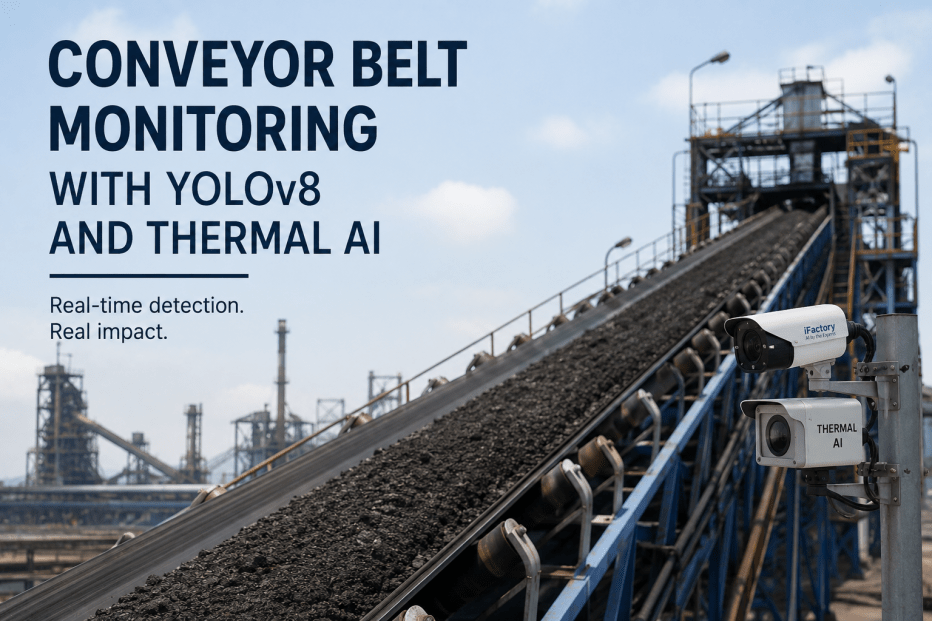
Conveyor belts are the circulatory system of a steel plant — moving iron ore, coal, coke, sinter, pellets, slag, and finished product across distances of 2–15 kilometres through some of the most hostile environments in heavy industry. A single belt failure on a critical raw material supply route can starve a blast furnace in under four hours, causing a production loss of ₹2–6 crore per event. Steel plants operate 40–120 conveyor belts per plant, with combined belt lengths exceeding 50 kilometres — making manual inspection impractical and reactive maintenance extremely costly. iFactory's AI Vision and Conveyor Monitoring platform deploys thermal cameras, AI vision systems, and vibration sensors across every conveyor — detecting belt wear, splice failures, belt mistracking, idler seizure, and hot material before any of them cause an unplanned stoppage.
Conveyor Belt Health Monitoring: AI Vision & Predictive Analytics for Steel Plants
Belt wear detection, splice monitoring, alignment AI, roller inspection & throughput optimisation — continuous automated conveyor health across every belt in your plant.
Six Conveyor Failure Modes — Ranked by Stoppage Risk & Detection Difficulty
Most conveyor failures are detectable days or weeks before they cause a stoppage — if you have the right sensors and AI in place. Each failure mode below has a specific detection signature that iFactory AI identifies from camera, thermal, and vibration data. Schedule a conveyor risk assessment to identify which of your belts carry the highest failure risk today.
How iFactory Monitors Every Conveyor — Six Sensing Technologies
iFactory's conveyor monitoring platform combines six sensing technologies — each targeting specific failure signatures — into a single unified health dashboard per belt, per idler set, and per splice location. Schedule a conveyor monitoring demo configured around your specific belt routes and material types.
AI Vision — Belt Surface
4K cameras with AI detect cracks, cuts, cover wear patches, foreign objects, and longitudinal rips in real time at full belt speed. Alerts generated with GPS belt position and defect size classification.
Thermal Array — Full Width
Thermal camera arrays across full belt width detect hot material carryover, idler bearing overheating (3°C threshold), and friction hotspots before they escalate to fire. Auto-triggers belt stop.
Idler Vibration Monitoring
Wireless vibration sensors on idler frames detect bearing degradation signatures 3–6 weeks before seizure. Frequency spectrum analysis classifies failure mode — inner race, outer race, or rolling element.
Edge Alignment Camera
Side-mounted cameras at 50m intervals detect belt edge position deviation of more than ±20mm. Mistracking alerts sent to SCADA with automatic tensioning correction where pneumatic tensioners are installed.
Splice Health Monitor
AI vision at each splice location inspects joint condition every belt revolution — detecting bolt loosening, cover separation, and steel cord exposure weeks before catastrophic splice failure.
Throughput & Load Analytics
Belt weigher integration with AI detects throughput variance indicating blocked chutes, material flow irregularities, and belt slippage — optimising loading profiles to reduce edge wear by up to 40%.
How AI Vision Detects Belt Wear — From Camera Pixel to Work Order in 4 Steps
AI belt monitoring is not a camera pointed at a belt with a threshold alarm. It is a multi-frame, multi-sensor pipeline that tracks progressive change across thousands of belt revolutions — detecting degradation patterns invisible to human inspectors walking past at shift-change.
4K cameras at head drum, tail drum, and every splice capture 3–8 images per belt revolution at full belt speed. Each image is tagged with belt position using encoder pulse data — giving GPS-level location of every pixel on the belt surface across its full 2D map.
60,000–200,000 images per belt per day stored and indexedCNN model trained on steel conveyor defect dataset classifies every anomaly — longitudinal rip, transverse cut, edge fraying, cover blister, splice separation, or foreign object impact. Defect size measured in mm² from pixel dimensions. Confidence score assigned per detection.
<50ms classification latency on edge GPU — no cloud requirediFactory AI tracks every detected defect across successive belt revolutions — measuring growth rate in mm²/hour. Defects growing faster than the threshold trigger escalation from "monitor" to "plan" to "urgent" status without human intervention.
Splice separation: tracked to 0.1mm accuracy across revolutionsPriority P1/P2/P3 work order created in SAP PM with defect image, belt position (metres from head drum), defect classification, trend data, and recommended action attached. Supervisor push notification sent simultaneously. Average time from detection to work order: 90 seconds.
Full traceability: defect image → belt position → SAP work order IDHow iFactory Connects Every Belt Sensor to SAP PM — Full Data Flow
iFactory's conveyor monitoring platform integrates with every component of your existing plant infrastructure — no rip-and-replace, no new PLC required. The entire data flow from sensor to SAP PM work order runs automatically.
Before vs. After — Conveyor Health at a 4.5 MTPA Raw Material Handling System
Results from a 4.5 MTPA plant with 68 conveyors and 43km of belt — verified by maintenance leadership after 12 months on iFactory Conveyor Monitoring.
| KPI | Before | After iFactory |
|---|---|---|
| Unplanned belt stoppages / year | 34 events | 6 events (−82%) |
| Average belt replacement life | 18 months | 52 months (3× life) |
| Belt fire events | 4 per year | Zero |
| Idler replacement — emergency vs planned | 68% emergency | 8% emergency |
| Splice inspection frequency | Monthly visual | Every revolution — AI |
| Annual maintenance & downtime cost | ₹9.4 Cr | ₹2.8 Cr (−70%) |
What a Raw Material Handling Manager Said
We had a main ore supply belt fail in the middle of a night shift — 6 hours of BF starvation, ₹3.8 crore of lost output. The iFactory system identified the splice degradation 11 days before it failed. We replaced the splice during a planned weekend window and the belt didn't miss a single shift. That one event paid for the entire monitoring system.
Frequently Asked Questions
How does AI vision detect splice failure before it happens?
iFactory AI vision cameras photograph the full splice area on every belt revolution — typically 3–8 seconds apart at normal belt speeds. The AI tracks millimetre-level changes in cover separation, fastener position, and cord exposure across successive frames, flagging progressive degradation weeks before structural failure.
How many cameras and sensors are needed for a typical steel plant conveyor system?
A standard deployment covers 1 thermal camera per 50m of belt, 1 AI vision camera per splice location plus 1 per head/tail drum, and wireless vibration sensors on all critical idler frames at 25m intervals. A 43km belt network typically needs 860–1,200 sensor points — all managed from iFactory's unified conveyor dashboard.
Can iFactory connect to existing belt weighers and PLC systems?
Yes — iFactory integrates with all major belt weigher brands (Schenck, Thermo Scientific, Siemens Milltronics) via Modbus or OPC-UA, and reads belt speed, material rate, and totalized weight directly from existing SCADA systems.
What happens when the AI detects a critical belt fault — what is the alert workflow?
Critical faults (splice failure risk, hot idler, belt mistracking beyond 30mm) trigger immediate supervisor mobile push alert, SCADA display alarm, and optional automatic belt deceleration command — all configurable per fault type and belt criticality rating. iFactory CMMS creates a PM work order automatically with the fault image and belt position attached.
See Conveyor AI Monitoring Live Across Your Belt Network
Demo built around your belt routes, failure history, and material types.