AI predictive analytics is the single highest-ROI technology investment available to steel plant maintenance leadership today — delivering documented returns of $14–24 million per year in large integrated plants through failure prevention, maintenance optimisation, and production protection. The technology is proven: plants in Germany, Japan, South Korea, and increasingly in India and the UAE have deployed AI predictive programmes across blast furnaces, rolling mills, and casting lines — with MTBF improvements of 80–150% on monitored assets reported consistently. The challenge is not whether AI predictive analytics delivers value — it is how to implement it correctly in a steel plant environment where sensor infrastructure is incomplete, SAP PM data quality is imperfect, and the maintenance team has limited data science experience. iFactory's AI Predictive Platform is designed specifically for steel plant realities — deploying in phases that deliver measurable ROI within 6 months, connecting to existing PLC and SCADA infrastructure, and building AI models from the actual failure history in your SAP PM records rather than requiring years of new sensor data before the first model goes live.
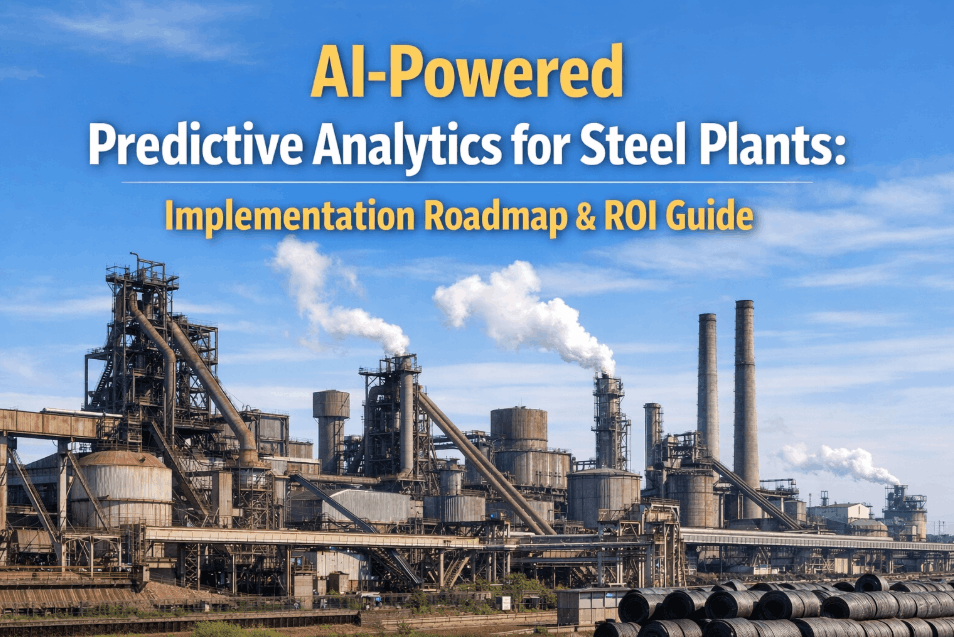
AI-Powered Predictive Maintenance for Steel Plants: 12-Month Implementation Roadmap & ROI Guide
Phased AI deployment across blast furnaces, rolling mills, and casters — sensor strategy, ML model training, SAP PM integration & documented $14–24M annual value creation.
12-Month iFactory AI Implementation Roadmap — Phase by Phase
Successful AI predictive deployment in a steel plant follows a structured sequence — not a big-bang installation. iFactory's phased approach ensures each phase delivers standalone ROI before the next begins, managing technical risk and organisational change simultaneously. Request your AI readiness assessment — iFactory quantifies your expected ROI before deployment.
SAP PM data quality audit and cleanse. PLC/SCADA connection via OPC-UA. Sensor gap identification and priority sensor deployment on top-10 critical assets. Baseline MTBF calculation per asset class.
ML models trained on SAP PM failure history + sensor data for top-10 assets. Vibration anomaly, thermal pattern, and process deviation models deployed. First failure predictions validated against actual outcomes.
AI coverage expanded to 40–60 assets. Model accuracy improves as feedback loop from SAP PM completions trains models continuously. Digital twin integration for cascade failure simulation. Team trained on AI alert response protocol.
Full programme: 80+ assets, continuous model retraining, AI-driven maintenance scheduling integration with SAP PM, monthly ROI reporting. Programme self-funds expansion from documented savings.
Where to Deploy AI First — Asset Priority Matrix for Steel Plants
Not all assets benefit equally from AI predictive analytics. The highest ROI comes from assets that combine high failure consequence, frequent enough failure for model training, and detectable precursor signals. iFactory prioritises assets on these three dimensions before recommending sensor investment.
| Asset | Failure Cost | Failure Frequency | AI Detectability | Deploy Phase | Expected MTBF Gain |
|---|---|---|---|---|---|
| Rolling Mill Main Drive | ₹2.1Cr+ | 4–6/year | Very High | Phase 1 | +140% |
| BOF Transformer / Drive | ₹3.8Cr+ | 2–3/year | Very High | Phase 1 | +180% |
| Caster Oscillator | ₹3.2Cr+ | 3–5/year | Very High | Phase 1 | +160% |
| BF Blast Blower | ₹1.6Cr+ | 1–2/year | High | Phase 2 | +110% |
| Reheating Furnace Fans | ₹0.8Cr+ | 6–10/year | Very High | Phase 2 | +130% |
| Pumps & Compressors | ₹0.3–0.6Cr | 8–15/year | High | Phase 3 | +90% |
iFactory AI Technology Stack — Five Layers From Sensor to SAP Work Order
iFactory's AI predictive platform is a complete five-layer stack — from physical sensors to SAP PM work order generation. Each layer is independently valuable and adds capability to the layers below it.
AI Predictive ROI — How $14–24M per Year is Built
The financial case for AI predictive analytics in a 3–5 MTPA steel plant is built from four independent value streams — each measurable separately, each accumulating as the programme matures.
What a VP Reliability Said
We had three different AI vendors tell us the same thing — deploy sensors everywhere, wait 2 years for training data, then the models will work. iFactory's approach was different: start with SAP PM failure history to train the first models, add sensors on the top-10 assets, and have the first AI alerts live within 90 days. The first alert — a developing bearing failure on our hot strip mill tension reel — was confirmed correct and the bearing was replaced during a planned stop. That single event paid for the first phase of the programme.
Frequently Asked Questions
Do we need years of sensor data before iFactory's AI models can make predictions?
No — iFactory trains initial models from SAP PM failure history (typically 5–10 years of breakdown records) combined with process data. First predictions are live within 60–90 days. Sensor data improves model accuracy progressively but is not a prerequisite for Day 1 predictions.
What happens when the AI model makes a wrong prediction — a false positive?
iFactory tracks every alert outcome in a feedback loop — confirmed failures vs false positives. The model automatically reweights its parameters after each outcome, improving precision over time. Typical false positive rate drops from 22% in Month 1 to under 8% by Month 6.
How does iFactory connect to existing PLC and SCADA systems without disrupting production?
iFactory uses read-only OPC-UA connections to PLC and SCADA systems — zero write access, zero production risk. Connection is made at the historian or OPC server level, requiring no PLC program changes and no production interruption.
What is the minimum plant size where AI predictive analytics delivers positive ROI?
iFactory's programme delivers positive ROI at plants from 0.5 MTPA upward. The ROI calculation depends on failure frequency and consequence, not plant size — a 0.8 MTPA minimill with a critical EAF drive failure costing ₹2Cr can achieve 4× ROI from a focused programme on 10–15 assets.
Start Your AI Predictive Programme Today
Free ROI assessment using your SAP PM data — first AI model live in 90 days.


-implementation-in-steel-plants-8-pillar-approach.png)
