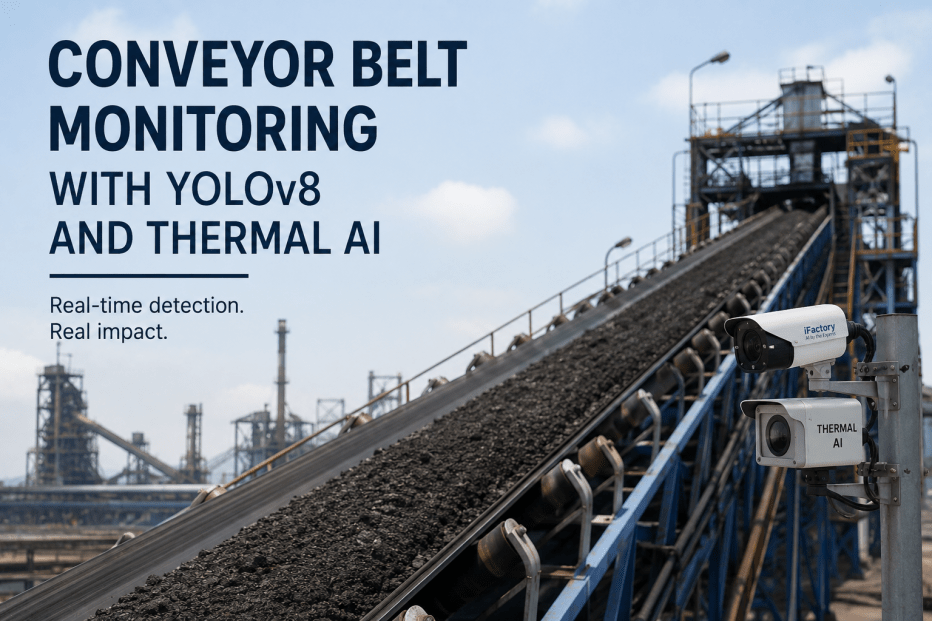
A conveyor belt in a steel plant doesn't get the attention a furnace or a rolling mill does. Nobody builds dashboards for conveyors. Nobody tracks conveyor KPIs in the morning meeting. And yet, when a single belt tears at 2 AM, the entire upstream and downstream process stops. Raw materials stop flowing. Furnaces run without feed. Finished goods don't reach dispatch. A $200 roller that seized up three weeks ago — unnoticed because nobody was monitoring it — just triggered a shutdown that costs $10,000 to $100,000 per hour. Over 80% of companies experience unplanned downtime, and conveyor failures are one of the primary contributors. The irony is that nearly every conveyor failure gives weeks of warning. The signals are there. Nobody's listening.
Material Handling Intelligence
The Most Ignored Equipment in Your Steel Plant Is Also the Most Disruptive When It Fails
AI-powered conveyor belt monitoring that catches misalignment, wear, and bearing failures weeks before they shut down your production line
80%+
Of plants experience unplanned downtime from conveyor issues
90%
Of belt failures during production occur at splice points
70%
Reduction in failures achievable with AI monitoring
The 6 Conveyor Failure Modes AI Catches Before You Feel the Impact
Conveyor systems fail in predictable patterns. The problem is that the early signatures of these failures are invisible to periodic manual inspections and only detectable through continuous sensor monitoring combined with AI pattern recognition.
Constant exposure to abrasive materials — iron ore, coal, clinker, limestone — causes surface wear, cracks, and thinning that reduces tensile strength and eventually leads to tears.
How AI Detects It
Vibration signatures and vision systems track thickness patterns and surface condition continuously, detecting wear progression weeks before critical failure thresholds.
The belt drifts to one side, causing edge damage, material spillage, and uneven wear. Left uncorrected, mistracking leads to belt edge destruction and complete failure.
How AI Detects It
Real-time monitoring of belt position and tension detects tracking issues before they cause edge damage or spillage. Computer vision algorithms analyze speed and alignment patterns for early-stage drift.
Seized rollers develop sharp edges that damage the belt. Wobbling idlers and worn sprockets create drag and localized belt wear. One failed roller cascades into multiple points of stress.
How AI Detects It
Acoustic and thermal monitoring catches seized rollers, wobbling idlers, and worn sprockets. Vibration analysis identifies bearing degradation weeks before seizure through signature pattern recognition.
Winding deterioration, shaft misalignment, and impending motor failures cause power loss, overheating, and eventually complete drive failure that stops the entire conveyor system.
How AI Detects It
Current signature analysis and temperature monitoring identify winding deterioration and shaft misalignment. Motor current analysis detects load imbalances within 3 electrical cycles.
Splice joints are the weakest point on any conveyor belt. Poor installation, excessive tension, and wear cause belt separation at splices — the single most common failure point during production.
How AI Detects It
Vibration pattern monitoring tracks splice joint integrity continuously. AI models learn each splice's baseline signature and detect degradation trends before separation occurs.
Bricks, metallic waste, and other debris cause punctures, cuts, and impact damage that grows over time into complete tears. Without monitoring, these go undetected until failure.
How AI Detects It
Multi-camera vision systems detect debris, cracks, tears, belt sway, and misalignments in real time. Automated alerts trigger when foreign objects enter the conveyor path.
How many of these failure modes are invisible in your plant today? Book a demo to see AI conveyor monitoring in action.
The Real Cost of "Run It Until It Breaks"
Most steel plants still manage conveyors reactively. The belt runs until something breaks, a maintenance crew scrambles to fix it, and production resumes hours or days later. The math on why this approach is so expensive becomes clear when you look at the full picture.
Emergency repair per incident
$10K - $100K
Major failures per year (typical)
2-3 events
Downtime per failure
1-2 days
Emergency parts markup
2-3x normal cost
Downstream production impact
Full line stoppage
Annual preventable loss
$300K - $500K+
vs
Annual monitoring cost
$7.5K - $20K
Failures prevented
60-70% reduction
Maintenance scheduling
Planned downtime
Parts procurement
Standard pricing
Production impact
Zero unplanned stops
Net annual savings
$200K - $400K+
What the Sensor Network Looks Like on a Steel Plant Conveyor
Effective conveyor monitoring requires sensors at five critical points on every belt. Wireless sensors with 5-10 year battery life and IP67+ ratings survive the extreme heat, dust, and vibration of a steel plant environment. No cable runs required.
Conveyor Belt System
S1
Drive Motor
Current analysis, temperature, vibration
Winding deterioration, shaft misalignment, overload
S2
Head Pulley
Vibration, temperature, speed
Bearing wear, pulley misalignment, lagging wear
S3
Carry-Side Idlers
Acoustic, thermal, vibration
Seized rollers, belt tracking, material buildup
S4
Belt Surface
Vision cameras, thickness sensors
Cracks, tears, wear patterns, foreign objects, splice condition
S5
Tail Pulley & Take-Up
Tension, position, vibration
Belt stretch, tension loss, return-side tracking
A maintenance team can instrument an entire conveyor system in under a day using wireless sensors — no cable runs, no shutdowns.
Every Conveyor in Your Plant Is Telling You Something. Are You Listening?
iFactory's AI monitors vibration, temperature, current, acoustics, and vision data across every conveyor in your steel plant — turning silent degradation signals into maintenance actions weeks before failures happen.
From Alert to Action: How AI Turns Data Into Work Orders
Sensors generate data. AI generates insights. But insights only matter if they reach the right person at the right time with the right action. Here's how the detection-to-correction loop works.
1
Continuous Monitoring
Vibration, temperature, motor current, and belt tension sensors capture data at sub-second intervals from every conveyor component. Edge computing filters noise and runs initial anomaly detection locally — no cloud dependency, no latency.
2
AI Pattern Recognition
Machine learning models compare current readings against historical baselines and fleet-wide patterns. The AI identifies degradation signatures specific to each failure mode — bearing wear sounds different from belt mistracking, and both sound different from splice degradation.
3
Severity Classification
Each anomaly is classified by type, severity, and predicted time to failure. Critical findings (imminent failure risk) escalate immediately to supervisors. Moderate findings enter the planned maintenance queue, optimized around production schedules.
4
Auto-Generated Work Orders
The system creates maintenance work orders automatically with equipment ID, failure mode, severity, recommended action, required parts, and supporting sensor data. No manual ticket creation. No communication gaps between detection and repair.
5
Feedback Loop
Closed work orders feed back to AI models. Did the predicted failure occur? Was the severity accurate? Continuous feedback improves prediction precision over time — the system gets smarter with every maintenance event.
Why Steel Plants Need Conveyor-Specific Monitoring
Steel plant conveyors operate under conditions that generic monitoring solutions aren't built for. The environment demands industrial-grade sensors and AI models trained on heavy-industry failure patterns.
Extreme Heat
Conveyors near furnaces and casters operate in ambient temperatures up to 1,200°C. Standard sensors fail. Steel-rated thermocouples and ceramic-housed accelerometers are required for reliable data in these zones.
Abrasive Materials
Iron ore, coal, sinter, and slag are among the most abrasive materials any conveyor handles. Wear rates are dramatically higher than in other industries, making continuous thickness monitoring essential rather than optional.
24/7 Operation
Steel plants run continuous operations with minimal shutdown windows. Maintenance must be planned around production schedules. AI's ability to predict failure timelines — not just flag current issues — is critical for scheduling repairs during planned breaks.
Cascade Risk
A conveyor feeding the furnace is a single point of failure for the entire melt shop. A conveyor moving finished coils is a single point of failure for dispatch. Every conveyor failure ripples into upstream and downstream processes within minutes.
Frequently Asked Questions
How early can AI detect conveyor belt problems?
AI typically identifies degradation patterns 2-8 weeks before failure occurs. Bearing wear signatures, belt thickness trends, and splice integrity changes are all detectable long before they become visible to manual inspection. The system doesn't just tell you something is wrong — it tells you how long you have before it fails, so you can schedule repairs at the optimal time.
What sensors are needed for conveyor monitoring in a steel plant?
A complete conveyor monitoring setup uses five sensor types: vibration sensors on bearings and rollers, thermal sensors on motors and pulleys, current analysis on drive motors, tension and position sensors on take-up systems, and vision cameras for belt surface inspection. All sensors are wireless with IP67+ ratings and 5-10 year battery life, designed for extreme steel plant conditions. No cable runs needed.
What's the ROI of conveyor monitoring?
A typical steel plant experiences 2-3 major conveyor failures per year, each costing $10,000-$100,000+ in emergency repairs and lost production. Annual monitoring costs $7,500-$20,000 per system. With a 60-70% reduction in unplanned failures, most plants see payback within 30-90 days. One global manufacturer reported ROI within three months while monitoring over 10,000 machines including conveyors.
Can monitoring work on our existing conveyor equipment?
Yes. The system is sensor-agnostic and works with conveyors of any age or manufacturer. It integrates with existing motor current analysis, acoustic emission sensors, and optical belt scales. Wireless sensors install without any modification to the conveyor itself — a maintenance team can instrument an entire system in under a day without any production interruption.
How does this integrate with our existing maintenance system?
iFactory connects with your existing CMMS through standard APIs. When AI detects a problem, it automatically creates a work order in your maintenance system with all supporting data — equipment ID, failure mode, severity, recommended action, and required parts. No manual data entry, no communication gaps. The entire flow from detection to work order is automated.
Your Conveyors Are Giving You Weeks of Warning. You Just Can't Hear Them Yet.
iFactory puts sensors on every critical conveyor component and AI behind every data point. The result: failures predicted weeks ahead, maintenance planned around production, and zero surprises at 2 AM.